Southons of Salisbury Closes After Nearly 120 Years, Ending a Remarkable Chapter in British Furniture Retail
Retirement, the absence of a family successor and mounting commercial pressures bring an end to one of Salisbury’s longest-established independent furniture businesses
By The Furniture Times (TFT) Editorial Desk | Furniture Retail | Independent Businesses | UK Furniture Market | Industry Heritage
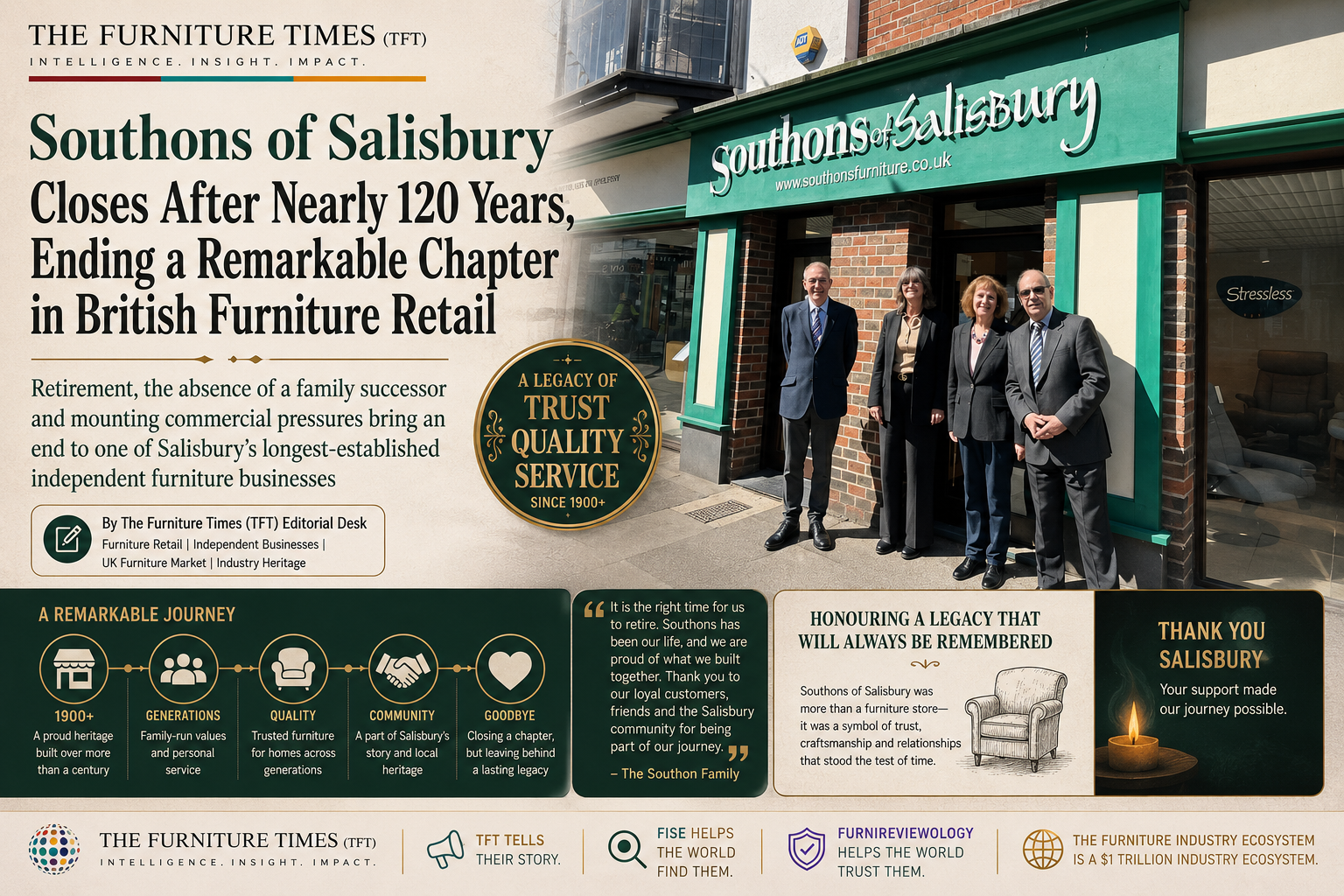
A major chapter in Salisbury’s retail history has ended with the closure of Southons of Salisbury, a family-owned furniture business whose roots stretched back to 1907.
The closure brings to an end nearly 120 years of furniture retailing under the Southon family name. From its premises at 38–40 Catherine Street, Southons served generations of customers while developing a reputation for quality furniture, established brands, knowledgeable staff and personal customer service.
The closure was not presented as a sudden insolvency or disorderly collapse. Management attributed the decision to retirement, the absence of a successor and increasing commercial pressures. A closing-down sale was launched in May 2026, with remaining stock and showroom displays reduced before the retailer closed its doors permanently at the end of July.
The development is more than the loss of another shop. It represents the disappearance of accumulated retail knowledge, community relationships and furniture-industry experience that had been passed through three generations.
It also highlights a broader issue confronting independent furniture retailers worldwide: even a respected company with deep community roots can face an uncertain future when succession challenges combine with changing consumer behaviour, rising operating costs and intense competition.
01 — Nearly 120 Years of Furniture Retailing Comes to an End
Southons was established in Salisbury in 1907 by Percy Southon, who had previously lived in Southampton.
The company’s own history states that Percy recognised the need for a dedicated home-furnishing shop in Salisbury and opened his first business in the town centre. Other stores were subsequently established, and his son Eric Southon later joined the company.
The different locations were eventually brought together at the Catherine Street premises during the early 1970s, following the opening of the nearby George Mall.
Christopher and Jane Southon entered the family business in the early 1980s. Their preparation included practical training, visits to other furniture retailers and attendance at exhibitions in the United Kingdom and overseas.
Those international industry connections later supported product sourcing from Europe, Scandinavia and the Far East. Southons’ company history
The business therefore evolved from a traditional local furnishing shop into an independent retailer with exposure to international brands and supply networks.
02 — A Three-Generation Family Business
Maintaining a family enterprise for almost 120 years is a significant achievement.
During that period, Southons operated through enormous changes in furniture design, manufacturing, transportation, retailing and consumer behaviour.
The company witnessed:
- The expansion of mass-produced furniture
- The growth of branded upholstery
- The development of modern mattresses
- The rise of imported furniture
- The arrival of shopping centres
- The growth of national furniture chains
- The expansion of out-of-town retail parks
- The arrival of online shopping
- The development of social-media marketing
- The transformation of home delivery
- The effects of recessions and inflation
- Changing expectations around customer service
A business surviving for several generations must repeatedly adapt while protecting the qualities that earned customer trust.
Southons’ longevity suggests that its role was not limited to selling individual products. It had become part of Salisbury’s commercial identity.
03 — The Reasons Behind the Closure
The closure was attributed principally to retirement, the absence of a family successor and mounting commercial pressures.
Managing director Chris Southon explained that, after three generations of family involvement, there was no succession route capable of continuing the company in its existing form. The business therefore concluded that the responsible decision was to close in an orderly manner.
The company also said it intended to meet its responsibilities to employees, customers and suppliers while maintaining service until the end of trading. Big Furniture Group
This distinction is important.
Some furniture businesses close because of insolvency, debt or an immediate loss of financial support. Southons’ announcement instead described a planned conclusion shaped by succession and the realities of the current retail environment.
Nevertheless, “commercial pressures” remains an important part of the story. Retirement may create the moment for a decision, but difficult trading conditions can make succession, investment or the sale of a business considerably more challenging.
04 — The Closing-Down Process
The retailer announced a closing-down sale beginning on 8 May 2026.
Stock, furniture displays and other merchandise were offered to the public as the company prepared to bring operations to an end. Later customer communications described the sale as a final opportunity to purchase products before permanent closure at the end of July.
The process included the clearance of products from the Catherine Street showroom, which had operated across two floors.
For a furniture retailer, closing an established store requires careful management because of the number of parties involved:
- Customers with outstanding orders
- Employees
- Manufacturers
- Delivery providers
- Landlords
- Warranty partners
- Service contractors
- Finance providers
- Local authorities
- Customers requiring after-sales support
An orderly closure seeks to minimise uncertainty for all of these groups.
05 — A Destination Furniture Store in Salisbury
Southons described itself as a destination store in the centre of Salisbury, with room-set displays arranged across two large floors.
Instead of selling furniture only through catalogues or warehouse-style arrangements, the business allowed customers to examine products in realistic settings.
Its ranges covered areas including:
- Sofas and upholstery
- Living-room furniture
- Dining furniture
- Beds and mattresses
- Bedroom products
- Home-office furniture
- Occasional furniture
- Lamps
- Rugs
- Mirrors
- Home accessories
The company carried recognised brands including Stressless, Natuzzi, Parker Knoll, Hypnos and Vispring, among others.
An industry membership profile described the retailer as operating approximately 14,000 square feet of showroom space and emphasised its reputation for customer care, product knowledge and quality furniture. Furniture and Home Improvement Ombudsman member profile
This was a service-led retail model built around physical comparison, staff knowledge and trust.
06 — The Value of Personal Furniture Advice
Furniture is different from many ordinary retail products.
Customers may need to evaluate:
- Seat comfort
- Mattress support
- Upholstery texture
- Furniture dimensions
- Material durability
- Reclining mechanisms
- Colour combinations
- Room suitability
- Delivery access
- Care requirements
- Warranty protection
A knowledgeable salesperson can help a customer avoid purchasing a product that is unsuitable for the room, body-support requirement or intended use.
Independent stores such as Southons often compete through this advisory role. Their strength may not be the lowest advertised price, but their ability to guide customers through a complex and expensive purchase.
When an experienced furniture store closes, the community loses more than a product outlet. It loses accumulated knowledge that cannot be reproduced easily through a product page.
07 — Customer Service as a Competitive Advantage
Southons’ public customer-review page contains repeated references to helpful staff, product quality, efficient communication and responsive service.
These comments reflect the traditional strength of many independent retailers: personal accountability.
Customers frequently know whom to contact. Staff remember previous purchases. Problems can be discussed directly rather than passed between automated systems and distant service departments.
This relationship becomes particularly important when furniture purchases involve:
- Long delivery periods
- Special orders
- Fabric selections
- Home installation
- Difficult access
- Replacement components
- Warranty questions
- Product-care advice
For nearly 120 years, Southons built trust through these human interactions. That intangible value is difficult to place on a balance sheet, but it is central to the reputation of a long-established retailer.
08 — Succession Is Becoming a Critical Industry Problem
The absence of a successor was a decisive factor in the closure.
This is not an issue unique to Southons. Family-owned companies across the furniture industry face similar questions.
The next generation may choose a different career. Family members may not want the financial risk or demanding working hours associated with retail. The company may require investment that the family is unwilling or unable to provide.
Succession can fail when:
- Planning begins too late
- The next generation lacks interest
- Leadership knowledge remains undocumented
- Ownership and management are not separated
- The business depends too heavily on one person
- Digital transformation has been postponed
- Property and business ownership are complicated
- Potential buyers cannot see a clear growth path
- Family expectations differ
- External management has not been considered
A profitable company can still close if nobody is prepared to lead it.
Succession planning should therefore be treated as a long-term business strategy, not a conversation reserved for the owner’s final year.
09 — Could an Outside Buyer Preserve a Family Business?
When no family successor exists, an outside sale or management buyout may offer another route.
Possible options include:
- Sale to another furniture retailer
- Management buyout
- Employee ownership
- Partnership with a larger group
- Sale of the brand and customer database
- Conversion to a smaller showroom
- E-commerce-led continuation
- Dealer or franchise arrangement
- Merger with a complementary home-interiors business
None of these options is simple.
A buyer must assess property costs, inventory, employees, supplier relationships, digital capabilities, customer demand and future profitability. A historically important name does not automatically guarantee a commercially sustainable acquisition.
The earlier succession planning begins, the more options a company can explore without the pressure of an approaching retirement deadline.
10 — Independent Furniture Retailers Face Structural Pressure
Southons referred to increasing commercial pressures. Those pressures affect much of the independent furniture-retail sector.
Common challenges include:
- High commercial rents
- Business rates
- Energy costs
- Staff expenses
- Delivery costs
- Insurance
- Showroom maintenance
- Inventory financing
- Expensive digital advertising
- Online price comparison
- National-chain competition
- Marketplace discounting
- Longer consumer decision cycles
- Weak housing-market activity
Furniture stores carry particularly demanding cost structures.
Large products require extensive display space. Customers expect to see multiple fabrics, finishes, sizes and room settings. Retailers need access for deliveries, storage and customer parking. Display products may remain on the showroom floor for extended periods.
These requirements make furniture retail more operationally complex than selling smaller products online.
11 — Online Shopping Has Changed Customer Expectations
Digital commerce has transformed the way customers discover and compare furniture.
Consumers can now examine hundreds of products without travelling to a showroom. They can compare prices, read reviews, view styled interiors and receive targeted advertisements from national and international retailers.
This creates pressure on traditional stores to provide:
- Accurate online catalogues
- High-quality photography
- Mobile-friendly websites
- Search visibility
- Digital advertising
- Customer reviews
- Clear delivery information
- Online enquiry systems
- Social-media content
- Rapid customer responses
Independent retailers must finance these digital requirements while continuing to operate physical premises.
The challenge is not that showrooms no longer matter. Furniture remains a category in which many customers want to see, touch and test products. The difficulty lies in funding both physical and digital retail at the same time.
12 — Consumer Spending Has Become More Cautious
Furniture is frequently a postponable purchase.
When households face rising living costs, expensive mortgages, uncertain employment or reduced confidence, they may delay replacing a sofa, bed or dining set.
Even customers who intend to purchase may spend more time comparing alternatives, waiting for promotions or seeking finance.
Furniture retailers consequently experience pressure from several directions:
- Fewer immediate purchases
- Longer decision periods
- Greater price sensitivity
- Increased discount expectations
- Higher customer-acquisition costs
- Reduced demand for premium products
- More abandoned enquiries
- Stronger competition for each transaction
A well-established reputation can help, but it cannot remove every economic pressure.
13 — The Housing Market and Furniture Demand
Furniture retail is closely connected to housing activity.
People commonly purchase furniture after:
- Moving into a new home
- Renovating a property
- Getting married
- Creating a home office
- Expanding a family
- Downsizing
- Moving into retirement accommodation
- Beginning a rental tenancy
When property transactions slow, an important source of furniture demand weakens.
Higher mortgage costs can also reduce the amount of money households have available after completing a home purchase.
Furniture retailers must therefore monitor not only direct sales data but also property transactions, consumer confidence, interest rates and household-finance conditions.
14 — A Loss for Salisbury’s City Centre
The closure affects the wider retail character of Salisbury.
Long-established independent businesses contribute to a city centre by providing:
- Local employment
- Distinctive retail experiences
- Business-rate contributions
- Supplier relationships
- Customer footfall
- Community identity
- Commercial continuity
- Knowledge of local households
When an independent destination store closes, neighbouring businesses may also lose some visitors.
The future use of a large city-centre premises can have consequences for the entire surrounding area. A suitable new occupier could bring activity back, while a prolonged vacancy could reduce the street’s commercial energy.
Local economic-development strategies must therefore consider how large former retail spaces can be adapted and reused.
15 — The Human Impact Behind the Closure
A business closure is not only a financial or property event.
Employees lose a familiar workplace. Customers lose trusted advisers. Manufacturers lose a retail partner. The family closes a business associated with several generations of its history.
Former staff may carry decades of specialised experience involving products, customer service, deliveries, measurements and supplier relationships.
That knowledge should not be allowed to disappear from the industry.
Other retailers, manufacturers and service companies may benefit from recruiting experienced Southons employees. Their understanding of furniture customers and showroom operations remains commercially valuable.
16 — Manufacturers Also Lose an Important Route to Market
Furniture brands depend on retailers to present their products properly.
An experienced independent dealer can:
- Explain product differences
- Demonstrate mechanisms
- Help customers choose fabrics
- Manage special orders
- Provide local delivery
- Handle customer questions
- Maintain brand reputation
- Display products attractively
- Communicate feedback to manufacturers
When a respected store closes, suppliers lose more than floor space. They lose a knowledgeable local representative.
Manufacturers must then decide whether to appoint another retailer, sell directly, increase online marketing or accept reduced visibility in the area.
The closure of independent stores can therefore change the balance of power between manufacturers, retail chains and direct-to-consumer platforms.
17 — Heritage Alone Cannot Guarantee Continuity
A company’s history can create trust, recognition and loyalty. However, longevity by itself cannot guarantee the next generation of commercial success.
Heritage must be converted into current customer value.
A traditional retailer still needs to be:
- Searchable
- Digitally visible
- Operationally efficient
- Financially disciplined
- Attractive to younger customers
- Easy to contact
- Clear about delivery
- Supported by recent reviews
- Active in its community
- Prepared for leadership transition
The strongest heritage businesses combine their history with modern technology and communication.
Their message should not simply be, “We have existed for more than a century.” It should explain why that experience makes the customer’s purchase safer, easier and more valuable today.
18 — Lessons for Independent Furniture Retailers
Southons’ closure offers several important lessons.
Lesson 01 — Begin succession planning early.
Owners should identify family and non-family options many years before retirement.
Lesson 02 — Document critical knowledge.
Supplier terms, customer processes and operational expertise should not remain with one individual.
Lesson 03 — Build a visible digital identity.
A strong local reputation must also be discoverable online.
Lesson 04 — Treat reviews as business assets.
Customer trust should be documented continuously.
Lesson 05 — Develop more than one sales channel.
Showrooms, websites, direct enquiries and local partnerships can support one another.
Lesson 06 — Monitor product profitability.
Floor space and inventory should be allocated according to real commercial performance.
Lesson 07 — Protect customer relationships.
A useful customer database can support repeat business and future ownership transitions.
Lesson 08 — Consider external leadership.
Family ownership does not require every manager to be a family member.
Lesson 09 — Plan property strategy separately.
The best retail location may change as customer behaviour evolves.
Lesson 10 — Communicate before a crisis.
Potential investors, employees and partners need time to evaluate succession possibilities.
19 — Lessons for Manufacturers and Suppliers
Manufacturers should not assume that long-established dealers will always remain available.
They should monitor retailer health and support important partners through:
- Product training
- Better digital assets
- Fair commercial terms
- Flexible ordering
- Local lead generation
- Joint advertising
- Accurate delivery information
- Responsive warranty service
- Territory planning
- Succession discussions
Suppliers may also need contingency plans for areas in which a major independent retailer closes.
A brand without a replacement dealer can quickly lose regional visibility.
20 — Independent Retail Still Has a Future
The closure of Southons should not be interpreted as evidence that every independent furniture store is destined to disappear.
Independent retailers continue to possess valuable strengths:
- Personal service
- Local knowledge
- Flexible decision-making
- Curated products
- Specialist expertise
- Community trust
- Faster problem resolution
- Strong customer relationships
- Distinctive showroom experiences
However, these strengths must be combined with digital discovery, operational efficiency, succession planning and disciplined marketing.
The future independent retailer may operate differently from its predecessor. It may use a smaller showroom, appointment-based consultations, stronger online catalogues, regional delivery partnerships and data-led inventory decisions.
Independence can remain a competitive advantage when it supports speed, expertise and customer care.
21 — Why Furniture Businesses Must Remain Visible
An established company can possess excellent products and deep industry knowledge, but those strengths lose commercial power if new customers cannot find them.
Retailers must protect visibility through:
- Search-engine optimisation
- Accurate business listings
- Industry news coverage
- Product content
- Customer reviews
- Email communication
- Social-media activity
- Local partnerships
- Dealer directories
- AI-readable company information
Visibility is particularly important during difficult trading periods. Reducing waste may be necessary, but disappearing from customer awareness can make recovery even harder.
The businesses customers discover and remember are the businesses most likely to enter their purchasing decisions.
22 — The Role of TFT, FISE and FurniReviewology
The Southons story demonstrates why furniture businesses need storytelling, discovery and trust.
The Furniture Times (TFT) preserves and communicates the stories of furniture companies, including their achievements, challenges and contributions to their communities.
Furniture Industry Search Engine (FISE) helps customers, buyers and industry professionals discover furniture businesses and suppliers.
FurniReviewology strengthens trust by helping the market understand customer experiences and business reputations.
Together, they address three essential requirements:
- Businesses need their stories documented.
- Companies need to be discoverable.
- Customers need evidence they can trust.
23 — A Farewell to a Salisbury Institution
Southons survived for nearly 120 years because generations of customers, staff, suppliers and family members contributed to its continuity.
Its closure deserves to be recognised not simply as another vacant retail unit, but as the conclusion of a significant independent-business story.
From Percy Southon’s first shop in 1907 to the later Catherine Street destination store, the company helped furnish homes across Salisbury and the surrounding region.
The final closure reflects a changing retail economy, but it also reminds the industry of the value created by long-term service, product knowledge and community trust.
That legacy remains even after the showroom doors have closed.
24 — Conclusion: A Warning and a Lesson for the Global Furniture Ecosystem
The end of Southons illustrates an uncomfortable truth: business longevity does not automatically solve the problem of succession.
A respected name, experienced staff and loyal customers can sustain a company for generations, but continuity still requires someone prepared to lead, invest and adapt.
Furniture businesses should learn from this moment.
Succession must begin early. Digital visibility must be protected. Customer trust must be documented. Industry knowledge must be transferred. Alternative ownership structures must be considered before retirement becomes urgent.
Southons’ closure is a loss for Salisbury, but its nearly 120-year history is also an extraordinary commercial achievement.
Few retailers operate long enough to serve several generations of the same community. Southons did—and its contribution to British furniture retail deserves to be remembered.
Source acknowledgement: This independently written report was developed from the Salisbury Journal report, supported by information from Southons’ official company history, Companies House and furniture-industry reporting.
The Furniture Times (TFT) & Furniture Industry Search Engine (FISE)
“TFT tells their story. FISE helps the world find them.”
FurniReviewology helps the world trust them.
The furniture industry ecosystem is a $1 trillion industry ecosystem.

Related Posts
Chandigarh Heritage Group Seeks Vice-President’s Intervention to Halt U.S. Auction of Panjab University Furniture
Ethan Allen CEO Farooq Kathwari Defends Long-Term Leadership as Activist Challenge Revives Governance Debate