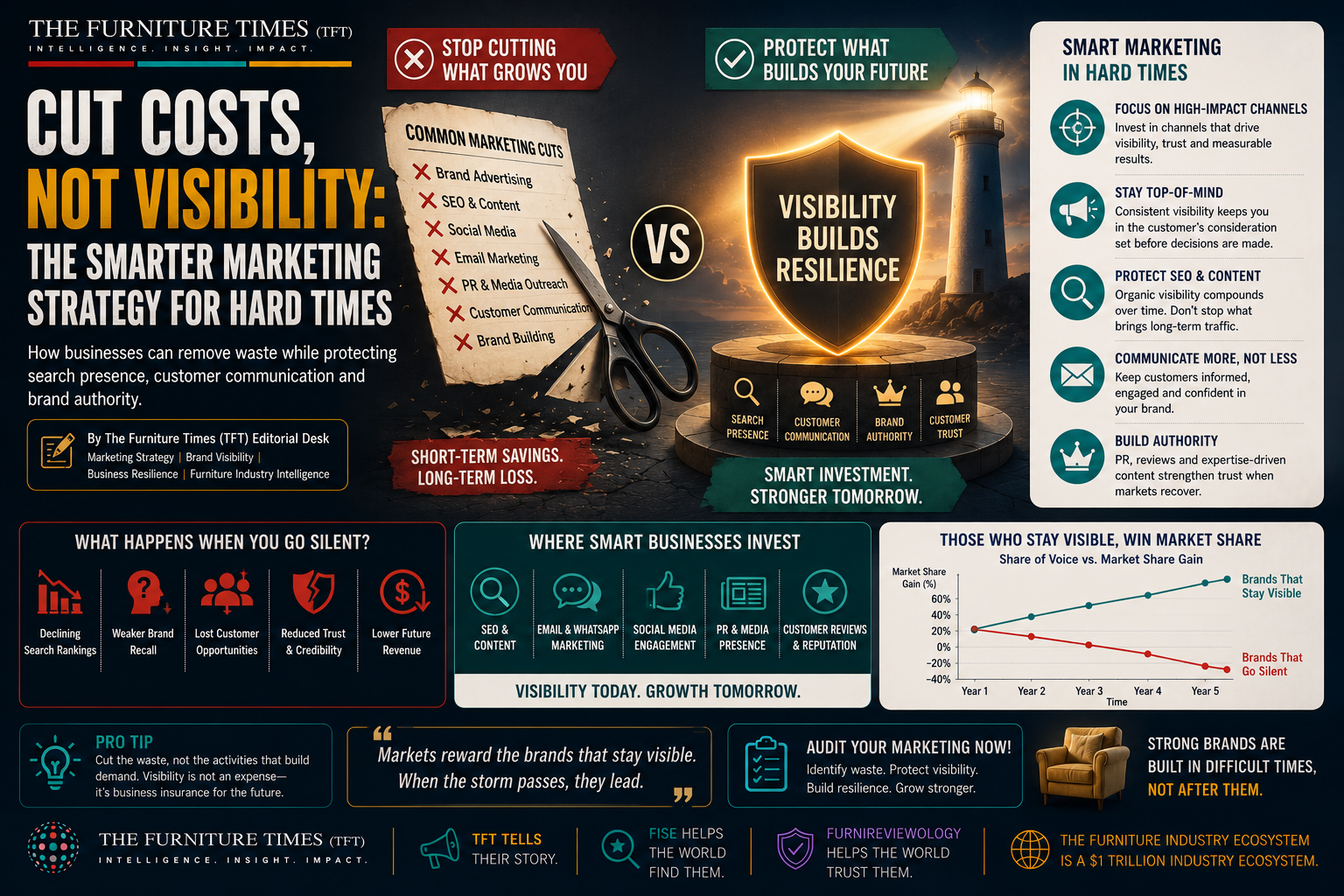
Cut Costs, Not Visibility: The Smarter Marketing Strategy for Hard Times
How businesses can remove waste while protecting search presence, customer communication and brand authority
By The Furniture Times (TFT) Editorial Desk | Marketing Strategy | Brand Visibility | Business Resilience | Furniture Industry Intelligence
When economic conditions become difficult, businesses naturally begin searching for ways to reduce expenditure. Rising operating costs, weaker consumer confidence, delayed purchasing decisions, higher financing expenses and pressure on profit margins can force management teams to reconsider almost every budget.
Marketing is frequently one of the first areas targeted.
At first glance, reducing advertising and promotional spending may appear to be a quick and relatively painless way to preserve cash. Unlike rent, salaries, utilities, raw materials or logistics, marketing may be viewed as something that can be paused until market conditions improve.
But this approach can create a dangerous contradiction: a business needs more customers, yet it reduces the activities that help customers discover, remember and trust it.
The smarter strategy is not to protect every marketing expense. Wasteful campaigns, unnecessary subscriptions, poorly targeted advertisements and unproductive agency arrangements should be challenged. However, businesses must distinguish between cutting waste and cutting visibility.
Saving money should not mean disappearing from the market.
01 — Hard Times Change Customer Behaviour
Economic uncertainty does not eliminate demand. It changes how customers make decisions.
Consumers become more cautious. Retailers carry less inventory. Designers compare more suppliers. Property developers delay projects. Procurement teams demand stronger evidence of quality, durability, service and value.
Furniture is often a considered purchase rather than an impulse purchase. Customers may research a sofa, bed, dining set, office system, hotel-furniture supplier or furniture component manufacturer for weeks or months before making a final decision.
During this extended research period, businesses must remain visible.
A company that stops communicating may disappear from the buyer’s shortlist. Meanwhile, competitors that continue publishing useful information, sharing projects, collecting reviews and maintaining their search presence may appear more stable and trustworthy.
Hard times should therefore lead to a marketing audit—not marketing silence.
02 — Visibility Is an Operational Asset
Visibility is not limited to paid advertising. It is the combined result of everything that helps the market discover and understand a business.
These assets may include:
- A functional and informative website
- Search-engine rankings
- Accurate business listings
- Product and category pages
- Industry news coverage
- Company announcements
- Customer reviews
- Social media profiles
- Dealer and distributor references
- Case studies and project portfolios
- Catalogues and technical documents
- Email databases
- Authoritative backlinks
- Searchable leadership expertise
- Consistent company information
These assets work together throughout the customer journey.
A buyer may discover a company through an industry article, search for its name, visit its website, inspect its product pages, read customer reviews and then contact the sales department.
If the company has no articles, outdated information, incomplete product pages or weak reviews, the buyer may choose a competitor that appears more credible.
Visibility must therefore be maintained like any other business infrastructure.
03 — Cut Waste, Not Marketing Capability
There is an important difference between removing a cost and removing a capability.
Cancelling an unused software subscription removes a cost. Eliminating the only process responsible for communicating with customers removes a capability.
Stopping poorly targeted advertising may improve efficiency. Abandoning website maintenance may weaken discovery and damage customer confidence.
Leaving an unproductive trade event may be reasonable. Disappearing from every relevant industry publication may surrender valuable authority.
Marketing supports several essential business functions:
- Customer discovery
- Lead generation
- Brand recognition
- Sales conversion
- Customer retention
- Reputation management
- Market education
- Dealer support
- Competitive positioning
- Business credibility
A reduction that damages several of these functions may cost more in future revenue than it saves in the present budget.
04 — Begin With a Marketing Waste Audit
Before making cuts, businesses should list every marketing-related expense and identify what purpose it serves.
The audit should cover:
- Advertising campaigns
- Agency retainers
- Marketing staff
- Software subscriptions
- Website services
- Search optimization
- Content production
- Photography and video
- Trade exhibitions
- Sponsorships
- Email platforms
- Social media management
- Public relations
- Directory listings
- Printed catalogues
- Influencer arrangements
Possible sources of waste may include duplicate software, inactive platforms, advertisements reaching irrelevant audiences, campaigns without tracking, outdated databases and agency services with unclear deliverables.
Every activity should have a defined role. It may support awareness, discovery, credibility, conversion, retention or customer service.
Not every valuable activity produces an immediate sale. However, every expense should contribute to an identifiable business objective.
05 — Protect Search Presence
Search visibility is among the most valuable assets a business can protect during an uncertain market.
Customers continue searching even when they are not ready to purchase immediately. They investigate manufacturers, retailers, materials, prices, warranties, delivery options, designs, components and customer experiences.
A company that repeatedly appears during this research phase is more likely to enter the customer’s consideration set.
Protecting search visibility requires businesses to maintain:
- Accurate company information
- Relevant product descriptions
- Clear website navigation
- Mobile-friendly pages
- Product specifications
- Useful industry articles
- Page titles and descriptions
- Internal website links
- High-quality images
- Location and contact information
- Authoritative external references
- Updated catalogues
- Customer questions and answers
Search authority develops gradually. A company may spend years earning rankings, backlinks and recognition. Neglecting these assets can allow more active competitors to replace it.
06 — Do Not Stop Publishing Completely
High-quality content can continue generating value long after it is published.
A useful article, technical guide, case study or product explanation may attract visitors for months or years. It can support the sales team, educate customers, strengthen search performance and provide material for newsletters and social media.
For furniture businesses, valuable content may address:
- Material selection
- Furniture durability
- Maintenance and care
- Hardware quality
- Installation requirements
- Space planning
- Product warranties
- Manufacturing capabilities
- Sustainability
- Custom furniture
- Hospitality applications
- Office requirements
- Delivery expectations
- Replacement components
- Safety and compliance
A business facing budget pressure does not necessarily need to publish every day. It needs a consistent schedule focused on useful subjects.
One authoritative article is more valuable than many shallow promotional posts.
07 — Improve Existing Content Before Starting Again
Businesses often own large quantities of underused marketing material.
Old product photographs, catalogues, presentations, technical documents, interviews, recorded webinars, customer questions and project reports can be updated and repurposed.
One detailed project case study can become:
- A website article
- A press release
- A newsletter feature
- Several social posts
- A sales presentation
- A portfolio page
- A customer testimonial
- A short video
- A dealer-support document
- A series of frequently asked questions
Repurposing lowers production costs without forcing the company into silence.
The original material should be reviewed for accuracy, relevance and quality before republication. Outdated prices, specifications, contact details and claims must be corrected.
08 — Maintain Customer Communication
Existing customers, dealers and business partners should not be forgotten during difficult periods.
When a company becomes silent, people may wonder whether it is still operating, whether products remain available or whether customer support has been reduced.
Competitors can use that uncertainty to strengthen their own relationships.
Affordable communication methods include:
- Email newsletters
- Product updates
- Dealer bulletins
- Service reminders
- Delivery notifications
- Warranty guidance
- Project announcements
- Educational articles
- Customer surveys
- Review invitations
- Direct communication with major accounts
Communication should be useful and relevant. Customers do not need constant promotion; they need reliable information.
Consistent communication reassures the market that the business remains active, responsible and available.
09 — Replace Broad Advertising With Precise Targeting
A business does not need to reach everyone. It needs to reach the people who are likely to buy, specify, recommend or distribute its products.
The furniture industry serves many audiences:
- Homeowners
- Interior designers
- Architects
- Retailers
- Importers
- Distributors
- Property developers
- Hotel operators
- Office planners
- Institutional buyers
- Furniture manufacturers
- Component buyers
- Contractors
- Facility managers
- E-commerce customers
Each audience has different priorities.
A homeowner may focus on appearance, comfort, price and warranty. A hotel procurement team may prioritize durability, project coordination, delivery capacity and replacement support. A furniture manufacturer purchasing hardware may require technical tolerances, testing data and supply continuity.
Separating these audiences reduces waste and makes every marketing message more relevant.
10 — Improve Conversion Before Buying More Traffic
Some companies spend heavily to attract visitors but fail to convert the visitors they already have.
A potential customer may leave because the website lacks:
- Clear product categories
- Detailed descriptions
- Product specifications
- Pricing guidance
- Professional photography
- Delivery information
- Warranty details
- Customer reviews
- Dealer locations
- Downloadable catalogues
- Contact options
- Case studies
- Frequently asked questions
Improving these areas may produce more enquiries without increasing advertising expenditure.
The website should function as an active sales representative. It should answer important questions, explain the company’s value and make the next action clear.
Businesses should examine the full journey from discovery to enquiry. Every unnecessary obstacle should be removed.
11 — Protect Reviews and Customer Trust
Customers become more cautious when money is tight. They want evidence that a purchase will deliver value and that the supplier will provide support.
Reviews can provide this reassurance.
Furniture reviews may influence perceptions of:
- Product quality
- Comfort
- Durability
- Delivery performance
- Assembly experience
- Customer service
- Warranty support
- Product accuracy
- Value for money
- Problem resolution
Businesses should continue encouraging genuine customers to share honest experiences. They should also respond professionally to criticism instead of ignoring it.
Trust does not require a perfect reputation. It requires transparency, responsiveness and visible evidence that the business takes customers seriously.
Stopping review collection can leave the company with an outdated or incomplete public reputation.
12 — Use Earned Media to Build Authority
Paid advertising is not the only route to visibility.
Industry articles, interviews, product announcements, expert commentary, market reports and case studies can help a company build authority.
When credible third-party publications discuss a business, potential customers receive independent confirmation that the company exists and participates actively in its industry.
Furniture businesses may have newsworthy stories involving:
- Factory investment
- New machinery
- Product launches
- Showroom openings
- Export expansion
- Dealer appointments
- Sustainability initiatives
- Technology adoption
- Design partnerships
- Project completions
- Certifications
- Awards
- Leadership appointments
- Community programmes
- Supply-chain improvements
A company does not need to be a global corporation to deserve coverage. Small and medium-sized enterprises frequently possess valuable expertise, manufacturing knowledge and local-market insight.
Their problem is often not a lack of stories. It is a lack of structured communication.
13 — Protect Brand Authority in AI Search
Customers are increasingly using AI-powered tools to research companies, compare products and request recommendations.
AI systems need clear, consistent and credible public information to understand a business.
A weak or confusing digital footprint may make it difficult for these systems to determine:
- What the business sells
- Where it operates
- Which customers it serves
- What makes it different
- Whether its information is current
- Whether independent sources recognize it
- Whether customers trust it
Businesses should maintain detailed company profiles, original product information, leadership expertise, case studies, press coverage and authentic customer reviews.
AI visibility cannot be created by repeating a company name many times. It depends on connected, understandable and credible information across the digital ecosystem.
14 — Combine Organic and Paid Marketing
Businesses should not treat organic visibility and paid promotion as opposing strategies.
Paid marketing can generate immediate attention. Organic content, media coverage, search authority and customer reviews create longer-lasting value.
During financial pressure, paid campaigns can be concentrated on:
- High-intent search terms
- Proven customer groups
- Priority product categories
- Important geographical markets
- Retargeting qualified website visitors
- Major product launches
- Dealer recruitment
- Time-sensitive promotions
- Campaigns with measurable conversions
Organic assets should support paid traffic. An advertisement becomes more convincing when it leads to a detailed product page supported by reviews, specifications, case studies and credible company information.
15 — Measure Outcomes, Not Vanity Metrics
Marketing performance should not be judged only by likes, impressions or follower counts.
A campaign that receives thousands of views from irrelevant users may be less valuable than a technical article read by 100 qualified buyers.
Businesses should monitor outcomes such as:
- Qualified enquiries
- Sales opportunities
- Enquiry-to-sale conversion
- Repeat customers
- Dealer applications
- Sample requests
- Catalogue downloads
- Appointment bookings
- Search visibility
- Cost per qualified lead
- Customer retention
- Review growth
- Revenue influenced by campaigns
- Media mentions
- Authoritative backlinks
No single measurement tells the complete story. Businesses need to evaluate both immediate results and long-term brand development.
The right question is not simply, “How much did marketing cost?”
The better question is, “What business value and capability did this spending create?”
16 — Protect Activities That Are Difficult to Rebuild
Some activities can be stopped and restarted easily. Others lose significant value when neglected.
Search authority, media relationships, customer-review momentum, subscriber engagement and industry credibility develop over time.
A company that stops publishing may not disappear immediately. However, competitors may continue improving their websites, answering customer questions, collecting reviews and earning backlinks.
When demand returns, the silent company may discover that recovering its previous position requires more time and money than maintaining a basic presence would have required.
Before eliminating an activity, management should calculate both the current saving and the future rebuilding cost.
17 — Establish a Minimum Visibility System
Even under serious financial pressure, a company should maintain a minimum visibility system.
This may include:
- A functional and updated website
- Accurate company listings
- Essential search optimization
- Regular customer communication
- A realistic publishing schedule
- Review collection and response
- Important company announcements
- Sales-support materials
- Basic performance measurement
- Clear responsibility for public information
The size of this system will vary. A multinational manufacturer and a local furniture shop do not require identical programmes.
However, both need a dependable way to remain discoverable, understandable and trustworthy.
Consistency matters more than unnecessary volume.
18 — Create Different Budget Scenarios
Companies should prepare marketing scenarios before financial pressure becomes severe.
Controlled Reduction:
Remove low-performing campaigns and unnecessary subscriptions while protecting successful channels.
Moderate Reduction:
Concentrate resources on priority products, markets, customers and essential content.
Emergency Reduction:
Maintain only the minimum visibility system, existing-customer communication and critical sales support.
Every scenario should specify:
- Which activities will stop
- Which activities will continue
- Which activities will be reduced
- What risks the changes may create
- How results will be monitored
- What conditions will trigger reinvestment
This creates disciplined decision-making and prevents panic-based cuts.
19 — The Furniture Industry Cannot Afford Invisibility
The furniture industry includes manufacturers, component suppliers, machinery businesses, material providers, retailers, wholesalers, designers, technology companies, logistics providers and professional services.
Together, these interconnected participants form part of a furniture industry ecosystem commonly framed at approximately $1 trillion when the wider value chain is considered.
Competition for attention within this ecosystem is intense.
A company may manufacture outstanding furniture or supply innovative components, but its capabilities remain commercially limited if buyers, distributors, designers and procurement teams cannot find it.
This is especially important for small and medium-sized companies. Many SMEs possess strong manufacturing expertise but lack the communication resources of larger corporations.
Focused industry visibility can help them compete through specialization, knowledge, responsiveness and credibility rather than advertising volume alone.
20 — TFT, FISE and FurniReviewology: Story, Discovery and Trust
The modern customer journey involves three fundamental stages: understanding, discovery and verification.
The Furniture Times (TFT) helps furniture-industry companies tell their stories, communicate developments and demonstrate expertise.
Furniture Industry Search Engine (FISE) supports discovery by helping the world find furniture businesses, brands, products, professionals and industry information.
FurniReviewology strengthens trust by emphasizing customer experiences, reviews and reputation.
Together, they address three critical questions:
- Can customers hear the company’s story?
- Can buyers find the business?
- Can the market trust the brand?
Visibility without credibility may attract attention but fail to generate confidence. Discovery without useful information may produce traffic but not enquiries. Reviews without sufficient visibility may remain unseen.
The three functions must work together.
21 — Who Wins When Competitors Become Silent?
When many companies reduce marketing at the same time, the market becomes quieter.
Businesses that remain visible can gain a greater share of customer attention without necessarily increasing their spending dramatically.
The likely winners are businesses that:
- Continue communicating
- Protect search visibility
- Publish useful information
- Maintain customer relationships
- Collect and answer reviews
- Improve website conversion
- Target spending carefully
- Share credible company news
- Measure meaningful outcomes
- Remain present without overspending
These companies do not always have the biggest budgets. They often make better decisions about where their limited resources should be allocated.
22 — A Practical Cost-Reduction Framework
Step 01 — Record every marketing expense.
Include staff, agencies, software, advertising, events, subscriptions and content production.
Step 02 — Define its purpose.
Identify whether it supports discovery, trust, conversion, retention or sales.
Step 03 — Examine the evidence.
Review lead quality, search traffic, customer engagement, sales influence and strategic value.
Step 04 — Remove waste and duplication.
Cancel unused platforms and poorly targeted campaigns.
Step 05 — Protect essential capabilities.
Maintain search presence, customer communication, reviews, website quality and industry credibility.
Step 06 — Improve conversion.
Generate more value from existing visitors and enquiries.
Step 07 — Repurpose existing assets.
Use articles, photographs, project reports and technical information across several channels.
Step 08 — Maintain a publishing rhythm.
Reduce frequency if necessary, but do not disappear.
Step 09 — Monitor competitors.
Observe which companies continue communicating and which market subjects they begin to occupy.
Step 10 — Establish reinvestment triggers.
Determine when improving conditions or stronger results justify increasing the budget.
23 — Questions to Ask Before Cutting Marketing
Before approving a significant reduction, leadership should ask:
- Will this make the company harder to find?
- Will customers receive less information?
- Could it weaken search performance?
- Will the sales team lose necessary support?
- Can the service be renegotiated instead of cancelled?
- Are competitors likely to occupy the space we leave?
- How much will rebuilding this capability cost?
- Is the real problem the channel, the message or its execution?
- Do we have evidence that the activity is not working?
- What minimum level must continue?
These questions do not prevent necessary reductions. They help companies avoid expensive strategic mistakes.
24 — Conclusion: Reduce Waste Without Disappearing
Hard times demand financial discipline.
Businesses should cancel unnecessary subscriptions, challenge poor-performing campaigns, improve targeting, renegotiate contracts and eliminate duplicated work.
But visibility itself should not be treated as waste.
A company that cannot be found may never receive the enquiry. A company that stops communicating may disappear from the customer’s memory. A brand without visible evidence of quality and credibility may lose the buyer’s trust.
The smarter strategy is clear:
Cut unnecessary costs, not customer access. Reduce waste, not search presence. Simplify marketing, but protect the visibility that connects the business with its next opportunity.
Companies that remain visible through uncertainty can preserve customer relationships, capture attention surrendered by quieter competitors and enter the eventual recovery with stronger recognition and authority.
The Furniture Times (TFT) & Furniture Industry Search Engine (FISE)
“TFT tells their story. FISE helps the world find them.”
FurniReviewology helps the world trust them.
The furniture industry ecosystem is a $1 trillion industry ecosystem.