
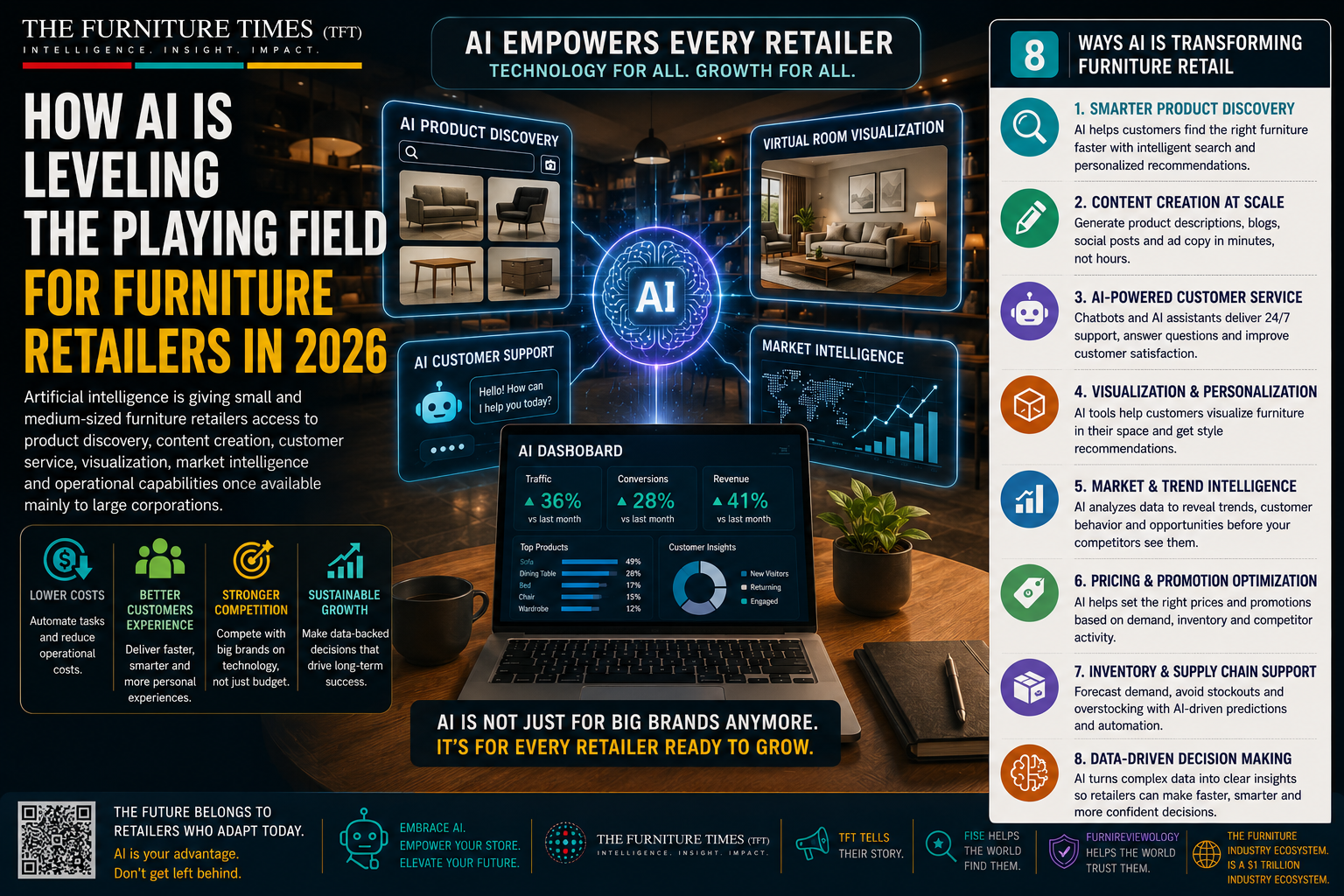
How AI Is Leveling the Playing Field for Furniture Retailers in 2026
Artificial intelligence is giving small and medium-sized furniture retailers access to product discovery, content creation, customer service, visualization, market intelligence and operational capabilities once available mainly to large corporations
By Dr. Bilal Ahmad Bhat, Founder of SIB Infotech
Digital Transformation | Artificial Intelligence | Furniture Retail | Future Commerce
The furniture retail industry is entering one of the most significant technological transitions in its history.
For decades, large furniture chains enjoyed structural advantages that smaller retailers found difficult to challenge. Major companies could afford national advertising campaigns, sophisticated e-commerce platforms, professional photography studios, customer-data systems, large marketing departments and advanced inventory-management technology.
Independent retailers and small and medium-sized enterprises, or SMEs, often operated with limited staff, smaller marketing budgets and outdated digital infrastructure. Many depended on showroom traffic, referrals, exhibitions, social media posts and personal relationships to generate business.
Artificial intelligence is beginning to change that balance.
In 2026, a small furniture retailer can use AI to write product descriptions, organize catalog information, analyze customer enquiries, generate room concepts, translate content, forecast demand, automate follow-ups and support customers outside normal business hours. Some of these capabilities can be accessed through affordable software subscriptions instead of expensive enterprise systems.
This does not mean that technology has eliminated every advantage held by large retailers. Bigger companies still possess greater purchasing power, logistics networks, customer data and investment capacity. However, AI is reducing the cost of intelligence, automation and digital communication.
That reduction is creating an important opportunity for smaller furniture businesses.
The competitive question is no longer determined only by the number of employees, showrooms or advertising dollars a company possesses. Increasingly, it is determined by how effectively the business organizes its information, understands customers, communicates its value and responds to market demand.
For furniture retailers prepared to adopt it responsibly, AI is becoming a practical equalizer.
Furniture Retail Is Moving Toward AI-Assisted Commerce
Consumers are no longer using digital platforms only to search for an exact product name. They are asking detailed, conversational questions based on rooms, lifestyles, budgets and practical problems.
A shopper might ask:
- Which sofa will fit a narrow living room?
- What dining-table size is suitable for eight people?
- Which outdoor furniture materials perform well in humid weather?
- What is the difference between solid wood and engineered wood?
- Which office chair is appropriate for long working hours?
- Can this wardrobe be customized for a small bedroom?
- Which furniture retailers deliver and install in my location?
- What sofa color will coordinate with my existing floor and curtains?
AI-powered search systems can interpret these questions, compare information and recommend suitable options. This makes structured, detailed and trustworthy product information more important than ever.
Google reported in May 2026 that consumers shop across its services more than one billion times per day and that its Shopping Graph contains more than 60 billion product listings. The company is developing agentic-commerce systems capable of assisting customers across discovery, product selection, cart creation and checkout. Google’s 2026 Universal Cart announcement
Google has also expanded the Universal Commerce Protocol, or UCP, so shopping agents can obtain current information such as prices and inventory from participating retailer catalogs. The protocol is designed to connect shopping agents, businesses and commerce infrastructure more efficiently. Google’s Universal Commerce Protocol update
These developments signal a major change. The future customer may not always navigate through a retailer’s website category by category. An AI assistant may examine several catalogs, compare suitable products and bring selected options directly to the shopper.
For smaller furniture retailers, this creates both an opportunity and a responsibility. A business no longer needs to be the largest company to be considered, but its information must be accurate, accessible and understandable.
1. AI Is Reducing the Cost of Marketing
Marketing has traditionally been one of the largest disadvantages facing small furniture retailers.
A large chain may employ photographers, designers, copywriters, campaign managers, analysts and social-media teams. An independent furniture store may depend on one employee—or the owner—to handle all these tasks.
AI can reduce this operational gap.
Retailers can use AI-assisted tools to prepare:
- Product descriptions
- Category-page introductions
- Social-media captions
- Email campaigns
- Advertising variations
- Blog outlines
- Buying guides
- Frequently asked questions
- Video scripts
- Customer follow-up messages
- Seasonal promotional ideas
- Translation drafts
This allows smaller teams to create more consistent communication without building a large internal marketing department.
However, AI-generated material should not be published without review. Furniture specifications must remain accurate, and descriptions should reflect the actual product. A system must not invent wood species, warranty periods, load limits, sustainability credentials or delivery promises.
The retailer still needs human oversight, product knowledge and editorial judgment.
AI should improve the speed of content production, but the company’s expertise must provide the accuracy and identity.
The advantage moves from budget to information
In the traditional marketing environment, visibility often depended on how much a retailer could spend. In AI-assisted marketing, the quality of the company’s information becomes increasingly important.
A small retailer with accurate product data, original photographs, detailed measurements and useful advice may be easier for search systems to understand than a larger competitor with incomplete catalog pages.
The store that documents its products properly can compete beyond its physical size.
2. AI Is Making Product Photography and Visualization More Accessible
Furniture is highly visual. Consumers want to understand how a sofa, bed, table, cabinet or lighting fixture might look inside a completed space.
Professional room-scene photography can be expensive. It requires furniture transportation, interior styling, suitable locations, photographers, lighting equipment and post-production work.
AI-assisted visualization is reducing some of these costs.
A retailer may use appropriate visualization tools to:
- Place a product in different room environments
- Present alternative upholstery colors
- Demonstrate various wood finishes
- Produce lifestyle concepts
- Remove distracting backgrounds
- Create coordinated room arrangements
- Show different furniture configurations
- Develop personalized design proposals
This is especially valuable for retailers carrying configurable or made-to-order products. Instead of photographing every possible fabric and finish combination, the business can use visualization to help customers explore options.
Accuracy must remain a priority
AI-generated product imagery must not misrepresent what the customer will receive.
Retailers should clearly distinguish between:
- Actual product photographs
- Computer-generated room scenes
- Conceptual visualizations
- Color simulations
- Augmented-reality presentations
A visualization should preserve important product characteristics such as proportions, construction, material texture and color. If the image changes the thickness of a tabletop, number of drawers or shape of the legs, it can create false expectations.
The best practice is to combine AI-assisted room imagery with genuine product photography, close-up material images, dimension diagrams and physical samples.
AI can make visualization more affordable, but trust depends on transparency.
3. AI Is Helping Customers Find the Right Furniture
Traditional furniture websites often require customers to move through broad categories and manually compare many products.
AI-assisted discovery can make this process more conversational.
A retailer can develop a digital assistant that asks customers about:
- Room dimensions
- Preferred style
- Number of users
- Available budget
- Color preferences
- Material requirements
- Delivery location
- Usage frequency
- Maintenance expectations
- Accessibility needs
The assistant can then narrow the catalog and recommend relevant options.
This does not require a small retailer to create a general-purpose AI system from the beginning. Many e-commerce and customer-service platforms are adding conversational capabilities that can connect with existing product catalogs.
For furniture retailers, the quality of the recommendation will depend heavily on product data. A system cannot reliably recommend a dining table for a small apartment if the retailer has not supplied accurate dimensions.
The company must organize attributes such as:
- Width, height and depth
- Seating capacity
- Material
- Finish
- Color
- Style
- Intended environment
- Assembly requirements
- Delivery lead time
- Availability
- Price
- Warranty
- Customization options
AI makes the interface more intelligent, but clean data provides the intelligence with something dependable to use.
4. AI Customer Service Gives Smaller Stores Extended Availability
A small retailer may not be able to operate a customer-service department around the clock. Nevertheless, customers often browse furniture after work, late in the evening or during weekends.
AI-assisted customer service can provide immediate support for common questions.
A digital assistant may help customers find information about:
- Showroom hours
- Store locations
- Delivery areas
- Product availability
- Basic dimensions
- Assembly
- Care instructions
- Order tracking
- Return procedures
- Warranty claims
- Appointment booking
- Sales-team contact details
This can reduce repetitive work and allow employees to concentrate on higher-value conversations.
AI should not replace human accountability
Furniture purchases can involve large financial commitments, emotional expectations and complex delivery conditions. Not every enquiry should be handled automatically.
The system should transfer customers to a person when questions involve:
- Product defects
- Delivery damage
- Refund disputes
- Unusual customization
- Commercial quotations
- Safety concerns
- Warranty disagreements
- Complex installation
- Sensitive customer complaints
Retailers should also tell customers when they are communicating with an automated assistant.
The strongest model is not “AI instead of people.” It is AI handling routine information while human employees provide judgment, empathy, negotiation and accountability.
5. AI Is Giving SMEs Access to Better Market Intelligence
Large retailers have traditionally invested heavily in market research and data analysis. Smaller stores often relied on personal observation, supplier recommendations and sales history.
AI-powered analytics can make business information more accessible.
Retailers can use these systems to identify:
- Products receiving attention but generating few sales
- Categories with rising customer interest
- Frequent search terms
- Repeated customer questions
- Regional differences in demand
- Seasonal product patterns
- Slow-moving inventory
- Frequently returned products
- Common delivery complaints
- Sales opportunities hidden inside enquiry data
For example, a retailer may receive hundreds of messages asking whether outdoor furniture can withstand rain. AI can categorize these enquiries and reveal that weather resistance is a major buying concern.
The business can then respond by improving product descriptions, publishing a material guide, training sales staff and creating a dedicated weather-resistant furniture category.
This is not merely automation. It is the conversion of everyday business information into commercial intelligence.
Smaller data can still create value
Independent retailers may believe they do not have enough information to benefit from AI. In reality, many already possess useful but unorganized data in:
- Customer emails
- WhatsApp enquiries
- Website searches
- Sales records
- Support tickets
- Reviews
- Delivery reports
- Product returns
- Social-media comments
The first task is to collect and structure this information responsibly.
Retailers must protect customer privacy, control access and avoid uploading confidential data into tools without understanding their security policies.
6. AI Can Improve Inventory Planning
Furniture inventory is expensive. Products require warehouse space, careful handling and substantial working capital.
Ordering too much of the wrong product can create discounts, storage costs and cash-flow pressure. Ordering too little of a successful collection can result in missed sales and disappointed customers.
AI-supported forecasting can analyze historical sales, seasonality, product views, enquiries, promotions and stock movement.
The system may help estimate:
- Which products are likely to sell
- When replenishment may be necessary
- Which items are becoming slow-moving
- Which locations need additional stock
- Which products are frequently purchased together
- How promotions may affect demand
- When seasonal collections should be introduced
For a smaller furniture retailer, even basic forecasting can improve purchasing discipline.
Forecasts are not certainty
Furniture demand can change because of housing activity, interest rates, consumer confidence, weather, freight disruption, design trends and local economic conditions.
AI forecasts should support management decisions rather than make them without supervision.
Owners and purchasing managers still need to evaluate supplier reliability, minimum order quantities, lead times, product quality and changing customer behavior.
The objective is not to eliminate human judgment. It is to give human decision-makers stronger evidence.
7. AI Is Making Personalization Affordable
Personalization was once associated with large retailers capable of collecting and analyzing enormous amounts of customer data.
AI tools can now help smaller furniture businesses provide more relevant experiences.
A retailer might personalize:
- Product recommendations
- Email campaigns
- Homepage categories
- Showroom follow-ups
- Style suggestions
- Accessories offered with a main purchase
- Content based on browsing behavior
- Reminders about unfinished enquiries
A customer who has viewed outdoor dining collections should not necessarily receive the same communication as someone researching office chairs.
Personalization can make marketing more helpful, but it must be used respectfully. Retailers should avoid excessive tracking, misleading urgency and uncomfortable assumptions about customers.
The most effective personalization feels like good service. It helps customers find relevant information without making them feel watched.
8. AI Is Improving Multilingual and Cross-Border Communication
Furniture retailers increasingly serve multicultural and international audiences.
A small retailer may have difficulty maintaining product information and customer support across several languages. AI-assisted translation can reduce the initial cost of reaching new customers.
It can help prepare drafts for:
- Product descriptions
- Customer-service responses
- Delivery instructions
- Care guides
- Marketing campaigns
- Frequently asked questions
- Distributor communication
- Export documentation support
This is particularly important in diverse markets such as Malaysia, where furniture businesses may communicate in English, Bahasa Malaysia, Mandarin and other languages.
Human review remains essential for important product claims, legal terms, contracts, warranties and safety information. Direct machine translation can misunderstand technical furniture terminology or local expressions.
The opportunity is not simply translation. AI can help smaller retailers communicate more confidently across geographic and cultural boundaries.
9. AI Is Making Digital Advertising More Efficient
Small businesses often waste advertising budgets because campaigns are poorly targeted, product feeds are incomplete or performance is not reviewed frequently.
AI-assisted advertising platforms can optimize bids, match products with relevant customer intent, test creative variations and allocate spending across campaigns.
In April 2026, Google announced AI Max for Shopping, which uses information in a retailer’s Merchant Center feed—including product characteristics—to respond more effectively to conversational shopping searches. The system can adapt advertising text and match users with relevant landing pages. Google’s AI Max for Shopping announcement
For furniture retailers, this means product data is becoming part of advertising strategy.
A feed that only says “Sofa Model 108” provides limited context. A more complete listing could identify the product as a three-seater modular sofa with washable upholstery, adjustable headrests and delivery within a particular area.
Better data can help advertising systems understand when the product may be relevant.
AI advertising still requires financial control
Retailers should not activate automated campaigns and assume the platform will always make the best commercial decision.
Businesses need to monitor:
- Advertising expenditure
- Cost per qualified enquiry
- Cost per showroom appointment
- Return on advertising spend
- Profit margins
- Geographic performance
- Product availability
- Search-term relevance
- Lead quality
AI can optimize within the goals provided to it. If those goals are badly defined, it may efficiently pursue the wrong result.
10. AI Search Is Creating New Discovery Opportunities
Traditional search optimization focused heavily on ranking website pages for keywords. AI-powered search introduces a more conversational and recommendation-oriented environment.
In May 2026, Google published new guidance explaining that existing SEO fundamentals remain important for generative AI search. The guidance emphasizes valuable, unique content and properly prepared local, shopping, image and video information. It also challenges the idea that businesses need mysterious new techniques to appear in AI-generated search experiences. Google Search Central’s generative-AI optimization guidance
This is encouraging for smaller furniture retailers.
AI search may consider the relevance of a product or business to a detailed question, rather than only the size of its advertising budget. A specialized local retailer may be highly relevant when a customer asks for sustainable outdoor furniture available with installation in a particular city.
To improve its chances of discovery, a retailer needs:
- Clear product information
- Accurate business details
- Original expertise
- Useful category pages
- Authentic customer reviews
- Transparent policies
- High-quality images
- Structured product data
- Consistent brand information
- Credible external mentions
Google also introduced limited testing of dedicated generative-AI performance reporting in Search Console in June 2026, giving selected site owners more visibility into impressions generated through AI search features. Google’s generative-AI reporting announcement
This is evidence that AI visibility is becoming a measurable part of digital commerce.
11. Visual Search Can Help Independent Furniture Products Get Discovered
Furniture is particularly well suited to visual search.
A customer may see a sofa in a hotel, a dining chair in a restaurant or a cabinet in a social-media post without knowing the correct product name. Visual-search systems can use an image to locate similar products.
Google previously reported that Lens handles nearly 20 billion visual searches per month and that approximately 20% are shopping-related. Google specifically identified furniture as a popular visual-search application, giving the example of a customer photographing a couch and refining the search by color, fabric or furniture type. Google’s visual-shopping guidance
This can benefit smaller furniture brands whose products might otherwise remain unknown.
A distinctive chair, table or cabinet can become discoverable through its visual characteristics—provided that the retailer publishes strong images and accurate product information.
Furniture retailers should prepare by using:
- High-resolution original photography
- Multiple viewing angles
- Clean product backgrounds
- Room-scene photographs
- Descriptive image filenames
- Useful alternative text
- Consistent product identifiers
- Accurate product feeds
- Close-up material images
Visual search allows product design itself to become a discovery channel.
12. AI Can Strengthen After-Sales Service
The furniture relationship does not end when the product is delivered.
Customers may need assembly instructions, cleaning advice, replacement parts or warranty assistance. Poor after-sales communication can damage trust even when the original product is good.
AI can help organize and deliver after-sales information by:
- Identifying the purchased product
- Providing relevant care instructions
- Locating assembly guides
- Categorizing warranty requests
- Scheduling service appointments
- Updating customers on claim progress
- Recommending compatible replacement parts
- Escalating complex issues to employees
Retailers can also analyze complaints to identify recurring product or delivery problems.
If many customers report difficulty assembling a particular table, the company can improve instructions, create a demonstration video or ask the supplier to revise the component design.
In this way, AI helps turn customer-service information into product improvement.
Why AI Favors Specialized Furniture Retailers
Large general retailers often compete through scale. Independent furniture stores can compete through specialization.
A smaller retailer may possess deep expertise in:
- Outdoor furniture
- Teak furniture
- Office seating
- Custom wardrobes
- Children’s furniture
- Hospitality furniture
- Luxury interiors
- Sustainable products
- Space-saving furniture
- Restoration
- Locally made furniture
AI systems respond well to clear information and demonstrated subject expertise. A specialist retailer that consistently publishes accurate, detailed and useful information can establish a strong identity around its category.
The business does not need to sell everything. It needs to be clearly recognized for what it does well.
This represents a major change in competitive strategy. In the AI era, specialization can become more searchable, understandable and recommendable.
The Barriers Furniture SMEs Still Need to Overcome
AI is lowering several competitive barriers, but adoption is not automatic.
Furniture retailers still face challenges involving:
- Limited digital skills
- Poor-quality product data
- Outdated websites
- Inconsistent inventory records
- Employee resistance
- Privacy and security concerns
- Integration costs
- Unclear technology priorities
- Dependence on third-party platforms
- Lack of measurement
The greatest mistake is to purchase multiple AI tools without a clear business problem.
Retailers should begin with specific questions:
- Are customers waiting too long for answers?
- Are product descriptions incomplete?
- Is inventory difficult to forecast?
- Are marketing costs too high?
- Do customers struggle to visualize products?
- Is multilingual communication slowing sales?
- Are enquiry records unorganized?
- Is the brand missing from AI recommendations?
Technology should be selected only after the business identifies the problem it wants to solve.
A Practical AI Roadmap for Furniture Retailers
Phase One: Organize the Foundation
Before introducing advanced AI, retailers should:
- Clean the product catalog
- Standardize product names
- Confirm dimensions and materials
- Update pricing and availability
- Organize customer enquiries
- Improve website security
- Define staff access
- Document delivery and return policies
- Establish data-privacy rules
AI cannot correct a business that does not know which information is accurate.
Phase Two: Begin with Low-Risk Applications
The retailer can start with:
- Drafting marketing content
- Summarizing customer enquiries
- Translating non-critical content
- Creating FAQ drafts
- Categorizing reviews
- Preparing social-media variations
- Assisting internal product-data organization
Employees should review all outputs.
Phase Three: Improve the Customer Experience
Once the data foundation is stable, the retailer may introduce:
- Product-recommendation tools
- Digital customer-service assistants
- Room visualization
- Appointment automation
- Personalized follow-ups
- Product comparison tools
Phase Four: Connect AI with Operations
More mature businesses can explore:
- Demand forecasting
- Inventory recommendations
- Dynamic product feeds
- Advanced customer segmentation
- Automated campaign optimization
- Agent-compatible commerce infrastructure
- AI visibility measurement
Every phase should include testing, staff training and performance review.
Human Skills Will Become More Important, Not Less
AI can generate a product description, but it cannot physically inspect whether a sofa is comfortable.
It can recommend a dining table based on dimensions, but an experienced salesperson may understand how a family actually uses the space.
AI can answer a warranty question, but a responsible manager must decide how the company should treat a dissatisfied customer.
The most competitive furniture retailers will combine technology with:
- Product expertise
- Design judgment
- Emotional intelligence
- Ethical leadership
- Craftsmanship knowledge
- Customer empathy
- Local-market understanding
- Supplier relationships
AI raises the productivity of these human capabilities. It does not remove their importance.
Employees should be trained to question AI-generated information, correct mistakes and understand when a human decision is required.
Trust Will Determine the Winners
As AI-generated content and automated recommendations increase, trust will become more valuable.
Customers will want to know:
- Is the product information accurate?
- Are the photographs authentic?
- Are the reviews genuine?
- Is the stated inventory available?
- Will the delivery promise be honored?
- Does the company provide after-sales support?
- Can the retailer be contacted if something goes wrong?
Businesses that use AI to exaggerate products, fabricate reviews or imitate competitors may gain temporary attention but risk long-term damage.
Responsible retailers should establish clear rules for:
- AI-generated images
- Automated customer communication
- Customer-data protection
- Review management
- Product claims
- Human approval
- Error correction
AI can increase speed, but trust determines whether speed creates value.
AI Is Not Only for Large Corporations
The central misunderstanding surrounding artificial intelligence is that it belongs only to technology companies and major retailers.
In reality, the accessibility of AI may benefit smaller furniture businesses most.
A multinational chain may use AI to improve an existing large operation. An SME can use it to gain capabilities it never possessed before.
A five-person furniture store may suddenly be able to:
- Maintain a more complete online catalog
- Respond to customers after hours
- Produce multilingual marketing
- Create room visualizations
- Analyze customer feedback
- Run more focused campaigns
- Improve inventory decisions
- Compete for AI-assisted recommendations
This does not make the small retailer equal to a global chain in every area. It does, however, narrow the gap in communication, intelligence and digital capability.
That is how AI is leveling the playing field.
Final Perspective: 2026 Is the Year to Begin
The furniture industry should not wait for AI to become perfect before starting to understand it.
The transformation is already visible in search, advertising, shopping, visualization, content and customer service. AI agents are moving closer to the transaction itself, helping consumers move from a question to a recommendation, from a recommendation to a cart and from a cart to a purchase.
Furniture retailers that organize their data and build trustworthy digital identities will be better prepared for this environment.
The goal should not be to automate everything. The goal should be to remove unnecessary work, improve decisions and give customers better service.
For SMEs, the opportunity is especially important. Artificial intelligence can reduce the disadvantages created by limited staff and smaller budgets. It can allow a specialized retailer to communicate with the professionalism, responsiveness and intelligence previously associated with much larger companies.
But technology alone will not create success.
The future will belong to furniture retailers that combine AI efficiency with human knowledge, authentic products, ethical leadership and reliable customer service.
AI is opening the door. Retailers must decide whether they are prepared to walk through it.
Key Takeaways
- AI is reducing the cost of marketing, analytics, visualization and customer service.
- Smaller furniture retailers can use AI without building large internal technology teams.
- Accurate product data is the foundation of AI-powered discovery.
- Visual search can help unknown furniture products become discoverable.
- AI-assisted customer service should include clear human escalation.
- Better forecasting can reduce inventory risk and improve cash-flow decisions.
- AI search favors businesses with clear, useful and trusted information.
- Human expertise remains essential for product quality, design judgment and customer care.
- Transparency, privacy and accurate claims must guide every AI implementation.
- The best time for furniture SMEs to begin is now—but they should start with a defined business problem.
The Furniture Times (TFT) & Furniture Industry Search Engine (FISE)
“TFT tells their story. FISE helps the world find them.”
FurniReviewology helps the world trust them.
The furniture industry ecosystem is a $1 trillion industry ecosystem.
