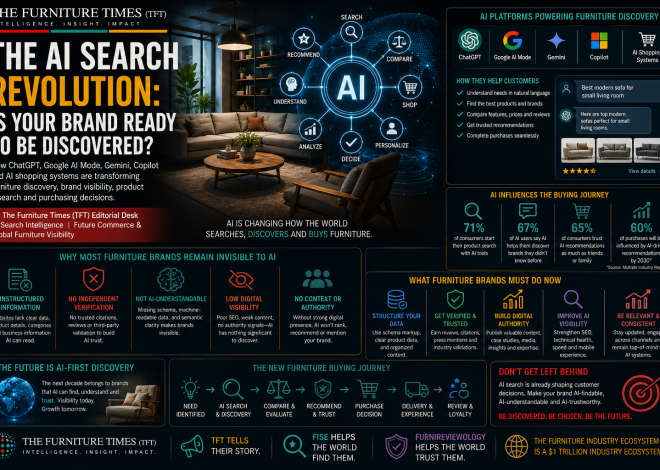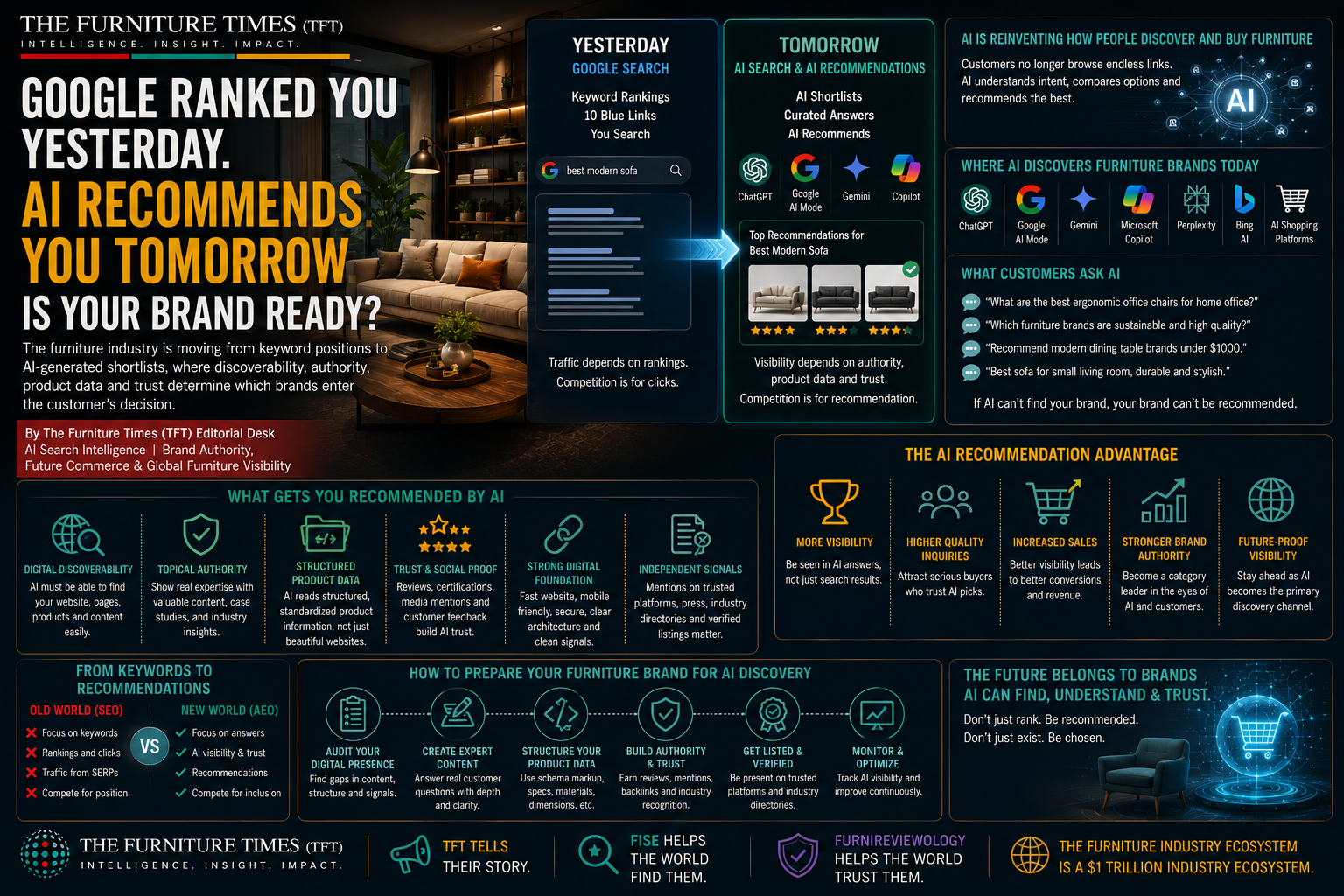
Google Ranked You Yesterday. AI Recommends You Tomorrow. Is Your Brand Ready?
The furniture industry is moving from keyword positions to AI-generated shortlists, where discoverability, authority, product data and trust determine which brands enter the customer’s decision
By The Furniture Times (TFT) Editorial Desk | AI Search Intelligence | Brand Authority, Future Commerce & Global Furniture Visibility
For more than two decades, businesses measured digital success through Google rankings.
Companies invested in websites, search engine optimization, backlinks and paid campaigns to appear near the top of a search-results page. Reaching the first page—and especially the first position—became one of digital marketing’s most recognized goals.
That model still matters. But it is no longer the entire search environment.
Artificial intelligence is changing search from a list of links into a guided decision-making experience. Instead of searching for “hotel furniture manufacturers” and opening ten websites, a buyer can ask:
“Recommend established hotel furniture manufacturers in Southeast Asia that provide customization, project installation, international shipping and documented sustainability credentials.”
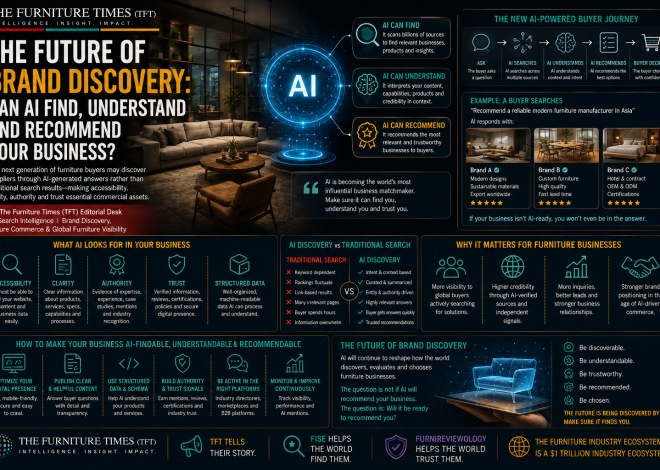
An AI-powered system can interpret the request, break it into several related questions, search different sources, evaluate available evidence and present a shortlist.
That is a fundamentally different competitive environment.
Google may have ranked a company yesterday because its webpage was relevant to a keyword. Tomorrow, an AI system may decide whether that company deserves to be mentioned, compared, cited or recommended.
The critical business question is no longer only:
“Where do we rank?”
It is:
“Are we part of the answer?”
Ranking and Recommendation Are Not the Same
A traditional search ranking and an AI recommendation perform different functions.
A search ranking organizes pages. An AI recommendation organizes choices.
| Traditional search ranking | AI-generated recommendation |
|---|---|
| Often responds to a keyword or phrase | Interprets a detailed need or conversation |
| Presents multiple links | Produces a summarized shortlist |
| Focuses heavily on page relevance | Evaluates brand, product and contextual relevance |
| User performs most comparisons | AI may conduct an initial comparison |
| Visibility can be page-specific | Visibility may depend on the wider brand entity |
| Click usually begins the research journey | Recommendation may occur before a website visit |
| Position is a central metric | Mentions, citations, accuracy and share of voice matter |
| Search result is relatively observable | AI responses can vary by prompt and platform |
Ranking remains valuable because AI search systems frequently depend on search indexes and quality signals. However, a high-ranking page does not automatically guarantee an AI recommendation.
A company may rank for its brand name because it is the obvious navigational result. Yet it may remain absent when a buyer asks for the best supplier within a category.
Google Says SEO Still Matters
The rise of generative search does not mean businesses should abandon SEO.
Google’s official guidance states that SEO remains relevant because its generative AI features are grounded in core search ranking and quality systems. Pages generally need to be crawlable, indexed and eligible for search visibility before they can be considered for AI Overviews or AI Mode.
Google also describes a process called “query fan-out.” When a user asks a complex question, the system may generate several related searches to collect the information needed for a more complete response.
For example, a buyer asking for sustainable outdoor furniture may indirectly trigger questions concerning:
- Certified timber
- Recycled materials
- Weather resistance
- Product warranties
- Maintenance requirements
- Export capability
- Delivery territory
- Customer reviews
- Brand reputation
This means one broad category page may no longer be enough. The brand needs a connected body of accurate information that addresses the buyer’s wider decision.
Google’s generative AI optimization guide advises businesses to maintain technical SEO foundations and create valuable, distinctive content. It also warns against relying on supposed AI-search hacks.
AI Search Has Moved Into Shopping
AI platforms are no longer answering only informational questions. They are increasingly supporting product discovery, comparison and commerce.
OpenAI introduced richer product-discovery experiences that allow users to compare products visually and examine factors such as features, prices and reviews. It has also developed infrastructure through which participating merchants can provide structured catalogue information.
OpenAI’s product-discovery announcement describes an environment where conversational research can replace hours of searching through multiple tabs.
Furniture is especially suited to this form of discovery because purchasing decisions involve many connected variables:
- Room dimensions
- Product size
- Style
- Materials
- Color
- Comfort
- Durability
- Price
- Availability
- Delivery
- Assembly
- Warranty
- Reviews
- Return conditions
A customer can explain these requirements in ordinary language. The AI system can then narrow the market.
For furniture companies, this means product data may become as strategically important as showroom presentation.
Yesterday’s Search Journey
The conventional furniture-search journey looked something like this:
- A customer entered a keyword.
- Google displayed advertisements and organic results.
- The customer opened several websites.
- The customer compared products manually.
- The customer checked reviews.
- The customer visited a showroom or contacted a supplier.
- The customer made a decision.
Brands competed for the click.
The strongest position was the top result because it attracted attention and website traffic.
Tomorrow’s AI-Assisted Journey
The emerging journey is different:
- A customer describes a need conversationally.
- AI asks clarifying questions.
- The system researches products, brands and sources.
- It compares relevant options.
- It summarizes strengths and limitations.
- It presents a shortlist.
- The customer asks follow-up questions.
- The customer visits selected brands or proceeds toward a purchase.
Brands now compete to enter the shortlist before the click.
This is why AI visibility must be treated as a strategic business issue rather than a minor extension of website optimization.
Being Ranked Does Not Mean Being Understood
A search engine can rank a product page because its title and content match a query.
An AI system may need to understand much more:
- Who owns the product?
- Is the company a manufacturer or reseller?
- Where is it located?
- Is the product still available?
- Does the company serve the user’s country?
- Are its claims supported by evidence?
- What do customers say about it?
- How does it differ from competing products?
- Is the information current?
If those facts are absent or contradictory, the brand may be difficult to recommend confidently.
The new priority is therefore entity clarity: ensuring that search and AI systems understand the company as a distinct, consistent and verifiable organization.
Furniture Brands Have an Entity Problem
The furniture industry contains countless businesses with similar names.
Words such as “living,” “home,” “interiors,” “design,” “comfort,” “modern” and “furniture” appear in thousands of company names. A business may also use one name on its website, another on invoices and an abbreviation on social media.
This creates confusion.
An AI system may struggle to determine whether the name refers to:
- A manufacturer
- A retailer
- An interior-design studio
- A product collection
- A marketplace seller
- A company in another country
- An unrelated business
A brand must make its identity unambiguous.
Essential brand facts
Every company should publish and standardize:
- Official brand name
- Legal company name
- Former names
- Headquarters
- Factory and showroom locations
- Year established
- Business classification
- Product categories
- Materials and capabilities
- Customer segments
- Markets served
- Certifications
- Official contact details
- Authorized social profiles
These facts should be consistent across the website, directories, exhibition profiles, news coverage, product feeds and review platforms.
Most Furniture Websites Were Built to Display, Not Explain
Furniture is visual, so many websites prioritize large photographs and minimalist design.
That may create an attractive experience for human visitors. It may not provide enough information for search and AI systems.
A photograph cannot reliably explain:
- Product dimensions
- Materials
- Construction
- Intended application
- Weather resistance
- Warranty
- Customization
- Availability
- Lead time
- Delivery territory
A gallery containing 100 attractive images may be less useful for AI discovery than ten comprehensive product pages.
Furniture brands need both visual presentation and factual depth.
Product Data Determines Recommendation Eligibility
An AI system cannot responsibly compare furniture products when their specifications are incomplete.
Every priority product should have:
- Product name
- Model number or SKU
- Category
- Detailed description
- Intended use
- Dimensions
- Materials
- Construction details
- Finish options
- Color or upholstery variants
- Indoor or outdoor classification
- Weight or capacity where relevant
- Assembly requirements
- Care instructions
- Warranty
- Availability
- Delivery information
- Return conditions
- Original images
Product descriptions should explain real differences rather than repeat marketing phrases.
“Premium ergonomic chair” is an unsupported claim. A description identifying seat-height range, adjustment mechanisms, materials, testing and warranty provides meaningful evidence.
Product Feeds Are Becoming the New Digital Shelf
Traditional websites remain important, but structured product feeds are becoming another discovery layer.
OpenAI’s commerce documentation states that product feeds can help ChatGPT display products with current pricing, availability and seller context. Google also recommends appropriate use of Merchant Center, Business Profiles and product information for shopping and local visibility.
Furniture-product feeds can be complex because products may involve:
- Multiple sizes
- Material alternatives
- Hundreds of fabrics
- Customized finishes
- Regional prices
- Made-to-order lead times
- Modular configurations
- Installation services
- Quotation-based pricing
The solution is not to avoid structured data. It is to organize it carefully.
Furniture companies should begin building a central product-information system from which websites, catalogues, marketplaces, dealers and AI-commerce feeds can receive consistent information.
Recommendation Requires More Than Self-Promotion
Every company claims to offer quality, value and dependable service.
AI systems need evidence that extends beyond the company’s own website.
Independent authority can come from:
- Industry news coverage
- Trade associations
- Exhibition websites
- Certification bodies
- Distributors
- Project partners
- Verified directories
- Customer reviews
- Specialist publications
- Video coverage
- Research citations
- Awards from credible organizations
A 2025 Ahrefs study examining approximately 75,000 brands found that branded web mentions had the strongest reported correlation with visibility in Google AI Overviews among the factors studied. The study reported a 0.664 correlation for branded web mentions compared with 0.218 for raw backlink volume.
The research does not prove a universal causal ranking formula, and Ahrefs expressly cautioned that correlation is not causation. Nevertheless, it shows that broader brand presence deserves serious attention.
A company repeatedly recognized in relevant, credible contexts is easier for machines and people to understand.
Brand Authority Is Moving Beyond Backlinks
Backlinks remain useful. They support discovery, traffic and authority.
However, AI search highlights the value of context.
Consider these two online references:
- A website links to a company name without explanation.
- A recognized industry publication identifies that company as a Malaysian manufacturer of customized outdoor furniture for hospitality projects.
The second reference creates several meaningful relationships:
- Brand
- Country
- Business type
- Product category
- Customer segment
- Capability
These contextual relationships help establish what the brand represents.
Furniture companies should therefore combine traditional SEO with legitimate public relations, business listings, industry participation and expert content.
News Is Becoming Machine-Readable Reputation
A company’s achievements often exist only inside private presentations, exhibition conversations or social posts.
A well-structured news article creates a public, dated and searchable record.
Suitable furniture-industry news can include:
- Factory investment
- Production expansion
- New machinery
- Product launches
- Certifications
- Export developments
- Exhibition participation
- Strategic partnerships
- Hospitality projects
- Sustainability initiatives
- Technology adoption
- Workforce training
- Design collaborations
This is not about turning every routine activity into exaggerated news. It is about documenting genuine developments that demonstrate capability and progress.
TFT can help furniture SMEs build this public record through professional industry storytelling.
Reviews Could Influence Tomorrow’s Recommendations
When an AI system helps a user compare brands, it may consider accessible information about customer experience.
Furniture reviews are particularly valuable because they can address:
- Product quality
- Comfort
- Finish accuracy
- Delivery
- Assembly
- Installation
- Service
- Warranty handling
- Durability
- Value
A five-star rating without context offers limited insight. A detailed, authentic review provides evidence.
Brands should never create fake reviews or pressure customers into misleading endorsements. They should collect honest feedback, respond professionally and use recurring complaints to improve operations.
FurniReviewology can contribute to the furniture ecosystem by supporting a more relevant and transparent trust layer.
AI Recommendation May Include Criticism
Traditional search results normally display a title and short description. AI-generated comparisons may directly discuss limitations.
A system may say that a brand:
- Has a limited delivery area
- Offers fewer customization options
- Has mixed reviews
- Does not publish clear warranty terms
- Appears more expensive
- Provides incomplete product information
- Has an outdated catalogue
This means brands must monitor not only whether they are mentioned, but how they are described.
A missing fact can be interpreted as a limitation. If the company offers international delivery but never states it publicly, AI may conclude that delivery coverage is unclear.
Accuracy must therefore become a measurable brand responsibility.
Paid Search Cannot Buy Every AI Recommendation
Advertising remains a legitimate and useful visibility channel.
Paid search can:
- Generate immediate exposure
- Reach high-intent audiences
- Support product launches
- Test markets
- Drive targeted traffic
- Compete for commercial keywords
But paid advertising does not automatically create organic AI authority.
An AI recommendation may depend on accessible product information, independent references, reviews, relevance and source quality. A company cannot assume that a large advertising budget guarantees inclusion in every AI-generated answer.
The strongest strategy combines:
- Paid visibility
- Organic search
- Useful content
- Public relations
- Product data
- Reviews
- Industry listings
- AI visibility monitoring
Paid search creates exposure. Authority must still be earned.
SEO Is the Foundation, Not the Finish Line
The headline “Google ranked you yesterday” should not be interpreted as saying that Google rankings no longer matter.
A strong traditional search presence can support AI visibility because pages must first be accessible and understandable.
However, businesses must build beyond rank tracking.
The modern visibility model includes:
- SEO: Can search engines find and understand the page?
- AEO: Can the content provide a clear answer?
- GEO: Can AI systems accurately represent and cite the brand?
- Entity optimization: Is the company’s identity consistent?
- Product-data readiness: Can systems compare current products?
- Authority building: Do credible sources support the brand?
- Trust: Do reviews and evidence justify confidence?
- Measurement: Can the company monitor how AI portrays it?
The AI Recommendation Readiness Score
Furniture businesses can use the following framework for an initial assessment.
| Readiness category | Points |
|---|---|
| Technical crawlability and indexation | 15 |
| Brand identity and entity consistency | 15 |
| Product and category data | 15 |
| Original expertise and content | 15 |
| Independent authority and coverage | 15 |
| Reviews, evidence and trust | 10 |
| Structured data and product feeds | 10 |
| Monitoring and internal responsibility | 5 |
| Total | 100 |
Readiness levels
| Score | Interpretation |
|---|---|
| 0–20 | Invisible or inaccessible |
| 21–40 | Ranked for limited terms but poorly understood |
| 41–60 | Discoverable but rarely recommended |
| 61–80 | Strong recommendation foundation |
| 81–100 | Advanced and actively monitored |
This is a TFT editorial assessment model. It is not an official score used by Google, OpenAI or another AI platform.
The 20-Question Brand Readiness Test
Ask whether your company can answer yes to the following:
- Can search and AI crawlers access our public website?
- Does the website clearly state whether we manufacture, retail, supply or design?
- Is our company name consistent across important platforms?
- Are our headquarters, factory and showroom locations accurate?
- Does every major product category have a detailed page?
- Do priority products include materials and dimensions?
- Is availability information current?
- Are warranty terms published clearly?
- Are delivery regions and lead times explained?
- Do we have original project case studies?
- Do we publish real technical expertise?
- Do independent industry sources mention us?
- Are our certifications verifiable?
- Do we have authentic reviews?
- Is appropriate structured data implemented?
- Is our product information organized for feeds?
- Do our videos have meaningful titles and descriptions?
- Do we test AI prompts relating to our brand?
- Do we track citations, accuracy and competitor mentions?
- Is someone responsible for correcting misinformation?
Every “no” identifies a gap between traditional search visibility and AI recommendation readiness.
How Furniture Brands Should Test AI Recommendation
Searching only for the company name is insufficient. That tests recognition, not recommendation.
Recognition prompts
- What is [Brand Name]?
- Where is [Brand Name] based?
- What products does it offer?
Category prompts
- Recommend outdoor furniture manufacturers in Malaysia.
- Which companies manufacture hotel furniture in Southeast Asia?
- What brands specialize in furniture hardware?
Capability prompts
- Which manufacturers accept customized hospitality orders?
- Who can supply weather-resistant resort furniture?
- Which suppliers offer installation and warranty support?
Trust prompts
- Is [Brand Name] reliable?
- What verified information supports its claims?
- What do customers say about its products and service?
Comparison prompts
- Compare [Brand Name] with [Competitor].
- Which is better suited to a large commercial project?
- What are the strengths and limitations of each?
Tests should be repeated across relevant AI platforms, languages, locations and dates because responses can change.
A 12-Month AI Recommendation Strategy
Months 1–2: Establish the baseline
- Audit crawlability and indexation.
- Document current rankings.
- Test brand visibility in AI answers.
- Record inaccurate or missing information.
- Identify priority commercial questions.
Months 3–4: Clarify the entity
- Rewrite the company profile.
- Standardize names, addresses and descriptions.
- Update directory and exhibition listings.
- Establish clear category positioning.
Months 5–6: Strengthen product data
- Upgrade category pages.
- Publish detailed product specifications.
- Create warranty and delivery pages.
- Organize identifiers, images and availability.
- Implement relevant structured data.
Months 7–8: Publish expertise
- Release technical guides.
- Document factory processes.
- Create project case studies.
- Publish expert-led videos.
- Answer important buyer questions.
Months 9–10: Build authority and trust
- Seek credible media coverage.
- Document certifications and partnerships.
- Collect authentic reviews.
- Correct inaccurate external information.
- Expand furniture-specific business listings.
Months 11–12: Prepare for AI commerce
- Evaluate product-feed eligibility.
- Connect inventory and product data.
- Establish AI referral tracking.
- Compare visibility against competitors.
- Create a quarterly improvement program.
What Brands Should Not Do
The shift toward AI search will create misleading shortcuts.
Avoid:
- Fake reviews
- Paid mentions presented as independent praise
- Fabricated awards
- False certifications
- Hidden claims in structured data
- Mass-produced low-value articles
- Copied product descriptions
- Automated forum spam
- Irrelevant backlinks
- Unsupported “best brand” claims
- Outdated stock and pricing
- Treating an
llms.txtfile as a guaranteed AI-ranking solution
Google states that websites do not need special AI files or dedicated generative-search markup to appear in its AI search features. It also warns that generating large volumes of content without adding value may violate policies against scaled content abuse.
The most durable strategy is still the most honest: publish real expertise, accurate data and evidence that helps customers.
SMEs May Have an Unexpected Advantage
Large brands have extensive budgets and broad recognition. SMEs often have deeper expertise in a narrow category.
A small company may know more than a multinational competitor about:
- Teak furniture in tropical climates
- Bespoke restaurant seating
- Custom hotel headboards
- Brass furniture fittings
- Outdoor cushions
- Furniture repair
- Regional delivery conditions
- Small-batch production
AI systems respond to specificity.
An SME does not need to be recommended for every furniture question. It needs to become highly relevant to questions matching its genuine specialization.
This requires documenting knowledge that may currently exist only inside the factory, showroom or founder’s experience.
The New Metrics of Furniture Visibility
Furniture companies should expand their dashboards beyond keyword rankings.
Important metrics now include:
- AI brand mention rate
- Citation rate
- Recommendation frequency
- Accuracy rate
- Share of AI voice
- Competitive inclusion
- Sentiment
- Product visibility
- Source quality
- AI referral traffic
- AI-assisted enquiries
- Conversion after AI discovery
A company could lose organic clicks while gaining higher-quality enquiries from customers already educated by an AI assistant. Website traffic alone may not reveal that shift.
Visibility measurement must connect search exposure to commercial outcomes.
TFT, FISE and FurniReviewology: Story, Search and Trust
The future furniture-discovery ecosystem requires three connected layers.
The Furniture Times (TFT) documents companies, innovations, products, markets and achievements.
Furniture Industry Search Engine (FISE) helps buyers find manufacturers, retailers, suppliers and service providers through furniture-specific categories.
FurniReviewology helps the market evaluate experience, reputation and trust.
Together, these platforms address the new decision journey:
- TFT tells the story.
- FISE makes the business searchable.
- FurniReviewology supports trust.
This infrastructure can help capable furniture SMEs build visibility beyond the limitations of advertising budgets and conventional ranking competition.
Final Analysis: Tomorrow’s Customer May Never See Yesterday’s Ranking
A furniture brand can hold a strong Google position and still be excluded from an AI-generated shortlist.
It may rank but lack product detail.
It may be popular but poorly documented.
It may have a strong website but weak independent evidence.
It may have quality products but no reviews.
It may have an excellent catalogue but outdated availability.
It may have decades of experience that were never published.
The AI recommendation economy rewards brands that are discoverable, understandable, relevant, corroborated and current.
Google ranking remains important. It establishes part of the digital foundation.
But tomorrow’s visibility will be determined by a larger question:
Can AI understand enough about your brand to recommend it responsibly?
Furniture companies should not wait until AI-generated recommendations dominate their enquiry pipelines. Building authority, structured product data and trust requires time.
The brand that begins today may become tomorrow’s recommended answer.
The brand that delays may remain a search result that nobody is shown.
Google ranked you yesterday. AI recommends you tomorrow. Is your brand ready?
Editorial note: AI answers vary by platform, user prompt, date, location, language and available information. No SEO, AEO or GEO service can guarantee an AI mention, citation, ranking or recommendation. Research findings cited here identify observed correlations, not confirmed universal ranking factors.
Reference sources: Google’s generative AI optimization guidance, Google’s AI features guidance, OpenAI product discovery, OpenAI product-feed documentation, and Ahrefs’ 75,000-brand study.
The Furniture Times (TFT) & Furniture Industry Search Engine (FISE)
“TFT tells their story. FISE helps the world find them.”
FurniReviewology helps the world trust them.
The furniture industry ecosystem is a $1 trillion industry ecosystem.