How B2C Furniture Used SEO to Challenge Australia’s Largest Furniture Retailers
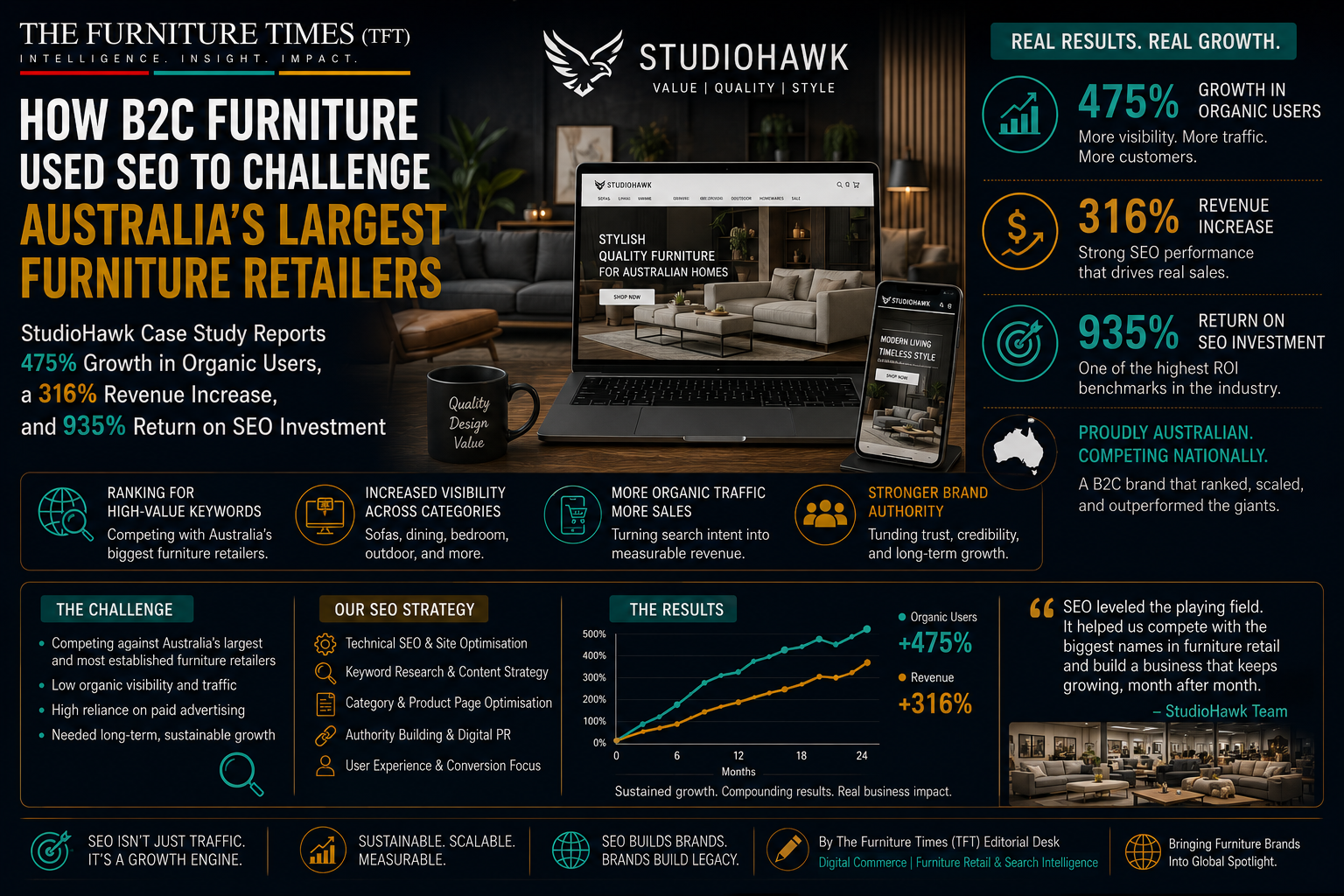
StudioHawk Case Study Reports 475% Growth in Organic Users, a 316% Revenue Increase, and 935% Return on SEO Investment
By The Furniture Times (TFT) Editorial Desk | Digital Commerce | Furniture Retail & Search Intelligence
A small furniture retailer does not need the advertising budget, physical-store network, or brand recognition of a multinational company to compete for customer attention. However, it does need a clear digital strategy, a technically reliable website, valuable content, strong category pages, and the patience to build search authority.
A case study published by Australian SEO agency StudioHawk demonstrates how B2C Furniture, a Melbourne-based furniture retailer, sought to compete in search results dominated by large names such as IKEA, Fantastic Furniture, Amart Furniture, and Forty Winks.
According to StudioHawk, the campaign contributed to a 475% increase in organic users, a 316% increase in revenue, a rise in organic search’s share of overall website traffic from 4.5% to 17.8% year over year, and a reported 935% return on SEO investment.
The results are significant because B2C Furniture was not described as a national retail giant. It was a smaller furniture business attempting to improve its visibility within a crowded Australian e-commerce market.
The case study offers a wider lesson for the global furniture industry: search visibility is not determined solely by company size. It is influenced by website structure, relevance, technical performance, product and category information, internal linking, content quality, authority, customer intent, and consistent execution.
The findings also challenge a common belief among furniture SMEs—that search engines belong permanently to large brands with large budgets.
Large retailers have advantages, but they do not automatically own every product search, local query, buying guide, long-tail keyword, or specialist furniture category.
About B2C Furniture
B2C Furniture is presented in the case study as a Melbourne furniture retailer offering competitively priced furniture made with sustainably sourced hardwood.
Its digital challenge was familiar to thousands of furniture SMEs around the world.
The company needed to compete against retailers with:
Greater brand awareness
Larger advertising budgets
More physical locations
Broader product catalogues
Stronger domain authority
Longer digital histories
Larger marketing departments
More established customer traffic
In search results, major furniture retailers often occupy the most valuable positions for commercial phrases such as beds, sofas, dining furniture, mattresses, children’s furniture, outdoor furniture, and bedroom collections.
For a smaller business, relying only on broad, highly competitive keywords can be discouraging. The search results may appear fixed, with the same dominant companies occupying the first page.
StudioHawk’s reported strategy was not built around defeating every large retailer across every furniture category. It focused on improving the technical and content foundations of the website, strengthening collection pages, publishing useful informational content, building links, and targeting commercially relevant product searches.
The Starting Challenge: A Major Website Upgrade
In mid-2020, B2C Furniture decided to redesign and upgrade its website. The project involved migrating from Magento 1 to Magento 2.
A platform migration can create a significant opportunity, but it also introduces substantial SEO risk.
If the migration is not managed correctly, a company can lose:
Existing rankings
Organic traffic
indexed pages
Page authority
Internal links
Product visibility
Category visibility
Historical search signals
Revenue from organic discovery
A new website can look better while performing worse in search.
This happens when old URLs disappear, redirects are missing, page content is removed, metadata changes, internal links break, or search engines cannot understand the new structure.
StudioHawk’s first priority was therefore to protect the existing organic visibility during the transition.
Why Website Migrations Are Dangerous for Furniture Retailers
Furniture e-commerce websites can contain hundreds or thousands of URLs, including:
Product pages
Category pages
Collection pages
Brand pages
Material pages
Style pages
Filter combinations
Buying guides
Blog posts
Warranty pages
Delivery information
Store-location pages
When the platform or site structure changes, every important URL must be reviewed.
If an old category page such as /kids-beds/ is replaced with a new URL and no redirect is implemented, search engines and customers may encounter a missing page. The ranking history associated with the old URL may also be weakened or lost.
A furniture retailer can suffer a sudden decline even if the new website appears technically modern.
The case study says StudioHawk used 301 redirects when URLs changed. A 301 redirect informs browsers and search engines that a page has permanently moved to a new location.
This helps preserve continuity between the old and new website.
However, redirects are only one part of a successful migration. A complete migration plan should also examine:
URL mapping
Indexability
Canonical tags
XML sitemaps
Internal links
Structured data
Metadata
Page speed
Mobile usability
Image URLs
Product availability
Duplicate content
Error pages
Analytics tracking
Search Console verification
The B2C Furniture case reinforces an important industry principle: SEO must be involved before a new furniture website is launched, not after traffic begins disappearing.
Information Architecture Became a Strategic Priority
Information architecture refers to the way website content is organised and connected.
For furniture retailers, a clear architecture helps customers and search engines understand the relationship between categories, collections, products, and educational content.
A logical structure might look like:
Furniture
Bedroom Furniture
Beds
Bed Frames
Trundle Beds
Children’s Beds
Queen Bed Frames
Dining Furniture
Dining Tables
Dining Chairs
Bar Stools
Living-Room Furniture
Sofas
Coffee Tables
TV Units
This type of organisation creates clear pathways.
Customers can move from a broad category to the specific furniture they need. Search engines can understand which pages represent the main commercial topics.
Poor architecture creates problems such as:
Important categories buried several clicks deep
Multiple pages targeting the same search
Confusing filter URLs
Orphaned product pages
Weak internal linking
Duplicate categories
Unclear navigation
Inconsistent URL structures
StudioHawk reports that it focused on making B2C Furniture’s collection pages easier for users and search engines to find through the migration.
This foundation supported the later content and authority strategy.
Collection Pages Became the Commercial Battleground
The StudioHawk plan placed significant emphasis on collection pages.
In furniture e-commerce, collection or category pages are often more commercially important than individual product pages.
A customer searching for “kids beds” is usually not looking for one specific model. The customer wants to view and compare several products.
A well-built collection page can provide:
A selection of products
Price ranges
Material options
Size choices
Filter tools
Delivery information
Category guidance
Frequently asked questions
Links to related collections
Buying advice
The page can satisfy both discovery and comparison intent.
The Reported Collection-Page Strategy
StudioHawk’s case study describes the following actions:
Adding dedicated content to collection pages
Improving URL structures
Optimising title tags
Improving H1 headings
Writing relevant meta descriptions
Strengthening navigation
Clarifying B2C Furniture’s value proposition
Building internal links
Acquiring backlinks to important category and product pages
These are standard SEO principles, but their effectiveness depends on execution.
Simply adding large blocks of repetitive text beneath products does not guarantee better performance. Category content must answer real buyer questions and support the shopping journey.
The Importance of Search Intent
Search intent describes what the customer is attempting to accomplish.
Furniture searches can carry different intentions.
Informational Intent
Examples include:
What size bed frame do I need?
How do trundle beds work?
Which timber is best for furniture?
How should I measure a dining table?
The customer is researching.
Commercial Investigation
Examples include:
Best kids beds in Australia
Hardwood bed-frame comparison
Trundle bed for small bedroom
Sustainable furniture Melbourne
The customer is comparing options.
Transactional Intent
Examples include:
Buy queen bed frame Melbourne
Kids trundle bed online
Hardwood bed frame delivery
Furniture sale Melbourne
The customer may be closer to purchasing.
Navigational Intent
Examples include:
B2C Furniture beds
B2C Furniture Melbourne
B2C Furniture delivery
The customer is looking for a particular company or page.
An effective SEO strategy creates the right page for each intention.
A product category should not be forced to answer every informational question. A buying guide should not necessarily serve as the main purchasing page. The two should support one another through internal links.
Targeting Difficult Furniture Keywords
StudioHawk reports that B2C Furniture initially struggled to rank for competitive searches such as:
Trundle beds
Kids beds
Queen-size bed frames
Single bed with trundle
Children’s beds
Kids trundle beds
These searches were commercially valuable because they represented customers looking for specific furniture categories.
Large competitors already had optimised category pages and established authority.
StudioHawk’s response was to bring B2C Furniture’s collection pages to a stronger standard through relevant content, metadata, site structure, navigation, internal linking, and backlink activity.
The goal was not merely to mention a keyword repeatedly. It was to build a page that deserved to appear when customers searched for that category.
The Homepage Needed to Explain the Brand’s Difference
A furniture homepage should immediately answer several questions:
What does the company sell?
Who is it for?
What makes it different?
Where does it deliver?
Which categories are available?
Why should the customer trust it?
What should the customer do next?
The case study says the homepage was revised to communicate B2C Furniture’s unique selling proposition more clearly and direct visitors toward important collections.
This is important because many furniture websites prioritise visual design while leaving the commercial message unclear.
A visitor may see a beautiful interior image but not understand whether the company is a manufacturer, retailer, marketplace, designer, wholesaler, or project supplier.
The homepage should combine visual appeal with clarity.
For B2C Furniture, relevant differentiators reportedly included hardwood furniture, sustainable sourcing, competitive pricing, and its position as a Melbourne retailer.
Content Marketing Created New Discovery Paths
A major part of the strategy involved publishing informative blog content related to furniture-buying questions.
StudioHawk highlights a guide concerning bed-frame sizes as one of the campaign’s successful content pieces.
The timing was relevant. During the 2020 lockdown period, Australian consumers spent more time at home, online furniture demand changed, and searches connected with beds and home furnishings increased.
The article reportedly began attracting search visibility shortly after publication.
Within two months, StudioHawk says the blog ranked for 163 keywords, including five first-page positions and 20 second-page positions.
These are agency-reported figures and should be understood within the measurement tools, dates, and keyword sets used in the case study. Nevertheless, they demonstrate how one useful guide can create multiple search entry points.
Why Buying Guides Work in Furniture
Furniture purchases often require education.
Customers need help understanding:
Sizes
Materials
Construction
Comfort
Room measurements
Delivery access
Assembly
Maintenance
Product compatibility
Style selection
Long-term value
A retailer that answers these questions can attract customers before they are ready to purchase.
Useful furniture content might include:
Mattress and bed-size guides
Sofa-measurement guides
Dining-table capacity guides
Furniture material comparisons
Outdoor furniture care
Wardrobe planning
Small-space furniture advice
Delivery-access checklists
Furniture assembly guidance
Product-lifespan information
The content should connect naturally with commercial pages.
A bed-size guide should link to relevant bed-frame collections. A teak-furniture care article should connect to teak products. A small-apartment guide should link to modular or space-saving furniture.
Internal Linking Strengthened the Website
StudioHawk reports that internal links were added between collection pages and the bed-size guide.
Internal linking helps in several ways.
It enables customers to move between information and products. It also helps search engines understand which pages are related and which pages are important.
For example:
A “kids beds” collection can link to a children’s bed-size guide.
The guide can link back to kids beds, trundle beds, and mattresses.
Product pages can link to delivery, assembly, and care information.
A hardwood guide can link to relevant timber collections.
This creates a connected content ecosystem.
Without internal links, a blog may receive traffic but contribute little to sales. Collection pages may also remain isolated from helpful educational content.
Internal links should be useful and natural. They should help customers continue their buying journey rather than being added only for search engines.
Backlinks Helped Build Page Authority
The campaign also included targeted backlink outreach.
A backlink is a link from another website to the retailer’s website.
Search engines can treat credible and relevant links as evidence that a page is useful or authoritative. However, link quality matters far more than raw volume.
Strong links may come from:
Industry publications
Interior-design websites
Home-improvement resources
Local business publications
Architecture platforms
Supplier websites
Furniture directories
News coverage
Relevant buying guides
Professional organisations
Weak or manipulative link schemes can create risk.
StudioHawk says its strategy included acquiring backlinks to selected category and product pages to improve page authority.
For furniture SMEs, this demonstrates why public relations, news coverage, directories, supplier partnerships, and industry platforms can support search visibility.
A strong digital presence is not built entirely within the company’s own website.
Reported Campaign Results
StudioHawk reports the following results from its work with B2C Furniture:
| Reported result | Outcome |
| Increase in organic users | 475% |
| Increase in revenue | 316% |
| Return on SEO investment | 935% |
| Organic share of total traffic | Increased from 4.5% to 17.8% YoY |
| Commercial visibility | First-page rankings for several children’s bed terms |
| Informational content performance | 163 ranking keywords within two months for a highlighted guide |
The agency says B2C Furniture achieved first-page visibility for searches involving kids beds, single beds with trundles, children’s beds, and kids trundle beds, appearing alongside larger retailers. StudioHawk’s B2C Furniture case study
These results are reported by the agency responsible for the campaign. The case-study page does not publicly provide every underlying analytics report, attribution setting, calculation, cost input, or revenue dataset required for an independent audit.
For responsible reporting, the percentages should therefore be described as StudioHawk-reported outcomes rather than independently verified industry benchmarks.
Understanding the 935% ROI Claim
Return on investment compares the financial return attributed to a campaign with the cost of that campaign.
A simplified formula is:
However, calculating SEO ROI can be complicated.
Companies must decide:
Which revenue is attributed to organic search?
Is the calculation based on total revenue or gross profit?
Are agency fees included?
Are content and development costs included?
How are assisted conversions treated?
What time period is used?
Are new and returning customers separated?
Are branded searches included?
The 935% figure is impressive, but furniture companies should not assume they will achieve the same result.
Every company begins with different website authority, market conditions, margins, products, competition, conversion rates, technical problems, content, and investment levels.
The more valuable lesson is that SEO performance was linked to measurable commercial outcomes rather than traffic alone.
Organic Traffic Is Valuable Only When It Supports Business
Traffic by itself does not pay salaries, purchase materials, or cover delivery costs.
A furniture company can attract thousands of visitors who never become customers.
SEO should therefore be evaluated through business metrics such as:
Organic revenue
Qualified enquiries
Product-page engagement
Add-to-cart rate
Checkout completion
Conversion rate
Average order value
Store visits
Quote requests
Assisted conversions
Customer-acquisition cost
Repeat purchases
Gross profit
The B2C Furniture case is notable because StudioHawk reported both traffic and revenue growth.
The relationship between the two matters.
A successful campaign should attract people whose needs match the products being sold.
Why Furniture SEO Is Particularly Difficult
Furniture is one of the more complicated e-commerce categories.
High Purchase Consideration
Customers may research for days or weeks before buying.
Large Product Variations
Size, material, colour, configuration, and finish create many options.
Delivery Complexity
Shipping costs, regional availability, stairs, elevators, access, and assembly influence purchasing.
Physical Experience
Customers may want to see, touch, or test the furniture.
Strong Visual Competition
Retailers compete through photography, room scenes, video, augmented reality, and showroom displays.
High Competition
Large national and international retailers dominate many searches.
Long Replacement Cycles
Customers do not purchase major furniture items frequently.
Local and National Intent
Some customers want local showrooms, while others want national delivery.
These challenges require a strategy combining technical SEO, content, user experience, product information, authority, reviews, and conversion optimisation.
What Furniture SMEs Can Learn
1. Small Brands Can Compete Selectively
An SME does not need to outrank the largest retailer for every furniture term. It needs to identify commercially valuable categories where its product, expertise, location, or customer service creates an advantage.
2. Category Pages Require Investment
A category page should do more than display products. It should help customers understand, compare, and select.
3. Website Migrations Must Be Managed Carefully
A redesign can damage years of search history if redirects, architecture, and indexing are ignored.
4. Informational Content Can Lead to Commercial Pages
Buying guides attract early-stage customers and help them move toward suitable products.
5. Internal Links Create a Connected Journey
Content, categories, products, delivery information, reviews, and care guides should support one another.
6. Authority Must Be Earned Beyond the Website
Credible backlinks, news coverage, listings, partnerships, and reviews strengthen visibility.
7. SEO Requires Consistency
One page or one article rarely transforms an entire business. Sustainable results come from repeated improvement.
What the Case Study Does Not Mean
The B2C Furniture results should not be interpreted to mean:
Paid advertising is always unnecessary.
Every furniture company can achieve 935% ROI.
Ranking alone guarantees profitable sales.
Blog publishing without strategy will create growth.
SEO is free.
Website design is unimportant.
Large retailers can easily be defeated.
All revenue growth came only from SEO.
The campaign occurred during an unusual period involving pandemic lockdowns and rapidly changing online demand. Consumer behaviour, furniture searches, and e-commerce adoption were affected by those conditions.
The case study itself connects part of the opportunity to rising online interest around children’s beds and related terms during 2020.
This does not reduce the campaign’s importance, but it shows that timing and market context matter.
SEO and Paid Search Should Work Together
The case study says B2C Furniture was able to reduce paid marketing activity and focus more heavily on organic search success.
This may be appropriate for that company at that stage, but furniture businesses should evaluate both channels strategically.
Paid Search Can Provide
Immediate visibility
Product-launch support
Promotional campaigns
Geographic targeting
Retargeting
Rapid testing
Organic Search Can Provide
Compounding visibility
Educational discovery
Lower dependence on advertising over time
Stronger category authority
Broader long-tail reach
Durable content assets
The strongest strategy may combine both.
Paid campaigns can generate immediate demand while SEO builds long-term visibility. Data from paid search can reveal converting terms, while organic content can reduce dependence on continuous advertising expenditure.
From Traditional SEO to AI Search
The original campaign focused heavily on conventional search visibility, but furniture discovery is now expanding into AI-generated answers.
Customers increasingly use AI systems to ask:
Which children’s bed is best for a small room?
What size bed frame should I buy?
Which furniture retailer offers sustainably sourced hardwood?
Where can I buy a trundle bed in Melbourne?
What is the difference between single and king-single beds?
The same foundations that supported B2C Furniture’s search growth remain relevant:
Clear site architecture
Strong category pages
Useful educational content
Accurate product information
Internal linking
Authority from external sources
A clear brand proposition
However, AI search adds new requirements.
Furniture websites should provide structured specifications, complete business details, consistent product information, clear authorship, supporting evidence, reviews, and content that answers natural-language questions.
Traditional SEO helps a company rank. AI search optimisation helps systems understand, compare, cite, and recommend it.
The Importance of Independent Furniture Platforms
Furniture businesses should not depend on their own websites alone.
External visibility can come from:
Industry news coverage
Verified directories
Furniture search platforms
Review systems
Professional publications
Retail marketplaces
Supplier and partner websites
Local business profiles
The Furniture Times, Furniture Industry Search Engine, and FurniReviewology can support different stages of digital authority:
The Furniture Times tells the industry’s stories.
FISE makes furniture companies searchable.
FurniReviewology helps buyers evaluate trust.
A furniture brand needs to be discoverable, understandable, and credible across multiple digital environments.
A Practical SEO Framework for Furniture Retailers
Phase 1: Measurement
Install and verify analytics, conversion tracking, Search Console, product revenue attribution, and call or enquiry tracking.
Phase 2: Technical Audit
Review indexing, page speed, mobile usability, duplicate content, broken links, schema, sitemaps, and crawlability.
Phase 3: Search Architecture
Create clear categories based on products and genuine customer demand.
Phase 4: Category Optimisation
Improve URLs, titles, headings, descriptions, filters, FAQs, internal links, and product presentation.
Phase 5: Product Information
Publish accurate dimensions, materials, delivery details, care instructions, warranty, and availability.
Phase 6: Content Strategy
Produce useful guides addressing real buying questions.
Phase 7: Authority Development
Build relevant links, media mentions, industry profiles, listings, and partnerships.
Phase 8: Conversion Improvement
Improve navigation, trust signals, reviews, checkout, delivery clarity, and mobile shopping.
Phase 9: AI Search Readiness
Organise product data, structured markup, entity information, FAQs, authorship, and third-party verification.
Phase 10: Continuous Review
Track rankings, traffic, revenue, margins, enquiries, returns, and customer behaviour.
The Broader Message for the Furniture Industry
The B2C Furniture case study is not only a story about one Australian retailer.
It represents a larger transformation in how furniture brands compete.
For decades, market power depended heavily on:
Store networks
Exhibition presence
Catalogue distribution
Advertising budgets
Wholesale relationships
Brand history
These advantages remain important, but digital discovery has introduced another route to growth.
A small furniture company can publish the most useful guide, build the strongest specialist category page, answer a customer question more clearly, or become the most relevant local result.
Search visibility can create a level of competitive access that traditional retail systems often deny smaller businesses.
However, that opportunity requires work.
Furniture SMEs must invest in websites as commercial infrastructure, not digital brochures. They must understand customer intent, organise product information, protect technical performance, publish useful content, build authority, and measure revenue rather than rankings alone.
Conclusion: Visibility Can Change the Competitive Balance
StudioHawk’s B2C Furniture case study reports a strong commercial transformation: 475% growth in organic users, a 316% revenue increase, first-page rankings for valuable children’s furniture searches, organic traffic growth from 4.5% to 17.8% of total traffic, and a reported 935% SEO return on investment.
The percentages are attention-grabbing, but the deeper lesson is more valuable.
The campaign was built on fundamentals:
Protecting visibility during a website migration
Creating a clean information architecture
Strengthening collection pages
Improving titles, headings, URLs, and descriptions
Publishing useful buying content
Connecting content through internal links
Building relevant backlinks
Measuring commercial outcomes
There was no single secret trick.
The growth came from treating search visibility as a long-term business system.
For furniture manufacturers and retailers, the message is urgent: a beautiful product that cannot be found remains commercially invisible. A strong showroom without digital discovery reaches only the people who already know it exists. A large catalogue without clear organisation becomes difficult for customers, search engines, and AI systems to understand.
The companies that get found earn the opportunity to be considered.
The companies that are considered earn the opportunity to be trusted.
The companies that are trusted earn the opportunity to grow.
The Furniture Times (TFT) & Furniture Industry Search Engine (FISE)
“TFT tells their story. FISE helps the world find them.”
FurniReviewology helps the world trust them.
The furniture industry ecosystem is a $1 trillion industry ecosystem.