
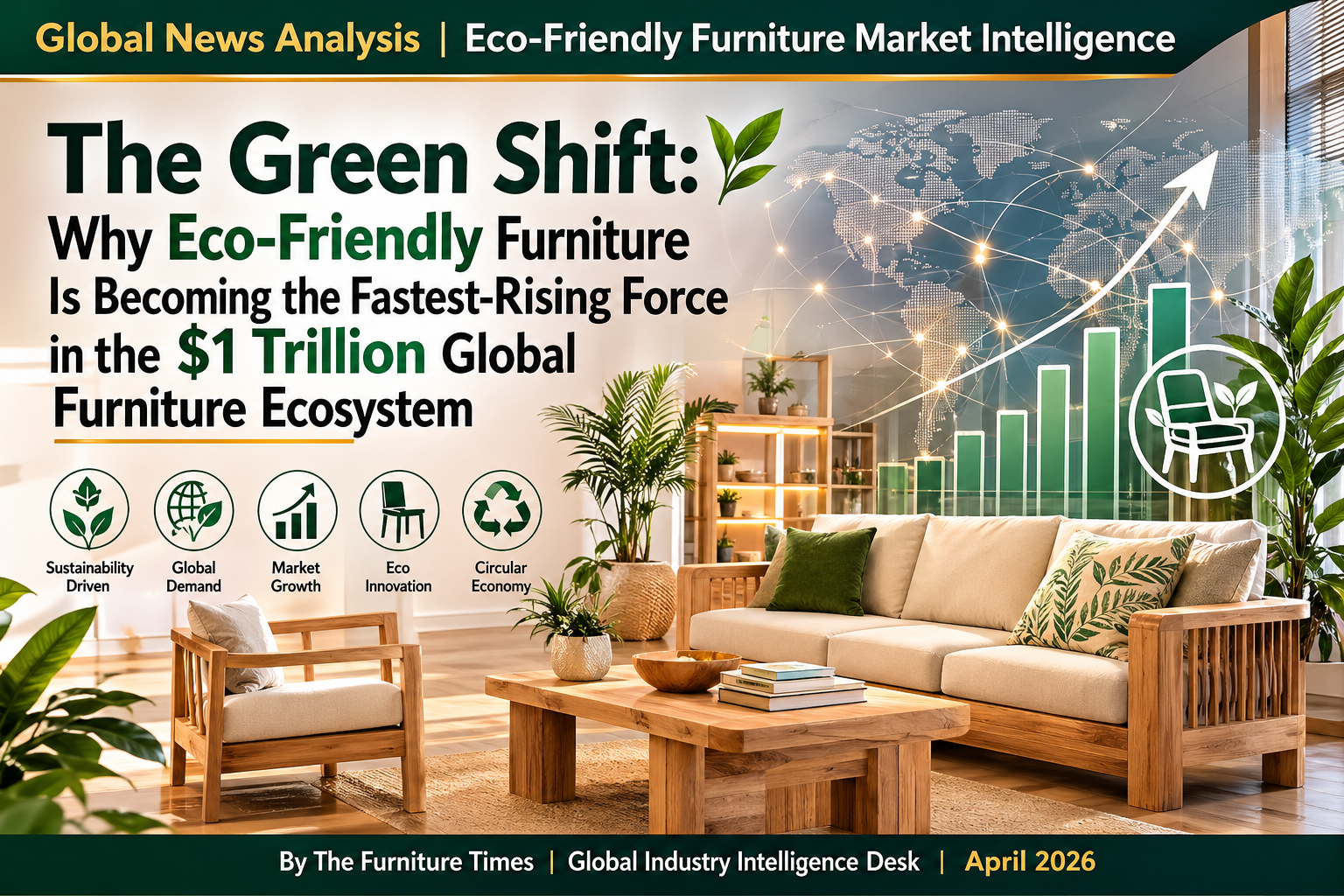
The Green Shift: Why Eco-Friendly Furniture Is Becoming the Fastest-Rising Force in the $1 Trillion Global Furniture Ecosystem
Global News Analysis | Eco-Friendly Furniture Market Intelligence
By The Furniture Times | Global Industry Intelligence Desk | April 2026
Introduction: Sustainability Moves from Trend to Industry Standard
The global furniture industry is undergoing one of its most important transformations:
Sustainability is no longer optional—it is becoming mandatory.
The eco-friendly furniture market is now one of the fastest-growing segments globally, driven by environmental awareness, regulatory pressure, and changing consumer expectations.
According to Research and Markets, the global eco-friendly furniture market is valued at approximately $59.03 billion in 2026 and is projected to reach $95.86 billion by 2032, growing at a strong ~8.3% CAGR.
The Big Picture: Why Eco-Friendly Furniture Is Rising Fast
1. Consumer Behavior Is Changing Globally
Consumers today are asking new questions:
- Where does this wood come from?
- Is this product recyclable?
- Is it safe for health?
- How long will it last?
Eco-friendly furniture is defined by:
- Sustainable sourcing
- Non-toxic materials
- Long lifecycle design
- Minimal environmental impact
This shift is transforming furniture from a product into a responsibility-driven purchase.
2. Governments & Regulations Are Driving Change
Governments worldwide are pushing:
- Green building certifications
- Carbon reduction targets
- Sustainable sourcing requirements
These policies are accelerating adoption of eco-friendly materials and manufacturing processes.
3. Sustainability = Competitive Advantage
Eco-friendly furniture is no longer just about compliance.
It is becoming a premium positioning strategy.
Brands that adopt sustainability gain:
- Higher trust
- Better export opportunities
- Stronger brand value
- Access to global markets
4. Rise of New Materials & Innovation
The industry is witnessing a major shift in materials:
- Bamboo and rattan
- Recycled wood and plastics
- Bio-based materials (hemp, mycelium, natural fibers)
- Low-VOC finishes
Designers are now combining:
Sustainability + Performance + Aesthetics
5. Growth Across Residential & Commercial Segments
The eco-friendly movement is not limited to homes.
Demand is growing across:
- Residential furniture
- Office furniture
- Hospitality furniture
- Institutional furniture
This makes eco-friendly furniture a cross-industry growth engine.
Market Structure: Where Growth Is Happening
Product Categories
Eco-friendly furniture spans across:
- Sofas
- Chairs
- Tables
- Cabinets
- Beds
- Outdoor furniture
Materials
- Wood (certified, reclaimed)
- Bamboo (fast-growing alternative)
- Metal (recyclable)
- Recycled polymers
End Users
- Residential → largest segment
- Commercial & hospitality → fastest-growing
The Hidden Challenges
Despite strong growth, the eco-friendly furniture market faces critical challenges:
1. Higher Production Costs
Sustainable materials and processes often cost more, making pricing a challenge for mass markets.
2. Greenwashing Risk
Many companies claim to be “eco-friendly” without real verification.
This creates:
- Trust issues
- Buyer confusion
- Market distortion
3. Supply Chain Complexity
Sustainable sourcing requires:
- Verified raw materials
- Certified suppliers
- Transparent production
This increases operational complexity.
4. Lack of Standardized Discovery
Here is the deeper issue:
Buyers want sustainable furniture—but cannot easily find verified suppliers.
- No global structured database
- No unified certification visibility
- No easy comparison system
The Real Problem: The Sustainability Search Gap
The eco-friendly furniture market reveals a critical industry gap:
Demand for sustainability is rising faster than discovery infrastructure.
This leads to:
- Buyers unable to verify claims
- Suppliers unable to showcase certifications
- Missed global opportunities
- Slower procurement decisions
TFT Deep Analysis: The Industry Is Entering the Green Intelligence Economy
Eco-friendly furniture is evolving through three stages:
Stage 1: Awareness
Consumers demand sustainable products
Stage 2: Adoption
Manufacturers adopt eco-friendly materials
Stage 3: Intelligence (Next Phase)
Markets require:
- Verified sustainability
- Transparent supply chains
- Smart supplier matching
Strategic Solutions: What the Industry Must Do
1. Move from Claims to Proof
Businesses must provide:
- Certification (e.g., FSC)
- Material sourcing details
- Production transparency
2. Build Sustainable Product Positioning
Suppliers should clearly define:
- Eco-friendly furniture manufacturers
- Sustainable office furniture suppliers
- Recycled material furniture producers
- Green hospitality furniture providers
3. Invest in Long-Life Design
Sustainability is not only about materials.
It is about:
- Durability
- Repairability
- Longevity
As recent design trends show, consumers now prefer furniture that lasts decades rather than disposable products.
4. Strengthen Digital Discovery
The biggest gap remains:
- Structured search systems
- Verified supplier databases
- Category-based discovery
- Sustainability filters
Role of FISE: The Missing Sustainability Infrastructure
The eco-friendly furniture market highlights a major gap:
There is no global search system connecting sustainability with furniture discovery.
Furniture Industry Search Engine (FISE) can solve this by enabling:
- Global eco-friendly furniture supplier listings
- Sustainability-based filters (certified, recycled, low-emission)
- Verified supplier profiles
- Country-level sourcing
- AI-powered supplier matching
Example Use Case
A buyer searching for:
“Sustainable hotel furniture suppliers with FSC-certified wood”
Today:
- Complex and manual process
With FISE:
- Structured search
- Verified certification
- Faster supplier selection
Key Takeaways (April 2026)
1. Eco-Friendly Furniture Is a High-Growth Market
Projected to reach nearly $96B by 2032
2. Sustainability Is Becoming Mandatory
Driven by regulation and consumer demand
3. Innovation Is Reshaping Materials
Bio-based and recycled materials are rising
4. Trust & Verification Are Critical
Greenwashing remains a major risk
5. Discovery Infrastructure Is Still Weak
Search and supplier visibility remain fragmented
Conclusion: Sustainability Is the Future of Furniture
Eco-friendly furniture is not a niche.
It is becoming the foundation of the future furniture industry.
It connects:
- Environmental responsibility
- Consumer trust
- Global trade
- Innovation
But to unlock its full potential, the industry must evolve from:
Sustainability claims → Verified, searchable, intelligent ecosystems
Final Thought
The future of furniture is not just about design.
It is about responsibility.
And the winners will be those who combine:
Search + Trust + Sustainability + Intelligence
