
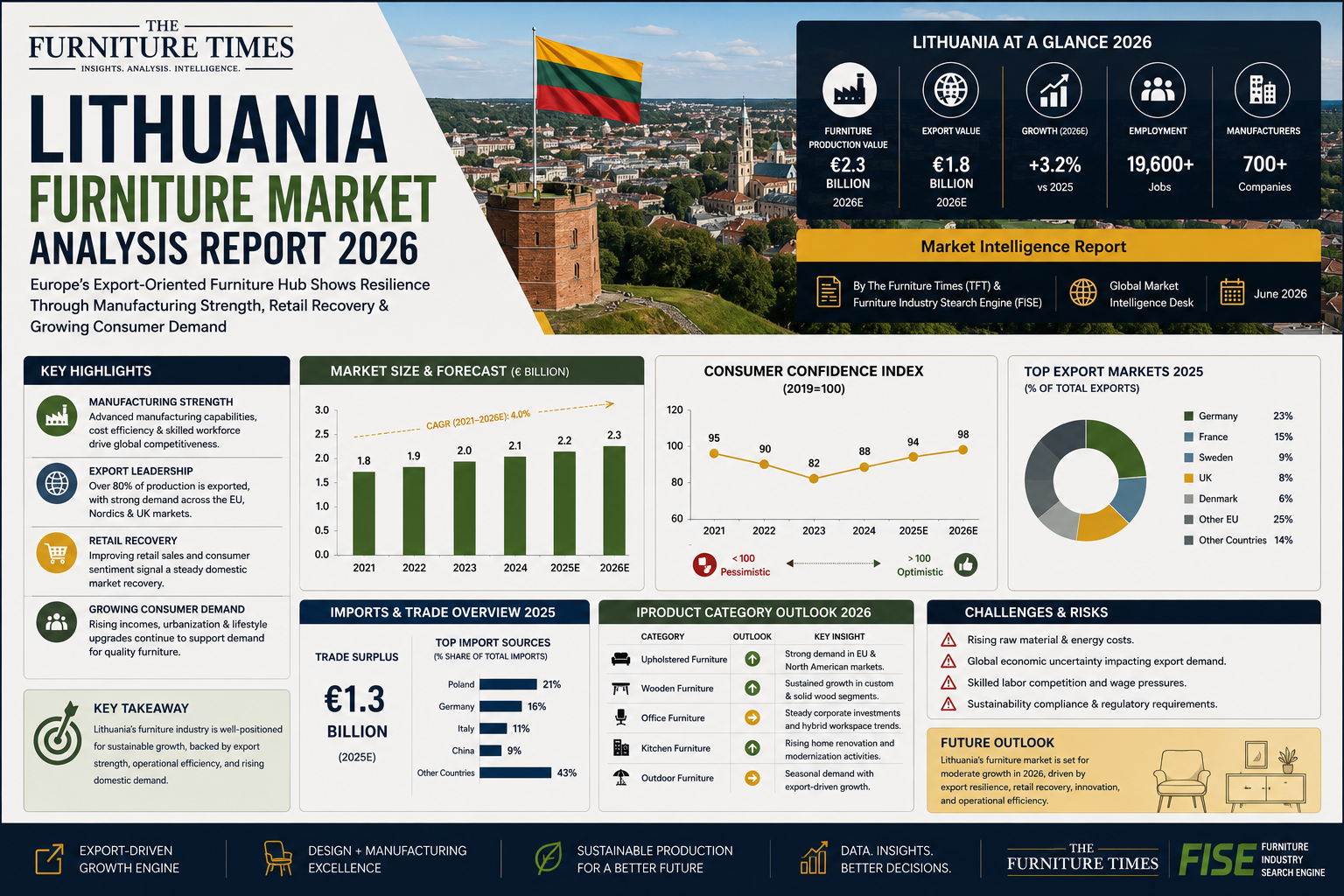
Lithuania Furniture Market Analysis Report 2026
Europe’s Export-Oriented Furniture Hub Shows Resilience Through Manufacturing Strength, Retail Recovery & Growing Consumer Demand
Market Intelligence Report | By The Furniture Times (TFT) & Furniture Industry Search Engine (FISE) | Global Market Intelligence Desk | June 2026
Lithuania may not be among Europe’s largest furniture markets by size, but it remains one of the continent’s most strategically important furniture manufacturing and export economies.
Over the past two decades, Lithuania has quietly developed a reputation as a highly efficient furniture production hub, serving major European markets through a combination of skilled labor, competitive manufacturing, strong export capabilities, and integration into European supply chains.
In 2026, the Lithuanian furniture sector is demonstrating encouraging signs of resilience. Retail demand is improving, online consumer interest is strengthening, and long-term growth prospects remain positive despite broader European economic uncertainties.
Lithuania Furniture Industry Health Check 2026
Manufacturing Strength
8.8 / 10
Export Competitiveness
8.5 / 10
Domestic Retail Demand
7.2 / 10
Consumer Confidence
6.8 / 10
Digital Demand Signals
7.8 / 10
Future Growth Potential
8.2 / 10
Overall Industry Health Score
7.9 / 10
Lithuania remains one of Europe’s healthiest export-driven furniture ecosystems.
A Small Country with a Big Furniture Industry
Lithuania’s furniture industry punches far above its weight.
Although its domestic consumer market is relatively small compared to Germany, France, Italy, or the United Kingdom, Lithuania has successfully built an international reputation as a manufacturing powerhouse.
The country’s furniture sector benefits from:
- Strong export orientation
- Access to European markets
- Skilled manufacturing workforce
- Wood-processing expertise
- Competitive production costs
- Strategic Baltic location
Today, Lithuanian furniture manufacturers supply products throughout Europe and increasingly participate in global furniture supply chains.
Retail Market Returns to Growth
One of the most positive developments in 2026 is the recovery of Lithuania’s domestic furniture retail market.
According to Furnilytics retail market data, Lithuania’s furniture retail turnover increased to approximately €460.8 million in 2025, representing a 6.7% increase compared with 2024.
This improvement suggests:
- Household spending is recovering.
- Furniture demand is stabilizing.
- Consumers are becoming more confident.
- Home improvement activity remains active.
For retailers and suppliers, this is a positive signal after several years of economic uncertainty.
Online Furniture Demand Is Improving
Digital demand indicators provide another encouraging sign.
Lithuania’s furniture product search index reached approximately 115 points in April 2026, indicating improving consumer interest in furniture-related purchases. Furnilytics notes that recent momentum is strengthening, with consumers increasingly researching furniture products online.
This trend is important because online search behavior often serves as an early indicator of future purchasing activity.
Consumers typically search for:
- Sofas
- Beds
- Wardrobes
- Kitchen furniture
- Office furniture
- Storage solutions
before making purchasing decisions.
The strengthening search trend suggests domestic demand may continue improving through the remainder of 2026.
Housing Activity Continues Supporting Demand
Like most furniture markets, Lithuania’s furniture sector remains closely connected to housing activity.
Furniture demand increases when:
- New homes are built
- Existing homes are renovated
- Residential transactions increase
- Consumers upgrade living spaces
Industry observers continue to identify housing construction and renovation activity as key drivers of Lithuanian furniture demand.
As disposable incomes rise and residential investment continues, furniture purchases are expected to remain supported by housing-related spending.
Export Manufacturing Remains the Core Strength
The true strength of Lithuania’s furniture ecosystem lies in manufacturing and exports.
The country has developed one of the most efficient furniture production sectors in Central and Eastern Europe.
Lithuanian manufacturers have become highly competitive in:
Flat-Pack Furniture
Large-scale production capabilities continue attracting international buyers.
Residential Furniture
Strong demand exists across European markets.
Wood Furniture
Lithuania benefits from a well-established wood-processing sector.
OEM Manufacturing
Many Lithuanian companies produce furniture for international brands and retailers.
Contract Manufacturing
Flexible production systems support commercial projects and private-label partnerships.
These strengths continue positioning Lithuania as a strategic production base for European furniture distribution.
Sustainability Is Creating New Opportunities
European buyers increasingly prioritize sustainability.
Lithuanian manufacturers are benefiting from their ability to provide:
- Sustainable wood sourcing
- Environmentally responsible production
- Shorter European supply chains
- Lower transportation emissions
- Compliance with EU sustainability standards
As sustainability becomes a purchasing requirement rather than a marketing advantage, Lithuania is well-positioned to benefit from this trend.
Consumer Preferences Are Evolving
Lithuanian consumers are becoming more sophisticated in their purchasing behavior.
Demand is increasingly focused on:
Functional Furniture
Consumers seek practical, space-efficient solutions.
Modern Design
Contemporary aesthetics continue gaining popularity.
Sustainable Products
Environmental awareness is growing.
Value-Oriented Purchases
Consumers seek durability and long-term value.
Omnichannel Shopping
Research increasingly begins online before purchases occur.
These trends mirror broader European furniture market developments.
Challenges Facing the Market
Despite strong fundamentals, several risks remain.
European Economic Uncertainty
Consumer spending remains vulnerable to broader economic conditions.
Rising Production Costs
Labor, energy, and raw materials continue affecting margins.
International Competition
Manufacturers face pressure from Poland, Turkey, Asia, and other European suppliers.
Supply Chain Volatility
Geopolitical disruptions continue affecting logistics networks.
Labor Availability
Manufacturing sectors across Europe continue competing for skilled workers.
These challenges require continued investment in productivity and innovation.
The Rise of the Visibility Economy
One of the most important developments affecting Lithuania’s furniture industry is digital discoverability.
Furniture buyers increasingly begin their journey through:
- Search engines
- AI assistants
- Online reviews
- Industry platforms
- Digital catalogs
- Professional directories
This creates what TFT and FISE describe as the Visibility Economy.
Manufacturers that are easy to find are increasingly the manufacturers that win inquiries.
For Lithuania’s export-oriented furniture sector, visibility is becoming as important as production capability.
TFT & FISE Analysis
Lithuania represents one of Europe’s most interesting furniture success stories.
The country has transformed itself into:
- A manufacturing hub
- An export platform
- A furniture production specialist
- A strategic European supplier
While domestic market growth remains important, the long-term future of Lithuania’s furniture industry will continue to be driven by:
- Export expansion
- Manufacturing excellence
- Sustainability leadership
- Digital transformation
- Supply chain reliability
The combination of improving retail demand and strong export capabilities creates a favorable outlook for the sector.
Strategic Recommendations
For Manufacturers
Invest in automation, sustainability, and export diversification.
For Exporters
Strengthen presence in Germany, France, the UK, Scandinavia, and North America.
For Retailers
Leverage growing online demand and omnichannel sales strategies.
For Industry Associations
Promote Lithuania as a premium European furniture manufacturing destination.
For FISE & TFT
Lithuania represents a strategic European furniture manufacturing ecosystem that deserves greater international visibility.
Final Verdict
Lithuania’s furniture industry enters the second half of 2026 from a position of strength.
Retail demand is recovering.
Online interest is increasing.
Manufacturing remains competitive.
Exports continue driving growth.
While challenges remain, Lithuania’s furniture sector is better positioned than many European markets to capitalize on future opportunities.
The country’s combination of manufacturing expertise, export orientation, sustainability readiness, and digital potential makes it one of Europe’s most promising furniture ecosystems for the years ahead.
By The Furniture Times (TFT) & Furniture Industry Search Engine (FISE)
Global Market Intelligence Desk | June 2026
“TFT tells their story. FISE helps the world find them.”
