
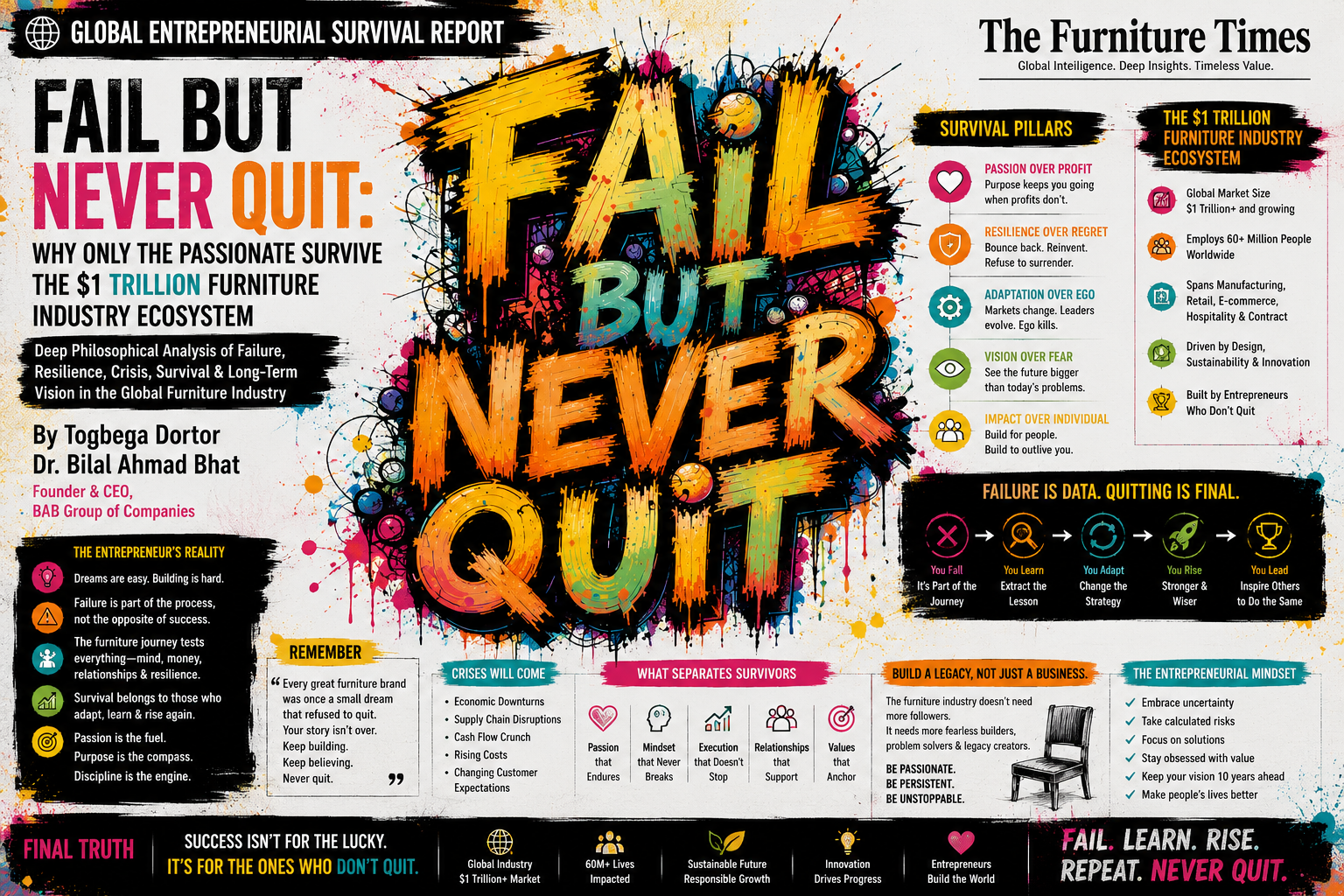
Fail But Never Quit: Why Only the Passionate Survive the $1 Trillion Furniture Industry Ecosystem
Global Entrepreneurial Survival Report | The Furniture Times
Deep Philosophical Analysis of Failure, Resilience, Crisis, Survival & Long-Term Vision in the Global Furniture Industry
By Togbega Dortor Dr. Bilal Ahmad Bhat, Founder & CEO, BAB Group of Companies
The uploaded image boldly says:
“FAIL BUT NEVER QUIT.”
Simple words.
But inside the global furniture industry ecosystem,
those words carry:
pain
sacrifice
uncertainty
emotional pressure
financial risk
survival instinct
entrepreneurial philosophy
Because the furniture industry is not an easy industry.
It is a:
$1 Trillion Global Ecosystem
built on:
manufacturing
labour
logistics
craftsmanship
retail
exports
emotions
homes
hospitality
lifestyle living
And within this massive ecosystem,
thousands of people:
enter
struggle
collapse
disappear
while only a few survive long enough to:
establish themselves.
According to Togbega Dortor Dr. Bilal Ahmad Bhat:
“People come and go in the furniture industry.
Only those who truly have passion for the industry survive uncertainty and establish themselves.”
The Furniture Industry Is Not for Weak Minds
Many outsiders see furniture only as:
chairs
sofas
tables
cabinets
But behind the scenes,
the furniture ecosystem is one of the most difficult industries in the world.
Why?
Because it combines:
manufacturing pressure
labour dependency
logistics uncertainty
design trends
customer emotion
economic cycles
global competition
raw material fluctuations
all together simultaneously.
This means entrepreneurs in furniture constantly face:
uncertainty.
Failure Is Common in the Furniture Industry
The image says:
FAIL.
And that word represents reality.
In the furniture ecosystem:
factories fail
retailers collapse
exporters lose containers
cash flow disappears
projects get cancelled
buyers vanish
freight costs rise
currencies fluctuate
The industry constantly tests:
emotional endurance.
Why Most People Quit
According to Dr. Bilal:
“Many people enter business because they want quick success.
But the furniture industry punishes short-term thinking.”
The industry requires:
patience
long-term commitment
relationship building
operational discipline
emotional strength
Most people underestimate:
how difficult survival really is.
The Hidden Emotional Pressure of Furniture Entrepreneurs
Furniture entrepreneurs often carry enormous hidden stress:
worker salaries
container delays
unsold inventory
showroom rental
factory overhead
raw material costs
customer complaints
project uncertainty
Yet very few people see this invisible pressure.
Many entrepreneurs silently fight:
survival battles every day.
Why Passion Matters More Than Money
According to Togbega Dortor Dr. Bilal Ahmad Bhat:
“Only those who genuinely love the industry survive long enough to build something meaningful.”
This is because passion creates:
resilience
endurance
emotional energy
persistence during crises
Without passion,
people often collapse when:
profits slow
uncertainty rises
markets become unstable
The $1 Trillion Furniture Industry Is Brutally Competitive
Globally, the furniture ecosystem is one of the most fragmented industries.
It contains:
millions of SMEs
factories
suppliers
importers
exporters
designers
traders
retailers
Everyone competes for:
visibility
buyers
survival
margins
market access
And yet:
only a small percentage truly survive long term.
Crisis Is Normal in the Furniture Industry
The industry has already survived:
financial crises
global recessions
COVID-19
logistics disruptions
tariff wars
shipping uncertainty
raw material inflation
geopolitical conflicts
Now again,
the global ecosystem faces:
uncertainty
trade instability
war pressure
economic slowdown
Yet the industry continues moving forward.
Why?
Because furniture remains connected to:
human living itself.
COVID-19 Changed Everything
The pandemic transformed the furniture ecosystem dramatically.
It exposed weaknesses in:
logistics
inventory systems
labour dependence
global sourcing
retail dependency
Many businesses:
collapsed
downsized
lost liquidity
shut down permanently
But others:
adapted
digitalized
reinvented themselves
This proved one major truth:
survival belongs to adaptable businesses.
“Every Crisis Is an Opportunity”
One of Dr. Bilal’s strongest philosophies:
“Every crisis is an opportunity.”
This does not mean crises are easy.
It means:
crises reveal hidden opportunities.
For example:
During uncertainty:
new markets emerge
weak competitors disappear
innovation accelerates
digital transformation rises
visibility becomes more important
new business models appear
The entrepreneurs who survive crises often become:
stronger than before.
Why Uncertainty Creates Opportunity
Most people fear uncertainty.
But visionary entrepreneurs study:
behavioural shifts
market gaps
changing customer needs
emerging ecosystems
During difficult times:
digital commerce rises
visibility becomes essential
operational efficiency improves
innovation speeds up
The strongest companies often emerge:
after crises.
The Industry Is Entering a New Era
The furniture industry is no longer only about:
manufacturing
retail
physical showrooms
Now the industry increasingly depends on:
discoverability
digital visibility
AI search
ecosystem connectivity
global communication infrastructure
This is why platforms like:
become increasingly important.
Visibility Is Becoming Survival
In the past,
location determined success.
Today:
visibility determines survival.
Businesses that remain:
invisible
unsearchable
disconnected digitally
may increasingly disappear from the future economy.
This transformation is happening globally across:
furniture retail
manufacturing
hospitality sourcing
B2B ecosystems
The Industry Needs Emotional Strength
The furniture industry is emotionally exhausting because success rarely happens overnight.
It requires:
relationship trust
long-term consistency
operational discipline
reputation building
Dr. Bilal strongly emphasizes:
endurance.
Because many people start businesses,
but very few remain standing after:
5 years
10 years
20 years
Why Furniture Entrepreneurs Become Different
Long-term furniture entrepreneurs develop:
emotional toughness
negotiation ability
survival instinct
operational intelligence
adaptability
because the industry constantly tests:
patience.
Failure Is Not the End
The uploaded image carries an important message:
“Fail But Never Quit.”
Failure in business does not necessarily mean:
defeat.
Sometimes failure teaches:
operational lessons
partnership mistakes
market realities
financial discipline
emotional maturity
Many successful entrepreneurs failed multiple times before:
establishing themselves.
The Difference Between Managers & Entrepreneurs
Dr. Bilal often says:
“Managers manage today. Entrepreneurs manage tomorrow.”
This philosophy reflects:
long-term thinking
future positioning
ecosystem vision
strategic endurance
Entrepreneurs survive uncertainty because they continue thinking beyond:
present difficulty
short-term pain
temporary collapse
The Furniture Industry Is an Emotional Industry
Furniture connects deeply with:
homes
families
lifestyles
emotions
hospitality
comfort
This makes the industry unique.
Furniture is not simply product manufacturing.
It is:
emotional environment creation.
The Future Belongs to Survivors
The future furniture ecosystem may increasingly belong to:
resilient entrepreneurs
adaptable businesses
digitally visible brands
ecosystem thinkers
emotionally disciplined leaders
Not necessarily the biggest companies.
But:
the most adaptable ones.
TFT Philosophical Industry Insight
The uploaded image represents one of the deepest truths in entrepreneurship:
Failure is temporary.
Quitting is permanent.
The global furniture industry constantly changes:
trends shift
markets fluctuate
crises emerge
competition intensifies
But those who remain:
disciplined
passionate
visionary
adaptable
often survive long enough to:
build legacy.
Final Thought
The furniture industry is not easy.
It is:
uncertain
emotionally demanding
operationally complex
financially risky
globally competitive
Yet it also remains one of the world’s greatest industries because it connects directly with:
human living itself.
The entrepreneurs who survive are often not:
the fastest
the richest
the loudest
But those who:
stay committed
adapt continuously
remain passionate
survive uncertainty
refuse to quit
because:
every crisis carries hidden opportunity.
Closing Insight
“The $1 Trillion Furniture Industry does not reward only intelligence or capital.
It rewards endurance, passion, emotional resilience, long-term vision, and the courage to continue even when uncertainty becomes overwhelming.”
