
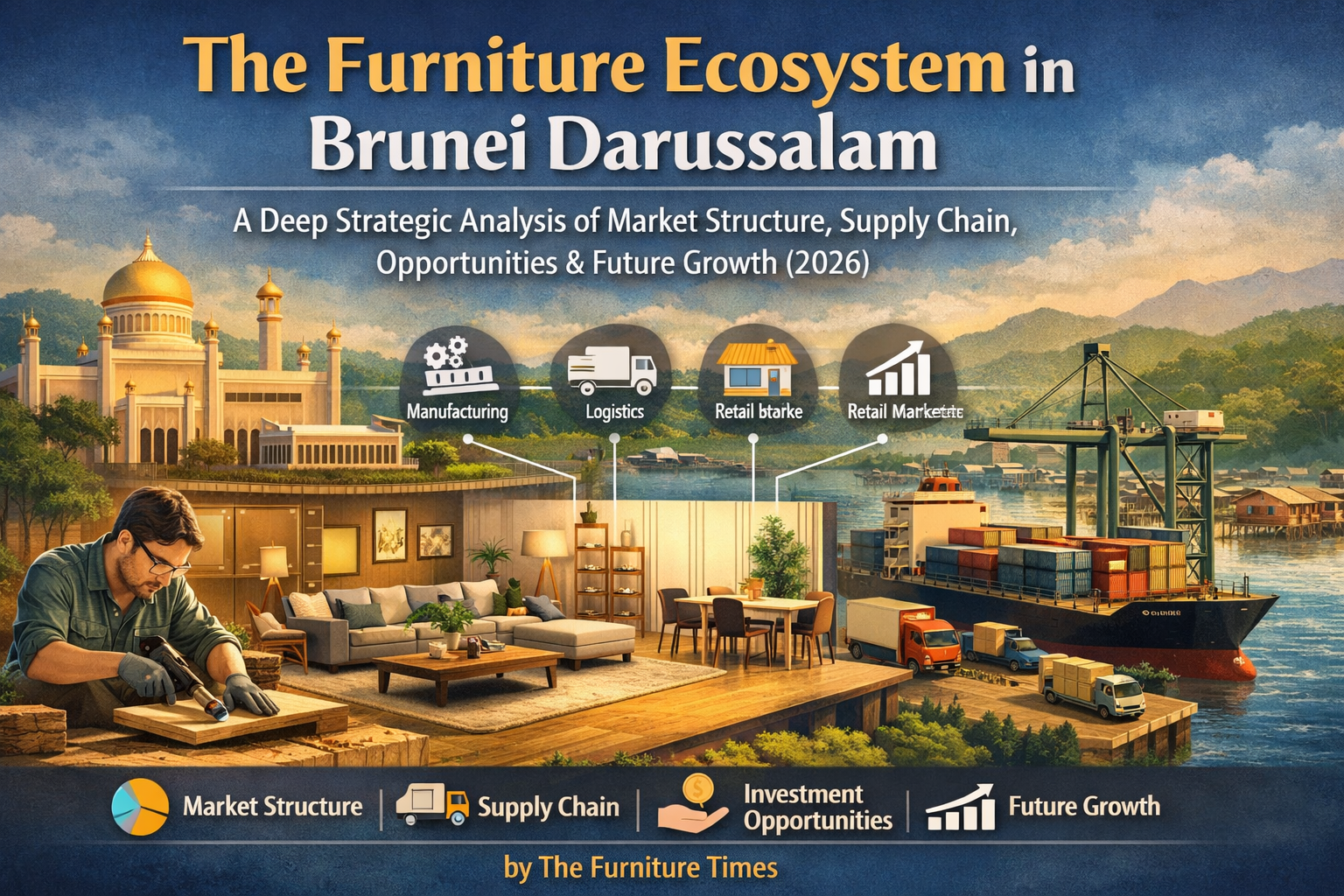
The Furniture Ecosystem in Brunei Darussalam
A Deep Strategic Analysis of Market Structure, Supply Chain, Opportunities & Future Growth (2026)
Market Overview: A Small Nation with Premium Potential
The furniture ecosystem in Brunei Darussalam is compact yet strategically significant. With a population of under 500,000 and one of Southeast Asia’s highest GDP per capita levels, Brunei represents a high-value, low-volume furniture market.
Unlike manufacturing-driven economies such as Vietnam or China, Brunei’s furniture sector is predominantly import-driven, with a strong focus on premium, customized, and lifestyle-oriented products.
The demand is shaped by:
- High disposable income
- Government-supported housing programs
- A growing preference for modern, minimalist, and luxury interiors
- Strong influence from Malaysian and international design trends
Structure of the Furniture Ecosystem
The Brunei furniture ecosystem can be divided into five core segments:
1. Retail & Showroom Market
Retail dominates the ecosystem, with most furniture sold through:
- Local showrooms in Bandar Seri Begawan
- Imported brands from Malaysia, China, and Europe
- Mid-to-premium positioning stores
Popular product categories:
- Living room sets (sofas, coffee tables)
- Bedroom furniture (beds, wardrobes)
- Dining sets
- Office and study furniture
Key Insight: Consumers prefer ready-to-use and premium imported designs over locally manufactured goods.
2. Manufacturing & Local Production
Brunei has limited large-scale furniture manufacturing due to:
- Small domestic market size
- High labor costs
- Lack of industrial-scale timber processing
However, there is a growing niche in custom carpentry, including:
- Built-in wardrobes and kitchens
- Office fit-outs
- Luxury villa interiors
Opportunity lies in high-margin custom furniture, not mass production.
3. Import & Supply Chain Ecosystem
Brunei’s furniture market is heavily dependent on imports, primarily from:
- Malaysia (Johor, Muar – major furniture hub)
- China
- Indonesia
Key logistics routes:
- Land transport via Malaysia (Sabah/Sarawak)
- Sea freight through Muara Port
Critical Insight:
Supply chain efficiency and partnerships with Malaysian manufacturers are the backbone of Brunei’s furniture ecosystem.
4. Construction & Real Estate Influence
Furniture demand is closely tied to:
- Residential housing projects
- Government housing schemes
- Private luxury villas
- Commercial spaces (offices, hotels, retail outlets)
The government’s housing initiatives create consistent baseline demand, while private developments drive premium furniture consumption.
5. Interior Design & Customization Market
Interior design plays a crucial role in Brunei:
- High demand for turnkey solutions
- Preference for minimalist + luxury hybrid styles
- Strong growth in custom cabinetry and fit-outs
Designers often act as decision-makers, influencing furniture selection and sourcing.
Market Characteristics
| Factor | Brunei Furniture Market |
| Market Size | Small but high-value |
| Demand Type | Premium, lifestyle-driven |
| Supply | Import-dominated |
| Manufacturing | Limited, niche custom |
| Growth Drivers | Housing + income + design trends |
| Competition | Low to moderate |
Key Opportunities in Brunei
1. Premium & Luxury Furniture Brands
Brunei consumers are willing to pay for:
- Imported luxury furniture
- European designs
- Custom-made interiors
Positioning matters more than price.
2. Custom Furniture & Fit-Out Businesses
High demand for:
- Kitchen cabinets
- Wardrobes
- Office interiors
- Hospitality projects
This is the fastest-growing segment.
3. Digital Furniture Marketplace (FISE Opportunity)
A platform like FISE (Furniture Industry Search Engine) can:
- Organize fragmented suppliers
- Enable cross-border sourcing
- Provide visibility to local businesses
Brunei is ideal for a digitally connected import ecosystem.
4. Hospitality & Tourism Furniture
With tourism development:
- Hotels and resorts require outdoor & indoor furniture
- Opportunity for companies like Decon Designs
Focus on durable, weather-resistant, luxury outdoor furniture.
Challenges in the Ecosystem
- Small population limits scale
- Heavy reliance on imports
- Limited industrial infrastructure
- High logistics costs
- Lack of global furniture branding within Brunei
Brunei vs Regional Ecosystem
| Country | Strength |
| Malaysia | Manufacturing + export powerhouse |
| Vietnam | Global production scale |
| China | Cost + scale dominance |
| Brunei Darussalam | High-value consumption |
Brunei is not a production hub—it is a premium consumption market.
Future Outlook (2026–2030)
The Brunei furniture ecosystem is expected to evolve in three directions:
- Premiumization of Demand
- More luxury imports
- Designer-led purchases
- Growth in Custom & Fit-Out Segment
- Local carpentry scaling up
- Interior firms dominating value chain
- Digital Transformation
- Online furniture discovery
- Cross-border B2B sourcing platforms
Strategic Conclusion
Brunei’s furniture ecosystem is a hidden opportunity market. While it lacks manufacturing scale, it compensates with:
- Strong purchasing power
- Demand for premium living
- Dependence on regional supply chains
The real opportunity is not to manufacture in Brunei, but to:
- Supply to Brunei
- Design for Brunei lifestyles
- Build premium, service-led furniture businesses
The Furniture Times Insight “Brunei is not a volume game — it is a value game.
Those who understand lifestyle, design, and premium positioning will dominate this market.”

Related Posts
