
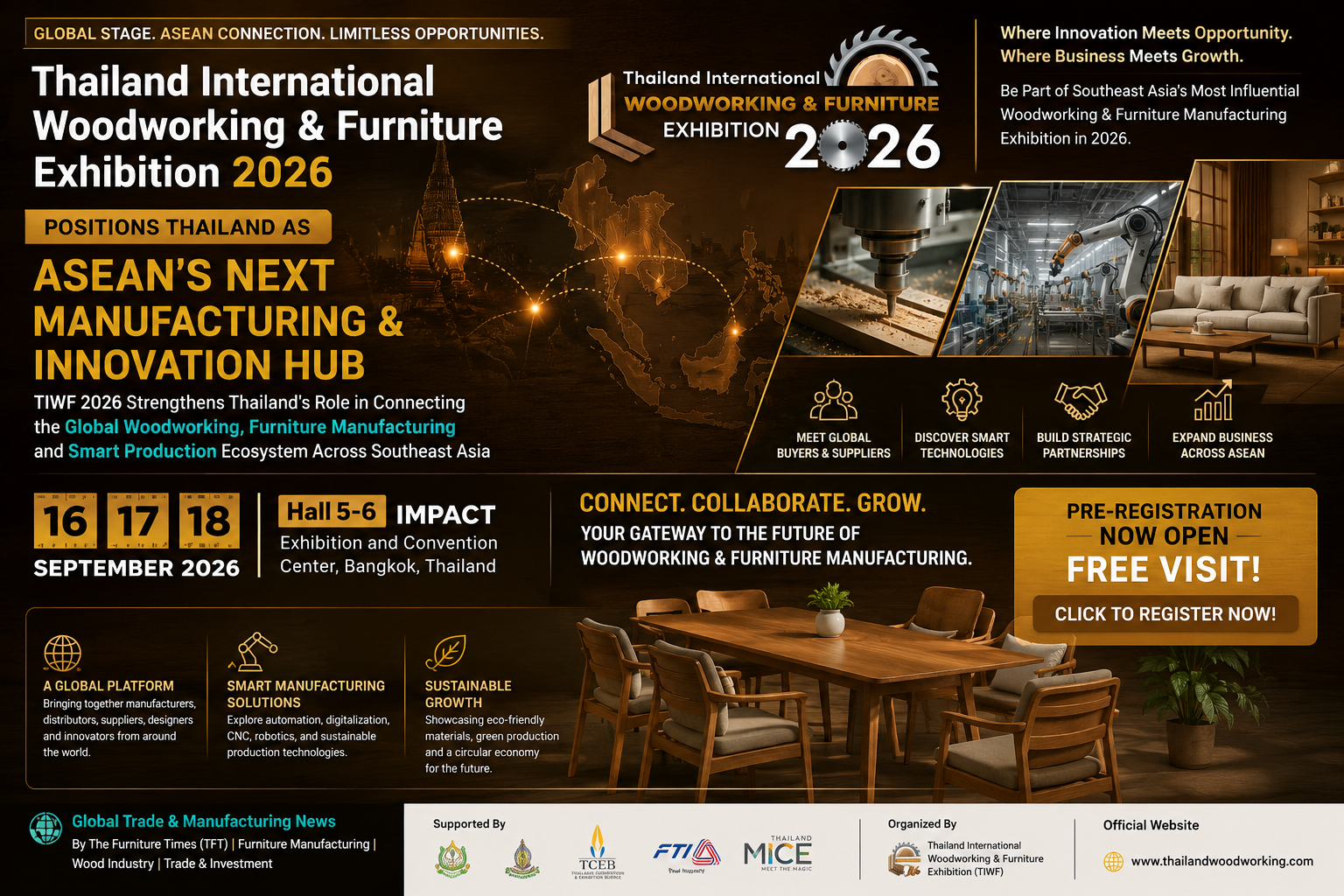
Thailand International Woodworking & Furniture Exhibition 2026 Positions Thailand as ASEAN’s Next Manufacturing and Innovation Hub
TIWF 2026 Strengthens Thailand’s Role in Connecting the Global Woodworking, Furniture Manufacturing and Smart Production Ecosystem Across Southeast Asia
Global Trade & Manufacturing News
By The Furniture Times (TFT) | Furniture Manufacturing | Wood Industry | Trade & Investment
Thailand is preparing to welcome one of Southeast Asia’s most influential industrial events as the Thailand International Woodworking & Furniture Exhibition (TIWF) 2026 returns to Bangkok from 16–18 September 2026 at the IMPACT Exhibition & Convention Centre. The exhibition is expected to bring together manufacturers, machinery suppliers, technology innovators, furniture producers, architects, designers, distributors, exporters, investors and industry professionals from across ASEAN and international markets.
At a time when global supply chains continue to diversify and manufacturers seek new production partnerships across Asia, Thailand is positioning itself as a strategic destination for woodworking technologies, furniture manufacturing, automation, sustainable materials and cross-border business collaboration.
Thailand’s Strategic Position in ASEAN
Thailand has long been recognised as one of Southeast Asia’s strongest manufacturing economies. Supported by well-developed logistics, industrial infrastructure, skilled craftsmanship and access to regional markets, the country has become an important production base for furniture, wood processing and interior products.
Its location at the centre of ASEAN provides businesses with efficient access to rapidly growing consumer markets while serving as a gateway to international trade.
As manufacturers continue to diversify sourcing beyond traditional production centres, Thailand’s combination of manufacturing capability and regional connectivity creates significant opportunities for global buyers seeking reliable production partners.
More Than an Exhibition
Modern trade exhibitions are no longer simply venues for displaying products.
They have evolved into platforms where industries exchange ideas, launch innovations, establish partnerships and accelerate investment.
TIWF 2026 reflects this transformation by bringing together every segment of the woodworking and furniture value chain under one roof.
The exhibition will showcase developments across:
- Woodworking machinery
- Furniture manufacturing technologies
- Automation systems
- Smart factory solutions
- CNC machinery
- Surface finishing technologies
- Furniture components
- Hardware and fittings
- Raw materials
- Sustainable production solutions
- Industry services
This integrated approach enables manufacturers to evaluate complete production ecosystems rather than individual products.
Technology Is Transforming Furniture Manufacturing
The global woodworking industry is undergoing rapid technological change.
Artificial Intelligence, robotics, Industry 4.0, digital manufacturing, predictive maintenance and smart production systems are becoming standard features in modern furniture factories.
Manufacturers increasingly seek technologies that improve:
- Production efficiency
- Material utilisation
- Quality consistency
- Labour productivity
- Energy efficiency
- Waste reduction
- Product customisation
- Delivery speed
Events such as TIWF provide opportunities for manufacturers to explore these technologies through demonstrations, technical discussions and direct engagement with solution providers.
Sustainability Drives Future Growth
Sustainability has become one of the defining priorities for the global woodworking industry.
Consumers, retailers, architects and governments increasingly expect responsible sourcing, efficient production and environmentally conscious manufacturing practices.
For manufacturers, sustainability now extends beyond certification.
It includes:
- Responsible timber sourcing
- Resource-efficient production
- Circular manufacturing
- Energy optimisation
- Waste minimisation
- Product durability
- Sustainable packaging
- Environmental compliance
Companies investing in these areas strengthen both their competitiveness and their appeal to international buyers.
Thailand’s Furniture Industry Continues to Evolve
Thailand has developed a reputation for combining traditional craftsmanship with modern manufacturing.
Its furniture sector spans residential, commercial, hospitality and export-oriented production, supported by experienced designers, skilled artisans and industrial manufacturers.
As global demand shifts toward higher-value products and customised manufacturing, Thailand is well positioned to offer both flexibility and production quality.
The increasing integration of digital technologies further enhances the country’s competitiveness.
Opportunities for SMEs
One of the most important aspects of regional exhibitions is their ability to create opportunities for small and medium-sized enterprises.
Many SMEs face challenges in reaching international buyers due to limited marketing budgets and restricted global visibility.
Trade exhibitions help bridge this gap by creating direct access to:
- International distributors
- Furniture retailers
- Procurement teams
- Architects
- Interior designers
- Hospitality developers
- Investors
- Strategic partners
These connections can accelerate export growth and open new commercial markets.
Building Cross-Border Partnerships
The future of manufacturing depends increasingly on collaboration.
Rather than competing in isolation, companies are forming partnerships across borders to strengthen supply chains, improve technology adoption and expand market reach.
TIWF provides an environment where machinery manufacturers, furniture producers, software providers and raw material suppliers can develop long-term commercial relationships.
Such collaboration strengthens the entire ASEAN manufacturing ecosystem.
Digital Transformation Is Reshaping the Industry
Today’s furniture manufacturers are investing not only in production equipment but also in digital capabilities.
Areas attracting significant attention include:
- Artificial Intelligence
- Smart factories
- ERP systems
- Production planning software
- Digital quality control
- Predictive maintenance
- E-commerce integration
- AI-assisted design
- Data-driven manufacturing
Digital transformation enables companies to improve efficiency while responding more quickly to changing customer expectations.
ASEAN’s Manufacturing Future
ASEAN continues to emerge as one of the world’s most dynamic manufacturing regions.
Growing consumer demand, expanding infrastructure, international investment and regional economic integration are creating favourable conditions for industrial development.
Thailand’s role within this ecosystem continues to strengthen through initiatives that encourage innovation, advanced manufacturing and international trade.
Exhibitions such as TIWF help reinforce this position by attracting global participation and facilitating knowledge exchange.
Beyond Machinery: Building an Ecosystem
The future of the woodworking and furniture industry extends beyond machines.
Success increasingly depends on creating integrated ecosystems that combine:
- Manufacturing
- Design
- Technology
- Sustainability
- Logistics
- Education
- Skilled workforce development
- Digital marketing
- Artificial Intelligence
- International trade
Companies that embrace this broader ecosystem approach will be better prepared for long-term growth.
The Importance of Industry Networking
Face-to-face engagement remains one of the strongest drivers of business development.
Trade exhibitions enable professionals to:
- Evaluate new technologies
- Meet suppliers
- Compare solutions
- Discover innovations
- Learn from experts
- Build strategic alliances
- Identify investment opportunities
These interactions often create partnerships that continue long after the exhibition concludes.
Looking Ahead
According to organisers, TIWF 2026 is expected to feature around 400 exhibiting companies and brands while welcoming approximately 8,000 trade visitors, building on the international participation achieved during the previous edition.
As the woodworking and furniture industries continue to embrace automation, sustainability and digital transformation, events that bring together technology providers, manufacturers and global buyers will play an increasingly important role in shaping the industry’s future.
For businesses seeking to expand across ASEAN, strengthen supply chains or invest in next-generation manufacturing, Thailand continues to position itself as a strategic destination where innovation, craftsmanship and commercial opportunity converge.
The future of furniture manufacturing will belong not only to companies that produce exceptional products, but also to those that embrace technology, sustainability, collaboration and global connectivity—and TIWF 2026 represents an important step in that direction.
