
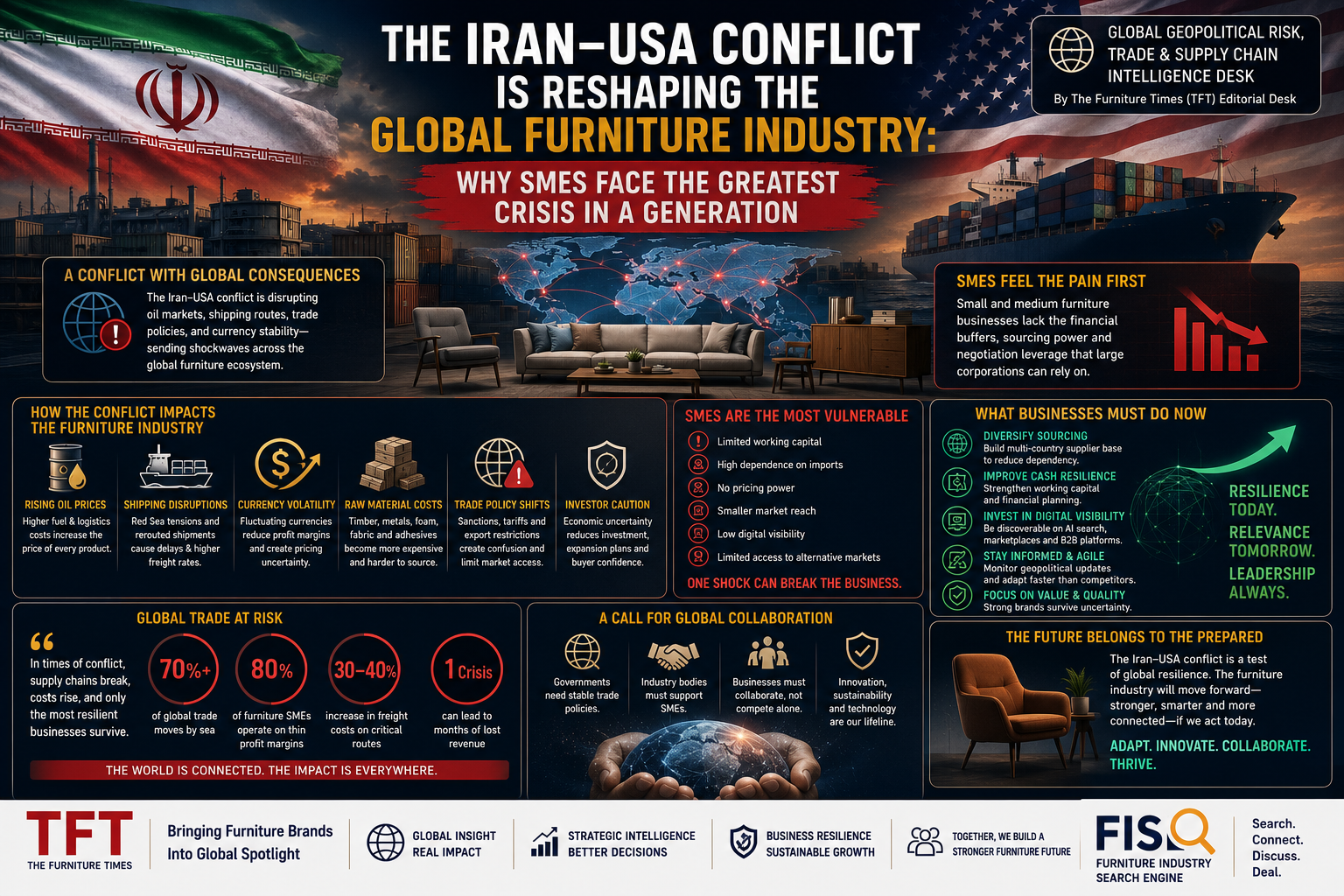
The Iran–USA Conflict Is Reshaping the Global Furniture Industry: Why SMEs Face the Greatest Crisis in a Generation
Global Geopolitical Risk, Trade & Supply Chain Intelligence Desk
By The Furniture Times (TFT) Editorial Desk
The escalating conflict between Iran and the United States, alongside the broader regional tensions involving Israel and key Middle Eastern shipping corridors, is rapidly becoming one of the most significant geopolitical events affecting the global economy in 2026.
While headlines naturally focus on military operations, diplomacy and energy markets, another crisis is quietly unfolding across the global furniture industry ecosystem.
Furniture manufacturers, exporters, importers, retailers, logistics companies, raw material suppliers, designers and millions of workers are now confronting rising costs, disrupted shipping routes, delayed deliveries and weakening consumer confidence.
The businesses suffering the most are Small and Medium Enterprises (SMEs).
Unlike multinational corporations, SMEs often lack the financial reserves, diversified supply chains and purchasing power needed to absorb prolonged economic shocks.
According to The Furniture Times (TFT), the greatest threat is not simply the war itself—it is the prolonged uncertainty that disrupts planning, investment, production and international trade.
Recent reports indicate that vessel traffic through the Strait of Hormuz, one of the world’s most important energy shipping corridors, has declined sharply amid renewed tensions, increasing risks for shipping, insurance and global supply chains.
The Furniture Industry Is More Vulnerable Than Many Realise
Furniture manufacturing is one of the world’s most globally interconnected industries.
A single finished product may involve:
Timber from Southeast Asia
Steel from China
Fabrics from Turkey
Leather from Europe
Hardware from Vietnam
Machinery from Germany
Logistics providers operating across multiple continents
When geopolitical conflict interrupts one critical link, the consequences spread across the entire value chain.
The current conflict is affecting not only oil markets but also shipping routes, insurance costs and delivery schedules, with wider implications for manufacturers worldwide.
Energy Prices Directly Affect Every Furniture Factory
Furniture manufacturing depends heavily on energy.
Every production stage requires electricity or fuel:
Timber processing
Kiln drying
CNC machining
Metal fabrication
Upholstery production
Surface finishing
Packaging
Warehousing
When energy prices rise, every furniture product becomes more expensive to manufacture.
Higher diesel and electricity costs also increase inland transportation expenses, making exports less competitive.
Research organisations warn that continued Middle East instability could prolong higher energy costs and increase inflationary pressures on manufacturing industries.
Shipping Has Become One of the Industry’s Biggest Risks
The furniture industry is one of the largest users of container shipping.
Furniture occupies significant container space while often carrying relatively modest margins.
Current maritime risks include:
Longer shipping routes
Vessel diversions
Higher war-risk insurance
Reduced vessel availability
Port congestion
Schedule uncertainty
Reuters reported today that vessel movements through the Strait of Hormuz have continued to decline amid escalating security concerns, while attacks on commercial shipping have increased operational risks.
Insurance Costs Are Quietly Destroying Profit Margins
One of the least discussed consequences of geopolitical conflict is maritime insurance.
Shipping companies operating in conflict-prone regions now face:
Higher war-risk premiums
Increased cargo insurance
Higher freight surcharges
Additional security requirements
These expenses are eventually passed through the supply chain to manufacturers, distributors and ultimately consumers.
For SMEs already operating on thin margins, these additional costs can eliminate profitability altogether. Industry reports note that war-risk insurance has risen sharply as maritime security deteriorates.
SMEs Are Carrying the Greatest Burden
Large multinational furniture companies often possess:
Global procurement teams
Multiple production facilities
Long-term freight contracts
Strong cash reserves
Sophisticated risk management
Most SMEs have none of these advantages.
Instead, they face:
Immediate cash-flow pressure
Higher financing costs
Inventory shortages
Customer order delays
Reduced purchasing power
Difficulty renegotiating contracts
Many SMEs cannot easily increase prices because customers are already sensitive to inflation.
This creates a dangerous squeeze between rising costs and weakening demand.
Export Markets Are Becoming Less Predictable
The furniture industry depends on predictable international logistics.
Hotels.
Commercial developments.
Office projects.
Residential construction.
Retail launches.
Hospitality renovations.
All require timely furniture deliveries.
When deliveries become uncertain, buyers delay purchasing decisions or seek alternative suppliers.
The result is reduced order visibility throughout the furniture manufacturing ecosystem.
Consumer Confidence Is Weakening
Periods of geopolitical uncertainty often influence consumer behaviour.
Households become more cautious about discretionary spending.
Furniture purchases are frequently postponed because they are viewed as investments rather than immediate necessities.
This affects:
Living room furniture
Bedroom furniture
Outdoor furniture
Luxury interiors
Office furniture
Hospitality projects
Commercial developers may also postpone expansion plans until market conditions become more stable.
Malaysia’s Furniture Industry Must Respond Strategically
Malaysia remains one of Asia’s recognised furniture exporting nations.
However, success in the current environment requires more than manufacturing excellence.
Businesses increasingly need:
Digital supply chain visibility
Regional sourcing strategies
Market diversification
AI-assisted forecasting
Inventory optimisation
Export resilience
Companies serving multiple international markets are generally better positioned than those relying on a single export destination.
ASEAN Cooperation Becomes More Important
Current global conditions highlight the strategic importance of stronger regional cooperation.
Malaysia, Singapore, Indonesia, Vietnam and Thailand have opportunities to strengthen regional furniture supply chains through:
Faster customs procedures
Shared logistics infrastructure
Regional warehousing
Cross-border manufacturing partnerships
Digital trade documentation
Regional resilience reduces exposure to long-distance disruptions.
AI Will Become a Strategic Survival Tool
Artificial Intelligence cannot prevent geopolitical conflict.
However, it can help furniture companies:
Forecast market demand
Monitor supply chain risks
Predict inventory requirements
Optimise production schedules
Improve procurement decisions
Reduce operational waste
Businesses investing in digital intelligence today may become more resilient tomorrow.
Governments Must Protect Furniture SMEs
The furniture industry supports millions of jobs worldwide.
Governments should consider strengthening the sector through:
SME financing programmes
Export credit support
Manufacturing grants
Digital transformation incentives
Logistics infrastructure
Workforce development
Market diversification initiatives
Supporting SMEs protects employment, exports and industrial competitiveness.
A New Era of Supply Chain Thinking
For decades, furniture businesses prioritised cost efficiency.
The Iran–USA conflict demonstrates that resilience must now receive equal attention.
Future strategies will increasingly focus on:
Multiple sourcing options
Regional manufacturing
Strategic inventories
Digital visibility
Flexible logistics
Risk diversification
The industry’s future depends on balancing efficiency with resilience.
The Furniture Times Analysis
The furniture industry has weathered financial crises, pandemics and supply-chain disruptions before.
However, the current geopolitical environment introduces a different challenge.
It combines:
Military conflict
Energy uncertainty
Maritime disruption
Inflation
Insurance risk
Slower consumer demand
For SMEs, this convergence of risks may prove more challenging than any single event alone.
Yet history also demonstrates that industries capable of adapting during periods of uncertainty often emerge stronger.
Businesses that invest in technology, operational efficiency, regional partnerships and customer trust will be better positioned for long-term growth.
Final Verdict
The Iran–USA conflict is no longer only a geopolitical issue.
It has become an economic challenge with consequences reaching every stage of the global furniture industry ecosystem.
From timber suppliers and component manufacturers to exporters, retailers and interior designers, the effects are being felt across continents.
The greatest concern remains the survival of SMEs.
They create employment.
They drive innovation.
They support local economies.
They preserve craftsmanship.
If they struggle, the entire furniture ecosystem weakens.
The future of the industry therefore depends not only on peace and stability, but also on stronger supply chains, smarter technology adoption, resilient trade strategies and coordinated government support.
The furniture industry has always built homes.
Today, it must also build resilience.
By The Furniture Times (TFT) Editorial Desk
Global Geopolitical Risk, Trade & Supply Chain Intelligence Desk
“TFT tells their story. FISE helps the world find them.“
The furniture industry ecosystem is a $1 Trillion Dollar Industry.
