Digital Twins and Smart Lighting Infrastructure
By The Furniture Times (TFT) | Indoor & Outdoor Lighting | Smart Lighting & AI
The Digital Copy That Is Transforming Real Buildings, Smarter Lighting, and the Future of Connected Spaces
Imagine being able to test a new lighting design for a shopping mall before a single light fixture is installed. Picture a facilities manager identifying a lighting fault in a 40-storey office tower before occupants even notice it. Consider a hotel operator adjusting lighting strategies across hundreds of guest rooms based on virtual simulations rather than costly trial and error.
This is the power of Digital Twins.
Once considered a technology used mainly in aerospace and advanced manufacturing, digital twins are now entering the world of smart buildings and intelligent lighting. They are changing how architects design, engineers plan, facility managers operate, and businesses maintain commercial properties.
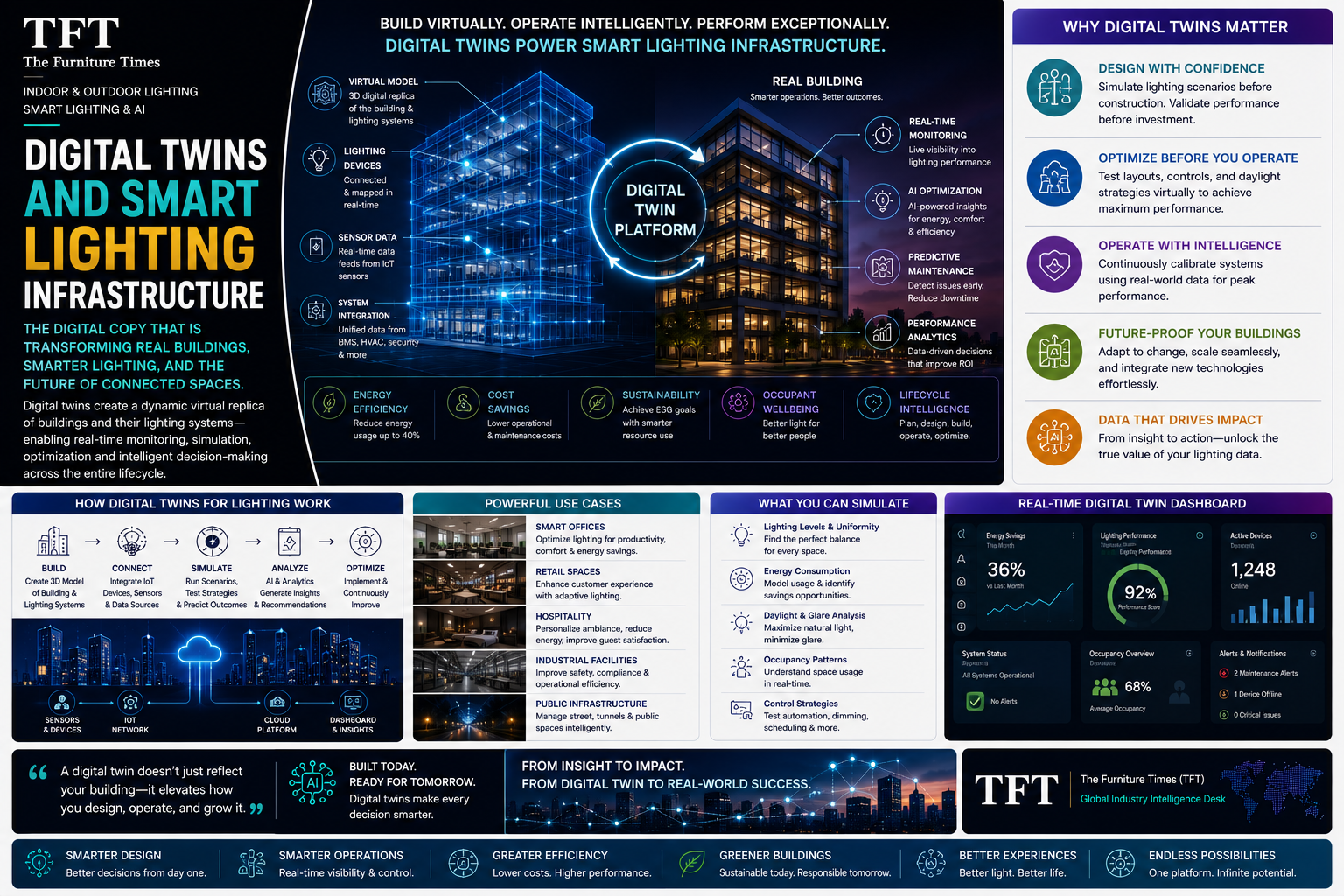
A digital twin is much more than a three-dimensional building model. It is a living digital replica of a physical asset that continuously receives real-time information from connected devices, sensors, lighting systems, and building management platforms. As conditions change in the real world, the digital version updates automatically, allowing owners and managers to monitor performance, predict problems, test improvements, and make informed decisions without disrupting daily operations.
For the global furniture industry ecosystem, this innovation represents a new chapter in digital transformation. Furniture manufacturers, lighting companies, architects, interior designers, developers, hospitality operators, retailers, and technology providers now have an opportunity to collaborate in creating buildings that are not only smart but also capable of learning, adapting, and improving over time.
The future of lighting is no longer built solely with physical infrastructure.
It is designed, monitored, and optimised in both the physical and digital worlds.
What Is a Digital Twin?
Think of a digital twin as the virtual heartbeat of a building.
It mirrors the physical environment using continuous streams of real-time information gathered from connected systems.
Lighting fixtures, occupancy sensors, daylight sensors, energy meters, HVAC equipment, security systems, elevators, and other smart devices constantly send information to the digital twin.
The virtual model reflects exactly what is happening inside the building.
Instead of relying on periodic inspections or static building plans, owners gain a living platform that evolves every second.
It allows decision-makers to understand not only what is happening but also why it is happening.
Lighting Becomes More Than Illumination
Lighting systems already generate enormous amounts of information.
With a digital twin, that information becomes meaningful.
Facility managers can visualise:
- Energy consumption across every floor.
- Lighting performance in real time.
- Occupancy trends.
- Areas receiving excessive daylight.
- Underutilised workspaces.
- Equipment health.
- Maintenance requirements.
- Emergency lighting readiness.
- Space utilisation.
- Building-wide operational efficiency.
Instead of reacting to problems, organisations begin anticipating them.
Designing Better Buildings Before Construction Begins
One of the greatest strengths of digital twins lies in planning.
Architects and lighting designers can simulate different lighting layouts before construction starts.
Questions that once required expensive physical testing can now be answered digitally.
For example:
How much natural daylight enters the building during different seasons?
Will certain workstations experience glare?
Are lighting levels sufficient for collaborative work?
Can energy consumption be reduced without affecting comfort?
How will lighting interact with interior furniture layouts?
Digital twins allow designers to experiment, improve, and optimise before investing in physical infrastructure.
Smart Offices That Continuously Improve
Modern workplaces rarely remain unchanged.
Departments grow, teams relocate, meeting spaces evolve, and hybrid working models reshape office layouts.
Digital twins help organisations understand how people actually use these environments.
Lighting systems combined with occupancy data reveal:
- Frequently used workspaces.
- Underutilised meeting rooms.
- Peak office hours.
- Collaborative zones.
- Quiet focus areas.
- Employee movement.
- Flexible workspace demand.
- Energy waste.
- Maintenance priorities.
- Future space planning.
Instead of designing offices based on assumptions, businesses can design them using evidence.
Hospitality Is Becoming More Predictive
Hotels operate thousands of lighting fixtures every day.
Managing them manually across multiple properties is increasingly difficult.
Digital twins allow hotel operators to monitor lighting performance across:
- Guest rooms.
- Corridors.
- Restaurants.
- Conference facilities.
- Spa environments.
- Outdoor landscapes.
- Reception areas.
- Event venues.
- Parking facilities.
- Emergency systems.
Managers gain the ability to identify inefficiencies, predict maintenance, and improve guest experiences before issues become visible.
Furniture Joins the Digital Ecosystem
Furniture is also becoming part of intelligent buildings.
Connected office desks, collaborative workstations, hospitality furniture, display cabinets, shelving systems, wardrobes, and retail fixtures increasingly integrate lighting, occupancy sensors, and IoT connectivity.
Digital twins provide context for how these products are actually used.
Manufacturers can better understand:
- Customer behaviour.
- Product performance.
- Workspace interaction.
- Lighting preferences.
- Maintenance needs.
- Occupancy patterns.
- Environmental conditions.
- Space efficiency.
- User comfort.
- Future product improvements.
Furniture evolves from a physical product into a connected source of operational intelligence.
Artificial Intelligence Unlocks the Full Potential
Digital twins become dramatically more valuable when combined with Artificial Intelligence.
AI continuously analyses incoming information to identify trends and opportunities.
Instead of waiting for human interpretation, intelligent systems can:
- Predict lighting failures.
- Recommend energy-saving adjustments.
- Detect unusual occupancy.
- Improve maintenance schedules.
- Optimise lighting scenes.
- Balance natural and artificial lighting.
- Support emergency planning.
- Improve employee wellbeing.
- Enhance customer experiences.
- Continuously optimise building performance.
Buildings become capable of learning from their own operations.
Sustainability Through Simulation
Environmental responsibility is becoming a major priority across commercial real estate.
Digital twins allow organisations to evaluate sustainability strategies before implementing them.
They can simulate:
- Reduced lighting schedules.
- Renewable energy integration.
- Occupancy-based automation.
- Daylight harvesting.
- LED upgrades.
- Carbon reduction initiatives.
- Building retrofits.
- Operational changes.
- Maintenance planning.
- Long-term environmental impact.
Instead of making costly assumptions, businesses can make informed decisions backed by digital evidence.
Opportunities Across the Furniture Industry Ecosystem
Digital twins are opening new opportunities for:
- Furniture manufacturers.
- Lighting manufacturers.
- Architects.
- Interior designers.
- Smart building consultants.
- Property developers.
- Hospitality operators.
- Healthcare providers.
- Retail businesses.
- Technology innovators.
As buildings become increasingly connected, companies that integrate furniture, lighting, AI, IoT, and digital twin technologies will help shape the next generation of intelligent environments.
Challenges the Industry Must Address
Despite enormous potential, digital twin technology also presents challenges.
These include:
- High-quality data collection.
- Cybersecurity.
- Data privacy.
- Integration with legacy buildings.
- Skilled workforce availability.
- Standardisation.
- Cloud infrastructure.
- Long-term software maintenance.
- Interoperability.
- Investment planning.
Success will depend on collaboration between technology providers, building owners, and industry professionals.
Tomorrow’s Buildings Will Exist in Two Worlds
The commercial buildings of the future will operate simultaneously in physical and digital environments.
Every lighting fixture, sensor, workspace, meeting room, hotel suite, showroom, and retail display will contribute real-time information to a continuously evolving digital twin.
Building owners will no longer rely solely on inspections or monthly utility reports.
They will make decisions based on live operational intelligence.
This represents one of the most important shifts in building management since the introduction of electricity itself.
The Future of Lighting Has a Digital Reflection
Digital twins are changing the way lighting infrastructure is designed, monitored, maintained, and continuously improved.
For the global furniture industry ecosystem, they offer an extraordinary opportunity to connect furniture, lighting, architecture, Artificial Intelligence, and real-time analytics into a single intelligent ecosystem.
The buildings of tomorrow will not simply react to change.
They will predict it.
They will test solutions before implementing them.
They will continuously learn from every occupant, every sensor, and every beam of light.
Because the future of smart lighting is no longer confined to the ceiling.
It now has a living digital reflection that helps every physical space perform better than the day before.
The Furniture Times (TFT) & Furniture Industry Search Engine (FISE)
“TFT tells their story. FISE helps the world find them.”
“FurniReviewology helps the world trust them.”
The furniture industry ecosystem is a $1 trillion industry ecosystem.