
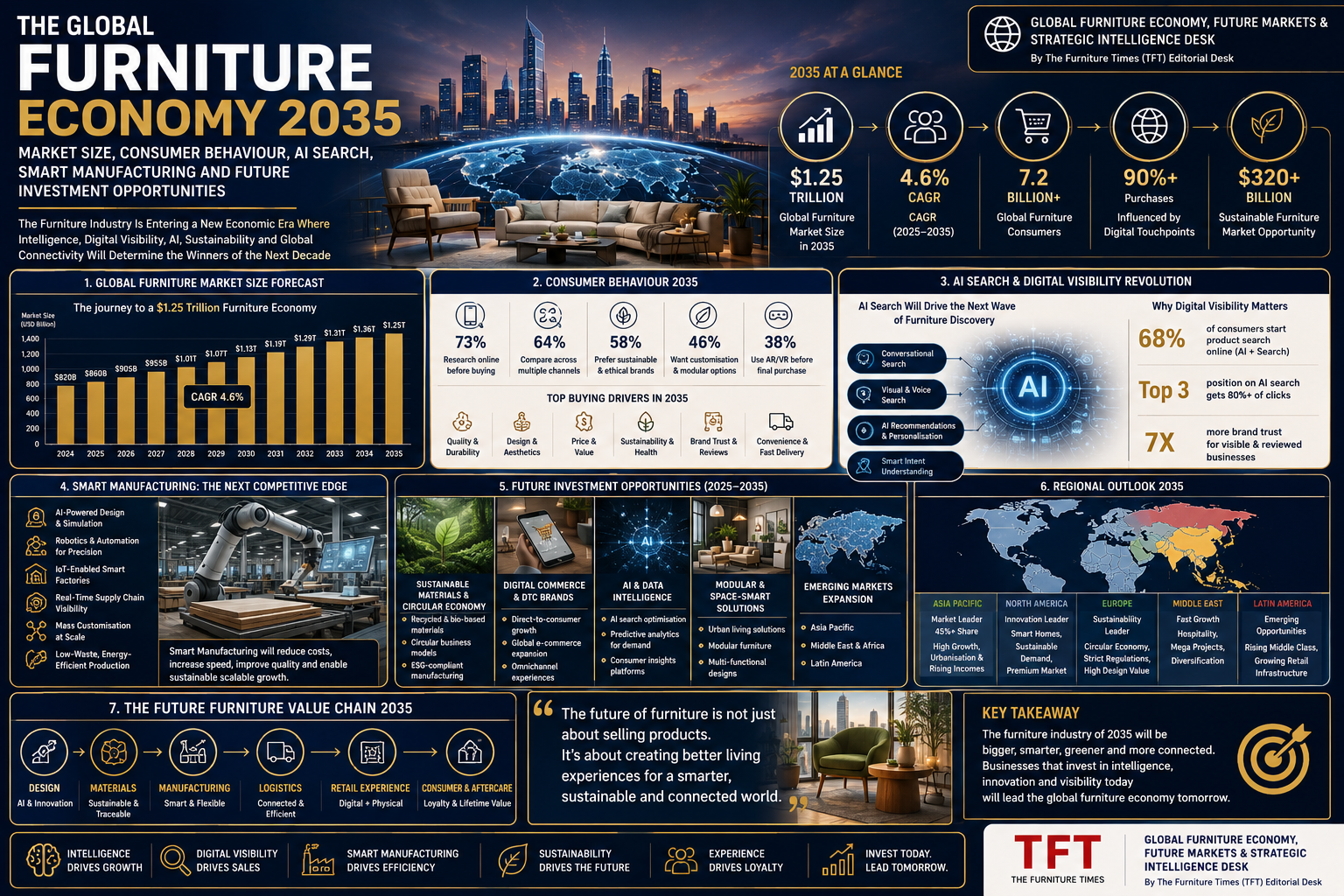
The Global Furniture Economy 2035: Market Size, Consumer Behaviour, AI Search, Smart Manufacturing and Future Investment Opportunities
The Furniture Industry Is Entering a New Economic Era Where Intelligence, Digital Visibility, AI, Sustainability and Global Connectivity Will Determine the Winners of the Next Decade
Global Furniture Economy, Future Markets & Strategic Intelligence Desk
By The Furniture Times (TFT) Editorial Desk
The global furniture industry is approaching one of the most transformative decades in its history.
For generations, furniture businesses competed primarily through craftsmanship, manufacturing capacity, pricing and distribution.
Today, those foundations remain essential—but they are no longer sufficient.
The furniture economy is evolving into a highly connected ecosystem where manufacturing, digital commerce, artificial intelligence, logistics, sustainability, construction, hospitality, finance, property development, consumer intelligence and global trade are becoming deeply interconnected.
By 2035, the furniture industry will not simply manufacture products.
It will manufacture experiences, data, visibility, sustainability, operational intelligence and customer trust.
The companies that succeed will no longer be those with the largest factories alone.
They will be the companies that combine:
- Manufacturing excellence
- AI-powered operations
- Digital discoverability
- Global supply chains
- Consumer intelligence
- Sustainable production
- Smart logistics
- Brand authority
- Search visibility
- Long-term partnerships
The furniture industry is moving from the Industrial Economy into the Intelligence Economy.
The Global Furniture Economy Is Becoming a Multi-Trillion-Dollar Ecosystem
The furniture sector should no longer be viewed only as furniture manufacturing.
Its economic influence now extends across:
- Forestry
- Timber processing
- Metal fabrication
- Textiles
- Foam
- Plastics
- Glass
- Stone
- Chemicals
- Machinery
- Robotics
- Interior design
- Architecture
- Construction
- Hospitality
- Healthcare
- Education
- Real estate
- Logistics
- Warehousing
- Digital commerce
- Artificial intelligence
- Finance
- Tourism
- Circular economy
- Recycling
- Workforce development
The industry’s economic footprint reaches almost every nation and nearly every household.
By 2035, value creation will increasingly come from connected ecosystems rather than isolated businesses.
Urbanisation Will Continue Driving Demand
Global urban populations continue to grow.
Cities are expanding.
New housing developments continue to emerge.
Commercial districts continue evolving.
Industrial parks are increasing.
Mixed-use developments are becoming standard.
Every completed building creates furniture demand.
Urbanisation will remain one of the strongest long-term drivers of furniture manufacturing throughout the next decade.
Housing Will Remain the Largest Demand Generator
Residential housing will continue generating demand through:
- Apartments
- Condominiums
- Villas
- Townhouses
- Senior living
- Student housing
- Mixed-use developments
Every housing lifecycle creates multiple furniture opportunities:
- Initial furnishing
- Renovation
- Replacement
- Expansion
- Rental turnover
- Property resale
The furniture lifecycle will become increasingly important.
Hospitality Will Become a Strategic Growth Engine
Hotels.
Resorts.
Restaurants.
Cafés.
Serviced apartments.
Branded residences.
Wellness destinations.
Entertainment venues.
These sectors are expected to remain among the fastest-growing commercial furniture markets.
Guest experience increasingly depends upon furniture quality.
Hospitality will reward manufacturers capable of delivering:
- Commercial durability
- Customisation
- Sustainability
- Fast installation
- Replacement support
Offices Will Continue Evolving
Workplaces will continue changing.
Future offices will emphasise:
- Collaboration
- Flexibility
- Wellness
- Technology
- Hybrid work
- Modular layouts
Office furniture will increasingly become adaptive rather than fixed.
Smart Manufacturing Will Redefine Productivity
Factories will increasingly adopt:
- Robotics
- Automation
- AI-assisted production
- Predictive maintenance
- Digital twins
- Machine vision
- Automated quality inspection
- Real-time production monitoring
Manufacturing competitiveness will increasingly depend upon data.
Factories that understand production intelligence will outperform factories relying only on labour efficiency.
AI Will Become a Business Partner
Artificial Intelligence will influence every stage of the furniture economy.
Design.
Forecasting.
Manufacturing.
Marketing.
Customer service.
Supply chain.
Procurement.
Pricing.
Maintenance.
Search.
AI will assist rather than replace most professional expertise.
Companies that integrate AI responsibly will improve speed, consistency and decision-making.
AI Search Will Replace Traditional Discovery
Consumers will increasingly ask:
- Which furniture brand is best for apartments?
- Compare sustainable dining tables.
- Recommend commercial outdoor furniture.
- Which manufacturers serve hotels in Southeast Asia?
Traditional keyword searches will increasingly be complemented by conversational AI.
Furniture companies must therefore become AI-readable, not merely searchable.
Structured product information, verified data and authoritative content will become strategic assets.
Digital Visibility Will Become Business Visibility
The future customer journey begins with discovery.
If a company cannot be found through:
- Search engines
- AI assistants
- Industry directories
- Professional platforms
- Trusted media
its commercial opportunities become limited.
Visibility will increasingly determine competitiveness.
Searchability will become infrastructure.
The Rise of Furniture Industry Intelligence
Successful businesses will continuously analyse:
- Consumer behaviour
- Market trends
- Search patterns
- Regional demand
- Material costs
- Competitor positioning
- Investment activity
- Property development
- Hospitality expansion
Data-driven decision-making will become standard.
Consumer Behaviour Will Continue Changing
Consumers increasingly value:
- Convenience
- Trust
- Sustainability
- Personalisation
- Reviews
- Delivery
- Installation
- Transparency
Furniture companies must communicate clearly throughout the buying journey.
Trust will become one of the industry’s strongest competitive assets.
Sustainability Will Move Beyond Compliance
Sustainability will become integrated into everyday business decisions.
Future priorities include:
- Circular manufacturing
- Product repair
- Modular construction
- Material traceability
- Certified timber
- Lower emissions
- Recycling
- Responsible sourcing
Companies that treat sustainability as long-term business strategy rather than marketing will gain competitive advantages.
Circular Furniture Will Expand
The furniture economy will increasingly include:
- Refurbishment
- Restoration
- Reupholstery
- Resale
- Furniture rental
- Component replacement
Product lifespan will become an important commercial metric.
Digital Product Passports
Future furniture products may increasingly include digital records covering:
- Materials
- Manufacturing
- Repairs
- Ownership
- Certifications
- Recycling guidance
These systems improve transparency throughout the product lifecycle.
Smart Materials
Innovation will continue in:
- Lightweight composites
- Performance textiles
- Sustainable foams
- Recycled plastics
- Bio-based materials
- Advanced coatings
Materials will increasingly balance:
- Performance
- Sustainability
- Cost
- Repairability
Mass Customisation
Consumers increasingly expect personalised products without excessive lead times.
Manufacturers will combine:
- Automated production
- Digital configuration
- Modular systems
Mass customisation will become commercially viable for more product categories.
Supply Chains Will Become More Regional
Global trade will remain important.
However, manufacturers will increasingly diversify production.
Regional manufacturing hubs will reduce:
- Transport risk
- Lead times
- Supply disruption
Balanced global and regional supply chains will improve resilience.
Logistics Will Become Strategic
Furniture logistics increasingly determines customer satisfaction.
Future logistics priorities include:
- Faster delivery
- Better packaging
- Installation
- Reverse logistics
- Refurbishment collection
- Component replacement
The customer judges the entire experience—not simply the product.
Furniture as a Service
Some commercial customers may increasingly purchase:
- Leasing
- Subscription
- Lifecycle management
- Maintenance contracts
Furniture revenue models will diversify beyond one-time sales.
Workforce Transformation
The future workforce will require:
- AI literacy
- Digital manufacturing
- Robotics
- Sustainability
- Data analysis
- Customer intelligence
Continuous learning will become essential.
Investment Opportunities Through 2035
High-growth opportunities include:
- Smart manufacturing
- AI software
- Digital marketplaces
- Hospitality furniture
- Outdoor furniture
- Healthcare furniture
- Senior living
- Student housing
- Circular economy
- Furniture logistics
- Search platforms
- Industry intelligence
- Smart factories
- Sustainable materials
- Robotics
Investment will increasingly flow toward technology-enabled businesses.
The Future Role of Retail
Retailers will evolve into:
- Experience centres
- Design studios
- Fulfilment hubs
- Consultation spaces
Omnichannel commerce will dominate.
Online and physical stores will work together.
The Future of Manufacturing Regions
Asia will remain a major production hub.
Europe will continue leading in premium design, engineering and sustainability.
North America will strengthen regional manufacturing and automation.
The Middle East will drive hospitality and luxury demand.
Africa will become an increasingly important manufacturing and consumer market.
Latin America will continue expanding residential and commercial demand.
Regional diversification will strengthen global resilience.
Furniture Tourism
Furniture tourism will emerge as an important economic opportunity.
Manufacturing cities can attract:
- Buyers
- Designers
- Architects
- Investors
- Students
- Tourists
Factory visits.
Design districts.
Furniture museums.
Craft villages.
Innovation centres.
Furniture tourism connects manufacturing with hospitality and education.
Property Intelligence
Furniture demand forecasting will increasingly analyse:
- Housing permits
- Hotel pipelines
- Office construction
- Retail development
- Industrial expansion
Property data becomes furniture intelligence.
Healthcare and Ageing
Global ageing populations create demand for:
- Accessible furniture
- Healthcare environments
- Assisted living
- Wellness products
- Ergonomic design
Demographic change creates long-term market stability.
Education
Educational institutions increasingly require:
- Flexible classrooms
- Collaborative learning
- Student housing
- Innovation spaces
Education remains a strategic commercial sector.
Hospitality Experience Economy
Hotels increasingly compete through:
- Design
- Comfort
- Authenticity
- Wellness
- Outdoor experiences
Furniture plays a central role in guest satisfaction.
The Rise of Furniture Intelligence Platforms
Industry platforms will increasingly combine:
- News
- Market research
- Company directories
- Product discovery
- AI search
- Buyer matching
- Trade intelligence
- Analytics
Information itself becomes commercial infrastructure.
The Search Economy
If consumers cannot discover manufacturers, products or suppliers, commercial opportunities decline.
Search platforms become economic infrastructure.
Verified business listings become digital assets.
Visibility becomes measurable.
SMEs Will Have New Opportunities
Digital platforms reduce traditional barriers.
Small manufacturers can increasingly compete globally through:
- Search visibility
- AI discovery
- Content
- Reviews
- Direct relationships
Technology democratises opportunity.
Financing Innovation
Future financing may increasingly support:
- Factory automation
- Sustainable upgrades
- AI adoption
- Digital transformation
- Export expansion
Financial innovation will accelerate industry modernisation.
Risk Management
Future furniture companies should prepare for:
- Climate change
- Supply disruptions
- Cybersecurity
- Labour shortages
- Raw material volatility
- Trade policy changes
Resilience becomes strategic.
Future Consumer Expectations
Consumers will increasingly expect:
- Personalisation
- Transparency
- Faster delivery
- Ethical sourcing
- Digital experiences
- Long-term service
Meeting expectations becomes competitive advantage.
Strategic Priorities for Manufacturers
Manufacturers should:
- Adopt AI responsibly.
- Invest in automation.
- Improve sustainability.
- Strengthen digital visibility.
- Develop AI-ready product data.
- Expand export capabilities.
- Improve logistics.
- Build lifecycle services.
- Measure consumer intelligence.
- Partner across the ecosystem.
Strategic Priorities for Retailers
Retailers should:
- Strengthen omnichannel commerce.
- Improve customer experience.
- Offer installation.
- Build financing options.
- Invest in digital content.
- Develop AI-assisted customer support.
- Improve search visibility.
- Build loyalty programmes.
- Publish authentic reviews.
- Support after-sales services.
Strategic Priorities for Governments
Governments can strengthen the furniture economy by:
- Supporting SME digitalisation.
- Investing in vocational skills.
- Encouraging sustainable manufacturing.
- Promoting exports.
- Developing furniture clusters.
- Supporting innovation.
- Improving logistics infrastructure.
- Encouraging responsible forestry.
- Promoting furniture tourism.
- Building international partnerships.
Strategic Priorities for Investors
Investors should monitor:
- Consumer trends
- AI adoption
- Hospitality growth
- Urbanisation
- Digital commerce
- Manufacturing automation
- Sustainable materials
- Search platforms
- Property development
- Regional manufacturing
Future investment success depends upon long-term structural trends.
The Global Furniture Economy Is Becoming an Intelligence Economy
The next decade will reward companies that think beyond products.
The winners of 2035 will connect:
Manufacturing.
Technology.
People.
Data.
Property.
Hospitality.
Sustainability.
Artificial Intelligence.
Consumer behaviour.
Global trade.
Search.
Investment.
The furniture industry is no longer simply about producing chairs, tables, sofas or wardrobes.
It is becoming one of the world’s most integrated economic ecosystems.
The companies that understand this transformation today will define the industry’s future tomorrow.
By 2035, competitive advantage will no longer belong only to those who manufacture furniture. It will belong to those who combine intelligence, innovation, digital visibility, responsible manufacturing and global collaboration to create lasting value across the entire furniture ecosystem.
