
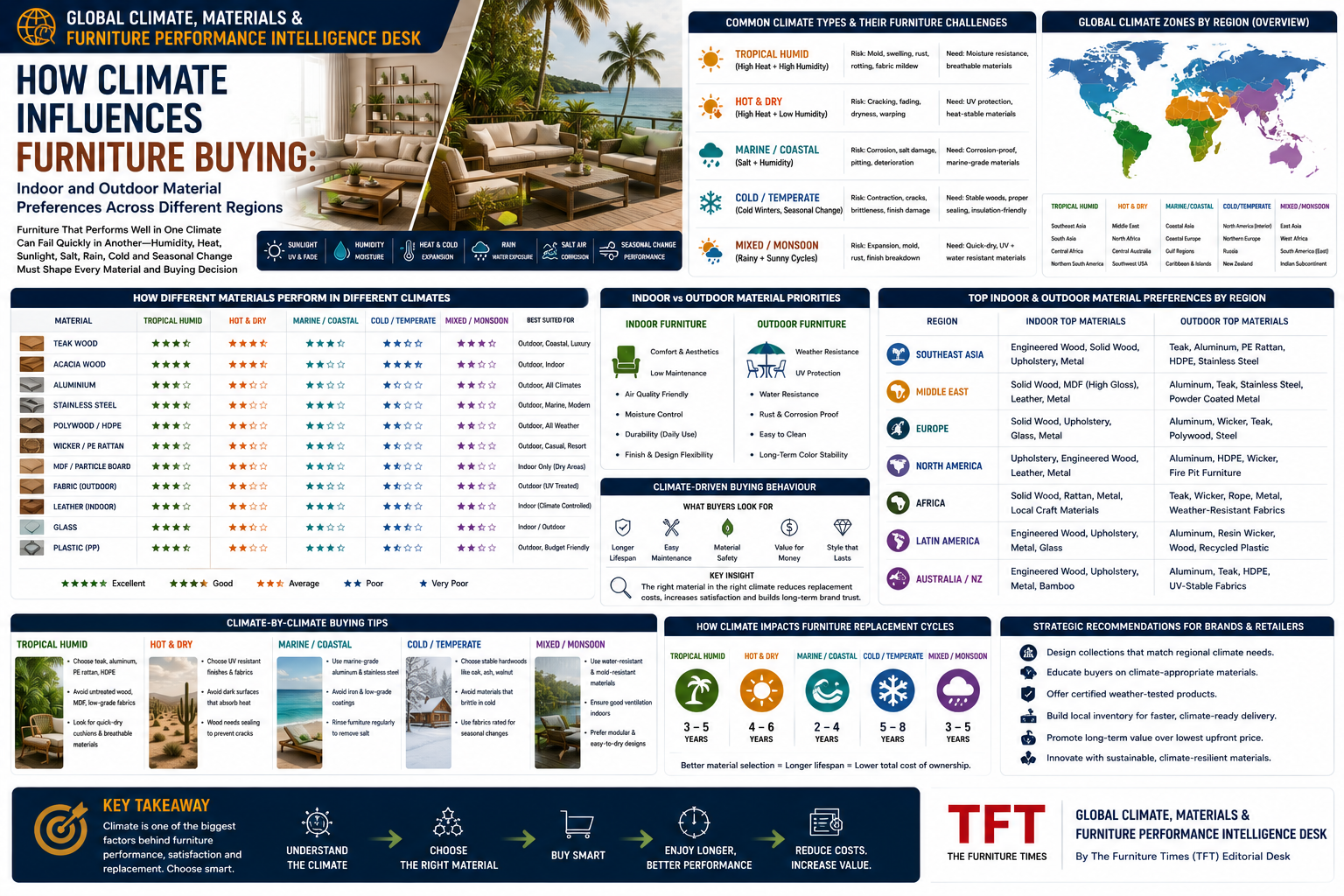
How Climate Influences Furniture Buying: Indoor and Outdoor Material Preferences Across Different Regions
Furniture That Performs Well in One Climate Can Fail Quickly in Another—Humidity, Heat, Sunlight, Salt, Rain, Cold and Seasonal Change Must Shape Every Material and Buying Decision
Global Climate, Materials & Furniture Performance Intelligence Desk
By The Furniture Times (TFT) Editorial Desk
Climate is one of the most important—but frequently underestimated—forces influencing global furniture demand.
Consumers often begin their furniture search by examining style, colour, comfort, dimensions and price. Yet the long-term success of the purchase may depend on environmental conditions that are not immediately visible in the showroom.
A solid-wood dining table manufactured for a dry, air-conditioned market may react differently when installed in a humid tropical home.
A steel outdoor chair that performs well in a sheltered urban courtyard may corrode rapidly beside the sea.
A dark metal table may become uncomfortably hot under intense desert sunlight.
A low-quality plastic chair may become brittle after repeated ultraviolet exposure.
An outdoor sofa with thick cushions may remain damp for long periods in a rainy climate if the foam, covers and frame do not support drainage.
Indoor furniture can also be affected by climate.
High humidity, condensation, dry heating, temperature fluctuations, flooding, dust, mould, insects and salt-laden air can influence:
- Timber movement
- Panel swelling
- Adhesive performance
- Metal corrosion
- Fabric fading
- Cushion hygiene
- Finish durability
- Hardware operation
- Furniture stability
- Product lifespan
Furniture therefore cannot be classified simply as “indoor” or “outdoor.”
The more useful questions are:
- In which climate will it be used?
- Will the space be naturally ventilated or air-conditioned?
- Is the product fully exposed, partially sheltered or enclosed?
- Is the property close to the coast?
- How much direct sunlight will reach the product?
- Will rainwater drain away quickly?
- Can cushions be stored?
- Which maintenance services are available locally?
- Can replacement parts be obtained?
Climate intelligence should influence every stage of the furniture ecosystem:
- Material selection
- Product design
- Manufacturing
- Drying and conditioning
- Finishing
- Packaging
- Warehousing
- Transportation
- Installation
- Maintenance
- Warranty
- Consumer education
The global furniture industry must move beyond universal claims such as “weatherproof,” “all-weather,” “water-resistant” and “suitable for every climate.”
No material performs identically in every environment.
The strongest furniture products are not those marketed as indestructible. They are those engineered honestly for clearly defined conditions.
Climate Is Part of Furniture Quality
Furniture quality is commonly judged through:
- Material
- Construction
- Workmanship
- Comfort
- Appearance
- Warranty
Climate suitability must be added to that list.
A well-made product can still fail when it is used in conditions for which it was never designed.
For example:
- Interior-grade engineered wood may swell after repeated moisture exposure.
- Untreated timber may deteriorate when water remains trapped.
- Mild-steel hardware may corrode in coastal environments.
- Some fabrics may fade rapidly in direct sunlight.
- Foam may retain moisture and develop odour when drainage is poor.
- Timber joints may loosen or crack when moisture levels change substantially.
Wood naturally exchanges moisture with surrounding air. Its moisture content moves toward equilibrium with the temperature and relative humidity of the environment, and those changes can cause shrinking or swelling. Correct drying, storage and conditioning can reduce dimensional problems, but protective coatings slow moisture movement rather than eliminating it completely.
This means furniture should be designed for the environment in which it will actually be used—not merely the environment in which it was manufactured.
The Major Climate Environments Affecting Furniture
A practical global furniture strategy should consider at least seven climate environments.
1. Hot and Humid Tropical Climates
Common across parts of:
- Southeast Asia
- South Asia
- Central Africa
- West Africa
- Central America
- The Caribbean
- Northern South America
- Pacific islands
These regions experience combinations of:
- High humidity
- Heavy rainfall
- Warm temperatures
- Strong sunlight
- Mould risk
- Insect activity
- Slow drying
- Coastal exposure in many markets
FAO describes hot-humid tropical conditions as environments where relative humidity can remain above 75%, creating significant moisture-management challenges for timber and buildings.
2. Hot and Dry or Desert Climates
Common across parts of:
- The Middle East
- North Africa
- Central Asia
- Australia
- Southwestern United States
- Northern Mexico
These environments create challenges involving:
- Extreme heat
- Strong UV exposure
- Dust
- Dry air
- Rapid temperature change
- Surface heating
- Occasional intense rainfall
3. Coastal and Marine Climates
Found along coastlines worldwide.
Key conditions include:
- Salt-laden air
- High humidity
- Strong wind
- UV exposure
- Rain
- Sand
- Chlorine around pools
- Corrosion risk
Coastal furniture may require a different specification from furniture used only a few kilometres inland.
4. Temperate Seasonal Climates
Common across:
- Europe
- North America
- East Asia
- Southern Australia
- New Zealand
- Southern South America
These areas experience seasonal changes involving:
- Warm summers
- Cold winters
- Rain
- Snow
- Freeze-thaw cycles
- Indoor heating
- Changing humidity
Furniture may move between outdoor use and seasonal storage.
5. Cold and Northern Climates
Common across:
- Canada
- Northern Europe
- Russia
- Northern United States
- Mountain regions
Furniture must account for:
- Freezing temperatures
- Snow loads
- Ice
- indoor heating
- Dry winter air
- Condensation
- Seasonal storage
6. High-Altitude and Mountain Climates
These environments may combine:
- Strong UV exposure
- Cold nights
- Large temperature changes
- Snow
- Dry air
- Moisture from fog or rain
- Difficult logistics
7. Flood-Prone and Extreme-Weather Regions
Furniture demand is increasingly influenced by:
- Flooding
- storms
- Hurricanes
- Cyclones
- Extreme rainfall
- Heatwaves
- Wildfire smoke
- Unpredictable seasons
These risks are creating interest in furniture that is lighter, movable, elevated, replaceable or easier to clean after an event.
Tropical Climate Furniture: Moisture Is the Main Enemy
Hot and humid climates create one of the most demanding environments for both indoor and outdoor furniture.
Moisture can enter furniture through:
- Humid air
- Rain
- Wet floors
- Condensation
- Cleaning
- Damp walls
- Poor ventilation
- Ground contact
- Cushion absorption
Excess moisture can contribute to staining, coating failure, timber decay, mould, swelling and loss of structural performance when the product is not properly designed or protected.
Indoor Tropical Furniture Preferences
Consumers in tropical regions commonly value:
- Moisture-resistant materials
- Easy-clean surfaces
- Elevated legs
- Ventilation beneath furniture
- Mould-resistant upholstery
- Removable covers
- Corrosion-resistant hardware
- Furniture that dries quickly
- Materials that do not trap heat
Popular indoor materials may include:
- Properly dried solid timber
- Good-quality plywood
- Moisture-resistant engineered panels
- Aluminium
- Powder-coated metal
- Rattan and cane in appropriate conditions
- Performance upholstery
- Laminated surfaces
Outdoor Tropical Furniture Preferences
Outdoor buyers frequently compare:
- Teak
- aluminium
- synthetic rope
- synthetic wicker
- stainless steel
- recycled plastic
- performance textiles
The correct product must manage both rainfall and the period after rainfall.
Water should not remain trapped inside:
- Seat frames
- Tubes
- cushion bases
- woven materials
- hardware connections
- table surfaces
Drainage holes, ventilated structures and quick-drying cushion systems are therefore essential.
Wood Furniture in Humid Regions
Wood remains highly desirable in tropical furniture markets because it offers:
- Natural appearance
- Warmth
- craftsmanship
- repairability
- cultural relevance
- premium value
However, the species name alone does not determine performance.
The product’s success depends on:
- Drying
- moisture conditioning
- species stability
- grain orientation
- joint design
- finish
- ventilation
- maintenance
- exposure level
USDA Forest Products Laboratory guidance explains that hardwood used for furniture, cabinetry and millwork is commonly dried to controlled moisture levels, and that correct drying and storage reduce later dimensional movement. The ideal moisture level should correspond reasonably closely with the product’s expected service environment.
Furniture manufactured in one climate and immediately shipped to another may require acclimatisation and careful packaging.
Common Humid-Climate Wood Problems
- Swollen doors and drawers
- sticking mechanisms
- cracked finishes
- warped panels
- loose joints
- mould growth
- surface staining
- veneer separation
- insect damage
- unpleasant odour
Better Wood Strategies
Manufacturers should:
- Dry timber correctly.
- Use stable construction.
- Avoid trapping water.
- Seal end grain appropriately.
- Select adhesives suited to the application.
- allow movement in wide timber components.
- avoid direct ground contact.
- provide ventilation around cabinets.
- explain indoor and outdoor use honestly.
Teak is valued internationally because of its comparatively strong stability under changing moisture and temperature conditions, although quality, origin, grading and construction still vary.
Engineered Wood in Humid Regions
Engineered wood is essential to the affordable and mid-market furniture economy.
It supports:
- Modular kitchens
- wardrobes
- television units
- office furniture
- storage
- bedroom furniture
- retail fixtures
However, different panel products have different moisture resistance.
Consumers may encounter:
- Particleboard
- MDF
- moisture-resistant MDF
- plywood
- blockboard
- oriented strand products
- laminated panels
The most common risk is not ordinary humidity alone but repeated contact with liquid water, leaking pipes, damp floors or unsealed edges.
Better Humid-Climate Panel Furniture
It should include:
- Appropriate board specifications
- protected edges
- sealed cut-outs
- good-quality laminates
- moisture-resistant backing
- corrosion-resistant hardware
- elevated plinths or legs
- proper installation
- ventilation near damp walls
The phrase “water-resistant” should never be interpreted automatically as “waterproof.”
Upholstery in Tropical Climates
Tropical households often prioritise:
- Breathability
- stain resistance
- washable covers
- mould resistance
- fast drying
- easy vacuuming
- lower heat retention
Heavy, absorbent fabrics may feel luxurious but require good ventilation and maintenance.
Leather can perform well indoors when protected and maintained, but intense heat, sunlight, dryness from air conditioning and humidity changes can influence its appearance and flexibility.
Strong Tropical Upholstery Features
- Removable covers
- replaceable cushion cases
- ventilated cushion construction
- performance fabric
- raised furniture bases
- accessible cleaning spaces
- materials suitable for local cleaning methods
Furniture should not be placed permanently against damp walls or in spaces with no airflow.
Desert and Hot-Dry Climate Furniture
Desert climates present a different challenge.
The air may be dry, but furniture can experience:
- Intense sunlight
- extreme surface temperatures
- dust and sand
- temperature changes between day and night
- low humidity
- strong winds
- occasional heavy rain
Indoor Desert Furniture Preferences
Air-conditioned homes, hotels and offices often favour:
- Upholstered furniture
- timber
- engineered wood
- leather
- stone
- metal
- glass
However, indoor air conditioning can create a much drier environment than the outdoor climate.
Wood products that were conditioned in humid environments may shrink after entering continuously cooled and dry interiors.
The furniture supply chain should consider:
- Factory humidity
- warehousing
- container conditions
- final indoor climate
- installation timing
Outdoor Desert Furniture Preferences
Popular options include:
- Powder-coated aluminium
- suitable stainless steel
- high-performance synthetic rope
- UV-stabilised polymer
- stone and ceramic surfaces
- teak with appropriate maintenance
- solution-dyed outdoor textiles
Products must manage intense solar heating.
Dark surfaces can become too hot to touch.
Metal chairs, stone tables and synthetic surfaces should therefore be evaluated for:
- Colour
- shade
- ventilation
- contact temperature
- user comfort
Key Desert Buying Questions
Consumers search for:
- Outdoor furniture that does not fade
- furniture for extreme heat
- UV-resistant outdoor sofa
- desert-proof furniture
- dust-resistant outdoor cushions
- best patio material for hot climate
- outdoor table that stays cooler
- furniture for shaded terrace
UV Exposure Influences Colour and Material Life
Ultraviolet radiation can affect:
- Fabric colour
- plastic flexibility
- coatings
- timber colour
- rope
- adhesives
- cushion covers
No outdoor material should be described as permanently fade-proof.
A more honest performance language includes:
- Fade resistant
- UV stabilised
- tested for defined exposure
- intended for covered outdoor use
- suitable for partial sun
- designed for full outdoor exposure
Furniture companies should explain that performance depends on:
- Exposure duration
- geographical location
- orientation
- shade
- maintenance
- product colour
- storage
Coastal Furniture: Salt Changes Everything
Coastal furniture markets include:
- Beach homes
- seaside apartments
- resorts
- restaurants
- marinas
- pool clubs
- waterfront offices
- coastal public spaces
Salt-laden moisture can accelerate corrosion and damage finishes, hardware and connections.
A product marketed simply as “metal furniture” provides insufficient information.
Buyers should understand:
- Metal type
- grade
- coating
- surface preparation
- weld quality
- hardware specification
- maintenance requirement
Coastal Aluminium Furniture
Aluminium is widely selected because it is:
- Lightweight
- corrosion resistant
- easy to form
- suitable for modern designs
- recyclable
However, aluminium furniture quality depends on:
- Alloy
- tube thickness
- weld quality
- pretreatment
- coating
- drainage
- fasteners
If water enters hollow tubes and cannot escape, corrosion, staining or structural problems may develop around connections.
Coastal Stainless Steel Furniture
Stainless steel can perform well, but not every grade is equally appropriate.
Surface deposits and salt should still be cleaned.
The quality of:
- Steel grade
- finish
- welding
- fasteners
- contact with dissimilar metals
can influence long-term performance.
Coastal Mild Steel
Mild steel may be used successfully when:
- Properly prepared
- protected with suitable coatings
- maintained
- kept away from standing water
- repaired when coating damage appears
Once the coating is scratched, exposed steel may begin corroding.
Protective coatings are an established method of slowing corrosion, but correct preparation, thickness, application and inspection remain essential.
Poolside Furniture Has Additional Material Risks
Pool environments expose furniture to:
- Water
- chlorine
- sunscreen
- oils
- cleaning chemicals
- wet towels
- constant movement
- strong sunlight
Poolside buyers need:
- Quick-drying materials
- chemical-resistant finishes
- stable loungers
- replaceable slings
- washable fabrics
- drainage
- non-marking feet
- accessible spare parts
Hotel operators should evaluate the cost of replacing:
- slings
- cushions
- wheels
- glides
- canopies
- hardware
The frame may remain usable long after textile components have worn out.
Temperate Seasonal Climates
Temperate regions experience changing conditions throughout the year.
Furniture may be exposed to:
- Rain in spring
- strong sun in summer
- falling leaves in autumn
- frost and snow in winter
This increases demand for:
- Seasonal storage
- furniture covers
- foldable products
- stackable chairs
- removable cushions
- freeze-resistant surfaces
- products that are easy to clean before storage
Indoor Seasonal Challenges
Indoor furniture may experience:
- Humid summers
- dry heated winters
- condensation
- fluctuating temperatures
Wood movement may become noticeable because indoor relative humidity changes over the year. USDA guidance identifies seasonal moisture variation as a more significant source of dimensional movement than small daily fluctuations.
Strong Temperate Indoor Materials
- Properly conditioned solid wood
- plywood
- engineered panels
- upholstery
- leather
- steel
- glass
- stone
The material is less important than correct construction and adaptation to seasonal indoor conditions.
Strong Temperate Outdoor Materials
- Teak
- aluminium
- properly protected steel
- durable hardwood
- recycled plastic
- synthetic rope
- ceramic or suitable stone
- performance textiles
Products should be stored or covered according to the manufacturer’s instructions.
Cold-Climate Furniture Preferences
Cold regions influence both furniture function and material behaviour.
Consumers may prioritise indoor furniture that creates:
- Warmth
- softness
- insulation
- physical comfort
- visual cosiness
Popular materials include:
- Timber
- wool-blend textiles
- upholstery
- leather
- thick rugs
- padded seating
Dry Heated Interiors
Central heating can produce dry indoor air.
Possible effects include:
- Wood shrinkage
- gaps in joints
- surface cracking
- leather dryness
- static electricity
- textile changes
Customers should avoid placing sensitive furniture immediately beside:
- Radiators
- heating vents
- fireplaces
- strong direct heat
Cold Outdoor Furniture
Furniture left outdoors may face:
- Freeze-thaw cycles
- snow loads
- trapped water freezing inside components
- brittle plastics
- coating damage
- ice expansion
Drainage remains important because trapped water can freeze and expand.
Outdoor products may require:
- Indoor storage
- covered storage
- protective covers
- cushion removal
- cleaning before winter
- raised feet
High-Altitude Furniture Markets
High-altitude environments may experience stronger UV exposure and greater temperature variation.
Furniture demand can include:
- Lodge furniture
- mountain-resort furniture
- outdoor terraces
- fireplace seating
- durable timber interiors
- weather-resistant dining
Products must account for:
- Intense sun
- cold nights
- snow
- moisture
- transport difficulty
- seasonal tourism
Local timber and craftsmanship can create strong design identity, but the wood must still be dried and manufactured correctly.
Rainy and Flood-Prone Markets
Flooding and extreme rainfall can destroy household and commercial furniture.
Products positioned directly on the floor are especially vulnerable.
Flood-Conscious Furniture Features
- Elevated legs
- replaceable lower panels
- metal or polymer feet
- movable modules
- washable covers
- lighter structures
- wall-mounted storage
- water-tolerant utility furniture
- easy disassembly
This does not make the product floodproof.
It can reduce the cost and difficulty of recovery.
Post-Flood Furniture Concerns
Furniture exposed to contaminated floodwater may not be safe or practical to restore, particularly when absorbent materials and enclosed cavities are involved.
The strongest industry opportunity lies in:
- Faster replacement
- modular components
- responsibly managed disposal
- insurance documentation
- emergency furnishing packages
- repair of suitable non-absorbent products
Indoor and Outdoor Furniture Boundaries Are Changing
Covered terraces, enclosed balconies, sunrooms, conservatories and semi-outdoor lobbies blur the traditional distinction between indoors and outdoors.
A product may be protected from direct rain but still exposed to:
- Humidity
- UV
- temperature changes
- condensation
- dust
- wind
Consumers should therefore understand four practical exposure levels.
Level 1: Indoor Controlled Environment
Used inside air-conditioned or heated spaces with limited direct sunlight and water exposure.
Level 2: Indoor Uncontrolled Environment
Used inside naturally ventilated spaces, warehouses, rural homes or buildings without stable temperature and humidity.
Level 3: Covered Outdoor Environment
Protected from direct rain but exposed to humidity, wind, temperature and indirect sunlight.
Level 4: Fully Exposed Outdoor Environment
Exposed to rain, sun, wind and changing temperatures.
A product suitable for Level 2 is not automatically suitable for Level 3 or Level 4.
Climate-Based Material Comparison
Solid Wood
Advantages
- Natural appearance
- repairability
- long service potential
- premium value
- structural strength
Climate Risks
- Moisture movement
- warping
- cracking
- fungal decay
- insect activity
- finish deterioration
Best Strategy
- Correct species selection
- proper drying
- climate conditioning
- water-shedding design
- maintenance
- repairable construction
Plywood
Advantages
- Layered stability
- structural performance
- suitability for cabinets and furniture
- better fastening than some low-density panels
Climate Risks
- Edge moisture entry
- adhesive failure in unsuitable grades
- veneer damage
- swelling after prolonged water exposure
Best Strategy
Use appropriate grades, seal edges and protect the product from standing water.
MDF
Advantages
- Smooth surface
- precise machining
- painted finishes
- affordable modular production
Climate Risks
- Swelling after water exposure
- edge damage
- heavy weight
- reduced screw holding in low specifications
Best Strategy
Use moisture-resistant specifications where appropriate and seal machined edges carefully.
Particleboard
Advantages
- Low price
- efficient panel use
- large-scale production
- laminate compatibility
Climate Risks
- Water sensitivity
- edge swelling
- fastener damage after repeated assembly
- limited repairability in low-quality products
Best Strategy
Use it in controlled indoor conditions with strong edge protection and appropriate hardware.
Aluminium
Advantages
- Lightweight
- corrosion resistance
- modern design
- recyclability
- suitability for outdoor furniture
Climate Risks
- Coating damage
- galvanic reactions with unsuitable hardware
- heat absorption
- weak structures when tube walls are too thin
Best Strategy
Specify alloy, pretreatment, coating, wall thickness, drainage and hardware carefully.
Steel
Advantages
- Strength
- rigidity
- slim structures
- affordability
- repairability through welding
Climate Risks
- Corrosion
- coating damage
- heavy weight
- heat absorption
Best Strategy
Use appropriate coating systems, drainage, maintenance and grade selection.
Stainless Steel
Advantages
- Strong appearance
- corrosion resistance
- slim premium structures
- suitability for hospitality
Climate Risks
- Tea staining
- surface contamination
- unsuitable grade selection
- corrosion near welds or mixed metals
Best Strategy
Select the correct grade and maintain the surface.
Plastic and Polymers
Advantages
- Lightweight
- affordable
- colour flexibility
- mouldability
- easy cleaning
Climate Risks
- UV degradation
- brittleness
- fading
- deformation under heat
- difficult repair
Best Strategy
Use UV-stabilised, quality-controlled materials and avoid unsupported lifespan claims.
Synthetic Wicker
Advantages
- Woven appearance
- outdoor suitability
- broad design flexibility
- lighter weight
Climate Risks
- Brittle fibres
- fading
- broken weaving
- difficult repair
- low-quality material failure
Best Strategy
Use high-quality fibres, stable frames and replaceable woven components where possible.
Natural Rattan
Advantages
- Craftsmanship
- natural appearance
- lightness
- cultural identity
Climate Risks
- Moisture
- mould
- prolonged direct rain
- drying and cracking
- insect damage
Best Strategy
Use primarily indoors or in well-protected covered areas unless specifically treated and designed otherwise.
Bamboo
Advantages
- Rapidly renewable resource
- lightweight strength
- natural appearance
- regional availability
Climate Risks
- moisture
- insects
- splitting
- coating failure
- inconsistent processing
Best Strategy
Ensure proper treatment, drying, construction and finishing.
Teak
Advantages
- Dimensional stability
- natural oil content
- premium outdoor reputation
- repairability
- attractive weathering
Climate Risks
- Surface checking
- colour change
- poor-quality young timber
- illegal or unclear sourcing
- staining around hardware
Best Strategy
Use responsibly sourced, correctly dried material and educate consumers about natural greying.
Stone and Ceramic
Advantages
- Premium appearance
- weather resistance in suitable specifications
- heat resistance
- strong architectural identity
Climate Risks
- Weight
- cracking
- staining
- freeze-thaw damage in unsuitable materials
- difficult replacement
- hot surfaces
Best Strategy
Select products according to porosity, climate and structural support.
Glass
Advantages
- Visual lightness
- easy surface cleaning
- modern appearance
- resistance to ordinary moisture
Climate Risks
- Heat
- breakage
- edge damage
- thermal stress
- frequent visible dirt
Best Strategy
Use appropriate safety glass, edge treatment, supports and shading.
Upholstery Fabrics
Advantages
- Comfort
- colour
- texture
- personalisation
Climate Risks
- Fading
- mould
- staining
- moisture retention
- heat absorption
- abrasion
Best Strategy
Match fabric specifications to exposure and provide replaceable covers.
Foam and Cushions
Climate Risks
- Water retention
- mould
- odour
- slow drying
- compression
- heat
Best Strategy
Use drainage-oriented foam and ventilated cushion design for exposed outdoor furniture.
How Climate Influences Furniture Search Behaviour
Consumers increasingly include environmental conditions in their searches.
Tropical Searches
- Best furniture for humid climate
- wardrobe material for Malaysia
- mould-resistant sofa
- outdoor cushions that dry quickly
- termite-resistant wood furniture
- rustproof furniture for rain
- best kitchen cabinet for humidity
Coastal Searches
- Outdoor furniture that will not rust near sea
- coastal furniture materials
- marine-grade outdoor chair
- best furniture for beach house
- salt-resistant pool furniture
- teak furniture for seaside resort
Desert Searches
- Furniture for extreme heat
- UV-resistant outdoor furniture
- outdoor sofa for Dubai weather
- dust-resistant patio furniture
- best furniture for desert climate
- outdoor fabric that does not fade
Cold-Climate Searches
- Outdoor furniture for snow
- freeze-resistant patio table
- furniture storage during winter
- best wood furniture for heated home
- outdoor chair for cold weather
Rainy-Climate Searches
- Waterproof outdoor storage
- quick-dry garden sofa
- furniture for heavy rain
- weather-resistant balcony furniture
- patio furniture with drainage
These are high-intent searches because the customer is trying to prevent failure, not merely find a style.
Climate Influences Consumer Price Decisions
Buyers often pay more for climate-suitable products when the value is explained clearly.
A consumer may accept a higher price for:
- Better coating
- premium outdoor fabric
- properly dried timber
- marine-suitable hardware
- moisture-resistant panels
- quick-drying cushions
- replacement components
However, technical claims must be understandable.
Retailers should explain:
- What the upgrade protects against
- how long it is expected to perform
- which maintenance remains necessary
- whether the product is for covered or full exposure
- which components can be replaced
Climate Influences Replacement Cycles
Furniture replacement can occur earlier because of:
- Corrosion
- fading
- swelling
- cracking
- mould
- insect attack
- coating failure
- storm damage
- prolonged moisture
Shorter Replacement Risk
Often found in:
- Low-quality outdoor furniture
- coastal metal furniture
- uncovered cushions
- untreated timber
- poorly sealed panel furniture
- UV-sensitive plastic
Longer Service Potential
Supported by:
- Correct climate specification
- maintenance
- covers
- seasonal storage
- repair
- component replacement
- drainage
- ventilation
Climate-appropriate furniture may cost more initially but create a lower annual ownership cost.
Residential and Commercial Climate Priorities
Residential Buyers
Residential customers often prioritise:
- Comfort
- appearance
- maintenance
- affordability
- family suitability
- product lifespan
They need clear guidance rather than highly technical documentation.
Hotels and Resorts
Hospitality buyers prioritise:
- Guest comfort
- high usage
- cleaning
- visual consistency
- replacement parts
- climate exposure
- operational downtime
A resort should calculate lifecycle cost rather than selecting furniture through purchase price alone.
Restaurants and Cafés
These operators need:
- Stackability
- stability
- easy cleaning
- UV performance
- corrosion resistance
- fast layout changes
- replacement access
Healthcare and Senior Living
Outdoor and indoor furniture should consider:
- Supportive seating
- cleanability
- heat exposure
- shade
- accessibility
- stability
Schools and Public Spaces
Furniture must balance:
- Affordability
- vandal resistance
- climate
- repairability
- safety
- local maintenance
Regional Material Preferences
Southeast Asia
Strong demand for:
- Teak
- rubberwood
- rattan
- aluminium
- moisture-resistant panels
- performance upholstery
- synthetic rope
Furniture must manage humidity, rain, mould and termites.
India and South Asia
Material preferences vary widely by climate.
Markets may favour:
- Solid timber
- plywood
- engineered panels
- steel
- aluminium
- cane
- outdoor polymers
Humid coastal cities, dry interiors, mountain regions and monsoon zones require different specifications.
Middle East
Strong demand exists for:
- Aluminium
- premium upholstery
- stone
- glass
- timber
- UV-resistant textiles
- outdoor rope
- powder-coated metal
Heat, dust and strong sunlight must be considered.
Northern Europe
Consumers frequently value:
- Timber
- upholstery
- wool-like textiles
- certified materials
- repairability
- seasonal outdoor furniture
- covers and storage
Southern Europe
Strong demand includes:
- Outdoor dining
- aluminium
- teak
- ceramic surfaces
- woven furniture
- performance textiles
North America
The region requires products suited to:
- Humid coastal states
- dry western regions
- snowy northern markets
- hot southern states
- large seasonal changes
One national specification cannot address the entire continent.
Latin America
Material demand includes:
- Timber
- upholstery
- rattan
- metal
- engineered panels
- outdoor furniture
Tropical, mountain, desert and southern temperate climates create diverse requirements.
Africa
Furniture specifications must respond to:
- Tropical humidity
- desert heat
- coastal salt
- dust
- seasonal rain
- limited maintenance access
Local timber, bamboo, metal, rattan and recycled polymers can support regionally adapted manufacturing.
Australia and Pacific Markets
Australia includes tropical, coastal, desert and temperate zones.
Strong categories include:
- Aluminium outdoor furniture
- teak
- performance fabric
- timber dining
- UV-resistant products
- pool furniture
Pacific islands require particular attention to humidity, salt and logistics.
Common Climate-Related Marketing Mistakes
Mistake One: Calling Every Outdoor Product “All-Weather”
Every material has limitations.
Mistake Two: Using “Waterproof” for Products That Are Only Water Resistant
Repeated immersion and ordinary rain exposure are not the same test.
Mistake Three: Ignoring Hardware
A strong frame can fail because screws, hinges or connectors corrode.
Mistake Four: Selecting Materials Only by Appearance
A beautiful product may perform poorly in the intended environment.
Mistake Five: Failing to Explain Covered Versus Uncovered Use
Customers may assume “outdoor” means full exposure.
Mistake Six: Treating Teak, Stainless Steel or Aluminium as One Uniform Quality Level
Grades, construction, source and finishing matter.
Mistake Seven: Ignoring Cushion Performance
Outdoor cushions are often the first components to fail.
Mistake Eight: Selling Furniture Without Maintenance Guidance
Even high-quality products require cleaning and inspection.
Mistake Nine: Importing Wood Without Climate Conditioning
Abrupt environmental changes can create movement and defects.
Mistake Ten: Offering Warranties Without Climate Exclusions Being Clear
The customer should understand the conditions covered.
What Furniture Manufacturers Should Test
Manufacturers should consider testing relevant to the intended product and market.
Depending on the material and application, this may include:
- UV exposure
- salt-spray resistance
- coating adhesion
- corrosion
- water drainage
- fabric colourfastness
- abrasion
- dimensional stability
- moisture resistance
- fungal resistance
- structural loading
- freeze-thaw performance
- cleaning-chemical compatibility
Testing should correspond to real use.
Passing one laboratory test does not prove that a product will survive every climate indefinitely.
Climate-Specific Product Development
The future furniture market will increasingly require regional collections.
Tropical Collection
Could include:
- Ventilated sofas
- raised cabinets
- moisture-resistant wardrobes
- quick-dry outdoor cushions
- aluminium frames
- mould-conscious textiles
Coastal Collection
Could include:
- Correctly specified stainless steel
- marine-conscious hardware
- coated aluminium
- teak
- replaceable slings
- washable covers
Desert Collection
Could include:
- UV-resistant textiles
- lighter-coloured frames
- heat-conscious surfaces
- dust-friendly materials
- shaded lounge systems
Cold-Climate Collection
Could include:
- winter-storable outdoor furniture
- freeze-conscious drainage
- warm indoor textiles
- timber designed for heated interiors
- protective covers
Flood-Conscious Collection
Could include:
- elevated cabinetry
- modular components
- washable surfaces
- replaceable lower panels
- movable furniture
The Role of Furniture Retailers
Retailers should ask customers about:
- Location
- coastal distance
- direct sunlight
- covered or uncovered use
- air conditioning
- humidity
- rainfall
- storage
- maintenance expectations
- commercial or residential use
A strong salesperson should not recommend outdoor furniture before understanding where it will be placed.
The question should not be:
Which design do you like?
It should begin with:
Where will the furniture be used, and what conditions will it face?
Product Pages Need Climate Information
Furniture product pages should explain:
- Indoor or outdoor use
- covered or exposed suitability
- recommended climate
- material
- coating
- cushion construction
- drainage
- UV performance
- corrosion considerations
- maintenance
- storage
- replacement parts
A useful outdoor product description might say:
Designed for covered and partially exposed outdoor areas in warm climates. The powder-coated aluminium frame should be cleaned regularly in coastal locations. Cushions should be stored during prolonged rain.
This is more credible than:
Completely weatherproof and maintenance free.
AI Search Will Make Climate Claims More Visible
Customers increasingly ask AI systems to compare furniture for specific conditions.
Examples include:
- Which is better for a coastal resort: teak or aluminium?
- Can MDF wardrobes be used in a humid apartment?
- What outdoor fabric performs best in intense sunlight?
- Which metal is suitable around a swimming pool?
- How should wood furniture be cared for in an air-conditioned desert home?
Brands with accurate, detailed information will be easier to recommend.
Brands relying on broad promotional claims may become less trusted.
Sustainable Furniture Must Also Be Climate Durable
A product should not be considered sustainable merely because it contains:
- Recycled material
- certified timber
- natural fibres
- low-emission finishes
If it fails quickly in the local climate, its environmental value may be limited.
Climate durability supports sustainability through:
- Longer product life
- fewer replacements
- reduced transport
- repairability
- retained material value
- better customer trust
The furniture industry should connect environmental responsibility with real-world performance.
Repair and Replacement Components
Climate exposure often damages specific components before the complete product fails.
These may include:
- Cushions
- slings
- canopies
- covers
- wheels
- glides
- hinges
- screws
- table tops
- coatings
Manufacturers can extend product life by offering:
- Replacement cushion sets
- new covers
- sling replacement
- hardware kits
- touch-up coatings
- spare modules
- repair manuals
- authorised service partners
This turns climate performance from a one-time sale into a lifecycle relationship.
Strategic Priorities for Furniture Manufacturers
Manufacturers should:
- Define the intended climate before product development.
- Condition timber for expected service environments.
- Use appropriate panel and adhesive specifications.
- Engineer drainage into outdoor products.
- Avoid water-trapping hollow sections.
- Select hardware according to exposure.
- Test coatings and textiles.
- Design cushions for drying and ventilation.
- Offer replacement outdoor components.
- Explain covered and uncovered use clearly.
- Create region-specific material guides.
- Maintain batch and supplier quality.
- Avoid unsupported “all-weather” claims.
- Account for product heat under sunlight.
- Design for maintenance and repair.
- Develop climate-specific warranties.
- Improve packaging against moisture changes during shipping.
- Train dealers and installers.
- Gather field-performance data.
- Use climate complaints to improve future products.
Strategic Priorities for Retailers and Project Suppliers
Retailers and suppliers should:
- Ask where the furniture will be installed.
- Identify full, partial or sheltered exposure.
- Check coastal and poolside conditions.
- Explain maintenance before purchase.
- Offer covers and storage solutions.
- Provide cleaning products.
- Stock replacement cushions and hardware.
- Publish climate-specific buying guides.
- Avoid recommending indoor furniture for semi-outdoor spaces.
- explain natural timber colour changes.
- Show aged material samples where possible.
- Confirm warranty conditions.
- Build relationships with local repairers.
- offer inspection and maintenance services.
- track failures by climate and location.
Climate Is Creating New Furniture Business Opportunities
Climate-Specific Collections
Brands can create products for tropical, desert, coastal and cold regions.
Furniture Maintenance Services
Outdoor cleaning, refinishing, coating repair and cushion replacement can generate recurring revenue.
Material Consulting
Hotels, architects and developers need help specifying products for demanding environments.
Replacement Components
Climate exposure creates repeat demand for parts.
Protective Products
Covers, storage boxes, shade systems and cleaning products extend furniture life.
Climate Performance Certification
Independent testing and transparent documentation can help buyers compare products.
Local Manufacturing
Products manufactured closer to the final climate can be conditioned, tested and serviced more effectively.
Furniture Buying Must Move From Style-First to Environment-First
Style remains important.
Customers will continue choosing furniture based on:
- Colour
- form
- comfort
- identity
- trend
- price
But those decisions must be built on a stronger environmental foundation.
The correct sequence should become:
- Climate
- Exposure
- Application
- Material
- Construction
- Maintenance
- Design
- Price
A visually beautiful product that fails rapidly does not provide premium value.
A simpler product that remains stable, repairable and attractive for many years may create much greater value.
There Is No Universal Best Furniture Material
The best material depends on:
- Climate
- exposure
- user
- maintenance
- budget
- product type
- construction quality
Teak may be an excellent outdoor option, but it is expensive and still changes colour.
Aluminium may resist corrosion, but poor coating or weak construction can reduce performance.
Stainless steel may perform well, but the wrong grade or neglected surface can create problems.
Engineered panels may be affordable and practical indoors, but exposed edges and standing water can cause failure.
Natural rattan may be beautiful but better suited to protected environments.
Plastic may be easy to clean but can fade or become brittle under prolonged UV exposure.
The industry should stop asking:
Which material is best?
It should ask:
Which material, grade, construction and maintenance system is best for this exact climate and application?
Climate Intelligence Will Define the Next Generation of Furniture
Climate change, urbanisation and global trade are making furniture performance more complex.
Products are manufactured in one climate, transported through another and installed in a third.
Consumers are purchasing through digital platforms from suppliers who may never have experienced the buyer’s environmental conditions.
This increases the need for:
- Better product data
- regional testing
- transparent material specifications
- climate-aware warranties
- local service
- long-term field monitoring
Furniture companies that understand climate will reduce:
- Product failure
- warranty costs
- returns
- customer complaints
- premature replacement
- environmental waste
They will also create stronger trust.
Climate does not merely influence which furniture looks suitable for a region. It determines which materials remain stable, which finishes survive, which cushions stay hygienic, which hardware continues working and whether the customer receives years of value—or an early and expensive replacement.
