
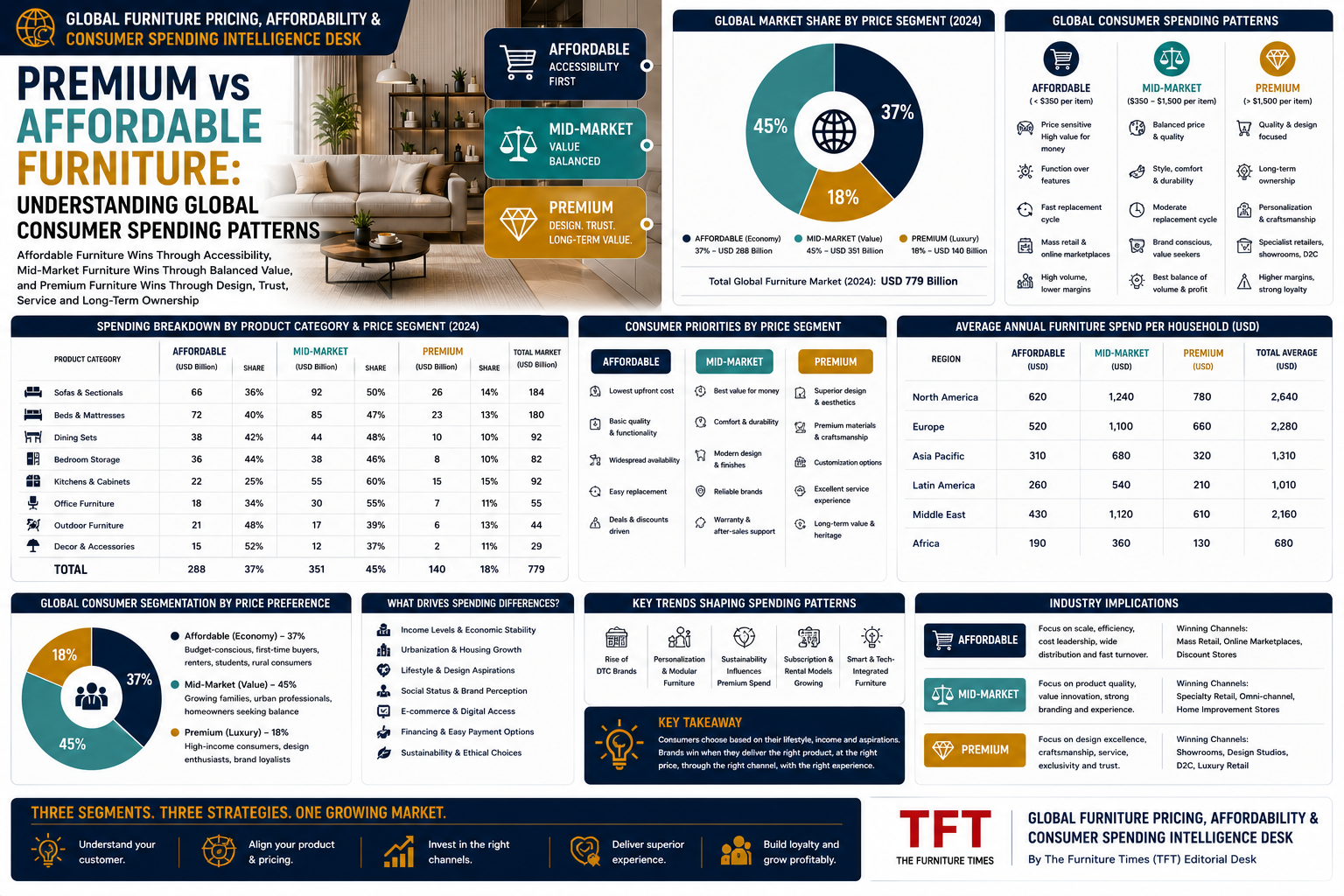
Premium vs Affordable Furniture: Understanding Global Consumer Spending Patterns
Affordable Furniture Wins Through Accessibility, Mid-Market Furniture Wins Through Balanced Value, and Premium Furniture Wins Through Design, Trust, Service and Long-Term Ownership
Global Furniture Pricing, Affordability & Consumer Spending Intelligence Desk
By The Furniture Times (TFT) Editorial Desk
The global furniture economy serves consumers whose financial circumstances, homes, lifestyles and expectations are dramatically different.
One household may need an affordable bed, basic wardrobe and small dining table immediately after moving into its first rented apartment.
Another may spend months selecting a handcrafted sofa, custom kitchen, designer dining table or complete luxury interior.
Between those two customers lies the largest and most competitive part of the furniture industry: consumers who want better design and dependable quality but remain highly conscious of price.
Furniture demand therefore cannot be understood through a simple comparison between cheap and expensive products.
The market consists of several connected pricing economies:
- Entry-level furniture
- Affordable furniture
- Value furniture
- Mid-market furniture
- Upper-mid-market furniture
- Premium furniture
- Luxury and collectible furniture
Each segment has different customers, buying triggers, materials, sales channels, margins, service expectations and replacement cycles.
The wider global furniture market was valued at approximately US$786.1 billion in 2025 under one broad industry estimate and is projected to increase from US$831.6 billion in 2026 to about US$1.33 trillion by 2033. Another current assessment places the 2026 market at approximately US$729.61 billion and projects it to reach US$952.1 billion by 2031. These differences result from variations in product definitions and pricing methods, but both forecasts confirm that furniture remains one of the world’s largest consumer and commercial industries.
The home-furniture market alone is estimated at approximately US$529.39 billion in 2026, with projected growth to US$646.86 billion by 2031.
Within this enormous market, affordable and mid-market furniture generate volume, while premium and luxury furniture generate greater revenue per transaction, stronger design influence and potentially higher gross margins.
The central commercial question is not:
Should a furniture business sell affordable or premium products?
The better question is:
Which combination of price, quality, service and product lifespan represents believable value for the target customer?
Furniture Price Segments Are Relative
A sofa considered affordable in Switzerland may be premium in a lower-income country.
A dining table priced as mid-market in the United States may be beyond the reach of many households in Africa or South Asia.
Furniture pricing must therefore be considered relative to:
- Household income
- Currency strength
- Local manufacturing costs
- Import duties
- Freight
- Property expenses
- Consumer-credit access
- Product lifespan
- Regional expectations
A meaningful price-segment definition should evaluate both the selling price and the customer’s economic environment.
A Practical Furniture Price-Segment Framework
Entry-Level Furniture
Designed primarily around immediate affordability.
Typical characteristics include:
- Basic materials
- Standard dimensions
- Limited finish options
- Flat-pack or simple construction
- Shorter warranties
- High-volume production
- Limited personal service
Entry-level products are important for students, first-time renters, temporary households, workers’ accommodation, value-sensitive families and rental properties.
Affordable Furniture
Affordable furniture attempts to provide better design and acceptable performance while remaining accessible to mass-market consumers.
It may include:
- Engineered-wood wardrobes
- Basic upholstered sofas
- Metal beds
- Modular storage
- Compact dining sets
- Moulded chairs
- Ready-to-assemble furniture
Mid-Market Furniture
Mid-market furniture offers a stronger balance of:
- Design
- Construction
- Comfort
- Material quality
- Warranty
- Price
This segment often attracts households that want to avoid disposable products but cannot justify luxury prices.
Upper-Mid-Market and Premium Furniture
Premium furniture typically offers:
- Better materials
- Stronger construction
- More customisation
- Distinctive design
- Improved comfort
- Longer warranties
- Professional delivery
- Stronger after-sales support
Luxury Furniture
Luxury furniture is priced through a combination of:
- Design authorship
- Brand reputation
- Craftsmanship
- Scarcity
- Material exclusivity
- Customisation
- Heritage
- Status
- White-glove service
Current estimates place the global luxury-furniture market at approximately US$34 billion to US$36 billion in 2026, depending on the definition used. Forecasts generally project the category to grow to roughly US$45 billion–US$53 billion during the early 2030s.
Luxury therefore represents only a relatively small share of total global furniture spending, but it has significant influence over design, materials, branding and consumer aspiration.
The Affordable Furniture Economy
Affordable furniture performs one of the industry’s most important social and economic functions.
It allows households to furnish homes during periods when money is limited but furniture is essential.
Demand is driven by:
- First-time household formation
- Rental housing
- Marriage
- Student accommodation
- Migration
- Urbanisation
- Family growth
- Emergency replacement
- Landlord furnishing
- Worker accommodation
A household may require a bed, mattress, wardrobe, table and seating almost immediately after moving.
The inability to purchase premium furniture does not remove the need.
It creates demand for products that offer acceptable function at the lowest manageable total cost.
What Affordable Buyers Prioritise
Affordable buyers commonly evaluate:
- Purchase price
- Instalment amount
- Immediate availability
- Delivery cost
- Essential functionality
- Product size
- Ease of assembly
- Basic durability
- Customer reviews
- Replacement affordability
These customers may be highly informed.
They often compare more products because a purchasing mistake would consume a larger share of their disposable income.
An affluent buyer may absorb the cost of replacing an unsuitable chair.
A lower-income customer may need the same chair to remain usable for many years.
Affordable buyers should therefore never be treated as buyers who do not care about quality.
They care deeply about avoiding wasted money.
Affordable Does Not Mean the Same as Disposable
One of the furniture industry’s greatest mistakes is assuming that low-priced furniture must have a short working life.
Affordable products can still provide credible value when manufacturers improve:
- Structural engineering
- Standardisation
- Material yield
- Flat-pack efficiency
- Packaging
- Automated production
- Replaceable components
- Product simplicity
A basic metal bed with standard components may provide longer service than a more visually complex but poorly constructed product.
A simple wardrobe with dependable hardware may create better value than a decorative product with weak connections.
Affordable furniture becomes socially and commercially stronger when it is:
- Honest about materials
- Easy to assemble
- Easy to repair
- Adaptable
- Supported by spare parts
- Designed around essential needs
Why Affordable Furniture Can Become Expensive
A low initial price can conceal a high total ownership cost.
Consider a low-cost sofa that lasts three years compared with a better sofa that lasts twelve years.
Even when the better sofa costs two or three times more, it may create a lower annual cost.
Affordable furniture can become expensive through:
- Premature failure
- Repeated replacement
- Delivery charges
- Difficult assembly
- Unavailable components
- Damage during relocation
- Weak warranties
- Disposal costs
The correct calculation is not only:
How much does the furniture cost today?
It is also:
How much useful service will the customer receive for every unit of money spent?
The Mid-Market: The Global Furniture Industry’s Largest Competitive Zone
The mid-market is where affordability, aspiration and risk meet.
Consumers in this segment want:
- Better-looking homes
- More reliable furniture
- Improved comfort
- Recognisable brands
- Clear warranties
- Professional delivery
- Reasonable prices
They may reject the lowest-cost product because they fear weak quality.
They may also reject a premium product because the price difference does not appear justified.
This makes mid-market customers highly demanding.
They ask:
- Is the material really better?
- Will it last longer?
- Is the warranty meaningful?
- Is the premium based on performance or branding?
- Can I find a similar product for less?
- Does delivery and installation justify the price?
The mid-market is especially significant across Asia-Pacific, where one regional assessment estimated that mid-range furniture represented approximately 42% of 2025 sales, supported by middle-class consumers seeking better quality at accessible prices.
Why the Mid-Market Is Difficult to Win
Affordable brands can reduce cost aggressively.
Premium brands can create emotional desire and stronger differentiation.
Mid-market brands must do both reasonably well.
They need:
- Efficient manufacturing
- Attractive design
- Dependable quality
- Transparent materials
- Competitive delivery
- Credible warranties
- Strong digital visibility
A mid-market business cannot survive by being vaguely “better.”
It must identify measurable improvements.
These may include:
- Stronger hardware
- Better fabric
- Denser foam
- Moisture-resistant panels
- Modular construction
- Professional assembly
- Replacement cushions
- Longer warranties
Premium Furniture: Why Customers Pay More
Premium furniture customers do not simply purchase more expensive materials.
They purchase reduced uncertainty and a more complete experience.
The premium price may include:
- Consultation
- Design guidance
- Material samples
- Custom sizes
- Fabric options
- Better internal construction
- Professional delivery
- Installation
- Warranty support
- Repair services
- Product continuity
Premium customers often expect the furniture company to help prevent the wrong decision.
A premium brand must therefore provide expertise, not merely a high price.
Premium Furniture Buying Motivations
Design and Identity
Furniture expresses personal taste, lifestyle and social position.
A customer may choose premium furniture because it makes the home or business feel:
- Distinctive
- Sophisticated
- Calm
- Contemporary
- Authentic
- Prestigious
Comfort
Premium sofas, chairs, mattresses and beds can justify higher prices through improved physical experience.
Material Authenticity
Customers may pay more for:
- Solid timber
- Premium veneer
- Natural leather
- High-performance fabrics
- Stone
- Handwoven materials
- Certified materials
Customisation
The ability to choose size, fabric, finish and configuration increases perceived ownership.
Longevity
Premium buyers may view furniture as a long-term investment rather than a temporary purchase.
Service
Delivery, assembly, installation, repairs and personal support reduce purchasing risk.
Premium and Luxury Are Not Identical
Premium furniture offers superior value through material, performance, design or service.
Luxury furniture adds exclusivity, status, authorship, scarcity or heritage.
A high-quality modular sofa may be premium without being luxury.
A handcrafted numbered chair by a recognised designer may be luxury even when its practical function is similar.
Premium buyers often ask:
Is it worth the higher price?
Luxury buyers may also ask:
Is it rare, distinctive or meaningful enough to own?
The Luxury Furniture Market
Luxury furniture remains a comparatively small but influential global category.
Current 2026 estimates vary significantly:
- One assessment estimates approximately US$34.5 billion, reaching US$52.56 billion by 2033.
- Another estimates approximately US$34.14 billion, reaching US$44.78 billion by 2031.
- Another estimates approximately US$33.7 billion, reaching US$39.8 billion by 2030.
Differences reflect whether reports include designer furniture, premium residential products, luxury outdoor furniture, hospitality products and other specialist categories.
Despite methodological variation, luxury-furniture demand is being supported by:
- High-net-worth households
- Luxury property development
- Branded residences
- Hotels and resorts
- Designer collaborations
- Collectible design
- Custom interior projects
- Expanding affluent consumer groups
Luxury Pricing Must Be Supported by Creativity
A high price alone does not create luxury.
The broader luxury-goods sector has faced customer resistance after years of price increases that were not always matched by stronger creativity or value. Bain’s 2026 outlook warned that aggressive price increases had alienated some aspirational and wealthy customers, even as the luxury market was expected to return to modest growth.
This lesson applies directly to furniture.
Luxury brands must provide credible evidence through:
- Original design
- Craftsmanship
- Material quality
- Limited availability
- Cultural relevance
- Exceptional service
- Long-term care
- Strong product stories
A mass-produced product with a luxury price but weak differentiation risks losing trust.
Consumer Spending Is Dividing Into Two Directions
In many markets, furniture spending is becoming polarised.
One group is trading down because of:
- Housing costs
- Inflation
- High interest rates
- Rent
- Childcare
- Employment uncertainty
- Debt
Another group is trading up because it wants:
- Greater comfort
- Longer product life
- Better design
- Customisation
- Premium experiences
- Stronger environmental credentials
This can weaken poorly differentiated middle brands.
Consumers may choose either:
- A low-cost product that solves the immediate need, or
- A premium product that clearly delivers longer-term value
The mid-market survives when it communicates a strong quality-to-price relationship.
The Role of Housing Costs
Furniture does not compete only with other furniture.
It competes with:
- Mortgage payments
- Rent
- Renovation
- Appliances
- Transport
- Education
- Travel
- Food
- Technology
A household purchasing an expensive property may have little cash left for furnishings.
This creates staged purchasing.
Consumers may:
- Buy a mattress and bed first.
- Add essential storage.
- Purchase a sofa later.
- Delay dining or decorative furniture.
- Upgrade products after income recovers.
Furniture companies should create collections that support customers across several financial stages.
Buying Capacity Is Different From Income
Two households with the same income may have different furniture-buying capacity.
Household A may own its home and have low debt.
Household B may pay high rent, childcare and education costs.
Furniture spending is influenced by:
- Disposable income
- Savings
- Family size
- Homeownership
- Consumer debt
- Credit access
- Financial confidence
- Expected job security
Furniture businesses should not assume that affluent-looking customers have unlimited budgets or that value-conscious customers lack future premium potential.
Gen Z and Affordable Furniture
Gen Z’s early furniture demand is often shaped by:
- Student living
- Shared rentals
- First apartments
- Early-career income
- Frequent relocation
- Small bedrooms
Strong products include:
- Flat-pack desks
- Compact beds
- Modular shelves
- Clothing racks
- Small sofas
- Sofa beds
- Portable storage
- Gaming furniture
Gen Z may combine affordable new products with:
- Second-hand furniture
- Vintage products
- Marketplace purchases
- DIY improvement
Visual identity still matters. Affordable products must not look unnecessarily unattractive or institutional.
Millennials and the Mid-Market
Millennials are one of the most important mid-market furniture groups.
They may be:
- Buying first homes
- Forming families
- Renovating
- Working from home
- Purchasing children’s furniture
- Improving outdoor areas
They seek a balance among:
- Price
- Durability
- Storage
- Design
- Family suitability
- Materials
- Sustainability
This makes them strong buyers of:
- Modular sofas
- Performance upholstery
- Storage beds
- Extendable tables
- Home-office furniture
- Modular wardrobes
- Mid-range kitchens
Generation X and Premium Upgrading
Generation X may have greater purchasing power and established homes.
Replacement and renovation create demand for:
- Premium sofas
- Better mattresses
- Solid-wood dining
- Custom storage
- Kitchens
- Outdoor living
- Executive home offices
This group may pay more but expects evidence of:
- Construction quality
- Warranty
- Professional service
- Long-term value
Baby Boomers and Comfort-Based Premium Spending
Baby Boomers may replace furniture because of:
- Retirement
- Downsizing
- Renovation
- Mobility
- Comfort
- Ageing in place
Demand can include:
- Supportive seating
- Recliners
- Adjustable beds
- Higher dining chairs
- Accessible storage
- Professional delivery
Premium spending is often justified through comfort, service, safety and reduced inconvenience rather than trend alone.
Affordable Furniture Materials
Affordable furniture commonly uses:
- Particleboard
- MDF
- Basic plywood
- Laminate
- Melamine
- Steel tubing
- Moulded plastic
- Polyester fabrics
- Standard foam
- Synthetic leather
These materials are not automatically poor quality.
Performance depends on:
- Specification
- Thickness
- Density
- Hardware
- Joinery
- Finishing
- Quality control
- Intended use
An engineered-wood wardrobe designed and installed correctly may perform effectively for many years.
The problem begins when low pricing is achieved through hidden reductions in essential structural quality.
Premium Furniture Materials
Premium furniture may use:
- Certified solid timber
- High-grade plywood
- Premium veneer
- Aluminium
- Stainless steel
- Natural stone
- Sintered surfaces
- Natural leather
- Performance textiles
- Higher-density foam
- Premium hardware
Material cost alone does not determine premium quality.
A premium product also requires:
- Better engineering
- Skilled workmanship
- Accurate finishing
- Moisture control
- Testing
- Careful packaging
- Dependable after-sales service
Affordable Furniture Manufacturing Strategy
Affordable furniture requires operational discipline.
Profitability is created through:
- Standard dimensions
- High-volume production
- Material optimisation
- Automated cutting
- Simple hardware
- Efficient packaging
- Flat-pack logistics
- Limited variants
- Rapid inventory turnover
The manufacturer must remove unnecessary cost without removing essential performance.
Poor affordable-furniture strategy reduces:
- Board thickness
- Frame strength
- Hardware quality
- Foam density
- Finish preparation
Strong affordable-furniture strategy improves:
- Engineering
- Production speed
- Packaging
- Standardisation
- Material yield
- Distribution
Premium Furniture Manufacturing Strategy
Premium furniture requires control of details that mass-market customers may not always inspect immediately.
These include:
- Joinery
- Alignment
- Fabric matching
- Stitching
- Timber selection
- Surface preparation
- Internal frame construction
- Cushion consistency
- Hardware feel
- Finishing
Premium quality must remain consistent across every visible and hidden component.
A beautiful exterior cannot compensate for a weak frame or unreliable hardware.
Affordable Furniture Retail Channels
Affordable furniture is frequently sold through:
- Mass retailers
- Online marketplaces
- Warehouse stores
- Factory outlets
- Discount chains
- Social commerce
- Direct-to-consumer websites
- Local dealers
The buying journey is often driven by:
- Price comparison
- Promotions
- Reviews
- Availability
- Delivery speed
- Instalments
Online platforms are especially powerful because they allow customers to compare large product ranges rapidly.
However, the ease of comparison intensifies price pressure.
Premium Furniture Retail Channels
Premium furniture is commonly sold through:
- Branded showrooms
- Designer stores
- Interior designers
- Architects
- Luxury department stores
- Direct consultations
- Specialist websites
- Trade showrooms
The purchasing experience may involve:
- Appointments
- Material samples
- Space planning
- Home measurement
- Custom quotations
- White-glove delivery
- Installation
Premium retail is not only about displaying a product.
It is about creating confidence that the complete project will be handled professionally.
E-Commerce Is Blurring Price Segments
Affordable furniture was an early beneficiary of e-commerce because standardised products are easy to compare and distribute.
Premium furniture is also expanding online as retailers improve:
- High-resolution imagery
- Video demonstrations
- Fabric samples
- Augmented reality
- Virtual consultations
- Delivery coordination
One luxury-market assessment expects online luxury-furniture retail to grow faster than the wider category as digital visualisation reduces hesitation around high-ticket purchases.
Nevertheless, premium e-commerce requires stronger trust.
Customers need clear information concerning:
- Authenticity
- Materials
- Comfort
- Lead time
- Returns
- Delivery
- Warranty
Search Behaviour: Affordable Buyers
Affordable-furniture searches commonly include:
- Furniture under budget
- Cheap sofa with delivery
- Affordable bedroom set
- Furniture instalment plan
- Ready-stock furniture
- Best value mattress
- Furniture clearance
- Flat-pack wardrobe
- Furniture package for first home
- Discount furniture near me
Affordable search intent frequently combines:
- Product
- Price
- Location
- Availability
- Delivery
Search Behaviour: Premium Buyers
Premium-furniture searches may include:
- Luxury furniture brand
- Bespoke sofa manufacturer
- Solid wood dining table
- Designer furniture showroom
- Custom luxury wardrobe
- Premium outdoor furniture
- Italian furniture brand
- Handcrafted furniture
- Hotel furniture manufacturer
- Furniture interior design service
Premium buyers search for:
- Brand
- Material
- designer
- Craftsmanship
- Origin
- Customisation
- Service
AI Search Will Increase Value Comparison
AI-assisted shopping allows customers to compare products through detailed requirements.
An affordable buyer may ask:
Which sofa offers the best durability for a family under my budget?
A premium buyer may ask:
Compare handcrafted oak dining tables based on construction, timber origin, warranty and customisation.
Furniture companies should prepare structured information concerning:
- Materials
- Dimensions
- Construction
- Warranty
- Price
- Service
- Replacement parts
- Delivery
- Intended user
AI will make it harder for weakly differentiated products to hide behind broad marketing language.
Affordable Customers Need Transparency
Affordable buyers are highly sensitive to hidden costs.
They need to know:
- Final product price
- Delivery fee
- Assembly fee
- Stair or lift charges
- Financing cost
- Return charges
- Warranty exclusions
A cheap advertised price can damage trust when the final delivered cost increases substantially.
Affordable furniture brands should compete through honest total pricing.
Premium Customers Need Justification
Premium customers need to understand why the product costs more.
The brand should explain:
- Material origin
- Construction
- Designer involvement
- Craft process
- Customisation
- Testing
- Expected lifespan
- Repair options
- Warranty
- Service
The phrase “premium quality” is not enough.
Customers require evidence.
Discounting in the Affordable Market
Discounts are common in value furniture because customers are price sensitive.
However, continuous promotions can create several problems:
- Customers delay purchases
- Reference prices lose credibility
- Gross margins decline
- Product quality becomes associated with discounting
- Inventory planning becomes difficult
Retailers should distinguish between:
- Genuine clearance
- Seasonal promotions
- Package pricing
- Volume discounts
- Artificial permanent sales
Discounting in the Premium Market
Premium brands should use discounts carefully.
Excessive promotion can damage:
- Exclusivity
- Brand confidence
- Perceived value
- Retailer relationships
Better premium incentives may include:
- Complimentary delivery
- Material upgrades
- Design consultation
- Care packages
- Private-client benefits
- Limited-event access
Financing and Furniture Affordability
Financing can make better furniture accessible to households that cannot pay the full amount immediately.
Options include:
- Retail instalments
- Credit cards
- Buy-now-pay-later
- Consumer financing
- Project payment stages
Financing should be transparent.
Customers need to understand:
- Total repayment
- Interest
- Fees
- Late-payment consequences
- Ownership conditions
Responsible financing can expand the mid-market.
Irresponsible financing can damage household wellbeing and brand trust.
Premiumisation in Emerging Markets
Premium furniture demand is expanding beyond traditional affluent markets.
Growth is supported by:
- Rising middle and upper-income populations
- Luxury residential development
- International travel
- Social media
- Designer awareness
- Hospitality growth
- Branded residences
Asia-Pacific represented the largest regional share of the luxury-furniture market under one assessment, accounting for approximately 30.7% in 2024. Other reports place Europe in the leading position because of different definitions and market boundaries.
This demonstrates that premium demand is becoming geographically diversified.
North America
North America supports all price segments.
Affordable Demand
Driven by:
- Renters
- Students
- First-time households
- Value retailers
- Online marketplaces
- Rental properties
Premium Demand
Driven by:
- Replacement
- Renovation
- Large homes
- High-income households
- Designer interiors
- Outdoor living
- Luxury property
Customers commonly expect:
- Fast delivery
- Reviews
- Returns
- Financing
- Warranties
Europe
European spending patterns vary significantly between countries.
Affordable and value products remain important for:
- Renters
- Students
- Young households
- Cost-conscious consumers
Premium demand is supported by:
- Design culture
- Kitchens
- Certified timber
- Craftsmanship
- Heritage brands
- Sustainability
- Repairability
Europe remains a major luxury-furniture region, with some estimates assigning it more than one-third of global category revenue.
Asia-Pacific
Asia-Pacific contains the widest spectrum of furniture affordability.
The region includes:
- Extremely price-sensitive households
- Rapidly expanding middle classes
- Premium urban consumers
- High-net-worth buyers
- Major manufacturing centres
Affordable Growth Categories
- Beds
- Mattresses
- Wardrobes
- Modular kitchens
- Compact sofas
- Dining sets
- Storage
Premium Growth Categories
- Designer sofas
- Smart beds
- Custom kitchens
- Luxury dining
- Imported brands
- High-end outdoor furniture
The mid-market will remain especially important as consumers upgrade from unbranded or informal products toward organised brands.
Middle East
The Middle East contains strong premium and luxury demand, particularly in:
- Saudi Arabia
- UAE
- Qatar
- Kuwait
- Bahrain
- Oman
Demand is supported by:
- Luxury villas
- Apartments
- Hotels
- Resorts
- Branded residences
- Offices
- Restaurants
The affordable market remains important for:
- Expatriate rentals
- Worker housing
- First-time households
- Furnished apartments
The region therefore requires both volume packages and highly customised premium projects.
Africa
Affordable furniture dominates much of the African opportunity because household purchasing power remains constrained in many markets.
Strong categories include:
- Beds
- Mattresses
- Metal furniture
- Basic storage
- Tables
- School furniture
- Institutional furniture
Premium niches exist in:
- Luxury urban homes
- Hotels
- Resorts
- Corporate offices
- Tourism
- High-income households
The strongest African strategy is likely to combine:
- Local manufacturing
- Durable construction
- Repairability
- Affordable pricing
- Regional premium craftsmanship
Latin America
Latin American buyers often balance design aspiration with affordability and economic volatility.
Demand is influenced by:
- Instalment availability
- Currency movements
- Inflation
- Housing
- Local manufacturing
- Social commerce
Affordable and mid-market furniture dominate volume, while premium opportunities exist in:
- Major cities
- Luxury property
- Hospitality
- Custom kitchens
- Designer furniture
- Outdoor living
Residential vs Commercial Price Segments
Affordable Residential
Products include:
- Beds
- Wardrobes
- Basic sofas
- Dining sets
- Storage
- Mattresses
Premium Residential
Products include:
- Bespoke upholstery
- Designer dining
- Custom kitchens
- Walk-in wardrobes
- Luxury beds
- Premium outdoor collections
Affordable Commercial
Common in:
- Schools
- Worker accommodation
- Rental properties
- Budget hotels
- Basic offices
- Public facilities
Premium Commercial
Common in:
- Luxury hotels
- Resorts
- Corporate headquarters
- Branded residences
- Fine-dining restaurants
- Executive offices
Commercial customers evaluate total lifecycle cost more closely than residential buyers.
A higher-priced chair may create better value when it lasts longer under intensive use.
Product Categories Most Influenced by Price
Mattresses
The market ranges from basic foam mattresses to advanced smart sleep systems.
Sofas
Price differences reflect frame construction, upholstery, foam, design, brand and customisation.
Kitchens
Affordable modular cabinets compete with fully custom premium systems.
Dining Tables
The market ranges from laminated flat-pack tables to handcrafted solid timber and stone products.
Outdoor Furniture
Low-cost plastic and steel compete with teak, aluminium, performance textiles and designer collections.
Office Chairs
Basic task chairs compete with specialist ergonomic and executive seating.
Which Segment Produces the Largest Volume?
Affordable and mid-market furniture
These segments serve the greatest number of households and commercial users.
Which Segment Produces the Highest Transaction Value?
Premium, luxury and custom furniture
A single custom kitchen, luxury sofa collection or hotel furniture project can generate substantial revenue.
Which Segment Has the Strongest Gross-Margin Potential?
Premium branded, custom and luxury furniture
However, higher gross margins can be reduced by:
- Showroom costs
- Design
- Marketing
- Samples
- Delivery
- Installation
- After-sales support
Which Segment Is Most Economically Resilient?
Essential affordable furniture can remain resilient because households always need beds, mattresses and storage.
High-end luxury demand can also remain resilient among the wealthiest customers.
The upper-middle customer may become more cautious during economic uncertainty, making the aspirational premium segment vulnerable.
The Rise of Affordable Premium
One of the strongest market opportunities lies between traditional affordable and luxury furniture.
Affordable-premium products provide:
- Attractive design
- Better-than-basic materials
- Transparent construction
- Limited customisation
- Good warranties
- Efficient online distribution
Customers want products that look and perform better without paying for full luxury infrastructure.
This segment is supported by:
- Direct-to-consumer brands
- Digital showrooms
- Modular design
- Efficient manufacturing
- Reduced retail overhead
Private Labels and Pricing Power
Retailers increasingly develop private-label furniture because it provides:
- Product differentiation
- Greater margin control
- Reduced direct price comparison
- Exclusive designs
- Customer loyalty
Private labels can target:
- Affordable households
- Mid-market consumers
- Affordable-premium buyers
- Specialist categories
The challenge is maintaining quality consistency and warranty support.
Second-Hand Furniture Changes the Price Ladder
Second-hand and refurbished furniture provide another alternative.
Consumers may purchase:
- Affordable used furniture
- Vintage furniture
- Restored solid wood
- Pre-owned designer furniture
- Refurbished office furniture
This creates a new pricing ladder:
Low-cost used → affordable new → mid-market new → refurbished premium → premium new → luxury collectible.
Furniture brands can participate through:
- Trade-in
- Certified resale
- Refurbishment
- Buy-back
- Authentication
Sustainability Across Price Segments
Affordable Sustainability
Should focus on:
- Durability
- Material efficiency
- Replaceable hardware
- Flat-pack transport
- Repairability
- Honest product life
Premium Sustainability
Can include:
- Certified materials
- Low-emission finishes
- Local production
- Recycled content
- Take-back
- Refurbishment
- Product passports
Sustainability should not become a privilege available only to wealthy consumers.
Long-lasting affordable furniture can create substantial environmental value.
The Danger of Green Premiums
Some sustainable products cost more because of:
- Certified materials
- Smaller production volumes
- Traceability
- Better labour conditions
- New technology
However, brands must explain the benefit clearly.
Customers may reject a higher price when environmental claims are vague or unverifiable.
The strongest sustainable premium combines:
- Better performance
- Longer life
- Lower impact
- Clear evidence
How Furniture Brands Should Choose Their Segment
A business should evaluate:
- Which customer problem does it solve?
- What can the target customer afford?
- What quality level can the factory deliver consistently?
- Which services can the company support?
- Can the product be differentiated?
- Is the price justified by visible value?
- What is the delivered cost?
- How often will the product require service?
- Does the sales channel match the price?
- Can the brand remain credible within the chosen position?
A discount business should not imitate luxury language without supporting the promise.
A premium brand should not undermine itself through constant discounting.
Strategic Priorities for Affordable Furniture Brands
Affordable brands should:
- Protect essential structural quality.
- Use standardisation to reduce cost.
- Publish honest materials.
- Improve assembly instructions.
- Provide basic spare parts.
- Design for transport efficiency.
- Offer transparent final prices.
- Create starter furniture packages.
- Support instalments responsibly.
- Reduce unnecessary variants.
- Improve packaging.
- Build compact urban products.
- Offer durable rural products.
- Collect long-term reviews.
- Measure product life and complaint rates.
Strategic Priorities for Mid-Market Brands
Mid-market brands should:
- Define measurable quality advantages.
- Avoid vague premium claims.
- Balance design and durability.
- Offer selective customisation.
- Build strong warranties.
- Develop modular product families.
- Provide replacement covers and parts.
- Use room packages to increase value.
- Build omnichannel retail.
- Explain total ownership cost.
- Reduce excessive promotion.
- Strengthen delivery.
- Offer material samples.
- Build trusted reviews.
- Prepare detailed product data for AI search.
Strategic Priorities for Premium and Luxury Brands
Premium brands should:
- Protect design originality.
- Document craftsmanship.
- Explain material origin.
- Provide exceptional consultation.
- Control distribution.
- Maintain pricing discipline.
- Offer professional installation.
- Support repair and restoration.
- Keep product records.
- Provide long-term material continuity.
- Use high-quality storytelling.
- Avoid unsupported exclusivity claims.
- Build designer and architect relationships.
- Create private-client services.
- Measure customer lifetime value.
The Future of Affordable Furniture
Affordable furniture demand will continue growing through:
- Urbanisation
- First-time households
- Rental living
- Population growth
- Student housing
- Digital commerce
- Smaller homes
The winners will not necessarily be the companies selling the lowest-priced products.
They will be the companies that deliver the strongest basic performance at the lowest sustainable total cost.
The Future of Premium Furniture
Premium demand will grow through:
- Affluent households
- Renovation
- Luxury property
- Hospitality
- Customisation
- Design awareness
- Sustainability
- Branded interiors
The strongest premium brands will move beyond ownership symbolism and provide:
- Better comfort
- Better service
- Longer product life
- Repair
- Traceability
- Authentic design
The Future of the Mid-Market
The mid-market will remain the furniture industry’s largest strategic battlefield.
Customers will become better informed.
They will compare:
- Affordable alternatives
- Direct-to-consumer brands
- Refurbished premium products
- Marketplace sellers
- Local manufacturers
- Luxury brands
The mid-market winner must prove that it offers a meaningful step up without an unreasonable step in price.
Price Is What the Customer Pays—Value Is What the Furniture Continues to Deliver
An affordable product can represent excellent value when it performs reliably, fits the space and remains repairable.
A premium product can represent poor value when the price is based mainly on marketing.
A luxury product can justify its cost when it delivers originality, craftsmanship, scarcity and exceptional long-term service.
The distinction between affordable and premium is therefore not simply a price label.
It is a relationship among:
- Customer income
- Product performance
- Expected lifespan
- Emotional value
- Service
- Risk
- Brand trust
Every Price Segment Has a Different Promise
Affordable furniture promises:
You can furnish your essential space without exceeding your means.
Mid-market furniture promises:
You can obtain better quality and design at a reasonable price.
Premium furniture promises:
You will receive stronger performance, distinction and service.
Luxury furniture promises:
You will own something rare, meaningful and exceptionally produced.
Problems begin when the product fails to fulfil its segment’s promise.
Cheap furniture fails when it becomes unusable too quickly.
Mid-market furniture fails when customers cannot see why it costs more.
Premium furniture fails when service and quality do not justify the price.
Luxury furniture fails when high pricing replaces creativity and authenticity.
Global Furniture Spending Will Continue to Split—but Value Will Unite It
Consumers around the world will continue purchasing at different price levels.
Some will need immediate affordability.
Some will seek balanced value.
Some will invest in longevity.
Some will purchase design, craftsmanship and exclusivity.
The strongest furniture companies will not disrespect customers in any segment.
They will recognise that every buyer is trying to create the best possible environment within a particular financial reality.
A first-time renter buying an affordable bed deserves accurate information and dependable construction.
A middle-income family buying a sofa deserves honest quality and credible service.
A premium homeowner deserves authentic materials and strong after-sales support.
A luxury client deserves originality, craftsmanship and exceptional care.
The future furniture economy will not be divided simply between cheap and expensive products. It will be shaped by brands that understand what value means at every income level—and deliver that value without breaking the promises attached to their price.
