
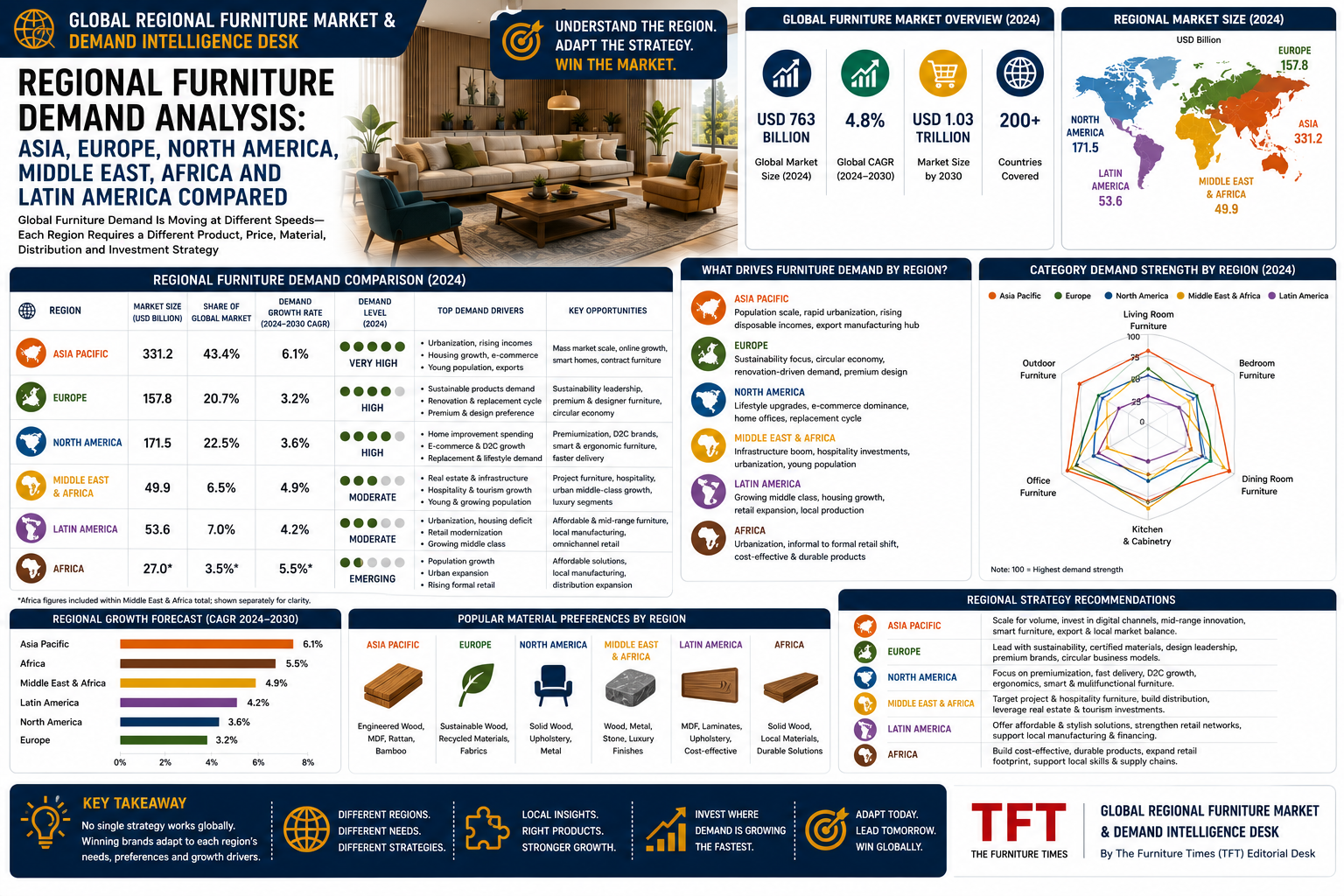
Regional Furniture Demand Analysis: Asia, Europe, North America, Middle East, Africa and Latin America Compared
Global Furniture Demand Is Moving at Different Speeds—Each Region Requires a Different Product, Price, Material, Distribution and Investment Strategy
Global Regional Furniture Market & Demand Intelligence Desk
By The Furniture Times (TFT) Editorial Desk
The global furniture market cannot be understood through one universal growth story.
Asia-Pacific is expanding through population scale, manufacturing strength, urbanisation and rising household consumption.
North America remains one of the world’s most valuable furniture markets because of its purchasing power, large housing stock, commercial infrastructure and dependence on imported products.
Europe combines a mature consumer market with globally influential design, machinery, sustainability standards and cross-border manufacturing networks.
The Middle East is creating high-value opportunities through tourism, luxury residences, offices, hospitality, entertainment and major urban-development programmes.
Africa has the world’s strongest long-term household-formation potential, but purchasing power, infrastructure and affordability determine how quickly that potential becomes formal furniture demand.
Latin America combines a highly urbanised population with major domestic markets, established manufacturing clusters, strong family-living cultures and growing digital commerce.
One major market estimate values the global furniture industry at approximately US$786.1 billion in 2025, increasing from about US$831.6 billion in 2026 to US$1.33 trillion by 2033. Under this broad methodology, Asia-Pacific represented approximately 38.5% of global revenue in 2025. A narrower industry-focused CSIL assessment values worldwide furniture consumption at more than US$440 billion and expects demand to remain broadly stagnant during 2026 before a marginal recovery in 2027. These figures differ because research organisations use different product definitions and valuation methods.
The difference between these forecasts reinforces an important principle:
Furniture market figures should be treated as directional intelligence rather than one universally accepted accounting total.
Some estimates include mattresses, fitted kitchens, outdoor products and decorative furnishings. Others focus more narrowly on movable furniture at producer or wholesale values.
A useful regional analysis must therefore look beyond market size and examine:
- Population and household formation
- Urbanisation
- Income and furniture affordability
- Homeownership and rental housing
- Residential construction
- Commercial property development
- Hospitality and tourism
- Furniture manufacturing capacity
- Imports and exports
- Materials and craftsmanship
- Digital search behaviour
- Retail and e-commerce
- Sustainability and regulation
- Logistics
- Political and economic risk
Global Regional Positioning at a Glance
Asia-Pacific
Primary position: Largest production and consumption region
Main demand engine: Urbanisation, population, housing and middle-class expansion
Strongest categories: Bedrooms, storage, modular furniture, mattresses, dining, home offices and hospitality
Major markets: China, India, Japan, South Korea, Indonesia, Vietnam, Malaysia and Australia
Core opportunity: Serving both high-volume affordable demand and premium urban consumers
North America
Primary position: High-value consumption and import market
Main demand engine: Replacement, renovation, large housing stock and commercial infrastructure
Strongest categories: Upholstery, mattresses, bedrooms, outdoor living, home offices and institutional furniture
Major markets: United States and Canada
Core opportunity: Premium value, convenience, fast fulfilment and dependable after-sales service
Europe
Primary position: Mature design, manufacturing and regulatory market
Main demand engine: Replacement, renovation, kitchens, compact living and sustainability
Strongest categories: Kitchens, upholstered furniture, dining, storage, office furniture and designer products
Major markets: Germany, United Kingdom, France, Italy, Spain, Poland and the Nordic region
Core opportunity: Durable, repairable, traceable and design-led furniture
Middle East
Primary position: Project-led premium and hospitality market
Main demand engine: Tourism, luxury residences, offices and urban development
Strongest categories: Hotel furniture, custom interiors, outdoor collections, luxury residential furniture and office systems
Major markets: Saudi Arabia, United Arab Emirates, Qatar, Bahrain, Oman and Kuwait
Core opportunity: High-value project furniture supported by customisation, installation and reliable delivery
Africa
Primary position: Long-term household-formation and infrastructure opportunity
Main demand engine: Population growth, urbanisation, education, healthcare and housing
Strongest categories: Affordable beds, mattresses, storage, school furniture, metal furniture and hospitality products
Major markets: South Africa, Egypt, Nigeria, Kenya, Morocco and Ghana
Core opportunity: Affordable local manufacturing, repairability and institutional furniture
Latin America
Primary position: Urban consumer market with domestic production capacity
Main demand engine: Housing, renovation, family formation, hospitality and digital commerce
Strongest categories: Bedrooms, upholstery, dining, kitchens, mattresses, offices and outdoor furniture
Major markets: Brazil, Mexico, Colombia, Argentina, Chile and Peru
Core opportunity: Locally adapted, finance-accessible furniture supported by regional production
Regional Comparison by Strategic Indicator
Largest Overall Scale
Asia-Pacific
The region leads through population, domestic consumption and global manufacturing capacity.
Highest Household Buying Power
North America
The United States and Canada combine high incomes, large housing stocks and developed credit and retail systems.
Strongest Design and Sustainability Influence
Europe
European manufacturers, designers and policymakers exert influence beyond the region through design, machinery, material standards and circular-economy policy.
Strongest Premium Project Pipeline
Middle East
Tourism, luxury development, branded residences, offices and destination projects create major contract-furniture opportunities.
Strongest Long-Term Demographic Potential
Africa
Population and urban growth will create enormous basic and institutional furniture requirements, although affordability remains decisive.
Strongest Combination of Urban Culture and Local Production
Latin America
Brazil, Mexico and other markets combine large urban populations with furniture-manufacturing traditions and growing digital distribution.
Asia-Pacific: The Global Furniture Industry’s Largest Engine
Asia-Pacific occupies the centre of the modern furniture economy.
It is simultaneously:
- A manufacturing base
- A raw-material-processing region
- A global export platform
- A major consumer market
- A design and technology centre
- A rapidly growing commercial-project market
Under one major market estimate, Asia-Pacific represented approximately 38.5% of global furniture revenue in 2025. Another assessment places its share at roughly 44%, illustrating how varying definitions still reach the same broad conclusion: Asia-Pacific is the largest regional furniture market.
CSIL’s recent industry outlook identifies Asia-Pacific as the primary structural growth engine, supported by population expansion, urbanisation and rising incomes, while Europe remains comparatively fragile and North America moves toward gradual recovery.
Why Asia-Pacific Leads
Population Scale
Asia contains several of the world’s largest populations, including China, India, Indonesia, Pakistan, Bangladesh, Japan and the Philippines.
Even modest increases in furniture spending per household can create enormous additional demand.
Urban Growth
Asian cities continue absorbing new residents and generating apartments, condominiums, rental housing, student accommodation, hotels, offices and retail facilities.
The United Nations’ World Urbanization Prospects 2025 shows the continuing importance of Asian cities and megacities within global urban development.
Manufacturing Capacity
China remains the world’s most complete furniture-manufacturing ecosystem.
Vietnam, Indonesia, Malaysia, India and Thailand contribute major production capacity across:
- Solid-wood furniture
- Upholstery
- Panel furniture
- Rattan
- Bamboo
- Outdoor furniture
- Mattresses
- Components
- Commercial furniture
Expanding Middle-Income Consumers
Growing household income supports movement from basic furniture toward:
- Coordinated room collections
- Better mattresses
- Modular storage
- Designer furniture
- Premium materials
- Custom interiors
- Smart products
Digital Commerce
Mobile commerce, marketplaces, social platforms and messaging applications are creating new furniture-discovery channels.
Digital tools are especially important in geographically large and highly fragmented consumer markets.
China: The Region’s Scale and Manufacturing Leader
China remains central to global furniture production, sourcing, component manufacturing and domestic consumption.
Its domestic market supports demand for:
- Apartment furniture
- Bedrooms
- Mattresses
- Modular wardrobes
- Children’s furniture
- Dining furniture
- Smart furniture
- Office systems
- Hospitality furniture
China’s advantages include:
- Large-scale factories
- Component clusters
- Machinery
- Logistics
- Domestic marketplaces
- Extensive supplier networks
Its major challenges include:
- Property-market weakness
- Intense price competition
- Slower household formation
- Population ageing
- Trade friction
- Excess manufacturing capacity
The opportunity is shifting from pure production volume toward stronger brands, better design, premium domestic demand and intelligent manufacturing.
India: The Largest Long-Term Household Opportunity
India offers one of the world’s most important long-term furniture-growth opportunities.
Demand is being created by:
- Population scale
- Urban housing
- Apartment development
- Marriage and household formation
- Expanding offices
- Hotels
- Healthcare
- Education
- Organised retail
- E-commerce
India’s furniture market remains fragmented between organised retailers, manufacturers, carpenters, interior contractors and informal workshops.
This fragmentation is both a challenge and an opportunity.
Companies can grow by providing:
- Standardised quality
- Transparent pricing
- Reliable delivery
- Modular furniture
- Financing
- Material clarity
- Warranty support
Strong Indian Growth Categories
- Modular kitchens
- Wardrobes
- Mattresses
- Bedroom furniture
- Affordable sofas
- Office furniture
- Education furniture
- Hotel furniture
- Compact urban storage
Main Constraint
Purchasing power varies substantially between cities, states and income groups.
A premium urban strategy cannot be applied uniformly across the entire country.
Southeast Asia: Manufacturing and Consumption Converge
Southeast Asia is increasingly important not only as an export base but also as a regional consumer market.
Vietnam
Vietnam is a major global exporter with strong capability in:
- Wood furniture
- Upholstery
- Bedrooms
- Dining
- Outdoor products
- Components
Urbanisation, income growth and hospitality are also supporting domestic demand.
Indonesia
Indonesia combines:
- Population scale
- Teak and rattan traditions
- Craft manufacturing
- Urban housing
- Tourism
- Digital commerce
The country’s furniture opportunity spans affordable domestic products, premium natural materials and hospitality furniture.
Malaysia
Malaysia has established strengths in:
- Rubberwood furniture
- Upholstery
- Mattresses
- Contract manufacturing
- Office furniture
- Hospitality interiors
Domestic demand is supported by condominiums, home renovation, hotels and commercial development.
Thailand
Thailand benefits from tourism, retail, hospitality and regional manufacturing.
Its markets include residential, resort, restaurant and outdoor furniture.
Japan and South Korea: Mature, Compact and Technically Demanding
Japan and South Korea are high-income markets where residential space is often limited.
Demand favours:
- Compact dimensions
- Modular storage
- Refined design
- High-quality mattresses
- Technology integration
- Age-inclusive furniture
- Professional service
Japan’s ageing population creates opportunities in:
- Adjustable beds
- Supportive seating
- Accessible storage
- Healthcare furniture
- Senior-living products
South Korea combines apartment living with highly digital consumer behaviour and strong interest in interiors, kitchens and modular systems.
Australia and New Zealand: High-Value Lifestyle Markets
Australia and New Zealand have smaller populations but relatively high household purchasing power.
Demand is strong for:
- Sofas
- Mattresses
- Dining
- Outdoor living
- Home offices
- Hospitality furniture
- Sustainable products
Australia’s outdoor-living culture makes it particularly important for garden, patio, pool and resort furniture.
Asia-Pacific’s Strongest Product Opportunities
- Compact apartment furniture
- Modular storage
- Mattresses and sleep systems
- Children’s furniture
- Affordable bedrooms
- Home-office furniture
- Hospitality furniture
- Outdoor and balcony products
- Smart furniture
- Natural-material furniture
Asia-Pacific’s Main Risks
- Price competition
- Excess capacity
- Property-market volatility
- Uneven quality
- Raw-material compliance
- Export tariffs
- Freight disruption
- Fragmented distribution
Asia-Pacific Strategic Outlook
Asia-Pacific will remain the world’s largest furniture engine.
However, the region’s next stage will be defined less by producing the cheapest unit and more by:
- Building brands
- Improving quality
- Serving domestic consumers
- Developing modular products
- Strengthening sustainability
- Using automation
- Improving digital visibility
North America: Purchasing Power, Replacement and Import Demand
North America—particularly the United States—remains one of the world’s most commercially valuable furniture regions.
Its strength comes from:
- High household income
- Large housing stock
- Relatively spacious homes
- Strong replacement cycles
- Mature consumer credit
- Extensive retail networks
- Developed e-commerce
- Major commercial and institutional markets
The United States is the world’s leading furniture-import destination. Reuters reported that the country imported approximately US$25.5 billion in furniture during 2024, with about 60% sourced from Vietnam and China.
This level of import dependence makes North America highly attractive to international suppliers but also exposes the market to tariff, freight and trade-policy changes.
United States: The Global Demand Powerhouse
The United States offers opportunities across almost every major furniture segment.
Residential Demand
- Sofas and sectionals
- Recliners
- Mattresses
- Bedrooms
- Dining furniture
- Outdoor products
- Home offices
- Storage and organisation
- Kitchens
Commercial Demand
- Corporate offices
- Hotels
- Healthcare
- Senior living
- Education
- Restaurants
- Retail
- Government facilities
Why the Market Is Attractive
Large Homes
Many US households have sufficient space for multiple rooms and large furniture formats.
Replacement Consumption
Even when new construction slows, the existing housing stock creates demand for renovation and replacement.
Strong Retail Infrastructure
The region contains:
- Large national retailers
- Independent stores
- Warehouse clubs
- Online furniture brands
- Designer showrooms
- Direct-to-consumer companies
Financing and Promotions
Consumer credit and promotional financing help households purchase expensive furniture.
Major Risks
- Mortgage and interest rates
- Housing transaction slowdowns
- Consumer confidence
- Import tariffs
- Freight costs
- High customer-acquisition costs
- Returns and warranty claims
Canada: High Value With Geographic Complexity
Canada combines high income, population growth, large homes in many regions and dependence on imported furniture.
Demand includes:
- Upholstery
- Bedroom furniture
- Mattresses
- Outdoor living
- Storage
- Commercial furniture
- Senior-living products
The country’s size creates logistical challenges.
Furniture businesses must manage:
- Long delivery distances
- Weather
- Regional warehousing
- Import costs
- Urban and remote customers
North American Consumer Behaviour
North American buyers frequently evaluate:
- Comfort
- Reviews
- Price
- Delivery speed
- Financing
- Returns
- Warranty
- Brand reputation
The region’s digital furniture journey is highly developed, but physical inspection remains important for sofas, mattresses, recliners and premium furniture.
North America’s Strongest Opportunities
- Premium upholstery
- Mattresses
- Senior-friendly furniture
- Outdoor living
- Storage
- Home offices
- Healthcare furniture
- Replacement components
- Furniture repair and resale
North America Strategic Outlook
North America will remain a high-value market, but companies must control:
- Freight
- Returns
- tariffs
- inventory
- Customer-acquisition costs
The strongest suppliers will combine product quality with local fulfilment, dependable delivery and after-sales service.
Europe: Mature Demand, Design Power and Regulatory Influence
Europe is one of the world’s most developed furniture ecosystems.
According to recent CSIL figures, the European furniture sector generated approximately €104 billion in production and €110 billion in consumption during 2025, supported by about 138,000 businesses and more than one million workers.
Europe’s influence extends beyond its market size.
The region plays a major role in:
- Design
- Luxury furniture
- Kitchens
- Machinery
- Hardware
- Sustainability policy
- Material certification
- Circular procurement
- Trade fairs
- Professional education
Europe’s Current Demand Environment
CSIL expects European furniture demand to remain almost stagnant during 2026 as households remain cautious amid economic uncertainty and elevated saving rates. The regional outlook is therefore more about selective recovery than rapid volume expansion.
This does not mean Europe lacks opportunity.
It means growth is likely to come from:
- Replacement
- Renovation
- Premiumisation
- Energy-efficient housing improvements
- Compact furniture
- Circularity
- Hospitality
- Specialist products
Germany: Europe’s Largest All-Round Market
Germany combines:
- Large consumption
- Domestic production
- Kitchen expertise
- Office furniture
- Strong import demand
- Technical standards
- Developed retail
Germany imported approximately US$2.26 billion of other wooden furniture in 2024, with Poland and China among its major suppliers in that category.
German consumers often value:
- Functionality
- Durability
- Technical performance
- Storage
- Warranty
- Environmental credibility
United Kingdom: Import-Driven and Design-Aware
The United Kingdom has:
- Strong residential demand
- Large upholstery and mattress markets
- Developed e-commerce
- Major hotel and restaurant sectors
- High import dependence
Demand is supported by renovation, rentals, student accommodation and compact urban housing.
Risks include:
- Housing affordability
- Consumer caution
- Import costs
- Currency fluctuations
France: Residential, Hospitality and Lifestyle Demand
France combines substantial household consumption with major tourism, luxury retail and hospitality markets.
France imported approximately US$1.49 billion of other wooden furniture in 2024, with China, Italy, Poland, Portugal and Spain among its major suppliers.
Opportunities include:
- Residential furniture
- Outdoor living
- Hotel furniture
- Designer products
- Dining
- Kitchens
- Compact urban collections
Italy: Global Design and Premium Manufacturing
Italy remains a global leader in:
- Luxury furniture
- Kitchens
- Upholstery
- Lighting
- Machinery
- Interior design
- Contract furniture
Its domestic market is important, but its international influence through brands, designers and manufacturing is even greater.
Poland and Eastern Europe: Production Strength and Nearshoring
Poland, Romania, Lithuania, Czechia and other Central and Eastern European markets play important manufacturing roles.
Their advantages include:
- Skilled labour
- Wood-processing capacity
- Access to EU markets
- Competitive production costs
- Shorter delivery routes to Western Europe
Poland is particularly important as a supplier to Germany and other European markets.
Nordic Region: Design and Sustainability
Sweden, Denmark, Norway and Finland influence global furniture culture through:
- Functional design
- Natural materials
- Flat-pack systems
- Minimalism
- Circularity
- Certified timber
These are relatively small national markets but can deliver strong spending per household and premium demand.
Europe’s Strongest Product Opportunities
- Kitchens
- Compact urban furniture
- Upholstery
- Designer furniture
- Office systems
- Certified timber products
- Repairable furniture
- Reclaimed and refurbished products
- Hospitality furniture
- Senior-friendly furniture
Europe’s Main Risks
- Slow economic growth
- Weak consumer confidence
- High labour and energy costs
- Regulation and documentation
- Ageing populations
- Competition from lower-cost imports
Europe Strategic Outlook
Europe is unlikely to lead global volume growth, but it will continue influencing:
- Product durability
- Material transparency
- circular design
- repairability
- Premium design
- Manufacturing technology
The region rewards companies capable of combining aesthetics with documented performance.
Middle East: Premium Projects, Hospitality and Urban Transformation
The Middle East furniture economy is strongly connected to construction, hospitality, luxury property, tourism, retail and corporate expansion.
One market estimate values the regional furniture sector at approximately US$28.6 billion in 2024 and projects growth to around US$41.6 billion by 2033.
The region’s most influential furniture markets include:
- Saudi Arabia
- United Arab Emirates
- Qatar
- Kuwait
- Bahrain
- Oman
Unlike mature replacement markets, a significant portion of Middle Eastern demand is project led.
Furniture is purchased for:
- New hotels
- Resorts
- Luxury villas
- Branded residences
- Offices
- Restaurants
- Retail destinations
- Entertainment projects
- Healthcare facilities
- Educational campuses
Saudi Arabia: The Region’s Largest Emerging Project Opportunity
Saudi Arabia’s furniture demand is expanding through:
- Tourism
- Hospitality
- Entertainment
- Housing
- Offices
- Healthcare
- Education
- Destination developments
High-potential categories include:
- Hotel rooms
- Resort outdoor furniture
- Restaurant furniture
- Custom joinery
- Luxury residential products
- Office furniture
- Healthcare and education furniture
Saudi projects can offer significant contract values, but suppliers must understand:
- Prequalification
- Approvals
- Local partnerships
- Installation
- Project documentation
- Payment cycles
- Delivery schedules
United Arab Emirates: Trading Hub and Premium Consumer Market
The UAE combines:
- Luxury residences
- Expatriate households
- Hotels and resorts
- Offices
- Restaurants
- Retail
- International trade
Dubai and Abu Dhabi provide access to premium consumers, interior designers, developers and hospitality groups.
The UAE is also an important distribution centre for furniture entering neighbouring Middle Eastern markets.
Demand ranges from affordable rental packages to fully bespoke interiors.
Qatar, Bahrain, Oman and Kuwait
These smaller markets can generate valuable project demand relative to their population size.
Qatar
Strong opportunities in:
- Hospitality
- Luxury residential
- offices
- Sports and event facilities
- Restaurants
Bahrain
Demand is supported by residential renovation, commercial interiors and hospitality.
Oman
Tourism, resorts, villas and locally appropriate furniture create opportunities.
Kuwait
High household purchasing power supports premium residential, dining and living-room furniture.
Middle Eastern Furniture Preferences
Demand often favours:
- Large seating configurations
- Luxury upholstery
- Dining and hospitality furniture
- Custom dimensions
- Natural stone
- Metal and glass
- Premium timber
- Outdoor collections
- Majlis furniture
Climate creates technical requirements involving:
- Heat
- UV exposure
- Dust
- Humidity
- Coastal corrosion
Middle East’s Strongest Opportunities
- Custom project furniture
- Hotel FF&E
- Luxury interiors
- Outdoor and pool furniture
- Branded residences
- Restaurants
- Offices
- Healthcare and education
Middle East’s Main Risks
- Geopolitical uncertainty
- Project delays
- Payment periods
- Import dependence
- Logistics disruption
- Intensive competition
- Demanding approval systems
Middle East Strategic Outlook
The region is one of the world’s most attractive markets for suppliers offering:
- Customisation
- Project management
- Technical documentation
- Installation
- Premium materials
- Replacement support
The Middle East is less suitable for businesses that compete only on catalogue price without local project capability.
Africa: The Long-Term Household and Infrastructure Frontier
Africa’s furniture opportunity is driven by one of the world’s most important demographic transformations.
Urban populations, household formation and infrastructure needs are expected to expand substantially over coming decades. The United Nations’ latest urban outlook identifies African and Asian countries among the largest contributors to future urban-population growth.
This creates long-term requirements for:
- Beds
- Mattresses
- Storage
- Tables and chairs
- School furniture
- Healthcare furniture
- Offices
- Hotels
- Restaurants
- Public seating
However, potential demand is not the same as immediate purchasing power.
The development of formal furniture markets depends on:
- Income
- Housing quality
- Consumer finance
- Roads
- Electricity
- Manufacturing
- Import costs
- Distribution
- Retail infrastructure
South Africa: The Region’s Most Developed Formal Market
South Africa has one of Africa’s most established furniture retail and manufacturing systems.
Its furniture market was valued at approximately US$2.47 billion in 2024 and is projected by one assessment to reach US$3.65 billion by 2032.
Demand includes:
- Residential furniture
- Mattresses
- Office furniture
- Outdoor products
- Hospitality
- Retail fixtures
The market nevertheless faces pressure from household affordability, unemployment and imported products.
Egypt: Population and Regional Access
Egypt offers demand through:
- Population scale
- Housing
- Hospitality
- offices
- Education
- Regional trade
It can serve as both a domestic market and a connection between Africa, the Middle East and the Mediterranean.
Nigeria: Enormous Scale, Uneven Purchasing Power
Nigeria’s population and urban growth create extraordinary long-term demand.
Key opportunities include:
- Affordable household furniture
- Mattresses
- School furniture
- Office furniture
- Hotel and restaurant products
- Local timber and metal furniture
Challenges include:
- Currency instability
- Import costs
- Infrastructure
- Financing
- Informal competition
Kenya and East Africa
Kenya acts as a regional business and hospitality centre.
Demand is expanding through:
- Nairobi’s commercial development
- Tourism
- Housing
- Education
- Healthcare
- Regional institutions
Kenya can become a distribution and production hub for East African markets.
Morocco and North Africa
Morocco combines:
- Craft traditions
- Tourism
- European trade access
- Residential demand
- Hospitality
- Manufacturing
Natural materials, upholstery, carved wood and hospitality furniture can support differentiated regional products.
Africa’s Manufacturing Opportunity
Africa’s future furniture development should not depend entirely on imported finished products.
Local manufacturing can use:
- Timber
- Bamboo
- Rattan
- Metal
- Recycled plastics
- Agricultural residues
- Textiles
Local production can reduce freight, support employment and improve repair access.
Africa’s Strongest Product Opportunities
- Affordable beds and mattresses
- Modular storage
- Metal furniture
- School desks and chairs
- Healthcare furniture
- Hospitality products
- Flat-pack systems
- Repairable furniture
- Rental-housing packages
Africa’s Main Risks
- Limited purchasing power
- Currency volatility
- Infrastructure gaps
- Informal competition
- Material inconsistency
- Limited finance
- High import costs
Africa Strategic Outlook
Africa may not become the largest furniture market in the immediate future, but it represents one of the world’s most important long-term demand frontiers.
The winners will be companies that build patiently around:
- Affordability
- Local production
- Durable materials
- Repairability
- Efficient logistics
- Institutional demand
- Regional partnerships
Latin America: Urban Demand, Local Production and Family Living
Latin America is a large urban furniture market shaped by residential demand, local manufacturing, family culture, tourism and economic volatility.
One estimate values the regional furniture market at approximately US$34.6 billion in 2024, projecting growth to about US$44 billion by 2030.
The region’s leading markets include:
- Brazil
- Mexico
- Colombia
- Argentina
- Chile
- Peru
Brazil: Latin America’s Largest Domestic Furniture Market
Brazil combines:
- Population scale
- Large cities
- Domestic manufacturing
- Timber and panel production
- Housing demand
- Retail networks
- Interior-design culture
Strong categories include:
- Bedrooms
- Upholstery
- Mattresses
- Kitchens
- Dining
- Office furniture
- Outdoor products
Brazil has strong local furniture clusters, but businesses must navigate:
- Taxes
- Logistics
- Currency volatility
- Regional income differences
- Import complexity
Mexico: Consumer Market and North American Production Platform
Mexico benefits from:
- Large domestic population
- Manufacturing capacity
- Tourism
- Hotel development
- Urban housing
- Proximity to the United States
Its furniture opportunity includes both domestic consumption and supply to the North American market.
Nearshoring may encourage investment in:
- Upholstery
- cabinets
- Office furniture
- Components
- Mattresses
- Hotel products
Colombia, Chile and Peru
Colombia
Demand is supported by urban growth, apartments, offices, hospitality and local manufacturing.
Chile
Chile offers a comparatively high-income consumer base and developed retail sector.
Peru
Peru’s urbanisation and hospitality markets support residential and commercial furniture demand.
Argentina
Argentina has strong design and manufacturing traditions, but currency instability and inflation can make long-term planning difficult.
Local manufacturing can benefit when imports become expensive, but material and financing costs can also increase.
Latin American Consumer Behaviour
Regional customers frequently consider:
- Instalment payments
- Local availability
- Durability
- Delivery
- Design
- Price
- Customisation
Social media, marketplaces and messaging applications are increasingly important discovery and sales channels.
Latin America’s Strongest Product Opportunities
- Bedroom furniture
- Sofas
- Mattresses
- Dining furniture
- Kitchens
- Home offices
- Hospitality products
- Outdoor furniture
- Affordable modular products
Latin America’s Main Risks
The World Bank lowered its 2026 regional economic-growth forecast to 2.1%, citing high borrowing costs, weak global demand and policy uncertainty. Slower growth in Brazil and Mexico can affect consumer confidence, housing and investment.
Additional furniture-market risks include:
- Currency volatility
- High interest rates
- Import taxes
- Political uncertainty
- Informal competition
- Logistics over long distances
Latin America Strategic Outlook
Latin America rewards businesses that:
- Manufacture regionally
- Adapt to local housing
- Offer instalments
- Use local materials
- Build strong digital channels
- Control import exposure
Regional Comparison by Consumer Buying Power
Highest Overall Purchasing Capacity
North America
Higher household incomes and mature credit systems support large average transactions.
Strong Premium Urban Buying Power
Europe and the Middle East
Europe supports design-led, durable and premium products, while the Gulf supports luxury residential and project furniture.
Largest Emerging Middle-Income Opportunity
Asia-Pacific
Population scale creates the largest opportunity for affordable-to-mid-market upgrading.
Most Price-Sensitive Long-Term Growth
Africa
Demand is enormous, but products must match income, infrastructure and local repair capacity.
Mixed Purchasing Capacity
Latin America
Premium urban segments coexist with broad affordability pressure.
Regional Comparison by Product Demand
Bedroom Furniture
Strong across every region because sleep and storage are universal.
Particularly significant in:
- Asia-Pacific
- Africa
- Latin America
where household formation creates first-time demand.
Living-Room Furniture
Strong in:
- North America
- Middle East
- Latin America
where family gatherings, large seating and entertainment play important cultural roles.
Kitchens and Wardrobes
Strong in:
- Europe
- Asia-Pacific
- Middle East
because of renovation, apartments and custom interiors.
Outdoor Furniture
Strong in:
- North America
- Australia
- Middle East
- Southern Europe
- Southeast Asia
- Latin American tourism markets
Office Furniture
Strong in:
- North America
- Europe
- China
- India
- Middle East
through workplace renovation and commercial development.
Education and Healthcare Furniture
Highest long-term infrastructure need exists in:
- Africa
- South Asia
- Middle East
- Latin America
Regional Comparison by Materials
Asia-Pacific
- Engineered wood
- Plantation timber
- Teak
- Rubberwood
- Bamboo
- Rattan
- Steel
- Aluminium
- Upholstery
North America
- Upholstery
- Engineered wood
- Solid timber
- Metal
- Outdoor aluminium
- Mattresses and foam
Europe
- Certified timber
- Engineered panels
- Recycled metals
- Designer upholstery
- Stone and glass
- Circular materials
Middle East
- Luxury upholstery
- Natural and engineered stone
- Metal
- Glass
- Premium timber
- High-performance outdoor materials
Africa
- Local timber
- Metal
- Bamboo
- Rattan
- Recycled plastic
- Affordable panels
Latin America
- Plantation timber
- Upholstery
- Leather
- Metal
- Natural fibres
- Engineered panels
Regional Comparison by Search Behaviour
Asia-Pacific
Search behaviour often emphasises:
- Price
- Small-space solutions
- Local availability
- Custom manufacturers
- instalments
- Mobile marketplaces
North America
Buyers commonly search for:
- Reviews
- Comfort
- Delivery
- Financing
- Warranty
- Material comparisons
Europe
Searches often focus on:
- Sustainability
- Materials
- durability
- Compact living
- Repairability
- Design
Middle East
Customers search for:
- Luxury furniture
- Hotel suppliers
- Custom interiors
- imported brands
- Fast project delivery
- Outdoor furniture
Africa
Search intent frequently focuses on:
- Affordability
- Durability
- Local manufacturers
- payment plans
- School and office supply
- Repairability
Latin America
Searches commonly combine:
- Price
- Instalments
- Local delivery
- Social-media discovery
- Customisation
- Marketplace comparisons
Regional Comparison by Furniture Trade
Largest Import Market
North America, led by the United States.
Largest Manufacturing and Export Region
Asia-Pacific, led by China and supported by Vietnam, Malaysia, Indonesia and other manufacturing countries.
Densest Cross-Border Manufacturing Network
Europe, where countries such as Poland, Italy, Germany, Romania and Lithuania serve interconnected regional markets.
Strongest Import-Dependent Project Market
Middle East, where many premium and specialist products are sourced internationally.
Greatest Local-Manufacturing Development Need
Africa, where domestic production can reduce costs and create employment.
Strong Regional Manufacturing Potential
Latin America, especially Brazil and Mexico.
Which Region Offers the Best Opportunity?
There is no universally best region.
The correct market depends on the product and business model.
Best for Large-Scale Affordable Furniture
Asia-Pacific
Best for Premium Household Replacement
North America
Best for Design, Kitchens and Sustainable Products
Europe
Best for Luxury and Hospitality Projects
Middle East
Best for Long-Term Affordable Household Growth
Africa
Best for Regional Manufacturing and Urban Consumer Demand
Latin America
Strategic Market Entry by Region
Entering Asia-Pacific
Businesses should:
- Localise sizes and price points
- Build marketplace visibility
- Offer compact and modular products
- Consider local manufacturing
- Adapt to climate
- Understand country-level diversity
Entering North America
Businesses should:
- Control fulfilment and returns
- Provide strong warranties
- Build reviews
- prepare for tariffs
- Offer fast delivery
- Meet local safety and compliance expectations
Entering Europe
Businesses should:
- Document materials
- Prepare for sustainability requirements
- Design for compact homes
- Support repairability
- build distributor or design relationships
- comply with local product expectations
Entering the Middle East
Businesses should:
- Build project-management capacity
- Develop local partnerships
- Provide samples and mock-ups
- offer customisation
- Manage installation
- Support premium service
Entering Africa
Businesses should:
- Prioritise affordability
- Use durable construction
- Build local production or assembly
- Offer repair support
- Work with institutions
- Develop regional distribution
Entering Latin America
Businesses should:
- Manage currency exposure
- Offer payment flexibility
- Adapt to regional housing
- use local suppliers
- build social and marketplace commerce
- control logistics
Regional Risks That Could Reshape Demand
Trade Policy
Tariffs can change sourcing patterns and retail prices.
Housing Affordability
High mortgage and rental costs can reduce furniture budgets in every region.
Currency Volatility
Emerging-market currency changes affect imported materials and finished furniture.
Geopolitical Conflict
Conflicts can disrupt shipping, tourism, construction and consumer confidence.
Energy and Freight Costs
Furniture is bulky and sensitive to transportation costs.
Climate
Heat, humidity, storms and coastal exposure affect materials and product lifespan.
Regulation
Sustainability, timber legality, emissions and product-safety requirements are becoming more important.
Digital Competition
Buyers can compare local and international suppliers more easily than ever.
Regional Opportunities Through 2035
Asia-Pacific
- Urban modular furniture
- Smart sleep
- Affordable bedrooms
- Storage
- Hospitality
- Digital commerce
North America
- Premium upholstery
- Senior-friendly furniture
- Outdoor living
- Refurbishment
- Healthcare
- Replacement components
Europe
- Circular furniture
- Kitchens
- compact living
- Certified materials
- Designer products
- Furniture-as-a-service
Middle East
- Hotels
- Resorts
- branded residences
- Outdoor furniture
- Healthcare
- Education
- Custom joinery
Africa
- Affordable beds
- Mattresses
- School furniture
- Local manufacturing
- Metal furniture
- Rental housing
Latin America
- Bedrooms
- Upholstery
- Kitchens
- Local manufacturing
- Home offices
- Hospitality
- E-commerce
Strategic Priorities for Global Furniture Businesses
Furniture manufacturers, retailers and investors should:
- Stop treating each continent as one uniform market.
- Analyse countries, cities and income segments separately.
- Compare purchasing power with household formation.
- Distinguish replacement demand from first-time demand.
- Adapt furniture dimensions to regional housing.
- Select materials according to climate.
- Build different pricing strategies for mature and emerging markets.
- Use local manufacturing where freight is uneconomical.
- Prepare technical documentation for professional markets.
- Build digital catalogues in local languages.
- Understand regional search behaviour.
- Offer financing where affordability is a constraint.
- Develop replacement and repair systems.
- Map import duties and trade risks.
- Build local design, retail and installation partnerships.
- Track tourism and commercial-development pipelines.
- Prepare for material traceability.
- Protect margins from freight and currency changes.
- Create region-specific product collections.
- Measure long-term market fit rather than chasing population alone.
The Global Furniture Market Is Becoming More Regional
Globalisation created highly international furniture supply chains.
Timber may be harvested in one country, processed in another, manufactured into furniture in a third and sold in a fourth.
That system will continue, but businesses are also moving toward greater regionalisation.
Reasons include:
- Freight costs
- Tariffs
- Delivery speed
- Sustainability
- Supply-chain resilience
- Local-content policies
- Replacement needs
- Consumer preference for local products
The future furniture economy may combine global design and technology with more regional manufacturing, assembly, distribution and after-sales support.
Every Region Represents a Different Furniture Economy
Asia-Pacific represents scale, production and household growth.
North America represents purchasing power, replacement and import demand.
Europe represents design, maturity, regulation and circularity.
The Middle East represents premium projects, hospitality and urban ambition.
Africa represents population growth, basic household need and manufacturing potential.
Latin America represents urban living, local production, family demand and regional creativity.
No global furniture strategy can succeed by offering the same product, price and message everywhere.
A sofa designed for a large suburban American home may not suit a compact apartment in Tokyo.
A lightweight balcony chair may not perform on a windy Gulf rooftop.
A premium imported wardrobe may not match the affordability requirements of a young African household.
A standard European outdoor finish may not withstand tropical Southeast Asian humidity.
Regional intelligence must therefore influence:
- Product design
- Materials
- Dimensions
- Packaging
- Pricing
- Distribution
- Marketing
- Warranty
- Repair
The Next Decade Will Be Won Region by Region
The global furniture industry will continue expanding, but growth will be uneven.
Asia-Pacific will remain the largest structural engine.
North America will remain one of the most valuable markets for international suppliers.
Europe will continue shaping design and sustainability expectations despite slower volume growth.
The Middle East will create some of the world’s most visible and valuable commercial projects.
Africa will gradually transform demographic need into formal household and institutional demand.
Latin America will expand through urban consumption, regional production and digital commerce.
The businesses that succeed will not simply ask:
Where is the furniture market largest?
They will ask:
- Where does our product solve a real problem?
- Where can customers afford it?
- Where can we deliver it profitably?
- Where can we provide installation and after-sales service?
- Where do our materials suit the climate?
- Where can our brand become searchable and trusted?
The future global furniture economy will not be won by entering every region. It will be won by understanding each region deeply enough to manufacture, position and deliver the right furniture for the right market at the right moment.
