
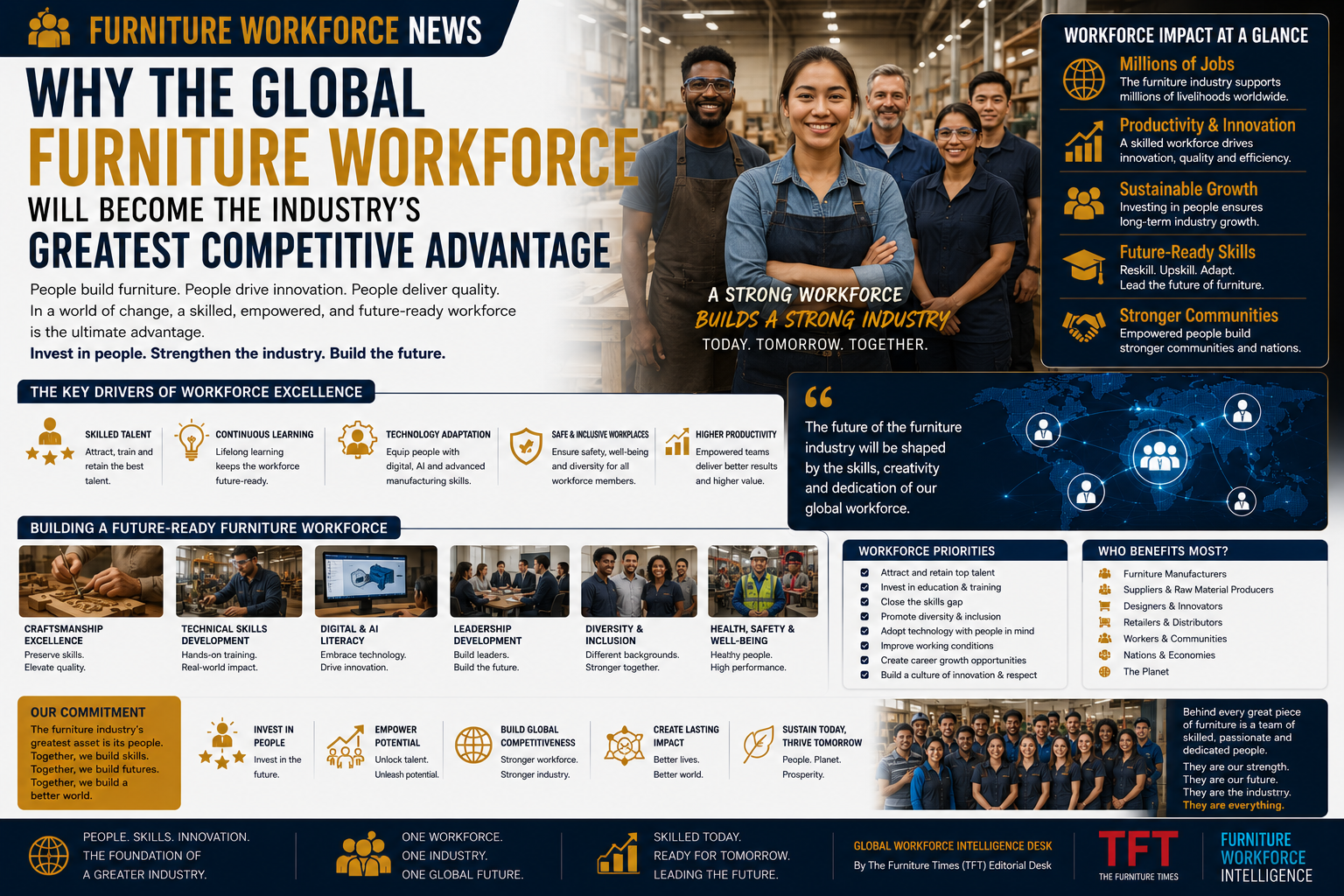
Why the Global Furniture Workforce Will Become the Industry’s Greatest Competitive Advantage
Global Workforce Intelligence Desk
By The Furniture Times (TFT) Editorial Desk
Executive Summary
The global furniture industry has always been powered by people.
Behind every handcrafted chair, precision-engineered kitchen cabinet, luxury hotel project and smart office workstation is a workforce whose knowledge, craftsmanship and dedication shape the industry’s success.
Yet as the furniture industry enters an era defined by Artificial Intelligence (AI), automation, sustainability and digital transformation, one challenge is becoming increasingly urgent:
The global furniture workforce is changing faster than ever before.
Many countries are facing:
- Skilled labour shortages
- An ageing workforce
- Declining interest among younger generations
- Skills mismatches
- Rising labour costs
- Digital transformation challenges
- Global talent competition
At the same time, entirely new career opportunities are emerging across manufacturing, technology, logistics, design, AI, sustainability, digital marketing and international trade.
According to The Furniture Times (TFT), the future of the furniture industry will not be determined solely by factories or technology.
It will be determined by the quality, adaptability and continuous development of its people.
The Furniture Industry Is a People Industry
The furniture industry supports millions of professionals across the world.
Its workforce includes:
- Furniture manufacturers
- Carpenters
- Upholsterers
- Interior designers
- Architects
- CNC machine operators
- Engineers
- Logistics professionals
- Retail specialists
- Export managers
- Sales consultants
- Digital marketers
- Product designers
- Installation teams
- Maintenance technicians
- Customer service professionals
- Entrepreneurs
Together, they form one of the world’s most diverse industrial workforces.
The Global Skills Gap
Many furniture-producing countries are experiencing shortages of skilled workers.
Manufacturers increasingly report difficulty recruiting:
Furniture makers.
Wood machinists.
Cabinet makers.
CNC programmers.
Spray finishing specialists.
Industrial designers.
Production supervisors.
Maintenance engineers.
As experienced professionals retire, attracting and training the next generation becomes a strategic priority.
The Workforce Is Becoming More Digital
Today’s furniture professionals require skills beyond traditional craftsmanship.
Modern workplaces increasingly demand knowledge of:
Artificial Intelligence.
Automation.
ERP systems.
CAD/CAM software.
Digital manufacturing.
Data analysis.
E-commerce.
Digital marketing.
Cloud collaboration.
Technology literacy is becoming an essential workplace skill.
AI Will Change Jobs—Not Eliminate the Workforce
Artificial Intelligence is transforming how people work.
AI can assist with:
Production planning.
Demand forecasting.
Quality inspection.
Inventory management.
Customer service.
Marketing.
Design support.
Rather than replacing skilled professionals, AI enables employees to focus on creativity, problem-solving and higher-value responsibilities.
The future workforce will combine human expertise with digital intelligence.
Lifelong Learning Is Becoming Essential
Furniture businesses can no longer rely on one-time training.
Continuous learning is becoming necessary in areas such as:
Manufacturing technology.
Digital transformation.
Leadership.
Sustainability.
International trade.
Customer experience.
Artificial Intelligence.
Cybersecurity.
Businesses that invest in employee development are better prepared for long-term growth.
Furniture Education Must Evolve
Educational institutions have an important role in preparing future professionals.
The industry increasingly benefits from:
Furniture universities.
Technical colleges.
Vocational training centres.
Design academies.
Research institutions.
Industry certifications.
Apprenticeship programmes.
Closer collaboration between education and industry helps graduates enter the workforce with practical, job-ready skills.
Young Talent Is the Future
One of the industry’s biggest opportunities is attracting younger professionals.
Many young people remain unaware of careers available in:
Furniture technology.
Industrial design.
Smart manufacturing.
Product innovation.
AI development.
International marketing.
Export management.
Entrepreneurship.
The industry must better communicate that furniture offers dynamic, technology-driven and globally connected career opportunities.
Women Are Driving Industry Growth
Women continue making significant contributions across:
Furniture design.
Retail.
Marketing.
Manufacturing leadership.
Entrepreneurship.
Research.
Interior architecture.
Executive management.
Expanding opportunities for women strengthens innovation, diversity and business performance throughout the furniture ecosystem.
Health and Safety Remain Priorities
A productive workforce depends on safe working environments.
Businesses increasingly invest in:
Workplace safety.
Ergonomic equipment.
Protective technologies.
Employee wellness.
Mental health awareness.
Continuous safety training.
Healthy workplaces improve productivity while reducing operational risks.
Furniture Entrepreneurship Creates Employment
Every successful furniture business creates opportunities beyond manufacturing.
Growing companies generate employment in:
Logistics.
Finance.
Technology.
Digital marketing.
Hospitality.
Retail.
Customer support.
After-sales service.
Entrepreneurship remains one of the strongest drivers of workforce expansion.
Global Mobility Creates New Opportunities
International trade allows professionals to work across borders.
Growing demand exists for:
Export specialists.
International buyers.
Technical consultants.
Installation experts.
Furniture project managers.
Industry trainers.
Global collaboration continues expanding career opportunities.
Sustainability Creates New Careers
The transition toward sustainability is creating demand for specialists in:
Circular economy.
Responsible sourcing.
ESG reporting.
Carbon management.
Green manufacturing.
Environmental compliance.
These emerging roles strengthen both industry competitiveness and environmental responsibility.
Digital Marketing Is a Workforce Skill
Every furniture business increasingly requires professionals skilled in:
SEO.
Content creation.
Video marketing.
Social media.
Brand strategy.
AI-assisted communication.
Digital visibility has become an essential business capability.
Logistics Expands Employment
Furniture logistics creates careers in:
Warehousing.
Transportation.
Supply chain management.
Freight forwarding.
Customs compliance.
Last-mile delivery.
White-glove installation.
As international trade grows, logistics employment continues expanding.
Leadership Development Is Critical
Future industry leaders require capabilities in:
Strategic thinking.
Innovation.
Digital transformation.
People management.
Global business.
Financial literacy.
Ethical leadership.
Leadership development strengthens long-term organisational resilience.
Workforce Diversity Builds Stronger Businesses
The furniture industry benefits from professionals with diverse backgrounds, cultures and expertise.
Diverse teams contribute:
Creative ideas.
Broader perspectives.
Better problem-solving.
Improved customer understanding.
Greater innovation.
Inclusive workplaces strengthen competitiveness.
Governments Must Support Workforce Development
National workforce strategies can strengthen the industry through:
Skills development programmes.
Vocational education.
Industry grants.
Apprenticeships.
Research funding.
Technology training.
Public-private partnerships.
Investment in people is an investment in national economic growth.
The Furniture Times Analysis
The furniture industry often celebrates factories, machinery and products.
Yet its greatest asset has always been its workforce.
Technology will continue transforming operations.
However, people will remain central to:
Innovation.
Customer relationships.
Craftsmanship.
Leadership.
Entrepreneurship.
Problem-solving.
The industry’s future depends upon empowering its workforce rather than simply expanding production capacity.
Final Verdict
The next generation of global furniture leaders will not simply build better factories.
They will build better people.
Businesses that invest in:
Education.
Skills.
Technology.
Leadership.
Employee wellbeing.
Innovation.
Continuous learning.
Will shape the future of the global furniture industry.
Because machines can improve productivity.
Artificial Intelligence can improve efficiency.
Automation can accelerate manufacturing.
But only skilled, motivated and forward-thinking people can build an industry that continues inspiring the world.
The future of furniture begins with its workforce.
And the countries that invest in their people today will lead the global furniture economy tomorrow.
By The Furniture Times (TFT) Editorial Desk
Global Workforce Intelligence Desk | July 2026
“TFT tells their story. FISE helps the world find them.”
The furniture industry ecosystem is a $1 Trillion Dollar Industry.
