
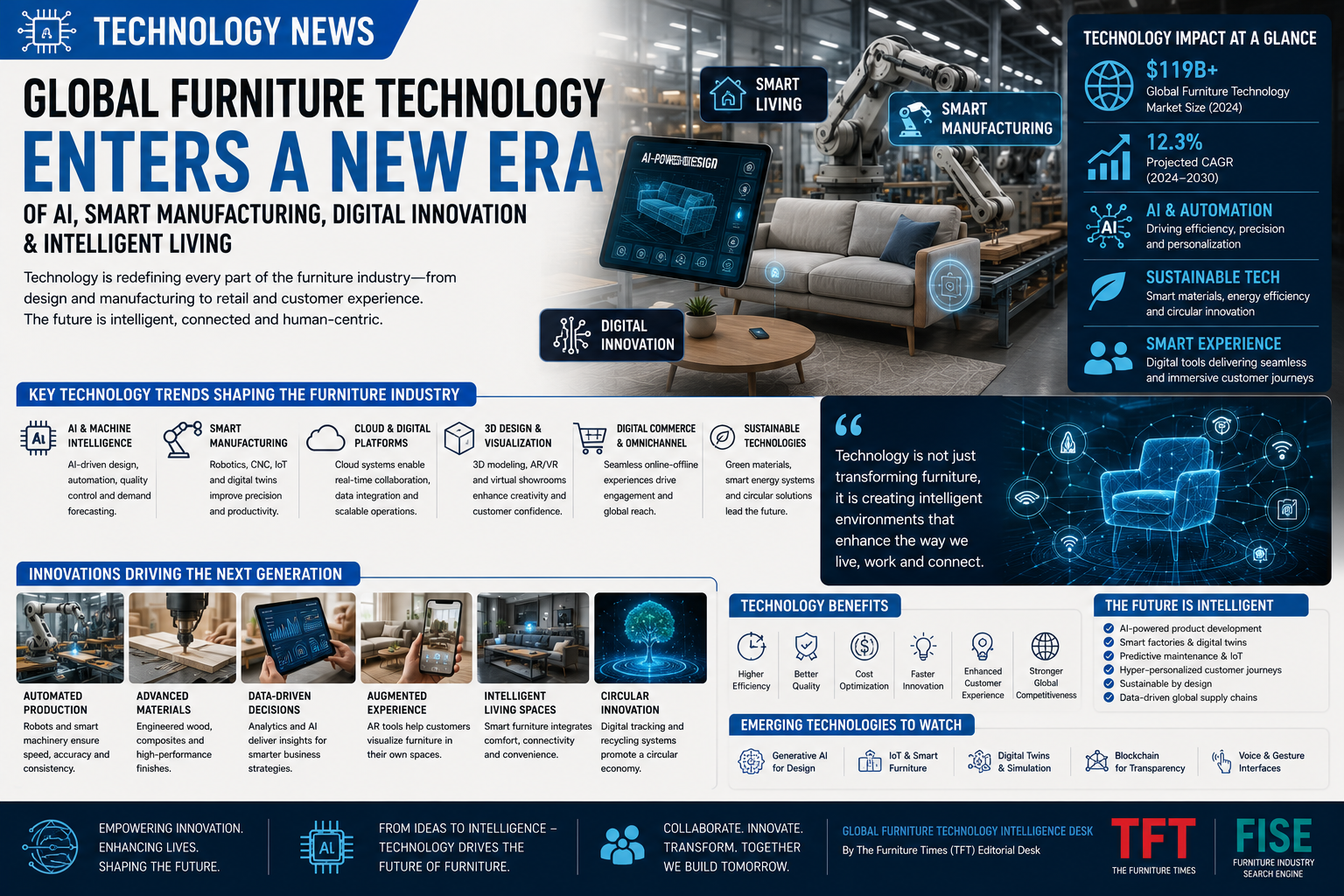
Global Furniture Technology Enters a New Era of AI, Smart Manufacturing, Digital Innovation & Intelligent Living
Global Furniture Technology Intelligence Desk
By The Furniture Times (TFT) Editorial Desk
Executive Summary
Technology has become one of the most powerful forces reshaping the global furniture industry.
For generations, furniture manufacturing relied primarily on skilled craftsmanship, mechanical machinery and labour-intensive production. While craftsmanship remains at the heart of the industry, today’s furniture businesses are rapidly embracing Artificial Intelligence (AI), automation, robotics, digital manufacturing, smart materials and connected technologies.
The furniture industry is no longer defined only by what it produces.
It is increasingly defined by how intelligently it designs, manufactures, markets, sells and services products.
Technology is transforming every stage of the furniture ecosystem—from forests and factories to warehouses, showrooms, homes and offices.
According to The Furniture Times (TFT), furniture technology is no longer simply about machines.
It is about creating an intelligent ecosystem where people, products, factories, customers and digital platforms work together to deliver greater value, higher productivity and better customer experiences.
Technology Is Redefining the Furniture Industry
The furniture industry is entering its Fourth Industrial Revolution.
Manufacturers are integrating digital technologies into operations that were once entirely manual.
Today’s technology ecosystem includes:
- Artificial Intelligence (AI)
- Machine Learning
- Robotics
- CNC Manufacturing
- Internet of Things (IoT)
- Digital Twins
- Cloud Computing
- Smart Sensors
- Automation
- Data Analytics
- Augmented Reality (AR)
- Virtual Reality (VR)
- 3D Printing
These technologies are improving productivity while opening entirely new business opportunities.
Artificial Intelligence Is Changing Everything
Artificial Intelligence is becoming one of the industry’s most valuable business tools.
Furniture companies are using AI to support:
Product design.
Demand forecasting.
Production scheduling.
Inventory management.
Customer service.
Marketing.
Content creation.
Product recommendations.
Translation.
Sales forecasting.
Quality inspection.
AI helps businesses make faster and better-informed decisions.
Rather than replacing human expertise, it enhances human capabilities.
Smart Manufacturing Is Becoming the Standard
Factories around the world are investing in:
Computer-controlled machinery.
Robotics.
Automated production lines.
Digital production monitoring.
Predictive maintenance.
Real-time quality control.
Smart manufacturing enables businesses to produce more efficiently while maintaining consistent quality.
CNC Technology Continues to Evolve
Computer Numerical Control (CNC) machinery remains one of the industry’s most important technological advancements.
Modern CNC systems provide:
Greater precision.
Reduced waste.
Higher productivity.
Complex machining.
Repeatable accuracy.
Custom production.
CNC technology supports both large-scale manufacturing and customised furniture production.
Robotics Improve Productivity
Industrial robots increasingly assist with:
Material handling.
Assembly.
Sanding.
Painting.
Packaging.
Warehouse operations.
Robots perform repetitive tasks while allowing skilled employees to focus on quality, innovation and craftsmanship.
Internet of Things (IoT)
Connected devices enable manufacturers to monitor:
Machine performance.
Production efficiency.
Energy consumption.
Equipment health.
Environmental conditions.
Inventory movement.
Real-time data helps businesses improve operational performance.
Digital Twins
Digital Twin technology creates virtual models of factories, products and manufacturing systems.
Businesses can:
Test production changes.
Predict maintenance.
Improve layouts.
Reduce downtime.
Optimise workflows.
Digital Twins reduce risk before physical changes are implemented.
3D Furniture Design
Modern design software enables:
Rapid prototyping.
Realistic visualisation.
Material simulation.
Customer customisation.
Design collaboration.
Manufacturers can evaluate products digitally before production begins.
Virtual Reality & Augmented Reality
Customers increasingly expect immersive shopping experiences.
VR and AR allow users to:
Place furniture virtually inside rooms.
Visualise colours.
Compare layouts.
Experience products before purchasing.
These technologies reduce purchasing uncertainty while improving customer confidence.
Smart Furniture Is Expanding
Technology is also transforming furniture itself.
Examples include:
Height-adjustable desks.
Wireless charging tables.
Smart beds.
IoT-enabled office furniture.
Health-monitoring seating.
Integrated lighting.
Connected storage.
Furniture is becoming part of the smart home ecosystem.
AI-Powered Customer Service
Furniture retailers increasingly use AI for:
Virtual assistants.
Customer support.
Product recommendations.
Room planning.
Order tracking.
Personalised shopping experiences.
Customers receive faster assistance while businesses improve service efficiency.
Digital Commerce Continues Growing
Technology supports every stage of online furniture sales.
Businesses invest in:
AI search.
Product visualisation.
Secure payments.
Inventory integration.
Real-time availability.
Mobile commerce.
Digital marketplaces.
Technology improves both convenience and customer satisfaction.
Data Is Becoming a Strategic Asset
Modern furniture businesses collect data to understand:
Customer behaviour.
Product performance.
Market demand.
Inventory levels.
Marketing effectiveness.
Production efficiency.
Businesses that use data effectively make better strategic decisions.
Technology Supports Sustainability
Innovation also improves environmental performance.
Technology helps reduce:
Material waste.
Energy consumption.
Transportation costs.
Inventory waste.
Carbon emissions.
Sustainability and technology increasingly work together.
Supply Chains Are Becoming Intelligent
Modern logistics systems use technology to support:
Shipment tracking.
Warehouse automation.
Demand forecasting.
Supplier coordination.
Inventory optimisation.
Real-time reporting.
Intelligent supply chains improve reliability and customer satisfaction.
Furniture Design Is Becoming Collaborative
Cloud-based technologies enable designers, engineers and manufacturers to collaborate across countries in real time.
Projects move faster while reducing communication barriers.
Global collaboration supports innovation.
Technology Supports Furniture Tourism
Emerging Furniture Tourism initiatives can also benefit from technology.
Future visitors may experience:
Digital factory passports.
AI travel assistants.
Virtual factory tours.
Interactive manufacturing demonstrations.
Smart visitor management.
Technology strengthens educational and business travel experiences.
Education Must Keep Pace
Technology adoption requires skilled professionals.
The industry increasingly needs:
AI specialists.
CNC programmers.
Robotics engineers.
Digital marketers.
Industrial designers.
Data analysts.
Automation technicians.
Continuous learning becomes essential for long-term competitiveness.
Opportunities for SMEs
Technology is no longer available only to large corporations.
Small and medium-sized manufacturers can adopt:
Cloud software.
Affordable automation.
AI tools.
Digital marketing.
Video communication.
E-commerce.
Industry platforms.
Technology enables SMEs to compete globally.
Challenges Ahead
Despite significant opportunities, businesses continue managing:
Investment costs.
Cybersecurity.
Skills shortages.
Technology integration.
Digital transformation.
Change management.
Successful implementation requires leadership, planning and workforce development.
The Future of Furniture Technology
The next decade may include:
Artificial General Intelligence (AGI).
Autonomous factories.
Predictive manufacturing.
AI procurement.
Fully connected smart furniture.
Advanced robotics.
Carbon-neutral production.
Digital supply networks.
Human-AI collaboration.
Technology will increasingly become the foundation of competitive advantage.
The Furniture Times Analysis
Technology is no longer an optional investment.
It has become the operating system of the modern furniture industry.
Businesses that embrace:
Artificial Intelligence.
Automation.
Digital manufacturing.
Customer experience.
Data.
Innovation.
Will shape the future of global furniture leadership.
Those that delay digital transformation risk falling behind in an increasingly competitive international marketplace.
Final Verdict
Furniture technology is transforming the industry faster than at any other time in history.
The companies that succeed over the next decade will not necessarily be those with the largest factories.
They will be those that combine:
Human creativity.
Digital intelligence.
Operational excellence.
Customer understanding.
Continuous innovation.
Technology does not replace craftsmanship.
It enhances it.
It does not replace people.
It empowers them.
The future of the furniture industry belongs to businesses that see technology not as a cost, but as an investment in growth, resilience and long-term competitiveness.
Because tomorrow’s furniture companies will not simply manufacture products.
They will build intelligent ecosystems powered by people, innovation and technology.
By The Furniture Times (TFT) Editorial Desk
Global Furniture Technology Intelligence Desk | July 2026
“TFT tells their story. FISE helps the world find them.”
The furniture industry ecosystem is a $1 Trillion Dollar Industry.
