
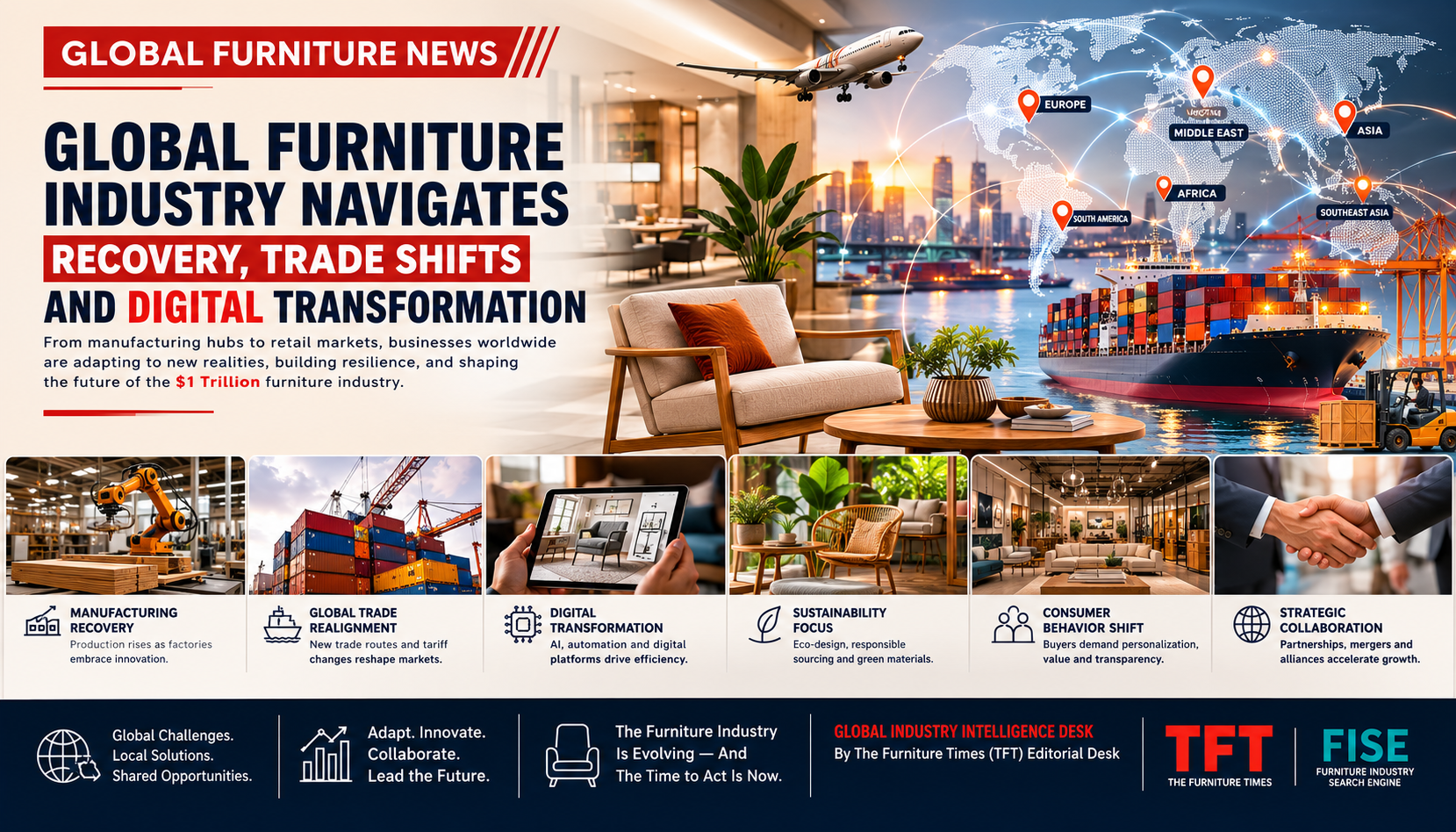
Global Furniture News
Global Furniture Industry Navigates Recovery, Trade Shifts and Digital Transformation
Global Industry Intelligence Desk
By The Furniture Times (TFT) Editorial Desk
Executive Summary
The global furniture industry is entering the second half of 2026 with cautious optimism. While economic uncertainty, inflationary pressures and geopolitical developments continue to influence international trade, manufacturers, retailers and suppliers are adapting through innovation, sustainability and digital transformation.
Across Asia, Europe, the Americas, the Middle East and Africa, businesses are investing in automation, AI, sustainable manufacturing and diversified export markets. Industry leaders are also placing greater emphasis on customer experience, resilient supply chains and digital visibility to remain competitive.
According to The Furniture Times (TFT), the industry is no longer focused solely on recovering from recent global disruptions—it is building the foundations of a smarter, more connected and more resilient furniture economy.
Global Furniture Market Continues to Expand
Industry forecasts continue to indicate steady long-term growth for the global furniture market.
Several market analyses project the sector will continue its upward trajectory over the coming years, supported by:
- Urbanisation
- Residential construction
- Hospitality investment
- Office modernisation
- Sustainable furniture demand
- Digital commerce
- AI-driven manufacturing
Depending on methodology, market forecasts suggest the global furniture sector is on course to approach or exceed USD 1 trillion over the next decade.
Recovery Remains Uneven
Although demand is improving in many markets, recovery varies by region and product category.
Manufacturers continue managing:
- Higher operating costs
- Labour shortages
- Energy prices
- Freight costs
- Shifting consumer demand
Industry analysts note that businesses capable of producing smaller batches, offering greater customisation and improving delivery speed are better positioned to compete.
Sustainability Moves to the Centre of Business Strategy
Environmental responsibility is no longer simply a marketing initiative.
Furniture companies are increasingly investing in:
- Certified timber
- Recycled materials
- Low-emission finishes
- Circular manufacturing
- Repair and refurbishment
- Durable product design
International exhibitions are also placing greater emphasis on green manufacturing and low-carbon supply chains.
Artificial Intelligence Is Transforming Operations
Artificial Intelligence continues to influence every stage of the furniture value chain.
Businesses are adopting AI for:
- Demand forecasting
- Production scheduling
- Customer service
- Product recommendations
- Marketing content
- Inventory management
- Product visualisation
Rather than replacing human expertise, AI is increasingly supporting faster and better-informed decision-making.
Global Trade Is Being Reshaped
International furniture trade continues to evolve.
Manufacturers are diversifying export markets while monitoring changes in tariffs, trade agreements and geopolitical developments.
Countries are strengthening regional partnerships and expanding into new destinations to reduce dependence on a limited number of export markets.
Malaysia Calls for Stronger Industry Support
Malaysia’s furniture industry has renewed calls for stronger policy support as manufacturers respond to rising costs, global competition and softer export demand.
Industry representatives have emphasised the importance of improving competitiveness, supporting SMEs and strengthening long-term industry development.
Brazil Records Export Growth
Brazil’s wood furniture exports increased by 7% in June 2026 compared with the same month last year, while average export prices also rose, suggesting resilient international demand despite ongoing market uncertainty.
Vietnam Continues Strengthening Export Position
Vietnam remains one of the world’s leading furniture exporters.
The country’s wood and furniture sector continues investing in sustainability, value-added manufacturing and export diversification while navigating changing international trade conditions.
Furniture Trade Exhibitions Continue Driving Business
Global exhibitions remain essential meeting points for the industry.
Major events continue focusing on:
- Design innovation
- Digital manufacturing
- Sustainability
- AI technologies
- International sourcing
Exhibitions such as CIFF continue attracting buyers, manufacturers and designers from around the world.
Consumers Want More Than Furniture
Modern buyers increasingly expect:
- Better design
- Sustainability
- Durability
- Personalisation
- Wellness-focused products
- Smart furniture
- Transparent sourcing
Customer expectations continue shifting from simply purchasing products to investing in long-term value.
Digital Visibility Has Become Essential
The purchasing journey increasingly begins online.
Customers search for:
Manufacturers.
Retailers.
Reviews.
Buying guides.
Videos.
Project portfolios.
As a result, businesses are investing more heavily in:
- SEO
- AI-ready websites
- Content marketing
- Product data
- Reviews
- Local search
- Digital branding
Visibility has become a competitive advantage.
Challenges Remain
Despite positive momentum, several challenges continue affecting businesses worldwide.
These include:
- Rising production costs
- Supply chain uncertainty
- Skilled labour shortages
- Raw material price volatility
- International competition
- Digital transformation requirements
Companies that adapt quickly continue strengthening their market positions.
The Furniture Times Analysis
The furniture industry is no longer defined only by manufacturing.
The next generation of industry leaders will combine:
Manufacturing excellence.
Innovation.
Artificial Intelligence.
Sustainability.
Digital marketing.
Customer trust.
Global partnerships.
Businesses that invest in these areas today will be better prepared for tomorrow’s opportunities.
Final Verdict
The global furniture industry is moving beyond recovery.
It is entering a new era defined by:
Innovation.
Technology.
Resilience.
Sustainability.
International collaboration.
Businesses that remain flexible, embrace digital transformation and continue investing in quality and customer trust will help shape the future of the global furniture ecosystem.
The industry’s greatest opportunities now lie not only in producing exceptional furniture, but also in building stronger brands, smarter factories and deeper relationships with customers across the world.
By The Furniture Times (TFT) Editorial Desk
Global Industry Intelligence Desk | July 2026
“TFT tells their story. FISE helps the world find them.”
The furniture industry ecosystem is a $1 Trillion Dollar Industry.
