How Buyers Actually Source Furniture in 2026 (And Why Most Suppliers Are Missing Them)
By The Furniture Times | Global Industry Intelligence Desk | May 2026
Introduction: The Biggest Misunderstanding in the Industry
Most suppliers believe they understand how buyers source furniture.
They believe:
Buyers visit exhibitions
Buyers rely on relationships
Buyers contact known suppliers
That model once worked.
But in 2026, it is no longer the reality.
The Core Truth
Buyers have changed.
Suppliers have not.
This gap is now one of the biggest hidden problems in the global furniture ecosystem.
1. The Old Buyer Journey (Now Broken)
Traditional Sourcing Model
Attend trade fairs
Meet suppliers
Exchange contacts
Follow up manually
Negotiate over time
Limitations
Time-consuming
Limited options
Geography-dependent
Relationship-driven
This model cannot scale in a global, fast-moving market
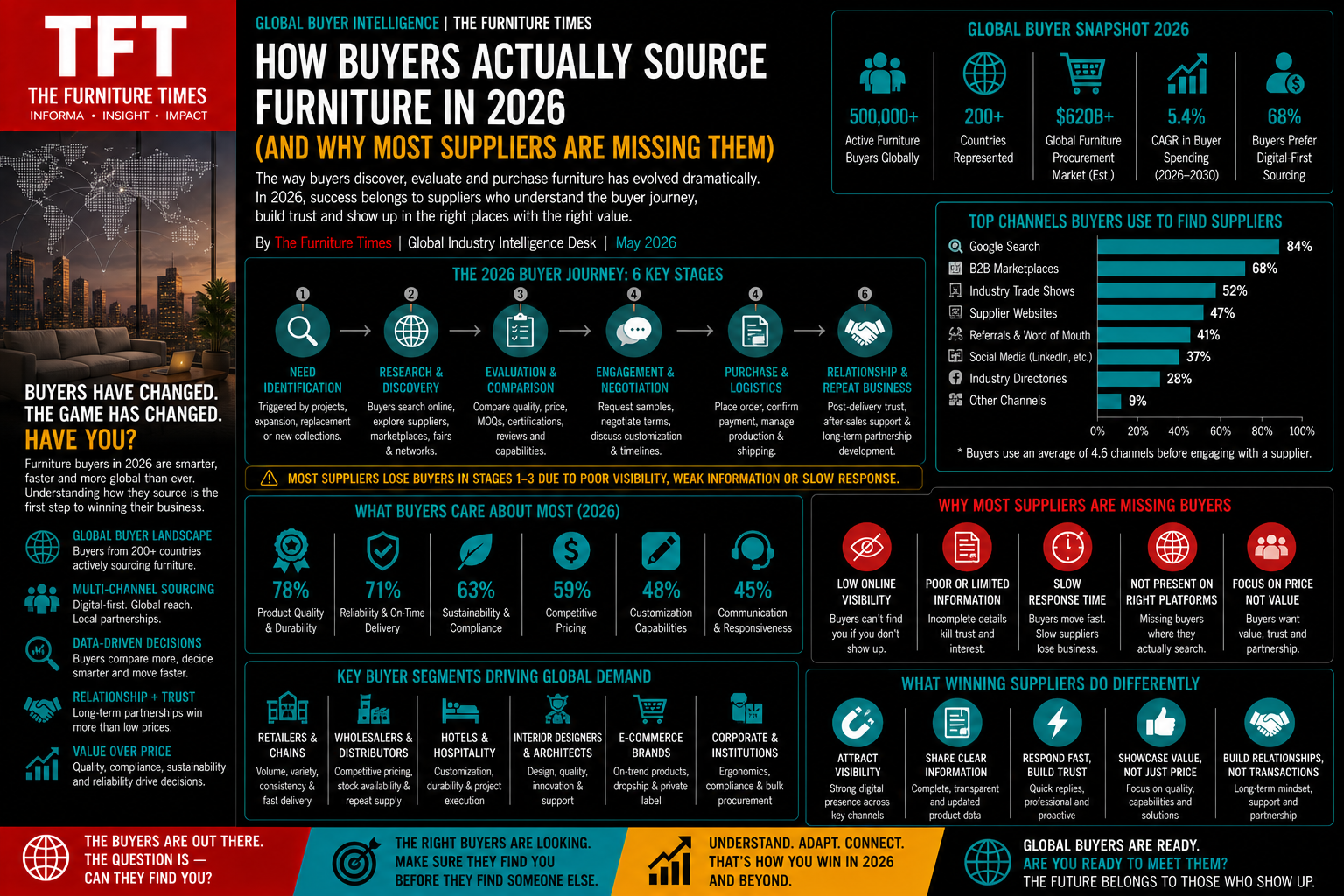
2. The New Buyer Journey (2026 Reality)
Today’s buyers follow a completely different path:
Step 1: Search
Buyers start with:
Product category
Location
Requirement
👉 Example:
“Hotel furniture supplier in Southeast Asia”
Step 2: Compare
Buyers evaluate:
Multiple suppliers
Pricing
Capability
Speed
Step 3: Shortlist
Only a few suppliers make it to:
Final consideration
Direct contact
Step 4: Decide
Decision is based on:
Availability
Responsiveness
Trust
Search → Compare → Shortlist → Decide
The Most Important Insight
If you are not in the search results,
you are not in the decision.
3. The Visibility Gap
What Buyers Are Doing
Searching globally
Comparing instantly
Moving faster
What Suppliers Are Doing
Waiting for inquiries
Attending exhibitions
Relying on old networks
Supply exists. Demand exists.
But connection is broken.
4. The Data Reality
Key Behavioral Patterns
1. Buyers Focus on the First Results
Top results get attention
Lower visibility = ignored
2. Speed Matters
Faster response wins
Delays lose deals
3. Trust Comes from Structure
Clear profiles
Verified data
Transparent information
Visibility creates trust before contact
5. Why Most Suppliers Are Missing Buyers
1. No Structured Presence
No categorized listings
No searchable profiles
2. Overdependence on Old Channels
Exhibitions
Referrals
3. Lack of Positioning
Unclear category
No defined offering
4. No Global Visibility
Limited to local networks
Suppliers are not invisible because they are weak.
They are invisible because they are not structured.
6. The Hidden Loss
Every day:
Buyers search
Suppliers exist
But:
They do not find each other
Result
Lost deals
Idle capacity
Missed growth
7. TFT Deep Analysis: The Industry Is Buyer-Controlled Now
The industry has shifted:
Phase 1: Supplier-Controlled Market
Limited options
Phase 2: Balanced Market
Growing competition
Phase 3: Buyer-Controlled Market (NOW)
Buyers choose from what they see
8. The New Rule
Visibility determines opportunity
9. The Role of FISE
The Furniture Industry Search Engine (FISE) solves this gap:
For Buyers
Access global suppliers
Compare instantly
Reduce sourcing time
For Suppliers
Become discoverable
Enter buyer searches
Increase inquiries
The Power Statement
TFT explains buyer behavior.
FISE connects buyers and suppliers.
10. Example: Invisible vs Visible Supplier
Invisible Supplier
Exists
Produces
Unknown
Visible Supplier
Listed
Structured
Found
👉 Result:
More inquiries
More deals
More growth
11. What Suppliers Must Do Now
1. Get Listed
Presence is the first step
2. Define Your Category
Be searchable
3. Structure Your Data
Make it indexable
4. Think Like a Buyer
Ask:
👉 “How would someone find me?”
5. Act Fast
Delay = lost opportunities
12. Key Takeaways
1. Buyers Have Changed
2. Search Is the Starting Point
3. Visibility Determines Selection
4. Most Suppliers Are Missing
5. Structured Presence Wins
Conclusion: The Real Competition
Suppliers often believe they are competing against other suppliers.
They are not.
Final Thought
You are not losing to competitors.
You are losing to visibility.
If buyers cannot find you,
you do not exist in their world.

Related Posts
Global Furniture Industry Shows Signs of Strategic Transformation Amid Economic Uncertainty
Why Core Values Will Become the New Competitive Advantage in the Furniture Industry