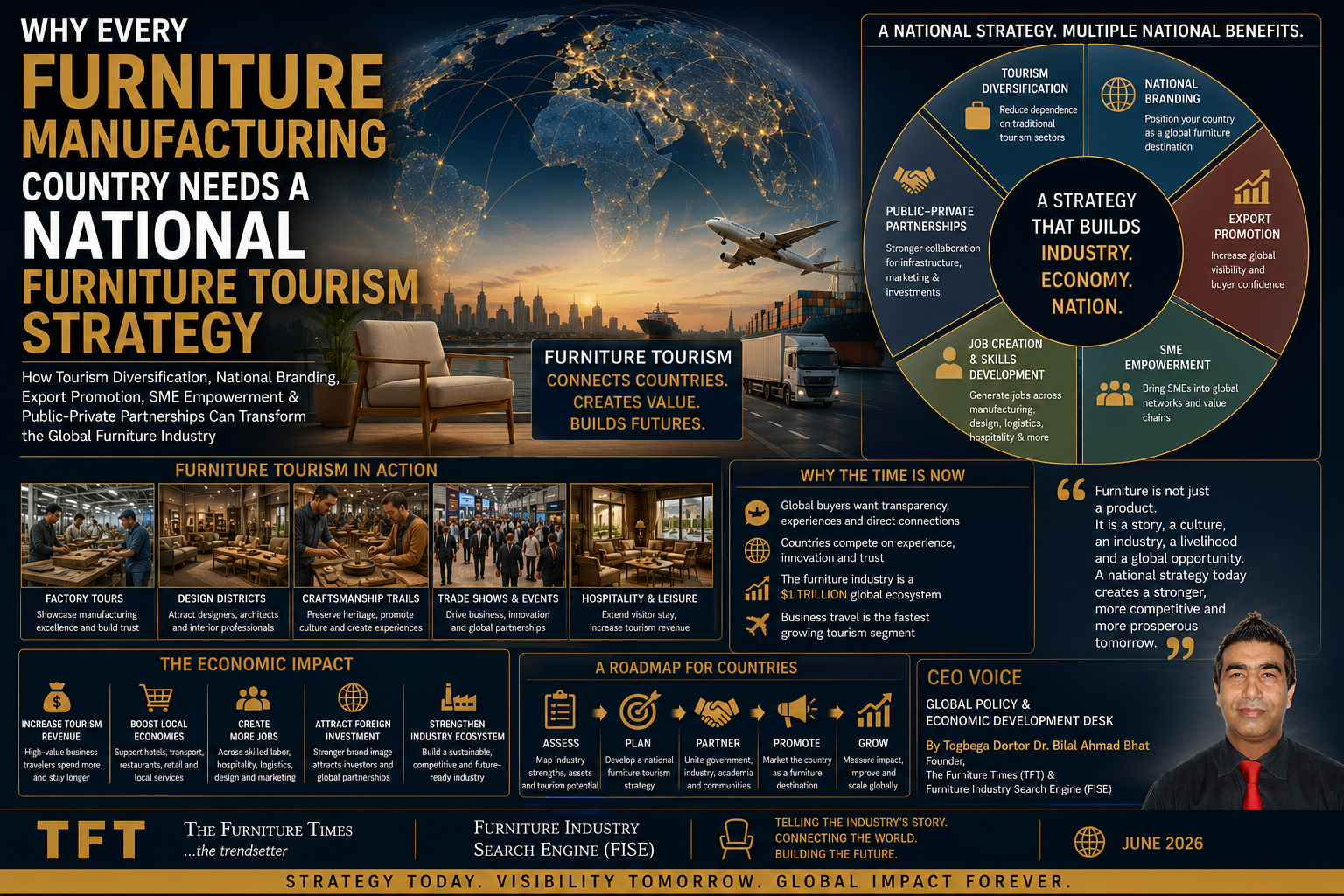
Why Every Furniture Manufacturing Country Needs a National Furniture Tourism Strategy
How Tourism Diversification, National Branding, Export Promotion, SME Empowerment & Public-Private Partnerships Can Transform the Global Furniture Industry
Global Policy & Economic Development Desk
By The Furniture Times (TFT) & Furniture Industry Search Engine (FISE)
June 2026
Every country searches for new engines of economic growth.
Governments look for sectors that can create jobs, attract foreign visitors, strengthen exports, promote national identity, support SMEs, increase investment and build long-term competitiveness.
Tourism has always been one of the most powerful tools for achieving these goals.
But the tourism economy is changing.
Countries are no longer relying only on beaches, monuments, shopping malls and leisure destinations.
They are diversifying into specialised tourism sectors.
Medical tourism.
Educational tourism.
Sports tourism.
Food tourism.
Wine tourism.
Eco-tourism.
Business tourism.
Industrial tourism.
Yet one major opportunity remains largely missing from national tourism strategies.
Furniture Tourism.
For countries with strong furniture manufacturing industries, this represents a powerful opportunity.
A national Furniture Tourism strategy can turn factories into destinations, furniture cities into international brands, manufacturing clusters into tourism assets, and SMEs into globally visible businesses.
The furniture industry is no longer only an export sector.
It can become a tourism sector.
And countries that understand this early may gain a major competitive advantage.
Furniture Manufacturing Is Already a National Asset
Many countries have spent decades building strong furniture manufacturing ecosystems.
They have:
- Skilled workers
- Export manufacturers
- Furniture clusters
- Design schools
- Woodworking traditions
- Material suppliers
- Machinery providers
- Trade associations
- Furniture exhibitions
- Logistics networks
However, most governments view these assets only through the lens of production and export.
They rarely view them through the lens of tourism.
That is a missed opportunity.
A furniture cluster can be more than an industrial zone.
It can become a business tourism destination.
Tourism Diversification Needs Industry-Based Experiences
Tourism diversification is essential for national resilience.
Countries dependent on one type of tourism are vulnerable to:
- Seasonal demand
- Economic slowdowns
- Global travel disruptions
- Changing consumer preferences
- Climate risks
- Political uncertainty
Furniture Tourism offers year-round business activity.
Factory visits.
Buyer missions.
Training tours.
Sourcing trips.
Design experiences.
Export meetings.
Investment delegations.
Unlike seasonal leisure tourism, business tourism can operate continuously.
This makes it valuable for long-term tourism planning.
National Branding Through Furniture
Countries are often known for specific industries.
Italy is known for fashion and design.
Germany for engineering.
Japan for precision.
Switzerland for watches.
France for luxury.
Furniture-producing countries can also build strong national identities.
A national Furniture Tourism strategy can promote:
- Local craftsmanship
- Sustainable materials
- Design innovation
- Manufacturing excellence
- Export reliability
- Cultural heritage
- Regional specialisation
Furniture becomes part of national storytelling.
A country does not only export products.
It exports identity.
Export Promotion Through Experience
Traditional export promotion often depends on brochures, exhibitions and trade missions.
Furniture Tourism adds something more powerful.
Experience.
When international buyers visit factories, they see:
- Production systems
- Material quality
- Workforce skills
- Quality control
- Sustainability practices
- Design capabilities
This builds confidence.
Confidence creates trade.
Trade creates exports.
A buyer who visits a factory is more likely to trust the manufacturer than a buyer who only sees a catalogue.
SMEs Need Tourism More Than Large Companies
Large furniture companies already have visibility.
They attend international exhibitions.
They have sales teams.
They maintain export networks.
They invest in marketing.
SMEs often do not have these advantages.
Many small furniture manufacturers, craftsmen, workshops and startups produce excellent products but remain invisible.
A national Furniture Tourism strategy can help SMEs by:
- Including them in factory routes
- Promoting them in official tourism materials
- Connecting them with international buyers
- Supporting digital listings
- Creating certified business tour programmes
- Helping them prepare for export
Furniture Tourism can democratise opportunity.
It can bring buyers to businesses that could never afford to reach those buyers internationally.
Furniture Cities Can Become National Growth Engines
Many countries already have furniture cities or clusters.
Examples include:
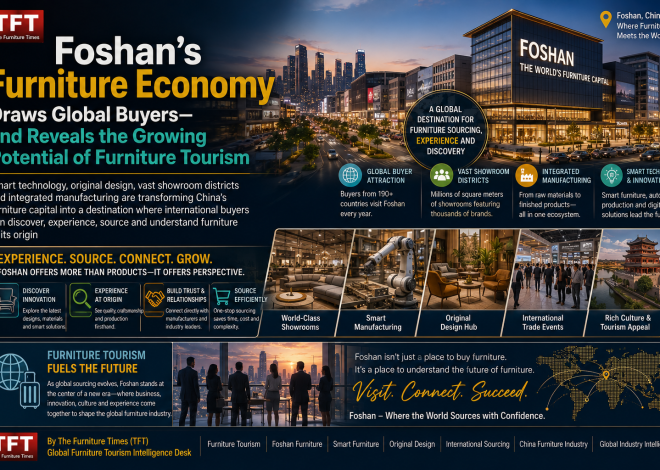
Foshan in China.
Muar in Malaysia.
Jepara in Indonesia.
High Point in the United States.
Milan and Brianza in Italy.
Poznań in Poland.
Binh Duong in Vietnam.
These cities have the potential to become international business destinations.
A national strategy can support:
- Furniture tourism routes
- Factory tour certification
- Local hotel partnerships
- Business visitor centres
- Export promotion offices
- Furniture museums
- Design districts
- Training academies
This transforms industrial clusters into recognised tourism ecosystems.
Government Policy Recommendations
A national Furniture Tourism strategy requires structured policy support.
Governments should consider:
1. Official Recognition
Recognise Furniture Tourism as part of business and industrial tourism.
2. National Mapping
Identify furniture clusters, manufacturers, design centres, exhibitions and heritage zones.
3. SME Participation
Create programmes helping SMEs prepare for international visitors.
4. Digital Infrastructure
Support searchable online profiles for manufacturers and furniture destinations.
5. Certification
Develop official certified factory tour standards.
6. Tourism Packages
Work with tour operators to create furniture-focused business travel itineraries.
7. Export Linkages
Connect Furniture Tourism with national export promotion agencies.
8. Education Partnerships
Include universities, design schools and vocational institutions.
9. Investment Promotion
Use tours to attract investors into furniture manufacturing and related industries.
10. Global Promotion
Promote the country internationally as a furniture business destination.
Public-Private Partnerships Are Essential
Furniture Tourism cannot be built by government alone.
It requires collaboration between:
- Tourism ministries
- Trade ministries
- Export agencies
- Furniture associations
- Chambers of commerce
- Manufacturers
- Hotels
- Airlines
- Universities
- Logistics companies
- Technology platforms
- Media organisations
Public-private partnerships create structure, credibility and long-term sustainability.
Government provides recognition and policy.
Industry provides experience.
Media provides visibility.
Technology provides discoverability.
Together they create a functioning ecosystem.
The Economic Impact Can Be Significant
Furniture Tourism can generate revenue through:
- Hotel stays
- Local transportation
- Restaurants
- Translation services
- Business consulting
- Factory visits
- Product sourcing
- Export orders
- Logistics
- Investment deals
- Training programmes
- Conferences
- Local retail spending
One international buyer may create immediate tourism spending and long-term export revenue.
That is the power of business tourism.
Education and Workforce Development
Furniture Tourism can also strengthen education.
Students can participate in:
- Factory learning tours
- Design exposure visits
- Manufacturing workshops
- Export training
- Sustainability programmes
This helps young people understand career opportunities within the furniture industry.
A national Furniture Tourism strategy can inspire the next generation of manufacturers, designers, entrepreneurs and exporters.
Sustainability and ESG Opportunities
Many countries are promoting green growth.
Furniture Tourism can highlight:
- Sustainable timber
- Circular manufacturing
- Waste reduction
- Low-carbon production
- Furniture recycling
- Refurbishment
- Renewable materials
This strengthens national ESG positioning.
Buyers increasingly want to see sustainability practices in person.
Factory visits create transparency.
Why Digital Discoverability Matters
A national strategy will fail if destinations cannot be found online.
Furniture manufacturers must be searchable.
Furniture cities must be searchable.
Factory tours must be searchable.
Design centres must be searchable.
This is where Furniture Industry Search Engine (FISE) becomes strategically important.
FISE can help furniture destinations, manufacturers, SMEs and service providers become discoverable to international buyers.
Searchability is the first step toward tourism.
The Role of The Furniture Times & FISE
The Furniture Times believes Furniture Tourism should become a recognised pillar of the global furniture economy.
TFT provides thought leadership, policy discussion, industry storytelling and international visibility.
FISE provides the search infrastructure needed to connect buyers with manufacturers, destinations, suppliers and services.
Together, TFT and FISE can help countries develop stronger, more visible and more inclusive furniture ecosystems.
TFT & FISE Analysis
Every furniture manufacturing country has two choices.
It can continue treating furniture only as a production sector.
Or it can recognise furniture as a national business tourism opportunity.
The second path creates more value.
It strengthens exports.
Supports SMEs.
Attracts investment.
Builds national identity.
Creates jobs.
Increases international confidence.
Promotes sustainability.
And connects the country to the global furniture ecosystem.
Furniture Tourism is not a replacement for traditional tourism.
It is a new pillar of tourism diversification.
Final Verdict
Every country with a serious furniture manufacturing base should develop a national Furniture Tourism strategy.
The opportunity is too large to ignore.
Factories can become destinations.
Furniture cities can become national brands.
SMEs can become globally visible.
Visitors can become buyers.
Tourism can become exports.
Education can become workforce development.
And national economies can become stronger.
The countries that move first will shape the future of Furniture Business Tourism.
The countries that wait may lose one of the most powerful opportunities emerging in the global furniture industry.
Because in the future, furniture will not only be something countries manufacture.
It will be something the world travels to experience.
By The Furniture Times (TFT) & Furniture Industry Search Engine (FISE)
Global Policy & Economic Development Desk | June 2026
“TFT tells their story. FISE helps the world find them.”
The furniture industry ecosystem is a $1 Trillion Dollar Industry.