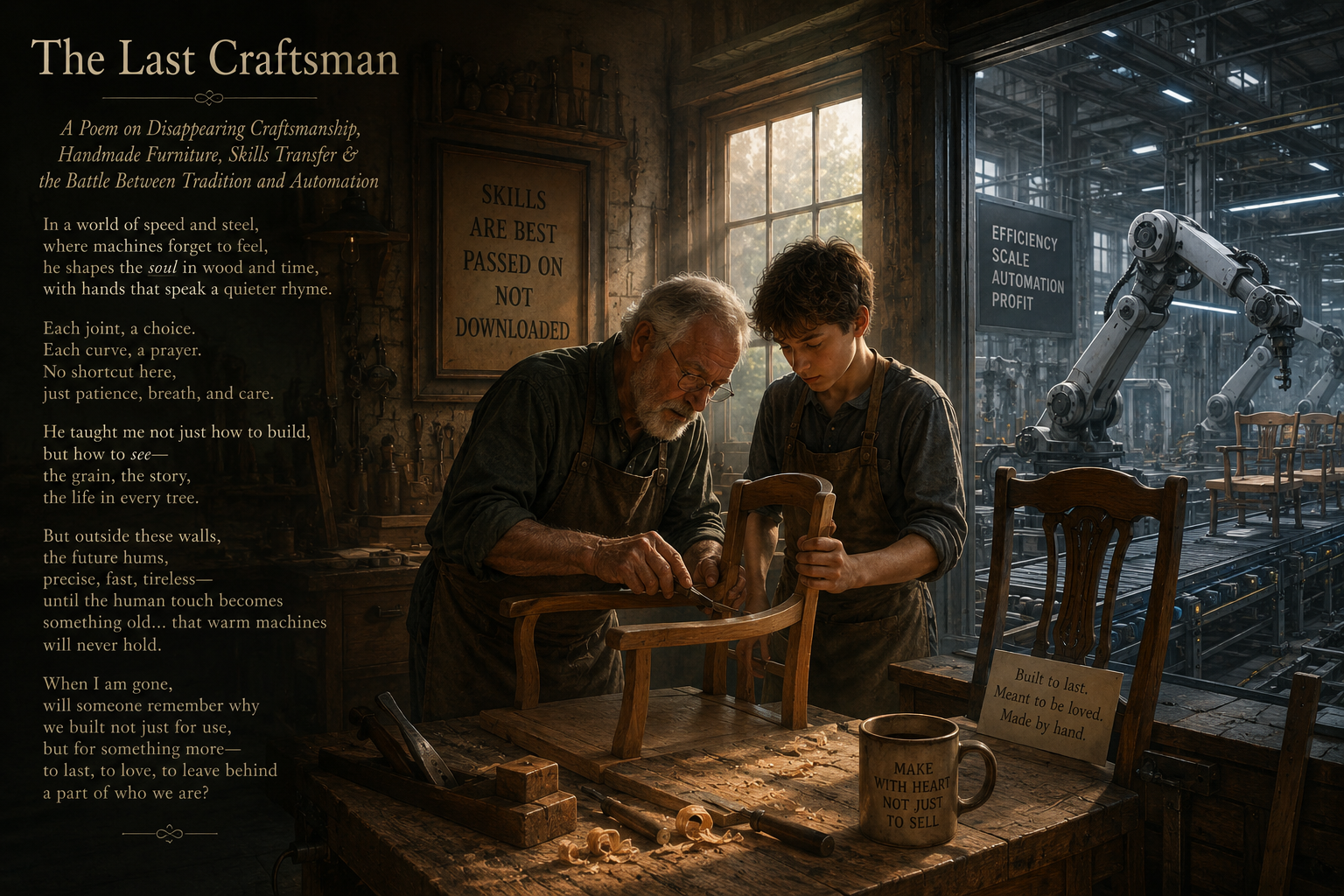
The Last Craftsman
A Poem on Disappearing Craftsmanship, Handmade Furniture, Skills Transfer & the Battle Between Tradition and Automation
By Dr. Bilal Ahmad Bhat / Serial Entrepreneur
There was a time
when furniture was not manufactured.
It was crafted.
Born not from machines,
but from hands.
Hands weathered by seasons.
Hands marked by labor.
Hands carrying stories
older than the timber they touched.
A craftsman would stand before a piece of wood
and see what others could not.
Not a plank.
Not a board.
Not a raw material.
But possibility.
A dining table where generations would gather.
A chair that would witness decades of conversations.
A cabinet that would guard memories.
A bed that would cradle dreams.
The craftsman did not make furniture.
He gave form to life itself.
His workshop was his universe.
The scent of freshly cut timber
filled the air like poetry.
The sound of chisels
was music.
The rhythm of sanding
was meditation.
Every cut carried intention.
Every joint carried precision.
Every imperfection carried character.
The craftsman knew wood.
Not through software.
Not through data.
Not through manuals.
But through touch.
He could feel the grain.
Understand its strength.
Respect its weakness.
Predict its movement.
Listen to its language.
Because wood spoke.
And the craftsman understood.
For centuries,
skills traveled from one generation to another.
A father teaching a son.
A master guiding an apprentice.
A grandfather sharing secrets
that never existed in books.
Knowledge was not downloaded.
It was lived.
It was earned.
It was inherited through patience.
Then the world changed.
Faster.
Louder.
More demanding.
Factories expanded.
Machines multiplied.
Production accelerated.
Markets globalized.
Efficiency became king.
Speed became currency.
Volume became power.
Furniture that once took weeks
could now be made in hours.
What once required experience
could now be programmed.
What once depended on human judgment
could now follow algorithms.
The world celebrated progress.
And perhaps it should have.
For innovation improved lives.
Technology created opportunities.
Automation increased accessibility.
The industry evolved.
But amid the celebration,
something quietly disappeared.
A silence emerged
where wisdom once lived.
A gap widened
between making furniture
and understanding furniture.
Workshops became fewer.
Apprentices became rare.
Traditional skills became endangered.
The old masters grew older.
And many began asking a painful question:
“Who comes after us?”
Across the world,
the last craftsmen sit quietly.
In forgotten workshops.
In small villages.
In aging factories.
Holding knowledge
that took decades to build.
Knowledge that no machine possesses.
Knowledge that no artificial intelligence can truly replicate.
Knowledge born from experience,
failure,
patience,
and time.
They watch as younger generations
choose different paths.
Not because they lack talent.
Not because they lack passion.
But because the world rarely celebrates craftsmanship anymore.
The spotlight follows technology.
The headlines follow disruption.
The investment follows automation.
While craftsmanship waits quietly in the background.
Yet the craftsman does not complain.
He continues working.
Sanding.
Carving.
Polishing.
Building.
Creating.
Because craftsmanship was never merely a profession.
It was a calling.
A machine can cut perfectly.
But can it understand emotion?
A robot can repeat endlessly.
But can it understand legacy?
Software can optimize production.
But can it understand soul?
The battle between tradition and automation
is not a battle of enemies.
It is a battle of balance.
For technology is not the villain.
Nor is tradition the obstacle.
The future belongs to those
who understand both.
The greatest factories of tomorrow
will not abandon craftsmanship.
They will preserve it.
The smartest technology
will not replace wisdom.
It will amplify it.
The strongest furniture brands
will not forget their roots.
They will honor them.
For consumers still seek authenticity.
Hotels still seek uniqueness.
Luxury still seeks artistry.
Collectors still seek stories.
And stories are not manufactured.
Stories are crafted.
The world may automate production.
But it must never automate purpose.
It may digitize processes.
But it must never digitize humanity.
It may accelerate speed.
But it must never abandon meaning.
Because somewhere,
in a small workshop,
under a dim light,
surrounded by wood shavings and memories,
the last craftsman continues his work.
Not for fame.
Not for recognition.
Not for applause.
But because he believes
that some things deserve to be made by hand.
And perhaps,
the future of the furniture industry
will not be decided
by machines alone.
Perhaps it will be shaped
by those who understand
that innovation without heritage is incomplete.
That automation without craftsmanship is empty.
That progress without wisdom is dangerous.
The last craftsman is not merely preserving furniture.
He is preserving identity.
He is preserving culture.
He is preserving history.
He is preserving humanity.
And when future generations sit upon a chair,
gather around a table,
or admire a handcrafted masterpiece,
may they remember
that long before machines built furniture,
there were craftsmen.
Dreamers.
Artists.
Builders.
Guardians of knowledge.
The silent architects of comfort.
The keepers of tradition.
The makers of legacy.
And though the world changes,
their fingerprints remain
upon civilization itself.
For as long as humanity values authenticity,
the craftsman will never truly disappear.
He will live on
in every masterpiece
made with heart,
with patience,
and with soul.

Related Posts
The Invisible Manufacturer
The Chair That Never Complained