Ireland’s €53 Million Government Jet Ignites Debate on Cost, Capability and National Priorities
Government Affairs & Infrastructure Desk | By The Furniture Times (TFT) | June 2026
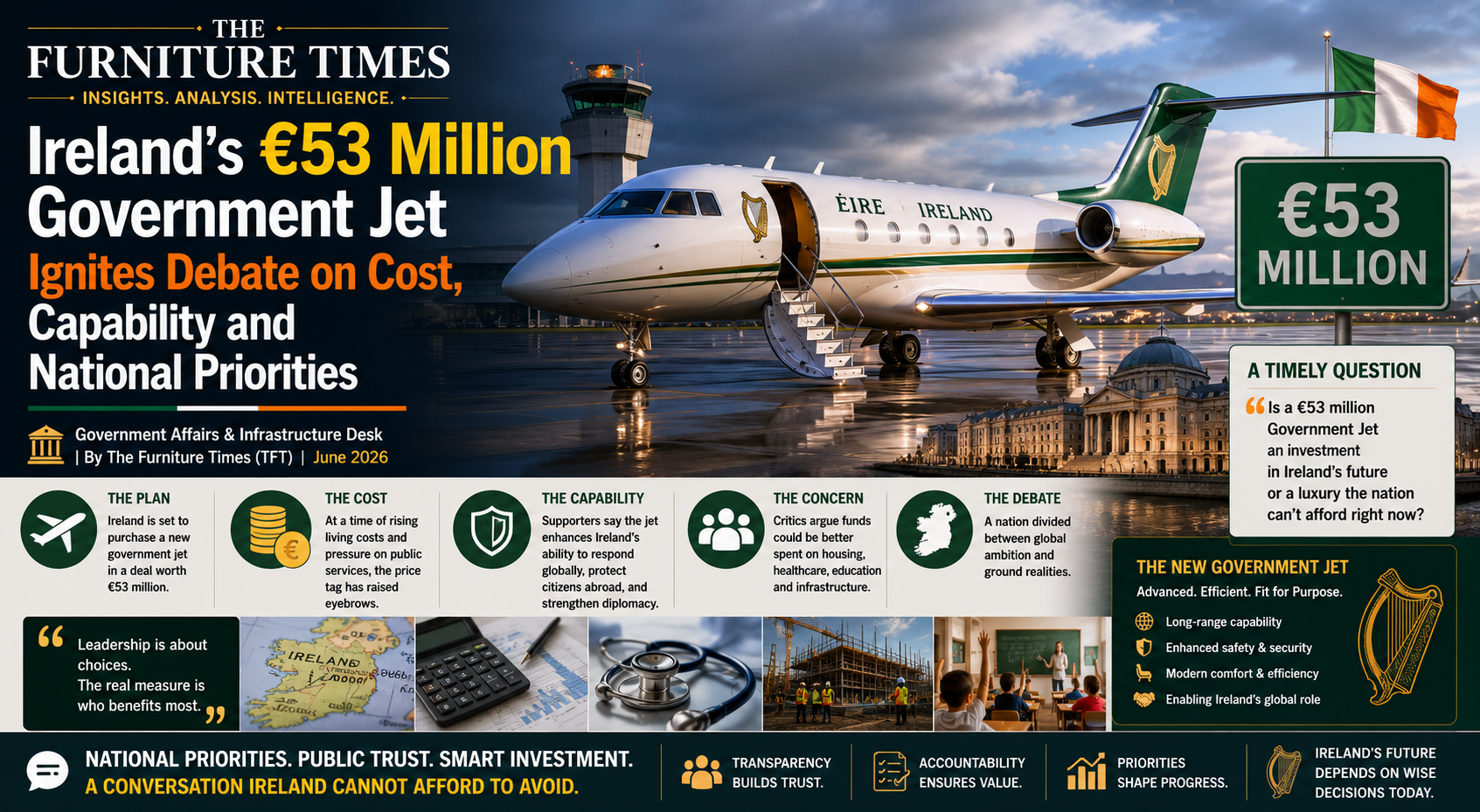
Ireland’s new €53 million government aircraft has become one of the most discussed public investments in the country, drawing attention not only for its impressive interior and advanced aviation technology but also for what it represents in terms of government mobility, national security, emergency response capability, and taxpayer spending. The aircraft, a state-of-the-art Dassault Falcon 6X, was acquired by the Irish Government to replace the country’s aging Learjet 45, which had been in service since 2004 and had increasingly suffered from reliability issues.
The arrival of the aircraft marks a significant milestone in Ireland’s aviation and defence infrastructure. While many headlines have focused on the luxurious cream-colored seating, spacious cabin, and executive-level comfort, government officials insist that the Falcon 6X is far more than a VIP transport aircraft. They describe it as a strategic national asset designed to serve multiple functions for decades to come.
More Than a Government Jet
The Dassault Falcon 6X is among the most advanced business aircraft currently operating worldwide. Manufactured in France, the aircraft offers long-range capabilities exceeding 5,000 nautical miles, allowing non-stop flights from Ireland to destinations including the western coast of the United States. It can accommodate up to 17 people, with 14 passenger seats, and is equipped with advanced avionics, secure communications systems, and operational safety technology.
Irish defence officials emphasize that the aircraft’s role extends well beyond transporting ministers and government officials. The Falcon 6X is expected to support:
Emergency evacuation of Irish citizens from crisis zones
Medical evacuation missions
Air ambulance operations
Transportation of defence personnel
Logistics support for overseas missions
Strategic government travel
Diplomatic and international representation missions
Government officials argue that these capabilities make the aircraft an essential national resource rather than merely a luxury convenience.
Why Ireland Needed a Replacement
The aircraft replaces Ireland’s Learjet 45, which entered service in 2004. Over the years, the aircraft experienced increasing maintenance challenges and operational disruptions. Several high-profile incidents, including mechanical issues that disrupted government travel, highlighted the need for a more reliable solution.
As Ireland’s international responsibilities expanded, including increased diplomatic engagements and preparations for major European Union responsibilities, the limitations of the older aircraft became more apparent. Officials concluded that a next-generation aircraft capable of long-range strategic missions was necessary to meet future national requirements.
The Cost Debate
The €53 million price tag has inevitably sparked debate among taxpayers and political commentators. Critics question whether such expenditure is justified at a time when many governments worldwide face pressures related to healthcare, housing, education, and public infrastructure.
Supporters, however, argue that the purchase should be viewed as a long-term investment rather than a luxury acquisition. Government assessments suggested that continued reliance on chartered aircraft, emergency leasing arrangements, and the maintenance of an aging fleet would become increasingly expensive over time. Officials also highlighted the aircraft’s ability to support medical and humanitarian operations as a key justification for the investment.
A Broader European Trend
Ireland is not alone in modernizing its government aviation capabilities. Across Europe, governments are investing in multi-purpose aircraft capable of combining diplomatic transport, emergency response, military logistics, and humanitarian missions.
The growing complexity of international relations, global crises, evacuation requirements, and disaster response operations has encouraged many nations to strengthen their strategic mobility capabilities. The Falcon 6X acquisition reflects this broader trend toward flexible, multi-role aviation assets.
Lessons for Public Infrastructure Investment
The debate surrounding Ireland’s new aircraft illustrates a challenge faced by governments worldwide: balancing public expectations of fiscal responsibility with the need to invest in modern infrastructure and national capabilities.
Infrastructure projects often appear expensive when viewed solely through their purchase price. However, governments increasingly evaluate investments based on long-term operational benefits, reliability, strategic flexibility, and national preparedness.
The Falcon 6X represents a case study in how governments must justify high-value investments not only through financial calculations but also through broader public value, resilience, and capability enhancement.
What the Aircraft Symbolizes
Beyond its technical specifications and luxurious interior, Ireland’s new government aircraft symbolizes a shift toward greater strategic independence. Rather than relying heavily on commercial flights, charter services, or aging equipment, Ireland now possesses an aviation asset capable of responding rapidly to domestic and international requirements.
For supporters, the aircraft represents preparedness, efficiency, and modernization.
For critics, it raises important questions about public spending priorities.
Regardless of perspective, the Falcon 6X has become one of the most visible examples of how governments are adapting to an increasingly interconnected and unpredictable world.
As Ireland prepares for future diplomatic, humanitarian, and strategic challenges, the aircraft is expected to play a central role in supporting national interests while continuing to fuel public debate about the balance between necessity, ambition, and accountability.
By The Furniture Times (TFT)
Global Affairs, Infrastructure & Strategic Mobility Desk
Bringing Industries, Leadership & Global Developments Into the Spotlight

Related Posts
Global Furniture Industry Faces a Conflict-Economy Test as Wars Disrupt Energy
UK Luxury Furniture Brand Pure White Lines Collapses Into Liquidation Owing More Than £1.4 Million