Furniture Prices Remain Under Pressure Despite Iran War: What the Latest Market Data Reveals About the Global Furniture Industry
Deep Analysis of Furniture Deflation, Consumer Demand, Supply Chains, Retail Pricing & the Future of the Global Furniture Ecosystem
By The Furniture Times | Global Crisis Report | Global Market Intelligence Desk | May 2026
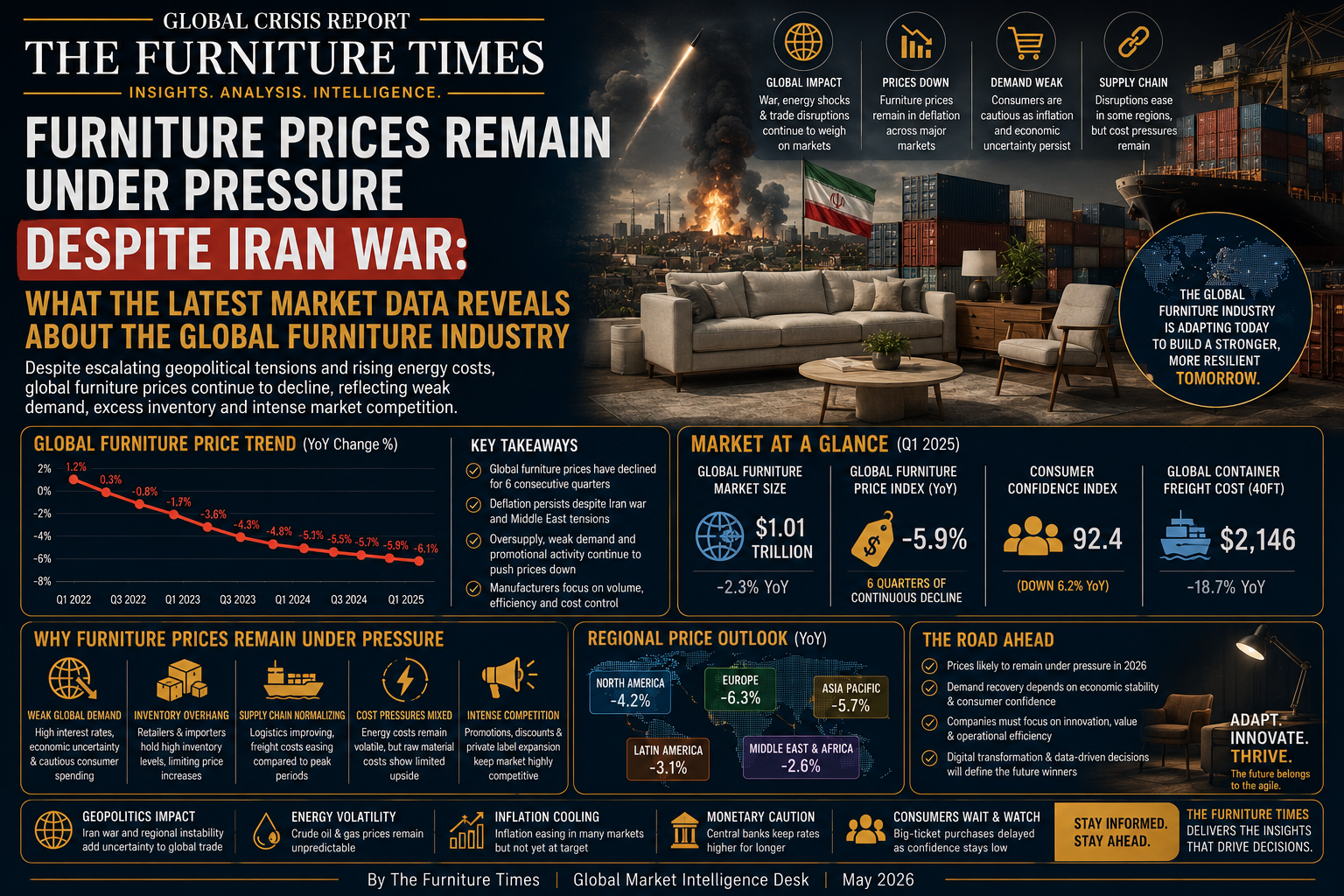
One of the most surprising developments in the global furniture industry during the early months of the Iran conflict has been the continued weakness in furniture pricing.
According to recent retail market data, household furniture prices remained below year-earlier levels even during the first month of the Iran war, suggesting that the conflict had not yet created an immediate inflationary shock strong enough to reverse existing furniture deflation trends.
This finding carries significant implications for manufacturers, retailers, importers, exporters, and furniture investors around the world.
A Surprising Contradiction
Traditionally, major geopolitical conflicts create pressure on:
energy prices
freight costs
logistics networks
raw material costs
consumer confidence
Many analysts expected the Iran conflict to quickly push furniture prices higher.
However, furniture prices remained relatively soft in the early phase of the conflict, highlighting a deeper structural challenge within the furniture industry.
The issue is no longer only about supply.
The issue is increasingly about:
demand.
Why Furniture Deflation Matters
Furniture deflation sounds positive for consumers.
But for the industry, it often signals pressure.
When furniture prices continue falling or remain below previous levels, manufacturers face:
margin compression
rising operational costs
weaker profitability
increased competition
inventory pressure
For SMEs especially, prolonged deflation can become dangerous.
Many businesses face:
higher wages
rising utility costs
higher financing costs
while being unable to fully pass those increases on to customers.
Consumer Behaviour Has Changed
The global consumer in 2026 is behaving differently than before.
Many households are prioritizing:
essentials
food
energy expenses
housing costs
before making large discretionary purchases.
Furniture is often considered a:
discretionary category.
When uncertainty rises, consumers frequently postpone:
sofa replacements
bedroom upgrades
dining room purchases
office furniture investments
This delays demand across the industry.
The Iran War Is Affecting Costs, But Demand Remains Weak
While furniture prices remained relatively soft initially, broader retail and economic reports show that energy, shipping, and raw material pressures have been increasing as a result of the conflict. Furniture was among the non-food categories showing price pressure due to higher input and transportation costs.
This creates a dangerous combination:
Rising costs + Weak demand
For furniture businesses, this is one of the most difficult operating environments possible.
The Global Supply Chain Remains Vulnerable
The furniture industry remains heavily dependent on:
container shipping
international sourcing
raw materials
global logistics corridors
Concerns surrounding Middle East trade routes and energy supply have increased uncertainty across international markets. Higher freight and energy costs are already influencing business planning and inventory decisions.
Furniture companies are now being forced to reconsider:
sourcing strategies
inventory management
supplier diversification
regional manufacturing networks
The Real Risk May Be Ahead
Many industry observers believe the full effects of the conflict may take time to reach consumers.
Retail organizations have warned that cost increases often appear gradually as existing inventories are depleted and new shipments arrive at higher costs.
This means furniture pricing may experience delayed pressure rather than immediate inflation.
The industry should therefore avoid assuming that current price stability will continue indefinitely.
What This Means for Furniture Manufacturers
Manufacturers should focus on:
operational efficiency
waste reduction
inventory optimization
energy management
digital sales channels
The businesses most likely to survive uncertainty are not always the largest.
They are often the most adaptable.
What This Means for Furniture Retailers
Retailers face a different challenge.
Consumers remain price-sensitive.
This means retailers increasingly need:
stronger branding
differentiated products
better customer experience
digital discoverability
trust-building content
Competing purely on price becomes increasingly difficult during periods of prolonged uncertainty.
The Visibility Economy Becomes More Important
Periods of economic pressure often expose weak business models.
In difficult markets, buyers become more selective.
They search more carefully.
They compare more aggressively.
They research before purchasing.
This reinforces a trend The Furniture Times has repeatedly highlighted:
Visibility matters.
The businesses that remain visible, discoverable, searchable, and trusted often outperform competitors during challenging economic cycles.
The Global Furniture Industry Health Check
Current conditions suggest the industry is experiencing:
Positive Signals
Continued consumer activity
Ongoing housing demand in many regions
Hospitality and tourism projects supporting commercial furniture demand
Growing interest in outdoor living and wellness-focused interiors
Warning Signals
Geopolitical uncertainty
Energy price volatility
Freight instability
Consumer caution
Margin pressure on SMEs
The industry is not collapsing.
But it is operating in a more complex environment than at any time since the post-pandemic recovery period.
TFT Industry Insight
The most important lesson from the latest data is not that furniture prices remained weak.
The real lesson is that:
The furniture industry is no longer driven by supply alone.
Today, success depends on understanding:
consumer psychology
economic confidence
digital visibility
brand trust
operational resilience
The companies that adapt to these realities will be best positioned for the next phase of the industry cycle.
Final Thought
The first months of the Iran conflict have revealed something important about the global furniture industry:
Despite geopolitical shocks, furniture demand remains the dominant force shaping pricing trends.
For now, furniture deflation and weak pricing continue to reflect cautious consumer behaviour and intense market competition.
However, rising energy, logistics, and raw material costs suggest the industry should remain alert to future pricing pressures.
The furniture businesses that survive and thrive in this environment will be those that combine:
Efficiency + Visibility + Trust + Adaptability
Because in uncertain times, resilience becomes the most valuable asset in the entire furniture ecosystem.