
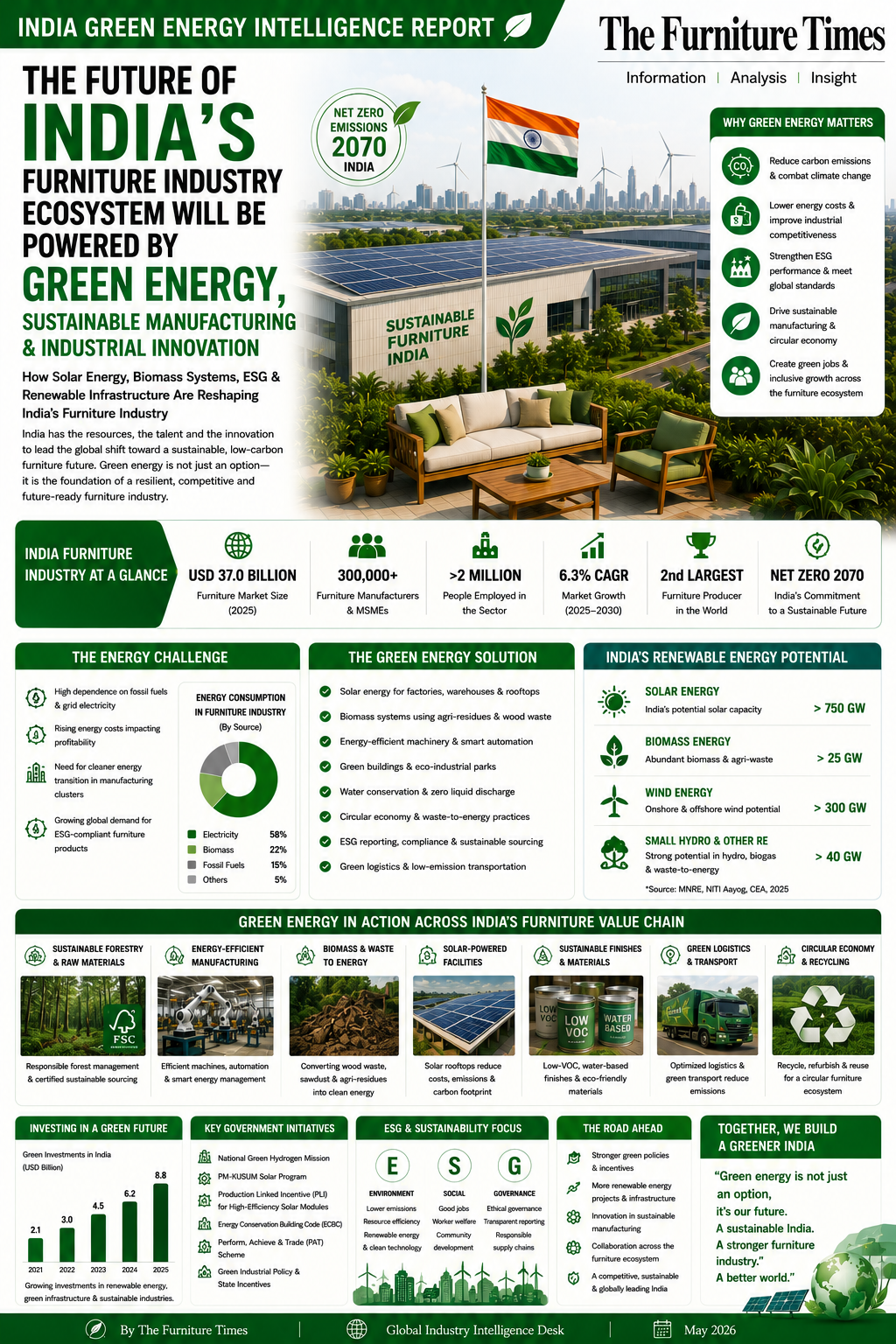
How Solar Energy, Biomass Systems, ESG & Renewable Infrastructure Are Reshaping India’s Furniture Industry
India Green Energy Intelligence Report | The Furniture Times
“The Future of India’s Furniture Industry Ecosystem Will Be Powered by Green Energy, Sustainable Manufacturing & Industrial Innovation”
By The Furniture Times | Global Industry Intelligence Desk | May 2026
India is entering one of the most important industrial and environmental transformations in its modern history.
For decades, India’s furniture industry grew through:
- urbanization
- real estate expansion
- rising middle-class demand
- woodworking traditions
- hospitality growth
- manufacturing scale
- export development
- interior design evolution
Today, India’s furniture ecosystem stretches across:
- residential furniture
- hospitality interiors
- modular furniture
- office systems
- wooden furniture
- upholstered furniture
- handcrafted products
- smart urban interiors
India has become one of the world’s fastest-growing furniture consumption and manufacturing ecosystems.
But now another powerful transformation is reshaping the industry:
the green energy and sustainability revolution.
Across:
- factories
- warehouses
- woodworking plants
- upholstery operations
- hospitality projects
- office ecosystems
- commercial interiors
- logistics infrastructure
India’s furniture industry is increasingly moving toward:
- renewable energy
- solar power
- biomass systems
- ESG-driven manufacturing
- sustainable production
- low-carbon operations
- environmentally responsible industrial systems
And this transition is no longer simply environmental.
It is becoming:
an industrial survival and competitiveness strategy.
🇮🇳 India’s Furniture Industry Is Becoming a Massive Industrial Ecosystem
India’s furniture market is rapidly expanding because of:
- urban population growth
- apartment culture
- hospitality expansion
- digital retail growth
- smart city development
- middle-class purchasing power
Major furniture hubs include:
- Delhi NCR
- Mumbai
- Bengaluru
- Chennai
- Hyderabad
- Pune
- Jodhpur
- Jaipur
- Kerala
- Coimbatore
India’s furniture ecosystem supports:
- SMEs
- artisans
- export manufacturers
- interior designers
- hospitality projects
- real estate infrastructure
But behind this growth lies:
enormous industrial energy consumption.
The Furniture Industry Quietly Consumes Huge Energy
India’s furniture ecosystem consumes energy through:
- woodworking machinery
- CNC systems
- spray booths
- upholstery equipment
- foam production
- cutting systems
- sanding operations
- warehouse lighting
- logistics infrastructure
- export transportation
Every:
- sofa
- wardrobe
- office workstation
- modular kitchen
- hotel fit-out
- dining set
requires a long production and logistics chain powered by electricity and fuel.
Why Green Energy Is Becoming Critical for India
India’s furniture ecosystem now faces multiple pressures:
- rising electricity costs
- global ESG expectations
- climate instability
- export competition
- sustainability demands
- fuel price volatility
- environmental pressure
- urban energy strain
At the same time:
- global buyers increasingly prioritize sustainability
- investors increasingly evaluate ESG performance
- hospitality operators increasingly seek green procurement
This means green energy is becoming:
“Economic resilience through sustainability.”
Solar Energy: India’s Greatest Industrial Opportunity
India possesses one of the world’s largest solar energy potentials because of:
- strong sunlight exposure
- large industrial rooftops
- growing renewable infrastructure
- supportive energy transition policies
Furniture factories often operate inside:
- industrial parks
- manufacturing compounds
- export warehouses
These spaces are ideal for:
rooftop solar energy systems.
How Solar Energy Can Transform Furniture Factories
Solar systems can support:
- machinery operations
- factory lighting
- offices
- warehouses
- production systems
- showroom operations
Benefits include:
- reduced electricity bills
- operational cost stability
- long-term energy savings
- improved ESG positioning
- reduced dependency on unstable energy markets
For factories operating daily, energy savings can become highly significant over time.
Biomass Energy: India’s Hidden Furniture Opportunity
India’s furniture industry generates enormous organic waste:
- sawdust
- wood chips
- offcuts
- sanding dust
- bamboo waste
- cane and rattan leftovers
Instead of treating these as waste, they can become:
biomass fuel systems.
Biomass energy can support:
- kiln drying
- factory heating
- operational power systems
- industrial fuel alternatives
This creates:
“Waste-to-energy furniture manufacturing.”
Why Biomass Is Strategically Important
India’s woodworking ecosystem naturally creates renewable organic material.
This allows factories to:
- reduce disposal costs
- lower fuel dependency
- reduce waste
- improve sustainability performance
- create circular industrial systems
Biomass becomes especially important for:
- wooden furniture manufacturing
- handicraft sectors
- plywood industries
- export furniture clusters
India’s Woodworking Traditions & Sustainability
India has strong furniture traditions using:
- sheesham
- teak
- mango wood
- bamboo
- engineered wood
- handcrafted timber systems
As global sustainability awareness rises, responsible sourcing becomes increasingly important.
International buyers increasingly seek:
- FSC-certified wood
- legal sourcing
- sustainable production systems
- low-carbon manufacturing
The future furniture market increasingly rewards:
environmentally responsible craftsmanship.
ESG Is Reshaping Global Furniture Trade
ESG — Environmental, Social, Governance — is becoming a major force in global procurement.
International retailers, hospitality groups, and investors increasingly evaluate suppliers through:
- sustainability practices
- environmental responsibility
- energy efficiency
- labour ethics
- carbon awareness
Furniture factories without sustainability positioning may eventually face:
- weaker competitiveness
- export pressure
- reduced hospitality opportunities
Hospitality Industry Is Driving Sustainability
India’s hospitality sector is expanding rapidly through:
- hotels
- resorts
- serviced apartments
- luxury tourism
- coworking spaces
- premium cafés
- commercial interiors
Hospitality operators increasingly market:
- eco-conscious luxury
- sustainable experiences
- environmental responsibility
This directly affects furniture procurement.
Hotels increasingly seek:
- sustainable upholstery
- renewable-energy suppliers
- recyclable furniture systems
- environmentally responsible manufacturers
Smart Cities & Green Interiors
India’s urban future increasingly revolves around:
- smart cities
- sustainable housing
- green buildings
- energy-efficient infrastructure
This affects:
- modular furniture
- office interiors
- hospitality ecosystems
- residential furniture systems
Green buildings increasingly require:
green interiors.
Furniture & Climate Change
Climate instability increasingly affects:
- timber supply
- transportation systems
- logistics costs
- energy pricing
- manufacturing operations
Extreme weather events can disrupt:
- factories
- ports
- transportation routes
- production timelines
Green energy becomes part of:
industrial resilience planning.
India’s SME Challenge
India’s furniture ecosystem is heavily driven by:
SMEs and artisan businesses.
Many smaller businesses already struggle with:
- rising operational costs
- labour shortages
- weak margins
- export competition
Adding sustainability investment may feel difficult.
This creates major need for:
- financing support
- green industrial incentives
- sustainability education
- renewable adoption programs
The Rise of Sustainable Consumer Thinking
Modern Indian consumers increasingly ask:
- Is this furniture sustainable?
- Is the wood responsibly sourced?
- Was renewable energy used?
- Is the brand environmentally conscious?
Especially younger consumers increasingly associate:
- sustainability
with: - premium living
- responsible consumption
- modern lifestyle identity
Green Logistics & India’s Furniture Ecosystem
Furniture logistics remain energy-intensive because products are:
- bulky
- warehouse-heavy
- transportation-dependent
Future transformation may include:
- electric delivery systems
- low-carbon logistics
- solar-powered warehouses
- smart inventory systems
This becomes increasingly important as India’s furniture retail ecosystem expands rapidly.
Smart Sustainable Factories: The Future of India
The future Indian furniture factory may increasingly integrate:
- solar systems
- biomass energy
- AI-powered manufacturing
- energy monitoring systems
- automated efficiency systems
- sustainable waste management
This creates:
“Intelligent green manufacturing ecosystems.”
India’s Opportunity: Global Sustainable Furniture Leadership
India possesses enormous potential because it combines:
- manufacturing scale
- craftsmanship
- renewable energy opportunity
- domestic demand
- export capability
- industrial workforce
India can position itself as:
“One of the World’s Largest Sustainable Furniture Manufacturing Ecosystems.”
Especially in:
- wooden furniture
- modular furniture
- hospitality furniture
- handcrafted interiors
- sustainable urban furniture systems
Opportunity for Global Partnerships
India’s green furniture transformation creates opportunity for collaboration with:
- Malaysia
- UAE
- Europe
- Singapore
- Indonesia
- Vietnam
- global hospitality groups
especially in:
- ESG manufacturing
- renewable energy systems
- sustainable interiors
- green hospitality ecosystems
Role of TFT & FISE in Green Transformation
India’s furniture ecosystem increasingly needs:
- sustainability visibility
- supplier discoverability
- ESG communication systems
- renewable manufacturing transparency
FISE can help buyers search suppliers by:
- sustainability standards
- FSC certification
- renewable energy adoption
- ESG capability
- eco-friendly manufacturing
FISE.live can showcase:
- sustainable factories
- green manufacturing systems
- eco-friendly furniture launches
- renewable-powered hospitality solutions
TFT can educate the industry about:
- renewable transformation
- ESG strategy
- sustainable manufacturing
- green urban living
TFT Philosophical Industry Insight
India’s furniture industry is deeply connected to:
- nature
- craftsmanship
- wood
- human living environments
Therefore, the industry carries a deeper responsibility.
An industry built from natural materials cannot survive long-term by continuously damaging the natural systems supporting those materials.
Green energy is not only about electricity.
It is about:
- industrial survival
- environmental protection
- future competitiveness
- economic resilience
- responsible growth
Final Thought
India’s furniture industry stands at a major industrial crossroads.
One path continues:
- unstable energy dependency
- environmental pressure
- rising industrial costs
- sustainability risk
The other path moves toward:
- renewable energy
- sustainable manufacturing
- ESG leadership
- green industrial systems
- future-ready competitiveness
The future winners will not simply manufacture furniture.
They will build:
- sustainable ecosystems
- renewable-powered factories
- environmentally responsible brands
- resilient industrial infrastructure
Closing Insight
“The next generation of India’s furniture industry leadership will not only be measured by production and exports.
It will also be measured by how responsibly the ecosystem powers, protects, and sustains its future.”
