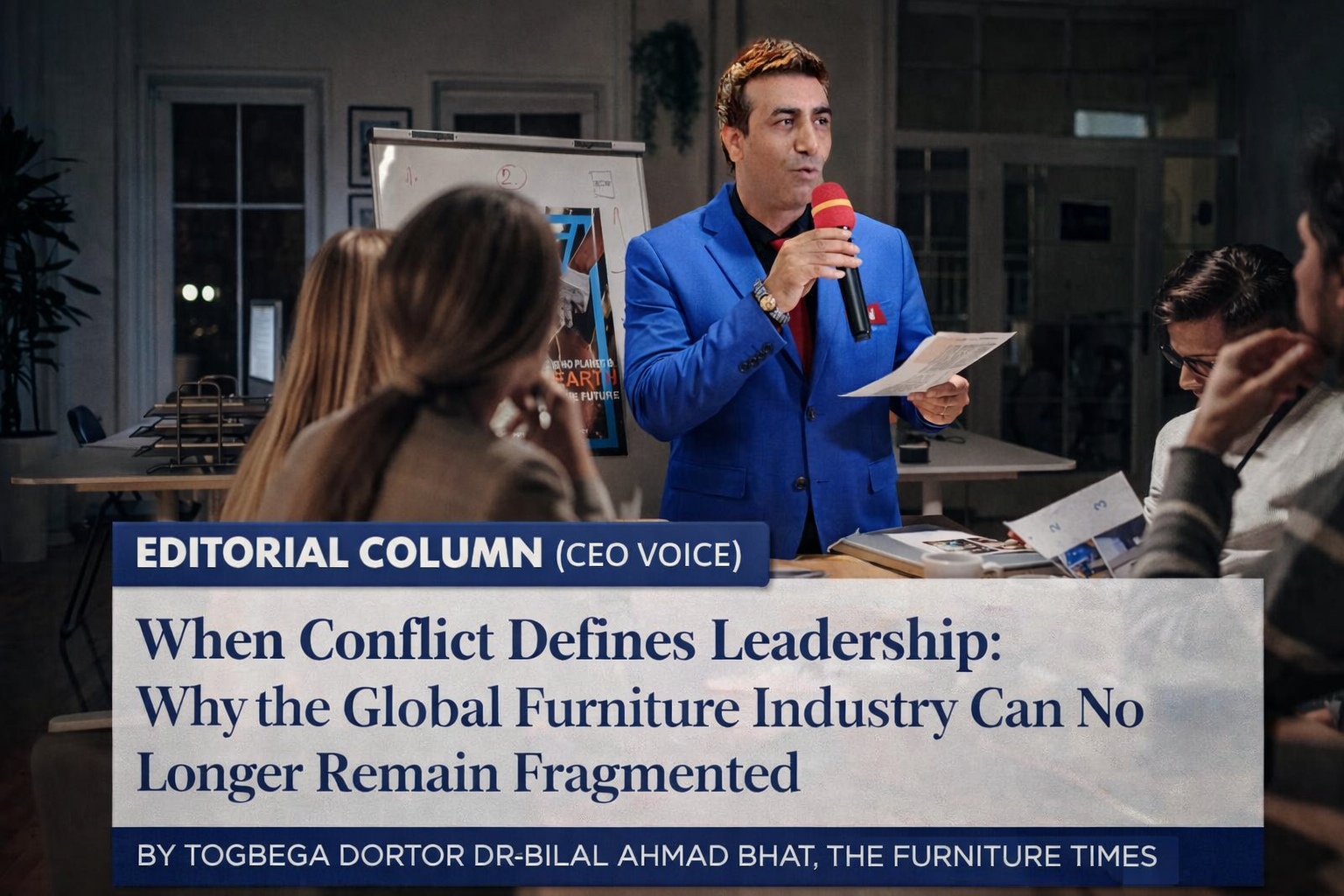
When Conflict Defines Leadership: Why the Global Furniture Industry Can No Longer Remain Fragmented
By Togbega Dortor Dr. Bilal Ahmad Bhat | The Furniture Times | April 2026
In times of stability, leadership is often measured by growth. But in times of conflict, leadership is defined by decisions.
Across industries, crises expose the truth: not just about markets, but about systems. And nowhere is this more evident than in the global furniture industry—a trillion-dollar ecosystem that remains fragmented, unorganized, and, most critically, voiceless.
The recent global disruptions—wars, supply chain breakdowns, pricing volatility—have revealed a painful reality:
We are not suffering from a demand crisis. We are suffering from a structure crisis.
For decades, the furniture industry has grown without integration. Manufacturers operate in silos. Retailers lack visibility. SMEs remain invisible. Data is scattered. Intelligence is delayed. There is no single platform that represents the industry as a whole.
This is not a weakness—it is a risk.
In moments of conflict, CEOs are forced to make decisions with incomplete information. They must balance speed with accuracy, survival with sustainability. But how can leaders make informed decisions when the system itself lacks transparency?
This is the turning point.
As highlighted in conversations with Togbega Dortor Dr. Bilal Ahmad Bhat, leadership today must evolve from company-centric thinking to ecosystem-centric action. Every decision we make impacts not just our organization, but the entire value chain.
That is why we made a decision—not to adapt to a broken system, but to build a new one.
The Furniture Times (TFT) is not just a media platform. It is the voice the industry never had.
FISE (Furniture Industry Search Engine) is not just a tool. It is the visibility engine the industry desperately needs.
Together, they represent a structural shift:
- From fragmentation → to organization
- From invisibility → to global visibility
- From silence → to a unified voice
This is not a project. This is an industry transformation.
Because in the end, leadership is not about reacting to crisis.
It is about building systems that make the next crisis irrelevant.

Related Posts
AI Search Optimization for Furniture Retailers: The Next Competitive Advantage in the Global Furniture Industry
Entrepreneurship Is Pain, Pressure, and Persistence