
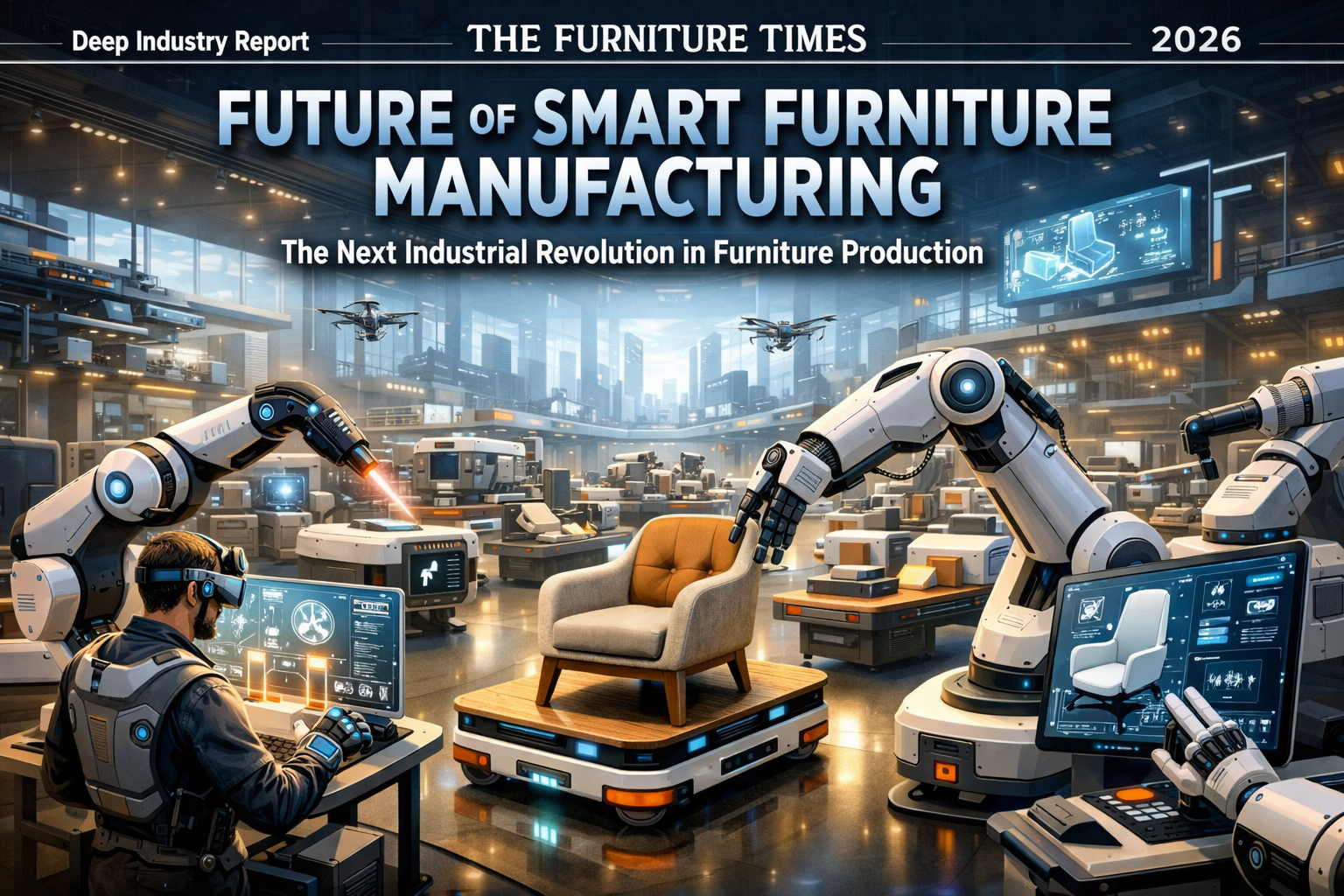
Future of Smart Furniture Manufacturing (Deep Report)
The Next Industrial Revolution in Furniture Production
Deep Industry Report | The Furniture Times | 2026
The furniture industry is entering its most transformative phase since industrialization. Smart manufacturing is no longer optional—it is becoming the foundation of competitive advantage.
What is Smart Furniture Manufacturing?
Smart manufacturing combines:
- automation
- artificial intelligence
- data analytics
- IoT (Internet of Things)
to create intelligent, adaptive production systems.
The Core Pillars of Smart Manufacturing
1. Automation & Robotics
Machines now handle repetitive and precision tasks.
Increases speed and consistency.
2. AI & Predictive Systems
AI enables:
- demand forecasting
- design optimization
- process improvement
Reduces waste and increases efficiency.
3. IoT-Connected Factories
Machines communicate in real time.
Creates a fully connected production ecosystem.
4. Data & Analytics
Data drives decision-making:
- production planning
- inventory control
- cost optimization
Data becomes the new competitive edge.
Sustainability Through Smart Manufacturing
Smart factories reduce:
- material waste
- energy consumption
- carbon footprint
Sustainability and efficiency go hand in hand.
Benefits for the Industry
- faster production cycles
- lower operational costs
- higher product quality
- scalable customization
Companies can produce more with less.
Challenges to Overcome
Despite its advantages, smart manufacturing faces:
- high initial investment
- technology adoption barriers
- workforce skill gaps
Companies must invest in both technology and talent.
Global Impact
Smart manufacturing is reshaping:
- global supply chains
- regional production hubs
- competitive dynamics
Countries investing early will lead the future.
Future Outlook (2026–2030)
By 2030, we can expect:
- fully autonomous factories
- AI-driven design ecosystems
- hyper-personalized furniture production
- near-zero waste manufacturing
Final Insight
Smart manufacturing is not just a technological shift—it is a strategic transformation.
The companies that adopt it early will lead.
The ones that delay will struggle to compete.
