
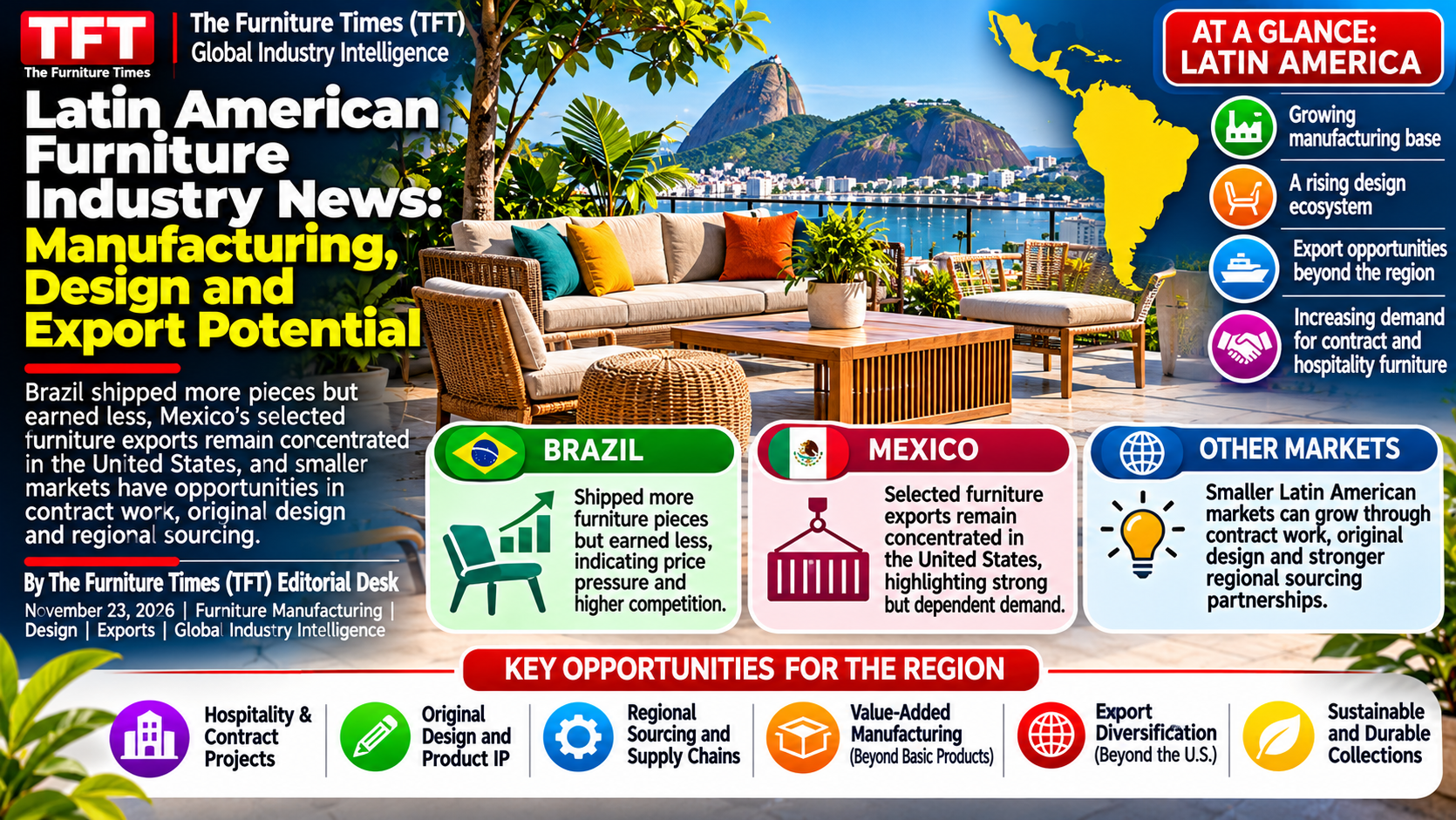
Latin American Furniture Industry News: Manufacturing, Design and Export Potential
Brazil shipped more pieces but earned less, Mexico’s selected furniture exports remain concentrated in the United States, and smaller markets have opportunities in contract work, original design and regional sourcing
By The Furniture Times (TFT) Editorial Desk | November 23, 2026 | Furniture Manufacturing | Design | Exports | Global Industry Intelligence
Brazil exported more furniture and mattresses in the first nine months of 2026, but earned less from those shipments. Mexico’s latest complete annual trade data show a different challenge: the United States took roughly 95% of its exports in one major wooden-furniture category. Together, the two signals point to a question facing manufacturers across Latin America: Can they turn manufacturing capacity into export sales that are profitable, repeatable and less dependent on a single buyer or market? eMóbile
The answer varies by country. Brazil can compete on industrial scale as well as original design. Mexico can use proximity to North American buyers to offer quicker replenishment. Colombia has an opportunity to package design, joinery and installation as a single contract offer. Argentina’s specialist makers can compete for smaller, higher-value orders, while Chile’s forestry and materials base warrants attention even where finished-furniture exports are not the main story. Emerging hubs in Peru, Paraguay, Guatemala and elsewhere are better evaluated by what suppliers can deliver than by the size of their national markets.
Brazil: Export volumes rose, but the value per piece fell
Brazil shipped approximately 17 million pieces of furniture and mattresses between January and September 2026, up 2.2% from the same period in 2025. Export revenue nevertheless fell 6.0% to US$538.1 million, according to IEMI figures prepared for the Brazilian furniture industry association ABIMÓVEL and reported by trade publication eMóbile. The average reported value fell from US$34.43 to US$31.67 per piece. That decline does not establish that manufacturers cut prices on equivalent products; changes in product mix or destination can also lower the average. eMóbile
The United States remained Brazil’s largest destination in that dataset, but shipments there fell nearly 39% by value, from US$149.1 million to US$90.6 million. Exports to other markets rose about 5.7%. Uruguay accounted for 13.2% of total export value, Argentina 8.0%, and Peru 6.1%. That regional business cushioned the decline without fully replacing the lost U.S. revenue. Meanwhile, Brazilian furniture and mattress imports rose 38.2% by value to US$304.7 million, adding a competitive test at home as exporters reassessed their overseas mix. eMóbile
What to watch entering 2027: whether Brazilian manufacturers can improve the value of repeat orders, not simply ship more pieces. A design-led collection can give a distributor a reason to carry the line, but only if the manufacturer can reproduce finishes, control packaging damage and supply matching pieces later. For a factory exporting flat-pack furniture, better packing density and fewer missing-hardware claims may matter more to margin than adding another collection. ABIMÓVEL and ApexBrasil’s Brazilian Furniture initiative tracks selected products across upholstery, wood furniture, metal furniture and mattresses—categories that should be evaluated separately when planning an export strategy. brazilianfurniture.org.br
Mexico: Nearshoring is most valuable when it improves replenishment
Mexico exported US$425.9 million in other wooden furniture under customs code HS 940360 in 2025, of which US$406.4 million went to the United States. In other metal furniture, HS 940320, Mexico exported US$387.9 million, including US$366.1 million to the United States. Those figures cover two specific customs categories, not the entire Mexican furniture industry. They nevertheless show the extent of U.S. exposure in both lines. Data
Proximity pays off when a Mexican supplier can do something a more distant supplier cannot do as easily: replace a damaged part quickly, replenish a successful line in smaller batches, ship in phases or respond to a last-minute commercial specification change. A nearby factory with inconsistent output or poor inventory visibility may offer little practical advantage over a reliable supplier farther away.
Buyers should also distinguish export geography from design and manufacturing networks. Data México identified Tamaulipas as the leading state by reported export value for HS 940360 in 2024, followed by Baja California and Mexico City. That customs picture is a useful starting point for research, not a map of every factory, designer or specialist supplier. Companies sourcing in Mexico should confirm where the product is actually made, which processes are subcontracted, and whether current origin and tariff treatment support the quoted landed cost before changing suppliers. Data México
Colombia: Turn design expertise into a contract offer buyers can specify
Colombia’s opportunity is to make design-led furniture easier to buy as a repeatable commercial product. A hotel buyer may be drawn to a custom headboard or lobby collection, but the decision also depends on finish consistency, installation sequencing, lead times and the ability to replace individual pieces after opening.
For manufacturers and design studios exploring Bogotá and Medellín as sourcing bases, the opportunity is not limited to finished retail products. Casegoods, millwork, upholstered seating and coordinated interiors can be quoted as packages for hotels, restaurants, workplaces and multifamily developments. A supplier that documents what it makes in-house, what it outsources and who handles site measurements or installation is easier to compare with an established contract vendor.
The first export step need not be a national retail rollout overseas. A smaller pilot with a regional distributor, hospitality operator or design practice can test whether the supplier can reproduce approved samples, protect finishes in transit and service a project after handover. This is a sourcing opportunity, not a claim that Colombian furniture exports are currently rising.
Argentina: Import pressure makes differentiation more important
Argentina’s wood and furniture federation FAIMA reported that imports in its selected timber-related Chapter 94 basket reached US$6.61 million in August 2026, up 33.9% year on year. The basket includes furniture, seating, parts and prefabricated buildings, so it should not be read as a furniture-only import total or a direct measure of retail demand. It does, however, give domestic manufacturers a reason to monitor where imported products are competing with local production. faima.org.ar
For specialist workshops and design brands, matching a mass importer’s price is not the only strategy. Upholstery with a defined textile programme, custom joinery, limited-run collections and products that can be repaired locally offer other ways to compete. Exporters should focus on models whose selling price can absorb freight, protective packaging and a realistic allowance for after-sales service. A low-volume line may have attractive margins at the workshop and still be difficult to sell profitably once delivered overseas.
Neighbouring markets are worth testing first where the buyer can handle installation and service. The signal to expand is a second order—ideally for the same specification at a viable margin—not the size of the first shipment.
Chile: A timber supply chain is an advantage, not a finished-furniture forecast
Chile’s Forestry Institute, INFOR, tracks forest exports and related industry statistics. Those data provide context for wood sourcing, but they do not by themselves measure demand for Chilean chairs, cabinets or finished outdoor collections. A country can have a substantial forestry supply chain without commanding the same position in finished furniture. infor.gob.cl
The opportunity is to turn that supply-chain knowledge into offers buyers can specify: documented timber inputs, repeatable machined components, fitted interiors and small-batch design collections with clear material and finish specifications. For a Chilean company selling complete furniture, the test is whether machining, finishing, packaging and quality control can deliver the same product at reorder—not simply whether wood is available.
Chile is also worth assessing as a buyer market in its own right. For an exporter, winning an interior or hospitality project through a local partner may be a better first step than attempting broad consumer distribution. The decision should come down to identified projects, dealer capability, freight and after-sales coverage.
Emerging hubs: Where the next opportunities may come from
The next regional hub need not be the next large-volume exporter. It may be a city where designers, component suppliers, factories and installers can reliably deliver a narrow category. These are markets to investigate, not a ranking or a claim that their finished-furniture exports are growing.
| Market | Opportunity to investigate | What would validate it |
|---|---|---|
| Peru | Hospitality fit-outs, custom joinery and regional distribution | Repeat orders from hotel operators, installers or dealers; Peru already accounts for a meaningful share of the Brazilian export basket cited above. eMóbile |
| Paraguay | Selected wood components, assembly and Mercosur supply relationships | Stable input sourcing, consistent tolerances and competitive cross-border delivery |
| Uruguay | Distribution, showroom partnerships and contract procurement | Distributor reorders and local service capacity; Brazil’s shipment figures show Uruguay’s relevance as a buyer, not necessarily as a manufacturing hub. eMóbile |
| Guatemala | Regional supply partnerships in cabinetry, timber work and commercial interiors | Suppliers that can deliver consistent batches, document inputs and support installation |
| Costa Rica and Panama | Hospitality procurement and distribution links | Funded projects, reliable import handling and access to installation or repair partners |
Central America illustrates why these distinctions matter. Mexico’s 2025 trade data show exports of selected furniture categories to markets including Guatemala, Costa Rica and Panama. Those flows establish commercial connections. They do not tell buyers whether a country is primarily a factory base, a distribution point or an end market for a particular product. Data
The 2027 export test: Can customers buy the same product twice?
A buyer’s first order may start with a striking design or an attractive quotation. The second depends on whether the first arrived intact, matched the approved sample and could be serviced after installation. That is where export potential becomes an operating capability.
- For manufacturers: Choose a small number of export-ready models. Lock down materials, dimensions, finish references, pack specifications and replacement parts. Quote the delivered cost at both trial-order and repeat-order volumes.
- For designers: Turn a signature product into a specification another team can reproduce. Define acceptable variation in grain, weave, colour and hand-finished details before the order.
- For distributors: Audit the factory behind the catalogue. Ask what can be reordered, which fittings are interchangeable, who handles defects and what happens when a finish is discontinued.
- For contract buyers: Compare more than the unit price. Review installation, replacement lead times, freight damage procedures and the ability to order matching pieces after handover.
The TFT takeaway: Brazil’s recent results show why shipment volume cannot stand in for export performance. Mexico’s trade concentration shows why access to a major buyer market is an advantage and a risk. For Colombia, Argentina, Chile and the region’s smaller hubs, the opening is to specialise where design, manufacturing and service can be offered together. The strongest indicator to watch in 2027 is repeat business at a viable delivered margin.
TFT tells their story. FISE helps the world find them. FurniReviewology helps the world trust them.
