Advertising Through a Downturn
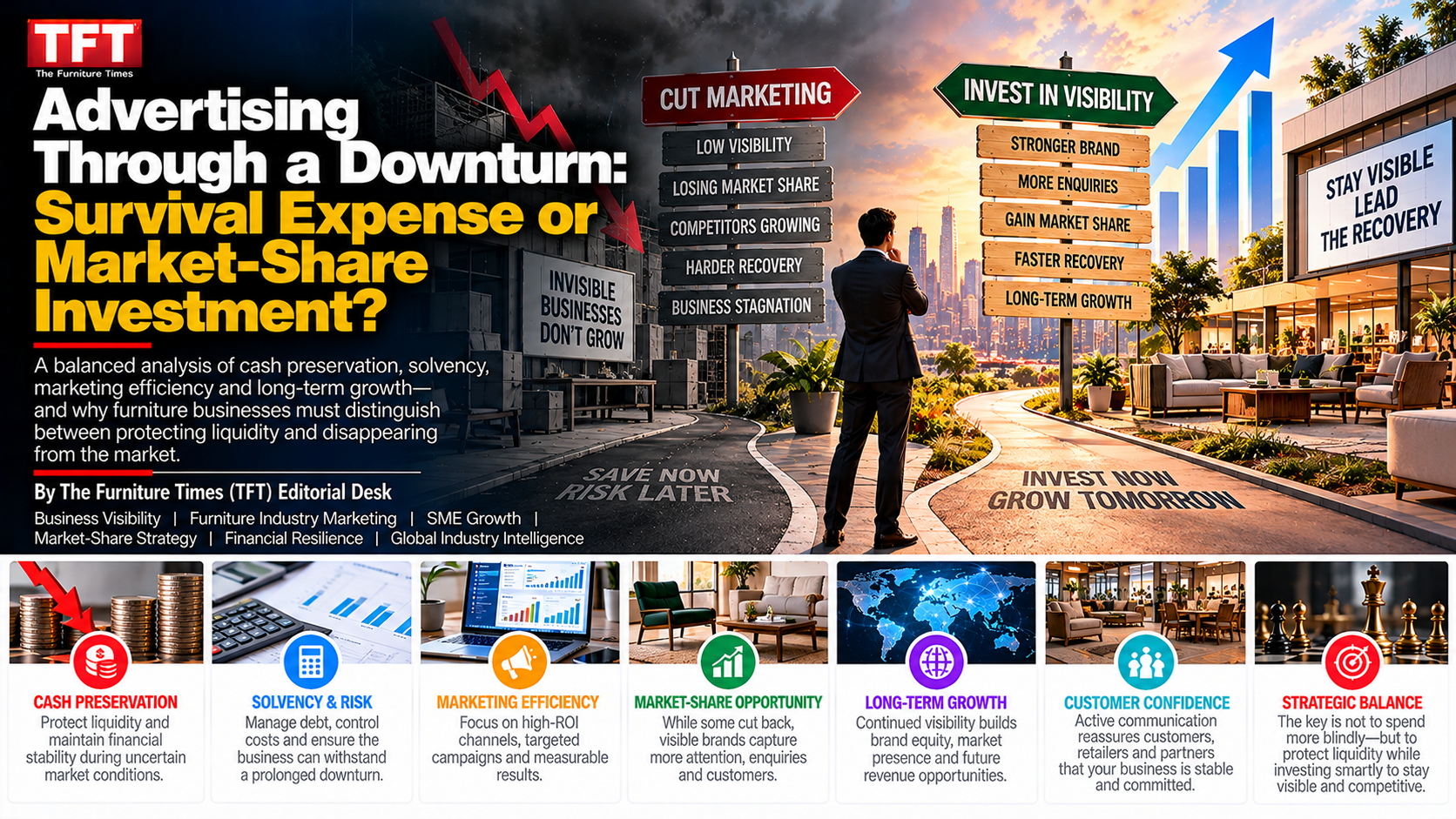
Advertising Through a Downturn: Survival Expense or Market-Share Investment?
A balanced analysis of cash preservation, solvency, marketing efficiency and long-term growth—and why furniture businesses must distinguish between protecting liquidity and disappearing from the market
By The Furniture Times (TFT) Editorial Desk
Business Visibility | Furniture Industry Marketing | SME Growth | Market-Share Strategy | Financial Resilience | Global Industry Intelligence
When sales weaken, orders slow and customers delay purchasing decisions, advertising expenditure quickly comes under scrutiny.
Management asks difficult but necessary questions:
- Should the company continue advertising when revenue is falling?
- Is marketing an avoidable expense or an investment in future demand?
- Should cash be protected for salaries, rent, suppliers and loan repayments?
- Is it sensible to spend money attracting customers who may not be ready to buy?
- Could competitors gain market share if the company becomes invisible?
- Should the budget be reduced, redirected or protected?
- How long can a brand remain silent before recovery becomes more expensive?
There is no responsible universal answer.
Advertising during a downturn is not automatically a wise investment. A company facing immediate insolvency should not sacrifice payroll, statutory obligations or critical supplier payments merely to maintain an impressive campaign.
At the same time, eliminating visibility without examining performance can create a second crisis. The business may preserve cash today but weaken demand, customer recall and market position tomorrow.
The strategic question is therefore not simply:
Should we advertise or stop advertising?
It is:
What level and type of market presence can the company afford to maintain without endangering its survival—and which activities are most likely to protect revenue, customer relationships and future market share?
That distinction matters enormously across the furniture industry, where purchases are often discretionary, housing-related, project-driven and sensitive to consumer confidence.
The Downturn Dilemma
Furniture businesses operate with significant financial pressures:
- Inventory occupies cash and warehouse space
- Showrooms carry rent, utilities and staffing costs
- Manufacturers maintain machinery and production workers
- Imported products expose companies to currency and freight risk
- Dealers and project customers may request longer credit
- Retail customers postpone large purchases
- Construction and hospitality projects may be delayed
- Raw-material suppliers may tighten payment terms
- Unsold seasonal stock may require discounting
In this environment, advertising can look like an easy cost to remove.
Unlike salaries or rent, marketing expenditure may not appear essential to daily operations. Its return is sometimes delayed, distributed across several channels or difficult to attribute to one transaction.
However, demand generation is also an operating requirement.
A factory cannot survive indefinitely without orders. A showroom cannot succeed without visitors. A distributor cannot grow without enquiries. A supplier cannot enter new accounts if buyers do not know it exists.
Advertising therefore sits between two realities:
- It consumes cash at a time when liquidity is precious.
- It supports the visibility and demand on which future cash flow depends.
The correct decision must consider both.
First Principle: Solvency Comes Before Market Share
The strongest argument for advertising through a downturn should never become an excuse for financially reckless spending.
If a business cannot meet essential obligations, its immediate priority is survival.
Essential obligations may include
- Employee wages
- Statutory payments
- Rent and utilities
- Loan obligations
- Insurance
- Critical suppliers
- Customer deposits and contractual commitments
- Safety and compliance expenses
- Essential machinery maintenance
- Minimum technology and cybersecurity requirements
A company facing a severe cash emergency must stabilise its operations before committing to ambitious brand campaigns.
No increase in “share of voice” can compensate for an inability to deliver orders, honour warranties or pay employees.
Advertising becomes irresponsible when it:
- Uses cash required for essential obligations
- Promotes products the company cannot supply
- Creates demand that production cannot fulfil
- Conceals serious operational instability
- Is funded through unsustainable borrowing
- Continues without measurement or management review
- Protects management pride rather than commercial performance
Solvency is not a marketing metric, but it determines whether a marketing strategy is viable.
Second Principle: Cutting Every Marketing Activity Can Accelerate Decline
While financial discipline is essential, indiscriminate cuts can damage the company’s ability to recover.
A business may experience the following cycle:
- Sales decline.
- Management removes advertising.
- Website traffic, enquiries and store visits weaken.
- The sales pipeline becomes smaller.
- Revenue declines further.
- Additional spending is cut.
- Customers increasingly encounter competitors.
- The company becomes dependent on discounts and old relationships.
- Recovery becomes slower and more expensive.
This is the danger of treating every marketing cost as waste.
The Institute of Practitioners in Advertising has continued to argue that cutting marketing during recessions can create a long-term competitive disadvantage and that maintaining or increasing marketing investment may support faster profit growth during recovery.
That evidence should not be interpreted as “every company must spend more.” It means that visibility decisions have consequences beyond the present accounting period.
Advertising as a Market-Share Investment
A downturn can create an unusual competitive opportunity.
When many businesses reduce advertising simultaneously:
- Media inventory may become less congested
- Competitor visibility may fall
- Customers may become more receptive to useful guidance
- A consistent brand may appear more stable
- The cost of gaining relative attention may improve
- Businesses that remain present may capture displaced customers
The relevant concept is share of voice—a brand’s proportion of category advertising or visibility compared with competitors.
Excess share of voice occurs when a brand’s share of advertising is higher than its current share of the market.
Historical analysis associated with the IPA has found a relationship between excess share of voice and subsequent market-share growth, including during downturns. When competitors cut spending, it can become comparatively easier for another brand to increase its relative presence without dramatically increasing its absolute budget.
The opportunity comes from relative position.
A company could reduce its advertising expenditure by 10% but still increase its category share of voice if competitors reduce theirs by 50%.
Conversely, a business may maintain the same budget but lose visibility if aggressive competitors invest more efficiently.
This is why management should evaluate the market—not only its internal budget.
Market Share Cannot Be Bought Without Operational Strength
The market-share argument has limits.
A furniture company should not advertise aggressively merely because competitors are quiet. It must be capable of converting attention into a satisfactory customer experience.
Before treating a downturn as an investment opportunity, management should confirm that the business can:
- Supply products on time
- Maintain acceptable quality
- Honour warranties
- Deliver and install reliably
- Respond to enquiries
- Manage returns
- Provide accurate product information
- Protect customer deposits
- Maintain inventory visibility
- Support dealers and project buyers
- Resolve complaints
Advertising magnifies whatever sits behind it.
If the operational experience is strong, advertising can accelerate growth.
If the operational experience is poor, advertising can accelerate negative reviews, refunds and reputational damage.
Not All Advertising Produces the Same Return
During prosperous periods, businesses can sometimes tolerate waste. During a downturn, every channel must justify its role.
Management should separate marketing into four broad categories.
| Marketing category | Primary role | Downturn treatment |
|---|---|---|
| Demand capture | Converts existing purchase intent | Protect and optimise |
| Customer retention | Preserves existing revenue | Protect strongly |
| Brand building | Creates future familiarity and preference | Maintain at a financially sustainable level |
| Experimental activity | Tests new audiences or channels | Restrict, stage or pause if evidence is weak |
Demand-capture advertising
This reaches people already searching for a product or supplier.
Examples include:
- Search advertising
- Marketplace visibility
- Local-search listings
- Retargeting recent visitors
- Product-feed advertising
- Industry-directory presence
- Tender and RFQ monitoring
- Dealer-location pages
Demand capture can be particularly important during a slowdown because fewer active buyers remain. Losing those high-intent customers to competitors can be expensive.
Customer-retention communication
Existing customers are often less expensive to reach than entirely new ones.
Furniture businesses can use:
- Email communication
- Reorder reminders
- Replacement and spare-part offers
- Maintenance services
- Warranty follow-ups
- Trade-customer updates
- New-collection previews
- Loyalty programmes
- Personal account management
A furniture supplier that ignores existing customers while spending heavily on cold audiences may be misallocating scarce resources.
Brand-building activity
Brand advertising creates memory before the customer is ready to purchase.
This is important in furniture because buying cycles can be long and unpredictable. A consumer may not need a sofa today but could move house in six months. A hotel developer may research suppliers long before issuing an RFQ. A retailer may monitor manufacturers before changing its product range.
Brand building supports future consideration.
However, it should be funded at a level consistent with financial capacity. A small manufacturer does not need to imitate the media spending of a multinational retailer.
Experimental activity
A downturn is not the ideal time to fund poorly designed experiments with no success criteria.
Innovation should continue, but tests should be:
- Small
- Measurable
- Time-limited
- Based on a clear hypothesis
- Protected by spending limits
- Reviewed quickly
Advertising Is Broader Than Paid Media
Businesses often use the terms “advertising,” “marketing” and “visibility” as though they mean the same thing.
They do not.
Paid advertising is only one component of market presence.
A furniture SME with limited cash can maintain visibility through a mix of:
- Search-optimised product information
- Google Business Profile management
- Industry news and press releases
- Customer reviews
- Project case studies
- Email marketing
- Social-media updates
- Sales-team outreach
- Dealer communication
- Industry-directory listings
- Educational content
- Local partnerships
- Trade associations
- Product demonstrations
- Founder commentary
- Referral programmes
- Showroom events
- Digital catalogues
- Video consultations
The choice should reflect where customers actually discover and evaluate the business.
Reducing paid media does not require abandoning the market.
The Minimum Visibility Layer a Business Should Protect
Even under financial pressure, furniture SMEs should consider protecting a basic visibility infrastructure.
1. An accurate website
The website should clearly explain:
- What the company sells or manufactures
- Where it operates
- Who it serves
- How customers can enquire
- Product specifications
- Delivery areas
- Warranty information
- Current contact details
- Opening hours
- Recent company activity
An outdated website can destroy confidence created by advertising.
2. Local-search visibility
Retailers, installers, repairers and local suppliers should maintain accurate:
- Business name
- Address
- Telephone number
- Operating hours
- Service area
- Product categories
- Photographs
- Reviews
- Map information
3. Existing-customer communication
Do not allow valuable customer relationships to disappear because management focuses exclusively on acquisition.
4. Product information
During a downturn, customers research more carefully.
They need:
- Dimensions
- Materials
- Colours
- Availability
- Lead times
- Care instructions
- Delivery information
- Warranty terms
- Genuine photographs
- Transparent pricing or quotation procedures
5. Reviews and reputation
Customers become more risk-conscious when money is tight. Credible reviews can reduce uncertainty.
6. Current news
Announcements about certifications, projects, investments, new products, appointments and partnerships can show that the business remains active.
7. High-intent promotion
Protect channels that reach customers who are already demonstrating purchasing intent.
This baseline is not extravagant. It is the minimum commercial infrastructure needed to remain findable and credible.
The Furniture Industry’s Particular Downturn Risks
Furniture demand is closely connected to economic conditions.
Housing-market weakness
Fewer home purchases and moves can reduce demand for major furniture categories.
High borrowing costs
Mortgage and consumer-finance costs can delay discretionary purchases.
Project postponements
Hotels, offices, housing developments, educational institutions and healthcare facilities may delay capital expenditure.
Consumer uncertainty
Customers may retain existing furniture longer, repair products or trade down.
Inventory pressure
Retailers with excess stock often turn to promotions, increasing competitive discounting.
Import and currency exposure
Exchange-rate movements can increase replacement costs even when local demand is weak.
Freight and geopolitical disruption
Shipping delays, route changes and fuel costs can affect margins and product availability.
Retail consolidation
Weak operators may close, leaving suppliers with unpaid invoices and excess capacity.
These pressures mean that a furniture advertising strategy must do more than create awareness. It must address buyer concerns about price, quality, availability, durability and risk.
Why Discounting Is Not a Complete Downturn Strategy
The fastest advertising response to weak demand is often a sale.
Discounts can help:
- Clear ageing inventory
- Generate short-term cash
- Increase store visits
- Support a seasonal campaign
- Introduce new customers
- Match a temporary competitive offer
But continuous discounting creates significant risks:
- Reduced gross margins
- Lower perceived value
- Customers trained to wait
- Conflict with dealers
- Damage to premium positioning
- Less cash for service and warranty support
- Difficulty returning to normal pricing
- Pressure on product quality
- Confusion between genuine value and artificial list prices
A business cannot permanently discount its way to brand strength.
Downturn advertising should communicate more than price. It can emphasise:
- Durability
- Repairability
- Warranty
- Delivery reliability
- Space efficiency
- Multifunctionality
- Energy or productivity benefits
- Local manufacturing
- Customisation
- Replacement parts
- Lifecycle value
When budgets are tight, customers need stronger reasons to buy—not only a red discount label.
The Three-Budget Approach
Instead of debating one fixed annual advertising number, businesses can prepare three scenarios.
Survival budget
Used when cash flow is under severe pressure.
Protect:
- Website and hosting
- Local listings
- Existing-customer communication
- Essential product information
- Reviews and reputation response
- High-intent search
- Core sales materials
- Critical industry listings
Pause or reduce:
- Broad campaigns with weak attribution
- Expensive sponsorships
- Low-performing exhibitions
- Duplicate software
- Unmeasured agency retainers
- Vanity campaigns
Stabilisation budget
Used when the company can meet obligations but requires caution.
Add:
- Retargeting
- Targeted email campaigns
- Trade media
- Press releases
- Case studies
- Selected social advertising
- Dealer support
- Content for priority product categories
- Structured testing of new channels
Market-share budget
Used when the balance sheet, operations and cash reserves are sufficiently strong.
Add:
- Brand campaigns
- Geographic expansion
- Competitor conquest campaigns
- New-market content
- Distributor recruitment
- Larger trade-media presence
- Research and thought leadership
- Product launches
- Professional video and photography
- Strategic event participation
The selected scenario should be reviewed frequently as conditions change.
A Financial Test Before Approving Advertising
A downturn campaign should pass four tests.
1. Liquidity test
After committing to the campaign, can the business still meet essential obligations under a conservative sales forecast?
Management should assess:
- Current cash
- Receivables and their collectability
- Inventory that can realistically be converted
- Monthly fixed costs
- Debt service
- Supplier obligations
- Customer refunds
- Tax liabilities
- Available credit
- Minimum cash reserve
2. Margin test
Can the product generate sufficient contribution after:
- Product cost
- Delivery
- Installation
- Sales commission
- Returns
- Warranty provision
- Payment-processing fees
- Advertising cost
- Discount
Revenue alone is not enough.
A campaign that produces large sales at negative contribution can make a cash crisis worse.
3. Conversion test
Does the business know what happens after a customer clicks, calls or visits?
Review:
- Enquiry response time
- Website conversion rate
- Quotation follow-up
- Showroom appointment rate
- Cart abandonment
- Sales close rate
- Stock availability
- Delivery lead time
Before buying more traffic, repair the conversion path.
4. Measurement test
Can the business determine whether the campaign influenced useful outcomes?
Possible measures include:
- Qualified enquiries
- Cost per qualified lead
- Store visits
- Quotation requests
- Appointments
- Conversion rate
- Revenue
- Contribution margin
- Repeat purchases
- Customer-acquisition cost
- Dealer applications
- RFQs
- Branded-search growth
If a company cannot measure perfectly, it can still establish practical indicators. Lack of perfect attribution should not become an excuse for either unlimited spending or complete withdrawal.
Use Contribution Margin, Not Revenue, to Judge Performance
Consider a simplified example.
A furniture retailer sells a dining set for $1,000.
The direct and variable costs are:
- Product cost: $550
- Delivery and installation: $100
- Sales commission: $40
- Payment fees: $20
- Expected returns and warranty provision: $30
The contribution before advertising is:\[ \$1,000-\$550-\$100-\$40-\$20-\$30=\$260 \]
If the retailer spends $300 in advertising to generate that one sale, the campaign does not become successful merely because it produced $1,000 in revenue.
The advertising decision must be evaluated against contribution, customer lifetime value and repeat-purchase potential.
Furniture businesses frequently overestimate campaign performance because they compare advertising cost with sales value rather than gross or contribution margin.
Short-Term Efficiency and Long-Term Growth Must Be Separated
One of the most common downturn mistakes is evaluating every advertisement by immediate sales.
Some activity is designed to capture demand now. Other activity creates memory and future preference.
Short-term measures
- Enquiries
- Leads
- Appointments
- Orders
- Cost per acquisition
- Return on advertising spend
- Inventory sold
Longer-term measures
- Branded-search volume
- Direct website visits
- Dealer interest
- Share of voice
- Customer awareness
- Repeat purchases
- Pricing power
- Organic recommendations
- Earned media
- Market share
A brand campaign may not produce immediate last-click revenue but can influence future searches and store visits.
Conversely, a performance campaign may show immediate sales while doing little to build long-term preference.
A resilient strategy normally requires both, though the balance may shift toward measurable demand capture when liquidity is tight.
When Advertising Should Be Reduced
A reduction is justified when:
- The company faces immediate solvency pressure
- The campaign targets customers outside the serviceable market
- Leads are consistently unqualified
- Inventory is unavailable
- The website does not convert
- The sales team cannot respond
- The channel has been tested sufficiently and performs poorly
- Customer complaints remain unresolved
- Advertising claims are unclear or misleading
- Product margins cannot support acquisition costs
- Management has no measurable objective
- Multiple campaigns compete against one another
- Agencies or platforms cannot provide useful transparency
Reducing waste is not the same as abandoning marketing.
The objective should be to remove weak expenditure while protecting essential visibility.
When Advertising Can Be Increased
An increase may be strategically sound when:
- The business has adequate cash reserves
- Competitors are retreating
- Media prices or auction pressure have improved
- The company has reliable inventory
- Product margins remain healthy
- The sales process converts efficiently
- Customer-acquisition cost is understood
- A geographic or category opportunity has emerged
- The business can fulfil additional demand
- The brand has a differentiated message
- Management can measure and adjust the campaign
Market-share investment should be deliberate, not emotional.
A company should not spend more simply because a downturn is described as an “opportunity.” It should invest because the economics, operations and competitive conditions support the decision.
A 90-Day Downturn Advertising Plan
Days 1–15: Establish financial reality
- Calculate cash runway
- Review receivables
- Identify essential obligations
- Calculate contribution margin by product category
- Identify stock that needs movement
- Separate profitable and unprofitable campaigns
- Review customer-acquisition costs
- Freeze unapproved experiments
Days 16–30: Protect the commercial foundation
- Correct website information
- Update local listings
- Verify telephone numbers and enquiry forms
- Improve priority product pages
- Contact existing customers
- Request genuine reviews
- Update delivery and warranty information
- Prepare accurate sales materials
Days 31–60: Concentrate expenditure
- Focus on high-intent searches
- Retarget qualified visitors
- Promote profitable and available products
- Support the best-performing locations
- Publish genuine company news
- Create useful buying guides
- Strengthen dealer and trade communication
- Test one or two small campaigns
Days 61–90: Reallocate and scale
- Compare leads by channel
- Examine contribution, not revenue alone
- Stop persistently weak campaigns
- Improve successful creative
- Increase spending gradually in proven areas
- Review competitor visibility
- Measure branded-search and direct-traffic movement
- Decide whether to remain in survival, stabilisation or market-share mode
The Role of News, Search and Reviews
Paid advertising is strongest when supported by credible information.
A buyer who sees an advertisement may next:
- Search for the company
- Visit its website
- Check its business profile
- Read independent news
- Compare reviews
- Examine product specifications
- Verify its address and history
- Contact the business
If the digital footprint is incomplete, advertising may simply pay to send potential customers toward uncertainty.
This is why furniture companies need three connected layers:
- Industry news, which documents activity and expertise
- Searchable company information, which helps buyers discover capabilities
- Reviews and reputation, which help buyers assess trust
The Furniture Times tells their story.
Furniture Industry Search Engine helps the world find them.
FurniReviewology helps the world trust them.
These layers do not replace paid advertising. They make advertising more credible and productive.
A Balanced Decision Framework
Management can use the following matrix:
| Business condition | Recommended approach |
|---|---|
| Immediate insolvency risk | Preserve cash; protect only essential visibility and customer communication |
| Weak cash flow but viable core business | Reduce waste; concentrate on retention and high-intent demand |
| Stable liquidity but uncertain demand | Maintain visibility; use controlled testing and targeted brand support |
| Strong balance sheet and competitors retreating | Consider disciplined market-share investment |
| Strong demand but poor fulfilment | Fix operations before increasing advertising |
| Good traffic but weak conversions | Improve product pages, service, pricing and sales response |
| Low awareness but strong product economics | Invest progressively in visibility and credibility |
| Heavy discount dependence | Rebuild value communication and brand differentiation |
This avoids both extreme positions:
- “Marketing must never be cut.”
- “Advertising is the first expense to eliminate.”
Neither statement is universally correct.
The Global Furniture Ecosystem
The furniture industry is a $1 trillion industry ecosystem, but it remains highly fragmented.
Thousands of manufacturers, suppliers, retailers, designers, installers, logistics providers, repairers, artisans and technology companies compete for attention. Many smaller businesses are technically capable but commercially invisible.
During a downturn, that invisibility becomes more dangerous.
Furniture Industry Search Engine – FISE helps the world find them.
The Furniture Times – TFT tells their story.
FurniReviewology helps the world trust them.
A furniture business does not need the largest advertising budget. It needs a protected, disciplined and measurable presence.
Final Assessment: Expense or Investment?
Advertising is a survival expense when it protects the minimum flow of enquiries, repeat business and customer communication needed to keep the company commercially active.
It becomes a market-share investment when a financially stable and operationally capable company uses the downturn to increase relative visibility, attract displaced customers and strengthen future consideration.
It becomes waste when spending is unmeasured, poorly targeted, disconnected from margins or used to promote an unreliable customer experience.
And it becomes dangerous when it consumes the cash required for essential obligations.
The correct strategy is not maximum spending. It is intelligent continuity.
Protect liquidity. Remove waste. Strengthen conversion. Communicate real value. Remain visible to customers who still need what the business provides.
A downturn will eventually end. When it does, the market will remember the companies that remained useful, credible and present.
The companies that completely disappeared may discover that restarting attention costs far more than maintaining it.
Cut waste—but do not cut your connection with the market.
If you are not searchable, you do not exist.
Sources:
Institute of Practitioners in Advertising—Why It Pays to Advertise, Advertising in a Downturn—Share of Voice and Market Share Analysis, LinkedIn Business—Advertising in Recession: Long, Short or Dark?