Why Property Developers Are Designing Apartments for Short-Term Rental Use
How investment properties are reshaping furniture specifications, space planning and residential development
By The Furniture Times (TFT) Editorial Desk | Airbnb & Homestay Furniture | Property Development | Investment Properties | Furniture Procurement | Short-Term Rentals | Space Planning | Global Industry Intelligence
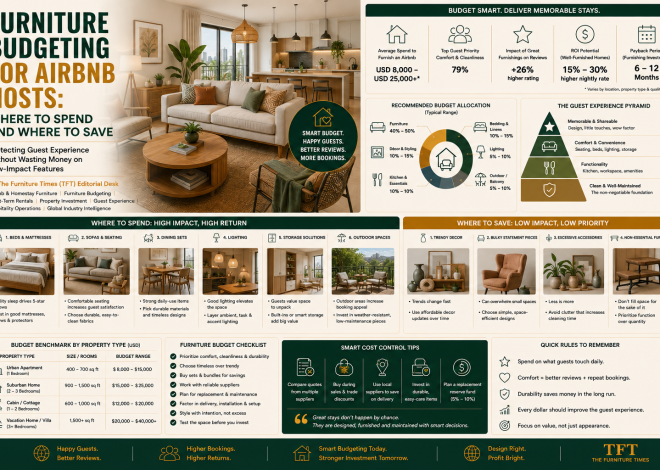
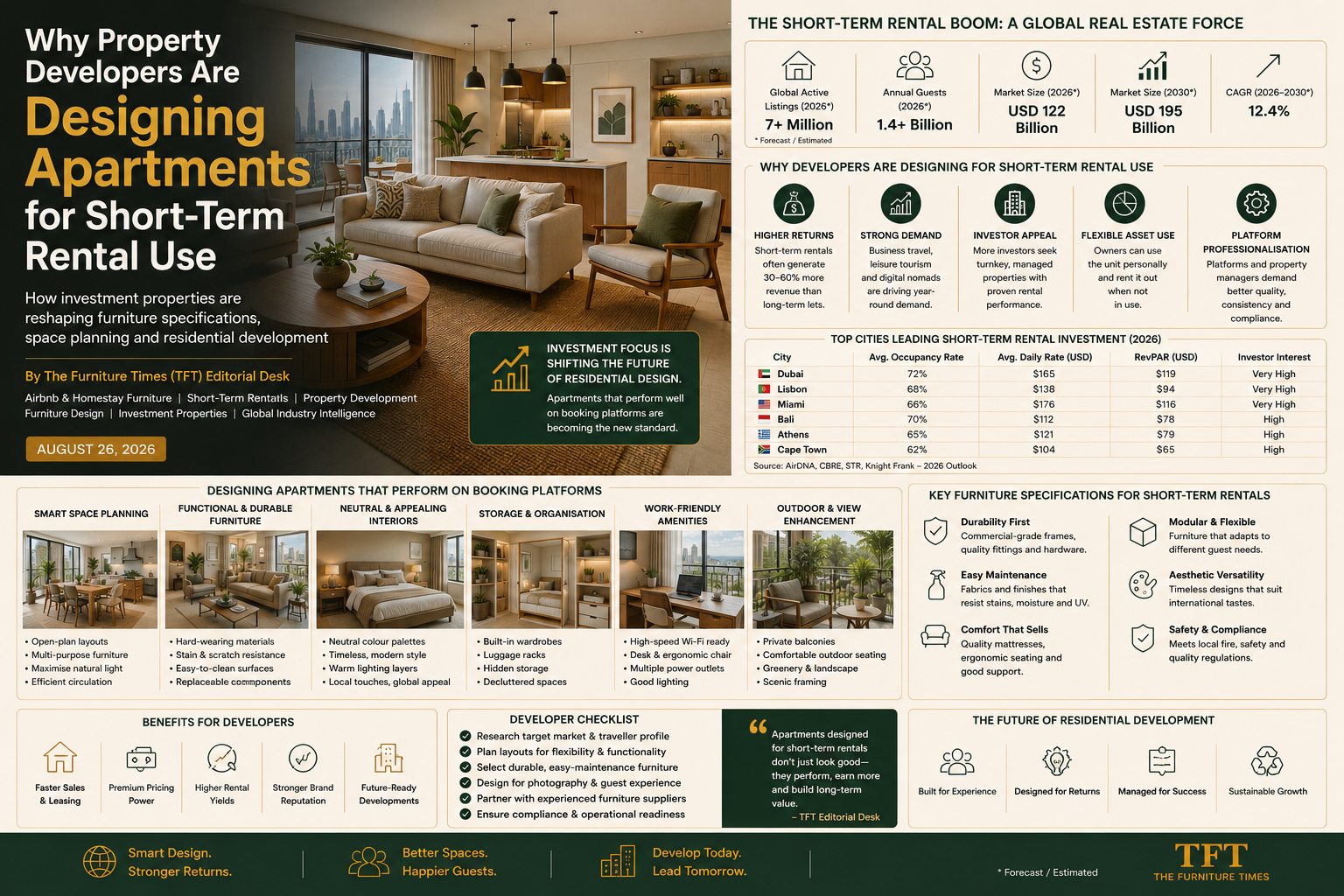
Property developers are increasingly treating short-term rental compatibility as a design requirement rather than an after-sales consideration.
Across tourism destinations, business hubs and fast-growing cities, new apartment projects are being planned for buyers who may occupy their properties only occasionally and rent them to visitors for the rest of the year. This investment pattern is changing decisions made long before construction begins—from unit sizes and furniture packages to storage, acoustic insulation, digital access and housekeeping circulation.
The result is a new type of residential product positioned between the conventional apartment and the hotel room. It must look like a home, operate like hospitality accommodation and remain flexible enough to serve owners, long-stay tenants and short-term guests.
For furniture manufacturers, interior designers, developers and property managers, this shift is creating a specialised market with requirements that differ substantially from ordinary residential furnishing.
The short-term rental model is entering the development brief
In the early years of home-sharing, most accommodation consisted of existing homes adapted by individual hosts. Owners bought furniture from local retailers, photographed the completed rooms and listed them on a platform.
That model remains important, but it is no longer the whole market.
Developers are now considering rental use during land acquisition, feasibility studies and architectural planning. Some developments explicitly permit short-term letting. Others provide optional rental-management programs, furniture packages or relationships with hospitality operators. A third group does not promote nightly rentals directly but designs apartments to accommodate flexible stays where local regulations permit them.
The growing institutionalisation of the sector can be seen in Airbnb’s real-estate partnerships. Its Airbnb-friendly program, which allows participating residential buildings to establish their own hosting rules, had expanded to more than 1,300 apartment and condominium buildings across more than 75 markets by November 2025, according to the company. The model gives participating building managers oversight while allowing eligible residents to host within building policies. Airbnb Newsroom
This does not mean every participating building is a purpose-built holiday-rental project. It does demonstrate, however, that short-term hosting is becoming a formal feature within parts of the professionally managed residential sector.
For developers, that formalisation creates an opportunity to sell more than square metres. They can sell flexibility, convenience and potential income—subject to regulation, building rules and actual market performance.
Investment buyers are influencing apartment design
An owner-occupier and an investment buyer evaluate an apartment differently.
The owner-occupier may prioritise personal taste, long-term storage, family routines and the ability to customise the home over time. An investor is more likely to ask:
- How quickly can the apartment begin earning income?
- How many guests can it accommodate comfortably?
- Will the interior photograph well?
- How frequently will furniture need replacement?
- Can housekeeping turn the unit around efficiently?
- Can the property serve both short and medium-length stays?
- Will the building allow the intended rental activity?
- Can a management company operate it without disrupting residents?
These questions influence the product that developers bring to market.
A compact apartment with a strong rental proposition may appeal to overseas buyers, second-home owners and purchasers who do not want to manage furnishing themselves. Developers therefore have an incentive to offer completed, operationally ready units rather than empty apartments requiring months of additional work.
The phrase “fully furnished” is consequently taking on a more demanding meaning. It may include not only beds, sofas and dining furniture, but also blackout window treatments, lighting, kitchen equipment, mattresses, linens, artwork, mirrors, luggage storage, workspace furniture and accessories.
In professionally organised projects, the furniture package becomes part of the investment product.
Smaller units require more intelligent space planning
Short-term-rental demand is reinforcing the development of studios and one-bedroom apartments in locations where land is expensive and visitor demand is strong. But simply making units smaller does not automatically make them suitable for guests.
The compact rental apartment must perform several functions within a limited area. It may need to accommodate sleeping, dining, remote work, luggage, food preparation and social activity without appearing crowded.
That requirement is changing space planning in several ways.
Flexible living areas
Developers are using open-plan living spaces that can support more than one activity. A dining table may also function as a desk. A bench may provide seating, luggage space and concealed storage. A sofa may convert into an additional bed, although operators increasingly recognise that poor-quality sofa beds can generate maintenance problems and negative reviews.
The best flexible spaces do not depend on constant furniture rearrangement. Guests staying only a few nights should be able to understand and use the room immediately.
Defined sleeping zones
Studios designed for rental increasingly use furniture, screens, partial walls or changes in lighting to distinguish the bed from the living area. Even when physical separation is impossible, visual zoning can make the apartment feel larger and more private.
Bed orientation also matters. A bed that dominates the entrance view can make a studio feel like a basic hotel room. A carefully positioned headboard, screen or shelving element can create a more residential impression.
Practical luggage management
Conventional apartment plans often overlook luggage because permanent residents unpack into wardrobes. Short-stay guests may keep suitcases open throughout their visit.
Purpose-aware designs provide luggage benches, raised bed frames, open wardrobe sections or dedicated suitcase recesses. These features prevent luggage from blocking circulation and reduce the likelihood that guests will place heavy suitcases on upholstered chairs, beds or dining tables.
Work-from-anywhere capability
Apartments serving business travellers, remote workers and longer-stay guests increasingly need a proper work surface, comfortable chair, accessible power and adequate lighting.
A narrow console described as a “workspace” may look convincing in a sales brochure but perform poorly in actual use. Developers must consider leg clearance, chair movement, video-call backgrounds, electrical outlets and the relationship between the workspace and sleeping areas.
More accessible power
Guests arrive with phones, laptops, watches, cameras and other devices. Bedside outlets, integrated USB charging and accessible sockets near work surfaces have therefore become part of furniture and electrical coordination.
This requires designers and furniture suppliers to collaborate earlier. A bedside table designed without reference to socket height can obstruct power points, while fixed headboards may make poorly located outlets unusable.
Furniture is being specified as operating equipment
A conventional purchaser may replace a sofa because tastes have changed. A rental operator replaces it because the upholstery is stained, a leg has loosened or the piece can no longer withstand repeated use.
That difference is fundamental.
In a short-term rental, furniture is exposed to a higher frequency of check-ins, cleaning cycles, luggage impacts and unpredictable guest behaviour. Dining chairs are dragged across floors. Bed frames are inspected and remade repeatedly. Sofa cushions are removed. Coffee tables become dining surfaces, desks and luggage stands.
Developers planning rental-oriented properties are therefore moving closer to hospitality procurement principles.
Durability over showroom appearance
Furniture must remain attractive after sustained use. Important specifications include:
- Reinforced bed frames and sofa structures
- Commercial-grade hinges, drawer runners and fittings
- Replaceable upholstery covers or cushions
- Stain-resistant and cleanable fabrics
- Moisture-resistant surfaces
- Scratch-resistant laminates and finishes
- Stable dining chairs with strong joints
- Tables that resist heat rings and cleaning chemicals
- Components that can be repaired without replacing the entire item
The lowest-cost furniture package can become expensive if it produces frequent call-outs, emergency replacements and inconsistent interiors.
Replaceability and standardisation
Large developments benefit from repeatable furniture specifications. If 100 apartments use the same bedside table, dining chair and headboard system, the operator can hold spare components and replace damaged items quickly.
Standardisation also helps purchasing teams negotiate volume pricing, simplifies staff training and makes maintenance more predictable.
However, excessive uniformity carries a commercial risk. If every unit looks identical, listings may appear generic and compete primarily on price. Developers and designers are therefore using controlled variation: a common durable base specification combined with different artwork, colour accents or accessory packages.
Cleanability
The suitability of a piece is increasingly judged by how efficiently it can be cleaned.
Deep buttoning, delicate fabrics, narrow gaps and intricate surfaces may create a luxury impression in a showroom but slow housekeeping and trap dust. Upholstered furniture must tolerate spot cleaning, while tables and cabinets must withstand frequent disinfecting without discolouration or surface failure.
Raised furniture can help cleaners reach underneath, but very low clearances may create inaccessible dirt traps. Fully flush plinths offer another solution, particularly for built-in cabinets.
Safety and stability
Furniture must be stable enough for guests who are unfamiliar with the space. Tall units may require anchoring. Glass, sharp corners and lightweight tables need careful consideration. Bunk beds and convertible furniture require particular attention to local safety standards, load ratings and operating instructions.
Fire performance can also become relevant depending on the jurisdiction, property classification and operator’s standards. Manufacturers seeking project work must be prepared to provide material certifications and technical documentation rather than simply product photographs.
Photography is influencing the floor plan
A short-term rental is usually selected through a screen before it is experienced in person. This gives photography an unusually strong influence over development and interior decisions.
Potential guests make rapid judgements about brightness, cleanliness, room size, bed quality and design character. Apartments therefore need clear visual focal points and uncluttered camera angles.
Developers are responding with:
- Feature headboards that define bedrooms
- Coordinated furniture and lighting
- Mirrors positioned to increase perceived depth
- Accent chairs or artwork that add colour
- Window treatments that frame views
- Open sightlines through living areas
- Furniture scaled to preserve visible floor area
- Concealed storage for operational supplies
This does not mean an apartment should be designed only for photographs. An oversized bed or undersized table may create an attractive image but frustrate guests in use. Successful schemes align photographic appeal with genuine comfort and circulation.
The strongest interiors communicate the property’s positioning immediately: urban business accommodation, coastal retreat, family apartment, premium residence or affordable extended-stay unit.
Developers are selling convenience as well as property
Furniture packages help developers reduce the gap between completion and rental income.
An overseas investor may not be able to visit multiple suppliers, supervise deliveries or coordinate installation. A developer-approved package offers a simpler route: select a scheme, complete the purchase and hand the unit to an operator.
This convenience can support sales, particularly in developments with large numbers of investment buyers. It can also improve the appearance of the building’s rental inventory by preventing a mixture of poorly furnished units from entering the market.
Developers may offer several package levels:
| Package | Typical positioning | Common features |
|---|---|---|
| Essential | Entry-level investor unit | Standard bed, sofa, dining set, curtains and basic accessories |
| Premium | Higher-rate urban or resort unit | Upgraded mattress, feature lighting, better upholstery and styled décor |
| Family | Multi-guest accommodation | Additional beds, larger dining table, durable storage and child-conscious layouts |
| Executive | Business and medium-stay guests | Proper desk, ergonomic seating, high-quality lighting and additional storage |
| Signature | Luxury or branded residence | Custom joinery, premium finishes, artwork, accessories and stronger design identity |
The package price must be transparent, but its operational value matters more than the item count. A long inventory of inexpensive accessories cannot compensate for an uncomfortable mattress or unstable dining chairs.
The building must support hospitality-style operations
Furniture cannot make a development suitable for short-term rentals if the building itself is not operationally prepared.
High guest turnover affects entrances, lifts, corridors, waste rooms, parking and security. Developers must decide how guests will enter, where they will wait, how their identities will be verified and who will respond when problems arise.
Important building-level considerations include:
- Digital or remotely managed access
- Separate or carefully controlled guest arrival routes
- Reception, concierge or remote support
- Housekeeping storage
- Linen and laundry handling
- Waste collection capacity
- Delivery and service access
- Lift capacity and protection
- Noise management
- CCTV and common-area security
- Maintenance response systems
- Clear emergency information
- Spaces for luggage before check-in or after checkout
In larger schemes, service circulation can have a direct effect on operating efficiency. Cleaners moving linen and supplies through the same congested routes used by residents and guests may face delays and generate complaints.
Acoustic performance is equally important. Short-term guests are more likely to arrive late, move luggage and use the apartment on unfamiliar schedules. Better wall, floor and door performance can protect both the guest experience and the quality of life of permanent residents.
Apartments are becoming more adaptable
One of the most valuable design strategies is adaptability rather than exclusive commitment to one rental model.
Short-term-rental regulations can change. Tourism demand can weaken. Financing conditions can shift. An investor may eventually decide to live in the apartment or place it on the long-term rental market.
Developers can reduce this risk by creating units that function across several forms of occupancy.
A well-designed apartment may support:
- Nightly or weekly stays where permitted
- Medium-term corporate accommodation
- Student or relocation housing
- Conventional annual tenancies
- Second-home use
- Full-time owner occupation
Adaptability affects furniture selection. Neutral but attractive foundations have a wider useful life than highly themed décor. Proper wardrobes matter for medium-term stays. Full-size appliances and usable dining areas expand the target market. Modular furniture makes it easier to change the unit’s configuration.
The goal is not to make the apartment anonymous. It is to give the property enough character to compete while preserving alternative uses.
Regulation remains the largest development risk
The commercial appeal of short-term-rental property must be considered alongside increasing regulatory scrutiny.
Cities are responding to concerns about housing availability, neighbourhood disruption, taxation, safety and building management in different ways. Their policies may include registration, licensing, primary-residence requirements, annual night limits, zoning restrictions or outright prohibitions in certain locations.
Barcelona, for example, plans not to renew licences for approximately 10,000 tourist apartments after 2028, a policy that received judicial support in 2025. The measure illustrates how a previously accepted investment model can be fundamentally altered by government action. Reuters
Elsewhere, regulation may be set not only by governments but also by strata corporations, condominium associations, landlords and building managers. In Malaysia, Airbnb has published reference materials intended to help strata buildings establish rules for responsible hosting, highlighting the importance of building-level governance. Airbnb Newsroom
Developers must therefore avoid presenting rental income as guaranteed. Before marketing a project as short-term-rental friendly, they need clarity on:
- Planning and zoning rules
- Tourism accommodation licences
- Building classification
- Fire and life-safety obligations
- Tax registration
- Insurance requirements
- Strata or condominium bylaws
- Maximum permitted rental nights
- Local host or manager requirements
- Rules governing advertisements and income projections
A development designed solely around nightly rentals may face serious problems if the regulatory environment changes. Mixed-use capability and conservative underwriting provide better protection.
Rental projections are shaping furniture budgets
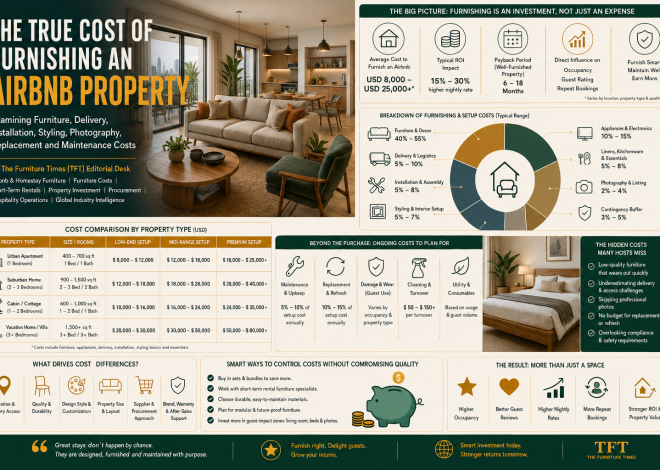
Furniture has traditionally been treated as an optional upgrade or decorative expense. In investment-oriented projects, it is increasingly assessed through operating returns.
A developer or operator may compare the additional cost of an upgraded mattress, blackout curtains or a statement headboard against possible effects on occupancy, reviews and average daily rate. Some improvements may not command an obvious nightly premium, but they can reduce complaints and extend replacement cycles.
The relevant calculation is total cost of ownership:
Purchase price + delivery + installation + maintenance + downtime + replacement cost.
A cheap sofa that fails after one year may cost more than a better-made alternative lasting several years. The loss is not limited to the replacement price. It can include cancelled bookings, emergency transport, staff time, photographic inconsistencies and poor guest reviews.
This operating perspective is encouraging earlier collaboration among developers, interior designers, furniture manufacturers and property managers. Operators can identify failure points that may not be obvious to a residential designer, while manufacturers can recommend materials and construction methods appropriate for repeated use.
Bedrooms remain the commercial core
Guests may select a property because of its living-room photographs or location, but sleep quality has a powerful influence on satisfaction.
Rental-oriented developers are consequently paying closer attention to:
- Mattress quality and support
- Bed-frame strength
- Blackout performance
- Noise transmission
- Bedside lighting
- Accessible charging
- Pillow and linen storage
- Space around the bed
- Headboard durability
- Air-conditioning and ventilation
In compact apartments, pressure to increase guest capacity can lead to too many beds or insufficient circulation. Although a higher advertised occupancy may appear to improve revenue, overcrowding can increase wear, complaints and cleaning time.
Good planning distinguishes between maximum capacity and comfortable capacity. A one-bedroom apartment that technically sleeps six may provide a worse commercial product than one designed properly for four.
Kitchens are being simplified—but not eliminated
Many short-term guests do not cook elaborate meals, yet a usable kitchen remains one of the major distinctions between an apartment and a hotel room.
Developers are refining kitchens around likely guest behaviour. Common priorities include:
- Easy-clean worktops
- Durable cabinet finishes
- Clearly visible storage
- Space for a microwave, kettle and coffee equipment
- Sufficient electrical outlets
- A practical refrigerator
- Simple, robust hardware
- Waste and recycling separation
- Replaceable kitchen inventory
- Adequate task lighting
For medium-stay and family markets, cooking capability becomes more important. A development targeting these segments needs greater food storage, more durable dining furniture and enough equipment for the advertised guest capacity.
Operational storage should be separated from guest storage wherever possible. Lockable cabinets can hold replacement linens, cleaning materials or owner possessions without reducing the apartment’s usable appearance.
Local identity is becoming a competitive tool
As the number of professionally furnished rentals increases, generic interiors become less effective at attracting attention.
Developers are using local materials, regional artwork, craft traditions and location-specific colour palettes to create identity. A coastal apartment may incorporate weather-resistant natural textures and colours drawn from the landscape. An urban development may reference local architecture, industry or culture through artwork and details.
This creates opportunities for local furniture manufacturers and artisans. They can supply feature pieces, artwork, lighting or accessories that distinguish a project while larger suppliers provide the standardised core inventory.
The challenge is to avoid superficial themes. Guests generally respond better to a coherent sense of place than to excessive decoration. Local character must also remain maintainable: fragile handmade objects and irreplaceable custom items may be unsuitable for high-turnover accommodation.
A new procurement opportunity for furniture suppliers
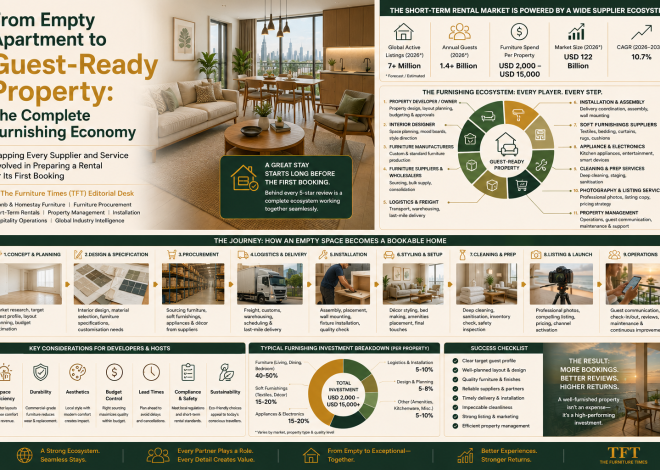
Rental-oriented development can generate larger, more structured orders than individual host furnishing.
A single project may require hundreds of beds, sofas, tables, chairs, headboards and storage units, followed by replacement orders once operations begin. Suppliers capable of supporting both the initial installation and the property’s continuing needs have a stronger proposition than those focused only on the first sale.
Manufacturers seeking this business should prepare to provide:
- Clear product specifications
- Material and safety documentation
- Samples and mock-up units
- Volume pricing
- Reliable production schedules
- Phased delivery
- Room-by-room labelling
- Installation services
- Defect-resolution procedures
- Spare parts
- Replacement guarantees
- Continuity of finishes and fabrics
- Regional warehousing or service partners
Lead time is particularly important. Furniture delays can prevent completed apartments from entering the rental pool, creating lost income for owners and reputational risk for developers.
Suppliers also need to understand that project completion is not the end of the relationship. Operators may require rapid replacement of one damaged chair or a matching bedside table several years later. Product continuity becomes a significant competitive advantage.
Data will increasingly guide future apartment design
Professionally managed rental buildings produce operational information that conventional residential developments rarely collect.
Operators can observe which furniture fails, which layouts attract higher occupancy, which units receive noise complaints and which amenities guests use most often. They can compare cleaning times, maintenance costs and review patterns across hundreds of stays.
This information can feed back into future development briefs.
A designer may discover that open wardrobes perform better than complex cabinets, that guests value a larger table more than an extra decorative chair, or that certain upholstery colours reveal stains too easily. A developer may learn that a slightly larger one-bedroom apartment earns more stable returns than an overcrowded micro-unit.
As operators, developers and manufacturers share more of this information, furniture specification is likely to become increasingly evidence-based.
The strongest projects will balance four interests
Rental-oriented development succeeds only when four groups receive a workable outcome:
- Guests need comfort, safety, clarity and an experience worth the price.
- Owners need a durable property with realistic income potential and alternative uses.
- Operators need efficient access, cleaning, maintenance and inventory control.
- Residents and communities need responsible management, security and protection from excessive disruption.
Designing exclusively around investor sales can produce apartments that perform poorly after completion. Designing only for maximum guest capacity can undermine comfort. Treating the property exactly like a conventional residence can make operations inefficient.
The best projects reconcile these interests from the beginning.
Outlook: from furnished apartment to flexible hospitality asset
Property development and short-term accommodation are becoming more closely connected, but the opportunity is not simply to build more apartments containing sofa beds.
The deeper transformation is the emergence of the flexible hospitality asset: a residence designed to accommodate changing patterns of ownership, travel and rental use.
For developers, short-term-rental compatibility can provide differentiation, support furnished-unit sales and attract a wider investor audience. For furniture companies, it creates demand for durable, standardised and serviceable products. For designers, it introduces a discipline in which visual appeal must coexist with housekeeping, maintenance and revenue performance.
The opportunity is significant, but it is not free from risk. Regulations can change, income projections can disappoint and badly planned buildings can generate conflict between guests and permanent residents.
Developers that approach the sector responsibly will therefore design for flexibility rather than speculation. They will verify permissions, involve operators early, specify furniture according to life-cycle performance and ensure that apartments remain useful even if the rental model changes.
That approach represents the next stage of the market: apartments that are not merely furnished for sale, but engineered for operation.
complete it
Conclusion: Short-Term Rental Design Is Becoming a Development Discipline
The growth of short-term rentals is changing more than the way apartments are marketed. It is influencing how developments are conceived, financed, planned, furnished, operated and maintained.
For property developers, designing apartments for flexible rental use can widen the potential buyer base, strengthen a project’s investment proposition and create opportunities for furnished-property premiums. It can also help developments respond to changing lifestyles in which people travel more frequently, work remotely, divide their time between cities and seek accommodation that combines residential freedom with hospitality convenience.
However, success depends on treating short-term rental readiness as an integrated development discipline—not simply adding furniture after construction.
The apartment layout must support guests without sacrificing long-term residential value. Furniture must survive repeated use while remaining attractive in photographs. Storage must accommodate guests, owners and operators. Building systems must support digital access, housekeeping, maintenance, security and responsible guest movement. Local regulations must be investigated before rental income becomes part of the sales narrative.
The most resilient developments will not depend on one platform, one type of guest or one regulatory environment. They will be designed as adaptable residential assets capable of supporting short stays, corporate accommodation, medium-term rentals, long-term tenancies and owner occupation.
This flexibility will become particularly important as governments strengthen oversight of short-term accommodation. Developers that build apartments exclusively around maximum nightly occupancy may expose buyers to unnecessary risk. Those that create high-quality, adaptable homes will retain more options if tourism demand, platform economics or local regulations change.
For the furniture industry, the development trend represents a major emerging opportunity. Rental-oriented apartments require complete furnishing packages, repeatable specifications, installation services, replacement programs, spare parts and continuing operational support. Suppliers that understand hospitality performance—not merely residential appearance—will be better positioned to secure these projects.
The future short-term-rental apartment will therefore be more than a furnished investment property. It will be a carefully planned operating environment where architecture, furniture, technology, hospitality and asset management meet.
Property developers are no longer asking only, “Will this apartment sell?”
They are increasingly asking:
Will it photograph well, operate efficiently, withstand repeated occupancy, satisfy guests, comply with regulations and remain valuable under different rental models?
That question is reshaping apartment development—and creating a specialised global market for furniture designed around performance, flexibility and investment value.
Key Takeaways for Property Developers
- Short-term-rental compatibility can differentiate an apartment project and attract investment buyers.
- Rental permissions must be verified before income potential is used as a marketing message.
- Furniture should be specified according to durability, cleanability, repairability and replacement availability.
- Smaller apartments require intelligent zoning rather than simply smaller furniture.
- Luggage storage, workspaces, charging access and blackout window treatments directly affect guest usability.
- Building operations—including access, housekeeping, security, waste and noise control—must be considered during planning.
- Standardised furniture packages improve procurement and maintenance, but controlled visual variation can help listings stand out.
- Adaptable units provide protection against regulatory or market changes.
- Property managers and hospitality operators should contribute to the design brief before construction begins.
- Total lifecycle cost is more important than the initial furniture purchase price.
Key Takeaways for Furniture Manufacturers
Furniture manufacturers seeking opportunities in rental-oriented developments should prepare for a more demanding procurement environment.
They may be expected to provide:
- Project-scale production capacity
- Consistent dimensions and finishes
- Commercial-quality construction
- Material and performance documentation
- Customisation within controlled parameters
- Model-room samples
- Phased delivery schedules
- Installation and room placement
- Replacement stock
- Spare fittings and components
- Fabric and finish continuity
- Warranty-response procedures
- Regional servicing capability
- Digital product catalogues
- Accurate product identification and labelling
Manufacturers should also design furniture families rather than isolated products. A coordinated range of beds, bedside tables, desks, dining tables, seating and storage can simplify apartment procurement while maintaining visual consistency.
The companies that combine design, manufacturing and after-sales support will have an advantage over suppliers competing only on unit price.
Industry Opportunities Created by Rental-Oriented Apartment Development
The rise of short-term-rental-compatible apartments creates opportunities across a much wider ecosystem:
- Furniture manufacturers
- Upholstery suppliers
- Mattress producers
- Modular furniture companies
- Joinery manufacturers
- Lighting suppliers
- Curtain and blind companies
- Interior designers
- Procurement consultants
- Furniture installers
- Property photographers
- Technology providers
- Smart-lock companies
- Housekeeping operators
- Linen and laundry suppliers
- Maintenance contractors
- Furniture repair businesses
- Property managers
- Rental-revenue specialists
- Insurance providers
- Compliance consultants
- Recycling and furniture-liquidation companies
This illustrates why Airbnb and homestay furniture deserves recognition as a specialised part of the global furniture industry ecosystem. Every new rental-ready apartment can create an initial furnishing order followed by years of maintenance, replacement and refurbishment demand.
The opportunity is not confined to luxury projects. It extends from compact urban studios and student-oriented accommodation to resort apartments, serviced residences, branded residences, suburban homes and mixed-use developments.
What Developers Should Ask Before Approving a Furniture Package
Before selecting a furniture scheme, developers and operators should examine the following questions:
- Is the furniture appropriate for the expected frequency of use?
- Can surfaces tolerate repeated professional cleaning?
- Are fabrics stain-resistant and replaceable?
- Can damaged components be repaired separately?
- Will matching replacement products remain available?
- Does the furniture obstruct circulation when the apartment reaches full guest capacity?
- Is there sufficient space for luggage?
- Can housekeeping reach beneath and behind furniture?
- Are beds, chairs and tables designed for realistic load conditions?
- Does the furniture meet relevant safety and fire requirements?
- Will the apartment still function for long-term residents?
- Does the furniture create strong listing photographs without compromising comfort?
- Can the supplier deliver every unit according to the construction schedule?
- Are warranties suitable for rental or commercial use?
- Who will handle defects and replacements after handover?
These questions can prevent expensive procurement mistakes and protect the development’s long-term reputation.
The Furniture Times Perspective
Short-term rental is no longer only a technology-platform story. It is becoming a property-development, furniture-manufacturing and hospitality-infrastructure story.
As more investors purchase apartments with rental flexibility in mind, the furniture industry must recognise that these properties have distinct requirements. They need residential warmth, hotel-level resilience and operational simplicity.
Developers that understand this convergence can create better-performing properties. Manufacturers that understand it can build long-term supply relationships. Designers that understand it can produce interiors that succeed both on the booking screen and during the actual stay.
The market will increasingly reward projects that combine:
Good design. Durable furniture. Efficient operations. Regulatory awareness. Flexible long-term use.
Together, these qualities will define the next generation of rental-ready apartment development.