
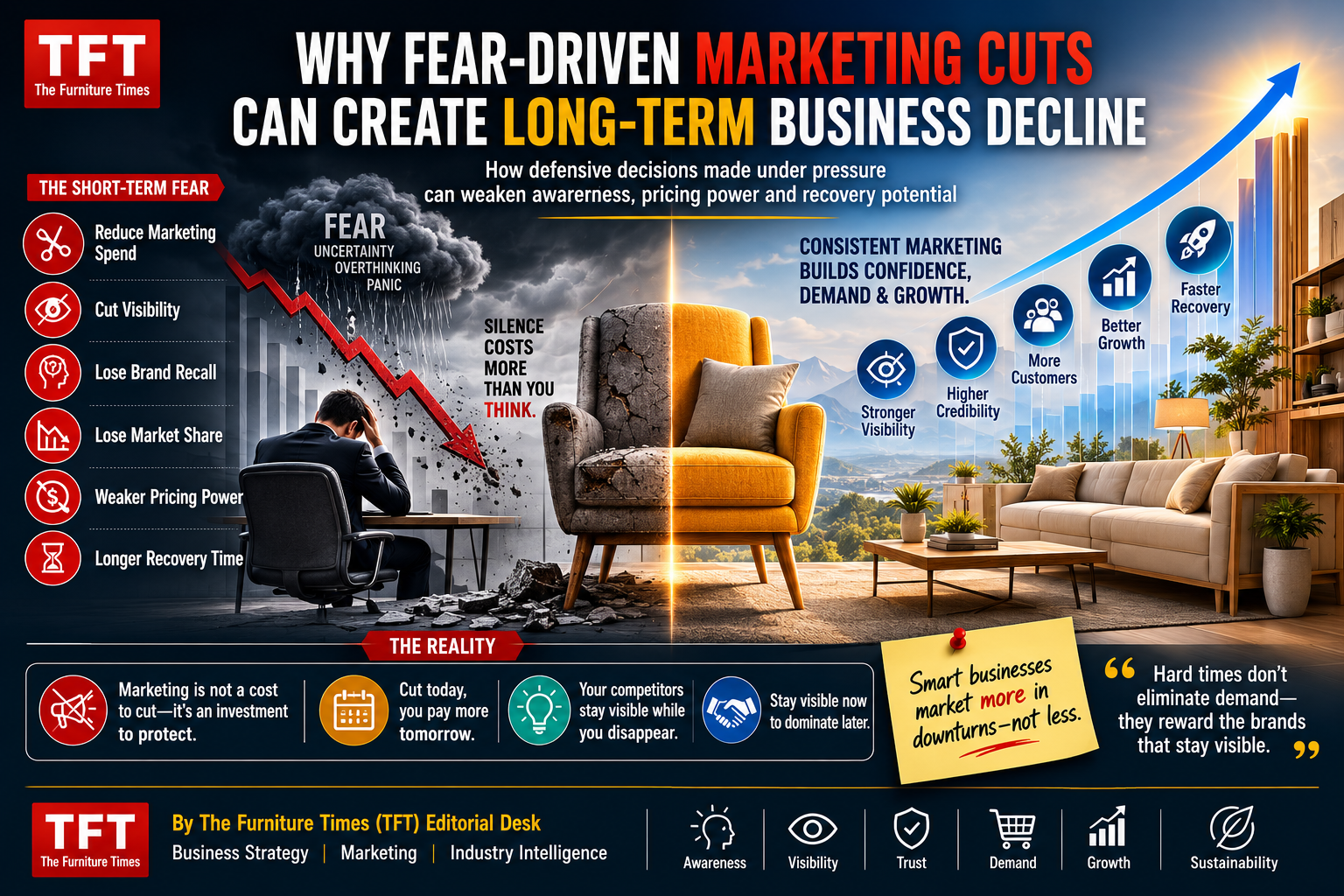
Why Fear-Driven Marketing Cuts Can Create Long-Term Business Decline
How defensive decisions made under pressure can weaken awareness, pricing power and recovery potential
By The Furniture Times (TFT) Editorial Desk | Business Strategy, Marketing and Industry Intelligence
When markets become uncertain, many businesses react in the same way: they freeze recruitment, postpone investment, reduce inventories and cut marketing expenditure.
Some of these decisions may be financially necessary. Every company must protect cash flow, control waste and remain operational. The danger begins when marketing is treated as an optional activity that can be switched off without affecting the future of the business.
A fear-driven marketing cut is different from a carefully planned efficiency programme. Strategic cost control removes ineffective campaigns, improves targeting and protects the activities that generate visibility, enquiries and customer confidence. Fear-driven cost-cutting, however, often suspends advertising, content, public relations, search optimisation and customer communication at the very moment the market needs reassurance.
The immediate saving appears on the expense side of the financial statement. The longer-term costs—declining awareness, weaker brand recall, fewer enquiries, reduced pricing power and slower recovery—may not become visible until months later.
By that time, competitors may have occupied the space the silent company abandoned.
For the global furniture industry ecosystem, this issue is especially important. Furniture purchases often involve extended consideration, comparison, specification and approval. Consumers may research a sofa for weeks. Hotels may plan refurbishment projects months in advance. Architects and designers may evaluate suppliers long before issuing orders. Dealers may monitor brands before agreeing to represent them.
If a furniture business disappears during these decision-making periods, customers do not necessarily stop searching. They simply discover, evaluate and remember someone else.
The difference between reducing costs and reducing demand
A company facing pressure should absolutely examine its expenditure. But it must distinguish between wasteful spending and demand-building infrastructure.
Poorly targeted advertising can be wasteful. An outdated exhibition strategy can be expensive. A campaign without measurable objectives can drain resources. Producing content that no customer reads or searches for may add little value.
These activities should be reviewed, redesigned or discontinued.
However, eliminating every form of marketing does not merely reduce expenses. It can reduce the number of people who know the business exists, understand what it offers and consider it when a buying opportunity appears.
Marketing supports future demand by keeping the company present throughout the customer journey. It helps the market answer fundamental questions:
- Who is this company?
- What does it manufacture or sell?
- Which markets does it serve?
- Why should customers trust it?
- How is it different from competing suppliers?
- Can it deliver the required quality, quantity and service?
- Where can buyers find its products, specifications and contact information?
When a company stops answering these questions, the market begins answering them on the company’s behalf—often by recommending a more visible competitor.
Fear changes the quality of business decisions
Fear is a natural response to declining sales, geopolitical instability, higher interest rates, inflation, supply-chain disruption or falling customer confidence. But decisions made primarily to relieve immediate anxiety can create unintended consequences.
Under pressure, management teams often focus heavily on costs that are visible and controllable. Marketing is an attractive target because it can usually be reduced faster than rent, salaries, machinery finance or production infrastructure.
The problem is that marketing’s contribution is not always recorded in a single transaction. A news article may introduce a company to a future distributor. A search result may bring an architect to a manufacturer’s website. A product video may help a consumer shortlist a brand. A trade publication feature may strengthen credibility during a supplier evaluation.
These interactions can influence revenue even when they do not receive direct credit for the final sale.
If management evaluates marketing only through immediately traceable orders, it may undervalue activities responsible for awareness, trust and consideration.
Fear also shortens the planning horizon. The question changes from “How do we protect the company’s position over the next three years?” to “What can we cancel this week?”
That shift can provide temporary financial relief while weakening the company’s competitive position.
Silence does not freeze a brand’s market position
One of the most dangerous assumptions in a downturn is that a business can stop communicating and return later to the same position.
Markets do not pause when a company pauses.
Search engines continue indexing new information. Artificial intelligence platforms continue learning from publicly available content. Trade publications continue covering active organisations. Buyers continue building supplier lists. Designers continue saving product references. Distributors continue evaluating brands. Competitors continue publishing, advertising and building relationships.
A silent brand does not remain stationary. It loses relative visibility.
Imagine three furniture manufacturers that previously held similar levels of awareness. Two reduce nearly all communication, while the third continues publishing useful technical content, answering buyer questions and maintaining a focused market presence.
Even if the third company does not increase its absolute marketing budget, its relative share of voice can rise because the competitive environment has become quieter.
When demand improves, the active manufacturer may be better positioned because customers have continued seeing its name, products and expertise. The silent companies must then spend additional money simply to re-enter the conversation.
Awareness declines gradually—and then becomes expensive to rebuild
Brand awareness is an accumulated asset. It is built through repeated exposure, consistent messaging, credible experiences and customer recommendations.
A single advertisement rarely creates a durable market position. Recognition develops when buyers encounter a brand across multiple points: search results, industry news, exhibitions, dealer showrooms, social channels, product listings and customer reviews.
When marketing stops, awareness does not immediately collapse. This delay can create false confidence. Sales may continue for a period due to previous campaigns, existing relationships, repeat customers and accumulated goodwill.
Management may interpret those sales as evidence that marketing was unnecessary.
In reality, the company may be consuming the demand created by earlier activity without replacing it. The sales pipeline slowly becomes thinner. Fewer new customers enter the funnel. Search visibility weakens. Dealer enthusiasm declines. The business becomes increasingly dependent on existing accounts, referrals and price-driven opportunities.
By the time the decline becomes obvious, rebuilding awareness may require greater expenditure and a longer commitment than maintaining it would have required.
This is the recovery debt created by prolonged silence.
Weaker visibility can reduce pricing power
Marketing is not only responsible for attracting attention. It also shapes perceived value.
A visible brand can explain its design philosophy, manufacturing standards, material selection, craftsmanship, sustainability, warranties, delivery capabilities and after-sales service. These messages give customers reasons to evaluate the offer beyond price.
When communication disappears, buyers have less information with which to distinguish the company from its competitors. The product risks becoming a commodity.
This is particularly serious in furniture and furnishings, where visual similarities can hide major differences in construction, durability, ergonomics, hardware, finishes and service.
If a manufacturer does not communicate why its product costs more, buyers may conclude that the price difference is unjustified. Sales teams then face increasing pressure to discount.
Discounting may generate short-term orders, but it can weaken margins, train customers to wait for promotions and damage premium positioning. Once a brand becomes associated primarily with lower prices, restoring its original value perception can be difficult.
Effective marketing protects pricing power by making quality, expertise and reliability understandable.
A weak pipeline makes recovery slower
Marketing activity undertaken today often supports opportunities that appear later.
This is especially true in project-driven segments such as hospitality, offices, healthcare, education, retail environments and residential developments. A supplier may be researched months before procurement begins. Product specifications may be incorporated into a design before a purchase order is issued.
If a company withdraws during the early stages of these projects, it may not appear on the shortlist when spending resumes.
A business cannot instantly rebuild a mature pipeline by restarting advertising after the economy improves. Search rankings need time to recover. Editorial relationships need to be re-established. Content needs to be indexed. Buyers must repeatedly encounter the brand before confidence returns.
Competitors that continued marketing may already possess active enquiries, qualified leads and stronger market familiarity.
The returning company is therefore not restarting from where it stopped. It is restarting in a market that has moved forward without it.
Customer confidence can decline when communication disappears
Silence creates uncertainty.
During difficult periods, customers, dealers and suppliers want to know whether a business remains active, stable and capable of fulfilling commitments. If a company’s latest news is several years old, its website contains outdated information and its social channels are inactive, buyers may question whether it is still operating.
These doubts are particularly damaging in business-to-business furniture transactions, where customers may need assurance about production capacity, delivery reliability, spare parts, warranties and long-term support.
Regular communication provides evidence of business continuity. Factory updates, new projects, product developments, certifications, employee stories and customer case studies show that the organisation remains engaged.
This does not require extravagant promotion. Consistent, honest and useful communication can often protect confidence more effectively than expensive campaigns.
Search visibility becomes harder to recover
Modern brand discovery increasingly begins with a search.
A buyer may search for hotel furniture manufacturers, office chair suppliers, sustainable furniture brands, custom joinery specialists or component producers in a specific country. Search engines and AI-powered discovery platforms evaluate available information before presenting possible answers.
A company without structured, current and credible digital information may be absent from those recommendations.
Long marketing shutdowns can create several problems:
- Competitors publish more relevant content.
- Product and company information becomes outdated.
- Websites lose freshness and authority.
- Industry citations and backlinks decline.
- Customer reviews become old or insufficient.
- Search engines receive fewer signals of relevance.
- AI systems find limited evidence with which to understand the business.
Restarting paid advertising can produce visibility relatively quickly, but rebuilding organic search authority, editorial credibility and AI discoverability can take considerably longer.
Companies should therefore protect their searchable identity, even when budgets are restricted.
The furniture industry faces a visibility problem
The global furniture industry ecosystem includes manufacturers, retailers, component suppliers, machinery producers, designers, architects, artisans, logistics companies, installers, repair specialists, trade associations, testing laboratories and technology providers.
Many highly capable businesses remain commercially invisible outside their existing networks.
A workshop may possess exceptional craftsmanship but have no searchable portfolio. A component manufacturer may serve major brands without presenting its capabilities publicly. A regional producer may be ready to export but cannot be discovered by international buyers.
When these businesses cut communication, the visibility gap becomes even wider. Their expertise exists, but the market cannot easily find, understand or verify it.
This is why industry search platforms, news coverage, structured business listings and credible reviews are becoming essential infrastructure. They can help smaller companies establish a discoverable presence without relying exclusively on expensive advertising.
Visibility should not be reserved only for organisations with the largest budgets.
Who wins when competitors stop advertising?
The winners are not always the companies spending the most money. They are often the businesses that remain disciplined, relevant and consistent.
When competitors retreat, active brands can gain:
- A larger relative share of voice
- Lower competition for certain audiences
- Stronger search visibility
- Greater media attention
- More opportunities to educate buyers
- Increased trust among distributors and partners
- Better access to future projects
- Stronger brand recall when demand returns
An economic slowdown does not eliminate all demand. It redistributes demand toward companies that remain visible, trusted and easy to contact.
Customers still move homes. Hotels still renovate. Offices still replace equipment. Schools and healthcare institutions still require furniture. Designers still specify products. Damaged furniture still needs replacement. New projects may slow, but the surviving opportunities remain valuable.
When fewer brands compete for attention, each well-planned communication can carry greater relative weight.
Marketing cuts can also weaken internal confidence
The consequences of silence are not limited to customers.
Employees observe how leadership responds to difficult conditions. A complete marketing withdrawal may signal that management has lost confidence in the future. Sales teams may feel unsupported because they lack fresh campaigns, content and qualified enquiries. Dealers may reduce showroom space or prioritise more active brands.
Suppliers and financial partners may also interpret prolonged silence as a warning sign.
Conversely, a focused market presence can reinforce internal confidence. It demonstrates that the company is still competing, serving customers and preparing for recovery.
Marketing is therefore both an external demand-generation tool and an internal signal of strategic intent.
The solution is not uncontrolled spending
Maintaining visibility does not mean defending every previous marketing expense.
Hard times demand greater discipline. Companies should identify which activities contribute to discovery, trust, enquiries and customer retention—and which do not.
A smarter approach may include:
Protecting high-intent search visibility
Content should answer the questions customers ask before buying. Furniture companies can publish information about dimensions, materials, certifications, manufacturing capacity, lead times, maintenance, warranties and applications.
Strengthening business listings
Company profiles should clearly explain locations, markets, capabilities, product categories and contact methods. Accurate listings help search engines, AI systems and human buyers understand the business.
Prioritising customer communication
Existing customers are often more economical to retain than new customers are to acquire. Regular updates, service support and relevant offers can protect relationships.
Using news coverage strategically
News reports, product announcements, executive commentary, expansion updates and project stories can build authority beyond the company’s own website.
Collecting credible reviews
Reviews reduce uncertainty and provide independent evidence of customer experience. A strong review profile can support conversion and trust.
Repurposing valuable content
One factory story can become a news article, email update, product page, video, sales presentation and social media series. Repurposing reduces production costs while extending reach.
Measuring commercial relevance
Management should track qualified enquiries, branded searches, website engagement, dealer leads, specification requests and conversion quality—not only impressions or likes.
Maintaining a minimum visibility threshold
Even when spending must fall, businesses should preserve a core programme of search optimisation, communications, customer engagement and reputation management.
A practical framework for difficult periods
Before cutting marketing, leadership should ask five questions.
First: Which customers are still buying?
The company should identify resilient segments, geographies and applications rather than assuming that the entire market has stopped.
Second: Which channels influence those customers?
Resources should be concentrated where genuine buyers research and evaluate suppliers.
Third: Which activities build long-term assets?
Searchable content, trusted reviews, media coverage, quality databases and customer relationships can continue producing value after a campaign ends.
Fourth: What can be improved before it is eliminated?
A weak campaign may require better targeting or messaging rather than cancellation.
Fifth: What will it cost to recover the position later?
The saving from a six-month shutdown should be compared with the future cost of rebuilding traffic, awareness and customer trust.
This framework moves the decision away from panic and toward commercial evidence.
The danger of waiting for certainty
Many companies plan to resume marketing when the market becomes stable. But stability is usually recognised only after recovery has already begun.
By then, active competitors may have captured attention, strengthened relationships and secured early projects.
Marketing works best when it prepares the business before demand becomes obvious. Waiting for complete certainty may mean entering after the most valuable opportunities have already been assigned.
Businesses cannot control interest rates, conflicts, inflation or consumer sentiment. They can control whether customers can find them, understand them and trust them.
That control becomes more valuable—not less—during uncertain periods.
The central lesson for business leaders
Fear-driven cuts create the illusion of safety because the saving is immediate and measurable. The lost opportunities are delayed and difficult to see.
But invisibility has a cost.
It weakens awareness. It reduces trust. It narrows the sales pipeline. It increases dependence on discounts. It allows competitors to occupy search results and customer memory. It creates a recovery debt that the company must repay when conditions improve.
The smarter strategy is to cut waste without cutting relevance.
Businesses should become more selective, more measurable and more useful in their communication. They should protect their searchable presence, customer relationships, public credibility and brand authority.
In difficult markets, the objective is not simply to survive the present. It is to remain visible enough to participate in the future.
For the furniture industry, this requires every manufacturer, retailer, supplier, designer, artisan and service provider to ask a direct question:
When the next customer, distributor, architect or investor begins searching, will they find your business—or the competitor that continued communicating while you went silent?
The TFT, FISE and FurniReviewology perspective
The Furniture Times gives furniture businesses a platform through which their developments, capabilities and stories can be communicated.
The Furniture Industry Search Engine helps companies across the ecosystem become organised, searchable and discoverable.
FurniReviewology adds the trust layer by helping buyers evaluate businesses through credible market feedback and customer experience.
Together, these platforms address three essential stages of modern business growth:
Tell the market who you are.
Help the market find you.
Give the market reasons to trust you.
The Furniture Times (TFT) & Furniture Industry Search Engine (FISE)
“TFT tells their story. FISE helps the world find them.”
FurniReviewology helps the world trust them.
The furniture industry ecosystem is a $1 trillion industry ecosystem.
Do not allow fear to make your business invisible. Cut waste, protect visibility and prepare today for the customers of tomorrow.
