
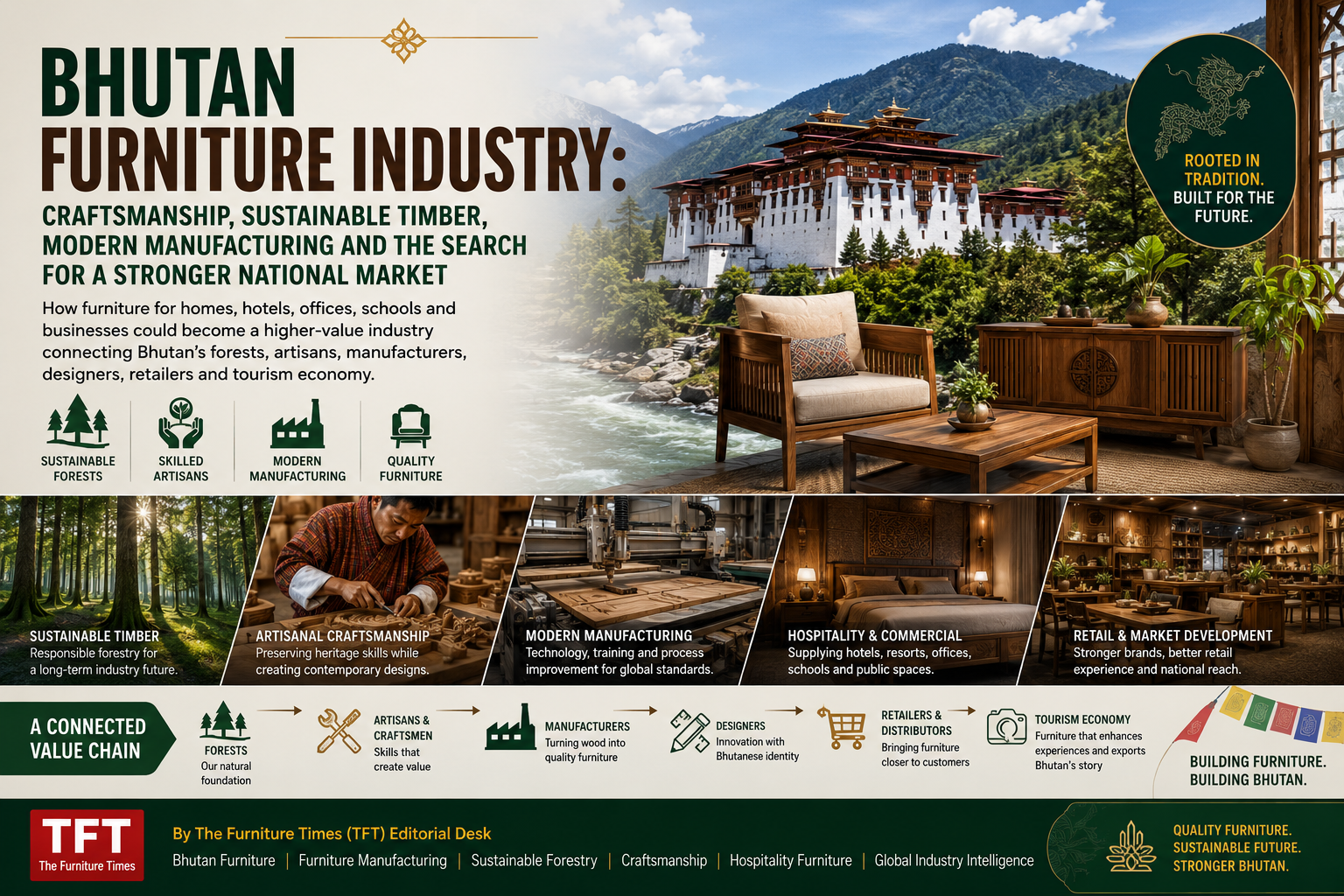
Bhutan Furniture Industry
Craftsmanship, Sustainable Timber, Modern Manufacturing and the Search for a Stronger National Market
How furniture for homes, hotels, offices, schools and businesses could become a higher-value industry connecting Bhutan’s forests, artisans, manufacturers, designers, retailers and tourism economy
By The Furniture Times (TFT) Editorial Desk | Bhutan Furniture | Furniture Manufacturing | Sustainable Forestry | Craftsmanship | Hospitality Furniture | Global Industry Intelligence
Bhutan’s furniture industry stands at an important intersection of tradition, natural resources, economic development and modern manufacturing.
The sector encompasses the design, production, distribution, installation, repair and sale of furniture for homes, hotels, offices, schools, monasteries, government buildings, restaurants, shops and other commercial environments. It also connects with mattresses, upholstery, furnishings, interior decoration, timber processing, hardware, logistics and after-sales services.
At its most traditional level, Bhutanese furniture reflects generations of woodworking knowledge. Carpenters and artisans transform timber into tables, beds, cabinets, chairs, storage chests, altars, doors, decorative panels and architectural features. Many products carry distinctive cultural forms, carved details, painted motifs and construction methods associated with Bhutanese identity.
At its emerging industrial level, the sector increasingly requires machinery, standardized production, technical drawings, digital design, computer-aided manufacturing, reliable hardware, efficient finishing and stronger quality control.
The future of Bhutan Furniture may therefore depend on the country’s ability to bring these two worlds together: preserving the intelligence of traditional craftsmanship while building a more productive, visible and commercially competitive furniture-manufacturing ecosystem.
Bhutan Furniture is larger than furniture factories
The furniture industry should not be understood only as workshops producing wooden tables and chairs. Its real ecosystem is much broader.
It includes:
- Timber growers and forest managers.
- Sawmills and timber processors.
- Furniture manufacturers.
- Traditional woodcarvers.
- Individual carpenters.
- Upholstery businesses.
- Mattress manufacturers and suppliers.
- Interior designers.
- Architects.
- Hardware and fittings suppliers.
- Wood-panel distributors.
- Metal fabricators.
- Plastic and composite-product suppliers.
- Paint, lacquer, coating and adhesive businesses.
- Machinery and power-tool suppliers.
- CAD and CAM service providers.
- Retailers and showrooms.
- Importers and distributors.
- Builders and contractors.
- Furniture installers.
- Repair and restoration businesses.
- Transport and logistics companies.
- Hotels, resorts and restaurants.
- Government and institutional procurement agencies.
- Vocational-training institutes.
- Digital marketplaces and business directories.
Every finished item of furniture is the result of decisions made across this value chain.
A hotel bed, for example, depends on timber or metal, joinery, hardware, surface finish, mattress quality, upholstery, installation, transportation and maintenance. A school desk must combine cost efficiency with stability, strength, repairability and safe dimensions.
Bhutan can create more value from furniture when it treats these activities as one connected industrial ecosystem rather than a collection of separate trades.
Wood remains central to Bhutanese furniture
Wood is likely to remain the country’s most culturally important and commercially preferred furniture material.
Customers often associate wooden furniture with:
- Durability.
- Warmth.
- Natural beauty.
- Traditional identity.
- Repairability.
- Craftsmanship.
- Long-term value.
- Compatibility with Bhutanese architecture.
Wood is also adaptable. It can be carved, joined, turned, painted, stained, laminated, veneered or combined with other materials.
However, the preference for wood creates a complex national question: how can Bhutan generate greater economic value from forest resources while maintaining its environmental commitments?
Bhutan is internationally recognized for its forest conservation. Yet an official 2024 report from the National Environment Commission noted that the country had more than 69% forest cover while still importing substantial wood products. The report suggested that sustainable forest utilization, supported by improved harvesting and processing technology, could create higher-value wood-based manufacturing without abandoning conservation goals. National Environment Commission of Bhutan
This presents a strategic opportunity.
Instead of viewing forestry only through timber extraction, Bhutan could examine the complete value created from each sustainably harvested tree:
- Sawing efficiency.
- Timber drying.
- Grading.
- Treatment.
- Component production.
- Furniture manufacturing.
- Engineered-wood products.
- Offcut utilization.
- Repair and restoration.
- Recycling.
- Biomass recovery.
The objective should be to create more economic value from less material.
From raw timber to higher-value products
Selling or consuming poorly processed timber captures only a small portion of possible value. Properly dried, graded and processed wood can become:
- Premium furniture.
- Hotel furniture.
- Doors and windows.
- Kitchen systems.
- Wardrobes.
- Decorative panels.
- Engineered components.
- Glued laminated timber.
- Cultural products.
- Export-oriented design pieces.
A country with strong environmental credentials should seek to build a reputation not for consuming forests carelessly, but for producing traceable, durable and high-value wood products through responsible management.
The National Environment Commission’s referenced analysis specifically identified investment opportunities in wood-based manufacturing and mentioned technologies such as glued laminated timber. That direction is relevant to furniture because improved processing and engineered-wood capability can support better material stability and more efficient resource use.
Traditional craftsmanship is a strategic national asset
Bhutanese furniture has an opportunity to stand apart from mass-produced international products through cultural authenticity.
Traditional knowledge may be visible in:
- Carved wooden details.
- Painted motifs.
- Religious and symbolic forms.
- Natural material selection.
- Joinery.
- Proportion.
- Hand finishing.
- Decorative cabinets and chests.
- Altars and ceremonial furniture.
- Architectural woodwork.
- Regional craft traditions.
These characteristics should not be dismissed as remnants of the past. They can become sources of differentiation in a global market dominated by standardized production.
The challenge is to prevent traditional furniture from becoming either:
- So expensive that only a small number of buyers can afford it, or
- So commercialized that its cultural meaning and craftsmanship are reduced to superficial decoration.
A stronger strategy would create multiple market levels.
Heritage and collectible furniture
This category could include museum-quality, ceremonial or artisan-signed pieces with documented provenance.
Premium contemporary Bhutanese furniture
Modern furniture could incorporate Bhutanese materials, proportions, colours or craft techniques without copying historic forms.
Hospitality and tourism furniture
Hotels, resorts, restaurants and wellness retreats could use furniture that communicates a genuine sense of place.
Accessible domestic collections
Simplified designs could bring locally inspired furniture to ordinary Bhutanese households without requiring extensive hand carving.
Architectural and institutional furniture
Government buildings, cultural centres, schools and public spaces could use standardized Bhutanese design elements in durable and maintainable products.
This approach would protect traditional craftsmanship while expanding its economic relevance.
The domestic market: homes, institutions and commercial development
Bhutan’s population is relatively small. The National Statistics Bureau projected the population at approximately 784,000 for 2025. That limits the potential scale of mass-market domestic furniture demand compared with neighbouring countries. Bhutan National Statistics Bureau
However, population alone does not determine market opportunity.
Furniture demand also comes from:
- Household formation.
- Urbanization.
- Housing construction.
- Replacement cycles.
- Government infrastructure.
- Education.
- Tourism.
- Offices.
- Restaurants.
- Retail development.
- Healthcare facilities.
- Renovation.
- Changing lifestyles.
The domestic furniture market can be examined through several principal demand groups.
Residential furniture
Households need:
- Beds.
- Mattresses.
- Wardrobes.
- Dining tables.
- Chairs.
- Sofas.
- Storage cabinets.
- Study desks.
- Kitchen cabinets.
- Children’s furniture.
- Outdoor furniture.
As urban homes become more compact, demand may increase for modular, multifunctional and space-saving products.
These could include:
- Storage beds.
- Folding tables.
- Stackable seating.
- Modular wardrobes.
- Expandable dining tables.
- Wall-mounted desks.
- Convertible sofas.
- Built-in storage.
Government and public institutions
Government departments, schools, training institutes, hospitals, administrative offices and public facilities represent a potentially important market.
Institutional furniture must be evaluated according to:
- Durability.
- Safety.
- Ergonomics.
- Repairability.
- Standardized dimensions.
- Replacement-part availability.
- Maintenance cost.
- Delivery capacity.
- Procurement transparency.
Local manufacturers may be able to compete for institutional projects when specifications recognize lifecycle value and local service—not merely the lowest initial price.
Office furniture
The office category can include:
- Workstations.
- Task chairs.
- Meeting tables.
- Filing cabinets.
- Reception furniture.
- Executive desks.
- Training tables.
- Breakout seating.
- Shelving.
- Acoustic furniture.
Modern office furniture increasingly requires cable management, modularity, ergonomic design and technology integration.
Schools and educational furniture
Education creates demand for:
- Classroom desks.
- Student chairs.
- Teacher tables.
- Library furniture.
- Laboratory furniture.
- Computer tables.
- Hostel beds.
- Storage.
- Training-room furniture.
Furniture designed for students must match age, size, safety and learning requirements. Poorly dimensioned furniture can affect comfort, posture and concentration.
Retail and commercial furniture
Shops, banks, restaurants, cafés, salons and service businesses need counters, displays, shelving, seating and storage.
Commercial buyers may prioritize:
- Fast installation.
- Brand consistency.
- Custom dimensions.
- Easy maintenance.
- Durable finishes.
- Replacement support.
Tourism could become a major driver of Bhutan Furniture
Bhutan’s high-value tourism positioning creates a special opportunity for furniture manufacturers and artisans.
Hotels, resorts, guesthouses, restaurants and wellness properties require:
- Guestroom furniture.
- Beds and headboards.
- Mattresses.
- Wardrobes.
- Bedside tables.
- Desks and luggage benches.
- Lobby seating.
- Restaurant tables and chairs.
- Outdoor furniture.
- Spa furniture.
- Decorative furnishings.
- Custom joinery.
- Traditional statement pieces.
Hospitality furniture must express design identity while surviving demanding commercial use.
A chair used in a hotel lobby may receive far more use than a chair in a private home. A hotel bed must support repeated occupancy, housekeeping and maintenance. Restaurant tables must resist spills, cleaning and constant movement.
Bhutanese manufacturers could strengthen their position by developing hospitality-specific capabilities such as:
- Room mock-ups.
- Technical drawings.
- Batch production.
- Sample approvals.
- Fire and safety documentation where required.
- Commercial finishes.
- Installation management.
- Spare parts.
- Refurbishment.
- Multi-year maintenance.
Furniture can strengthen the visitor’s sense of place
Tourists travel to Bhutan for an experience that is culturally and environmentally distinctive. Generic imported furniture can weaken that experience.
Well-designed local furniture can communicate Bhutanese identity through:
- Materials.
- Colour.
- Joinery.
- Textile selection.
- Carving.
- Proportion.
- Craft stories.
- Artisan attribution.
This does not mean that every hotel room must be filled with heavy traditional furniture. Contemporary forms can incorporate Bhutanese character in refined and practical ways.
The most successful hospitality furniture may be locally meaningful, internationally comfortable and commercially durable at the same time.
Upholstery, mattresses and furnishings belong within the ecosystem
The furniture industry is often reduced to hard furniture, particularly wooden case goods. That view excludes several important categories.
Upholstery
Upholstery adds value to sofas, chairs, benches, headboards, restaurant seating and hospitality furniture.
The upholstery value chain includes:
- Frames.
- Springs and webbing.
- Foam.
- Fibres.
- Fabric.
- Leather or alternatives.
- Sewing.
- Cushion production.
- Finishing.
- Repair.
Local upholstery businesses can compete through customization and repair services. However, they need access to consistent-quality foam, fabrics, tools and skilled labour.
Mattresses
Mattresses are closely connected to residential and hospitality furniture.
A growing mattress market may include:
- Foam mattresses.
- Spring mattresses.
- Hybrid mattresses.
- Hospitality mattresses.
- Institutional mattresses.
- Custom-size products.
- Mattress protectors.
- Pillows and bedding accessories.
Quality, hygiene, durability, support and warranty service are essential.
Furnishings
Curtains, rugs, carpets, cushions, wall textiles and other soft furnishings help complete interior environments.
Bhutan’s textile and craft traditions could support distinctive furnishing collections for homes, hotels and international buyers.
The role of metal, plastic, rattan and mixed materials
Although wood is central, the industry should not be limited to wooden furniture.
Metal
Steel, aluminium and stainless steel can be used for:
- Office furniture.
- School furniture.
- Institutional products.
- Outdoor furniture.
- Shelving.
- Bed frames.
- Restaurant furniture.
- Mixed-material collections.
Metal can provide strength, slimmer profiles and repeatable manufacturing. It also requires proper welding, corrosion protection and finishing.
Plastic and polymers
Plastic furniture can serve price-sensitive, outdoor and institutional markets. However, material quality and UV stability must be controlled.
Recycled polymers could present future opportunities if products are engineered for strength, durability and recyclability rather than treated as low-quality alternatives.
Rattan and woven materials
Natural or synthetic woven furniture can be relevant to hospitality, residential and outdoor applications. Locally appropriate natural-fibre value chains could create opportunities for rural enterprises if material supply and product durability are developed responsibly.
Silver and decorative metals
Silver is not a mainstream structural furniture material. It may nevertheless appear in highly specialized ceremonial products, decorative fittings, inlay or luxury objects.
It should be understood as a niche craft or decorative application rather than a principal industrial furniture material.
Hybrid furniture
Future Bhutanese furniture may combine:
- Timber and steel.
- Wood and woven fibres.
- Metal and upholstery.
- Engineered panels and solid-wood details.
- Bamboo and timber.
- Recycled polymers and metal.
- Local textiles and contemporary frames.
Hybrid construction can improve material efficiency and create a modern Bhutanese design identity.
Machinery is necessary, but it should strengthen craftsmanship
Skilled workers remain at the heart of furniture manufacturing, but machinery can improve accuracy, productivity and consistency.
Relevant equipment includes:
- Saws.
- Planers.
- Thicknessers.
- Routers.
- Lathes.
- Drilling machines.
- Sanders.
- Mortising and tenoning machines.
- Panel saws.
- Edge-banders.
- CNC machines.
- Spray-finishing systems.
- Dust extraction.
- Upholstery machinery.
- Sewing machines.
- Packaging equipment.
Small workshops do not necessarily need to own every machine. Shared production facilities or cluster-based centres could give multiple enterprises access to advanced equipment.
This could be particularly valuable for:
- Timber drying.
- CNC processing.
- Panel sizing.
- Edge banding.
- Spray finishing.
- Testing.
- Packaging.
- Digital design.
Technology should not replace the artisan’s knowledge. It should reduce repetitive work, improve precision and allow craftsmanship to focus on higher-value details.
CAD and CAM can transform design and production
Computer-aided design and computer-aided manufacturing are increasingly important to modern furniture companies.
CAD can help businesses create:
- Accurate drawings.
- Three-dimensional models.
- Production details.
- Component lists.
- Customer visualizations.
- Room layouts.
- Cutting plans.
- Technical specifications.
CAM can translate approved designs into machine instructions for CNC cutting, drilling and shaping.
The combination can improve:
- Repeatability.
- Material yield.
- Customization.
- Quotation accuracy.
- Design communication.
- Production planning.
- Quality control.
For hospitality or government projects, digital drawings can also reduce misunderstandings between the client, designer, workshop and installer.
Bhutanese manufacturers could use digital tools to preserve traditional patterns. Carved or painted motifs can be documented digitally, protecting design knowledge and making controlled reproduction possible.
Skills development is already taking place
Bhutan has formal furniture-making and carpentry training programmes that can support the development of a more professional workforce.
The Technical Training Institute in Chumey offers a Furniture Making BQFC Level 2 programme. Its published curriculum includes practical training in basic woodwork, common furniture, living-room furniture, bedroom furniture and kitchen cabinets. It also incorporates workplace safety, computer applications, entrepreneurship and communication. TTI Chumey furniture-making programme
The Ministry of Education and Skills Development has also advertised advanced BQFC Level 3 training in furniture making, demonstrating a continuing pathway for technical progression. Bhutan Ministry of Education and Skills Development
Bhutan’s Labour Market Information System listed a Certificate II furniture-making programme in 2026 covering furniture production, assembly, repair, workplace safety, timber selection, measuring, cutting, shaping, joining, sanding and finishing. Bhutan Labour Market Information System
These programmes are valuable, but training must remain connected to the real needs of the market.
Future skills should include:
- Furniture design.
- Ergonomics.
- CAD and CAM.
- CNC operation.
- Upholstery.
- Finishing technology.
- Quality control.
- Machine maintenance.
- Production planning.
- Costing.
- Packaging.
- Installation.
- Digital marketing.
- E-commerce.
- Customer service.
- Entrepreneurship.
- Sustainable material use.
Employment and youth entrepreneurship
Bhutan’s furniture industry could support meaningful employment because it combines technical skill, creativity and entrepreneurship.
Potential careers include:
- Furniture maker.
- Carpenter.
- Wood machinist.
- Furniture designer.
- CNC operator.
- Upholsterer.
- Finishing technician.
- Production supervisor.
- Quality inspector.
- Installer.
- Interior designer.
- Sales consultant.
- Project manager.
- Repair specialist.
- Digital catalogue manager.
Official National Statistics Bureau indicators placed youth unemployment at 16.5% in the first quarter of 2026. This strengthens the case for industries capable of converting practical training into employment and enterprise development. Bhutan National Statistics Bureau
Furniture training must therefore lead toward:
- Apprenticeships.
- Workshop placements.
- Tool access.
- Small-business finance.
- Shared machinery.
- Government procurement opportunities.
- Design mentorship.
- Market access.
- Digital visibility.
Training without market opportunity can produce frustration. Skills, finance and demand must be developed together.
Cottage and small industries will remain essential
Bhutan’s economic scale suggests that cottage and small industries will continue to play a central role in furniture production.
Small enterprises can be highly competitive in:
- Custom furniture.
- Repair.
- Restoration.
- Local installation.
- Traditional carving.
- Small hospitality projects.
- Built-in furniture.
- One-off design.
- Regional service.
- Artisan products.
The Department of Industry operates an Industry Information System and reports hundreds of registered production, manufacturing, cottage and small industrial entities across Bhutan’s wider economy. The department’s stated vision emphasizes a mindful, green and globally competitive industrial Bhutan. Bhutan Industry Information System
The government has also maintained a CSI market in Thimphu to promote locally manufactured goods in domestic and international markets. Platforms of this kind can support Bhutanese furniture and craft products if they provide real merchandising, buyer outreach and digital promotion—not only physical display space.
Imports create competition and reveal market gaps
Bhutanese furniture businesses compete with imported products that may benefit from:
- Large production volumes.
- Automated factories.
- Lower unit costs.
- Wider selections.
- Standard packaging.
- Established brands.
- Regional distribution systems.
Imports can satisfy customer demand, but high dependence on imported finished furniture can limit domestic value creation.
Local manufacturers should not attempt to replace every imported product. Instead, they should identify areas where proximity and local knowledge create an advantage.
These advantages include:
- Custom sizing.
- Faster repairs.
- Cultural design.
- Local installation.
- Small order quantities.
- Direct customer communication.
- Hospitality customization.
- Adaptation to Bhutanese architecture.
- Replacement-part support.
- Lower transport distance.
- Local economic contribution.
A locally manufactured product should not compete only by claiming that it is local. It must deliver quality, service and value.
The export opportunity should focus on distinction, not volume
Bhutan is unlikely to compete with major furniture-exporting countries through high-volume, low-price production.
Its stronger export opportunity may lie in:
- Premium artisan furniture.
- Contemporary Bhutanese design.
- Sustainable wood products.
- Cultural statement pieces.
- Small-batch collections.
- Hospitality furniture for distinctive resorts.
- Decorative panels.
- Carved products.
- Furnishings and textile-linked furniture.
- Ethically documented products.
Successful exports require more than craftsmanship.
Export-ready manufacturers need:
- Accurate specifications.
- Consistent dimensions.
- Moisture control.
- Quality assurance.
- Export packaging.
- Product photography.
- Digital catalogues.
- Reliable lead times.
- Material documentation.
- International payment capability.
- Shipping knowledge.
- After-sales communication.
A beautiful handmade table can still fail commercially if it arrives damaged, varies from the approved dimensions or cannot be reordered consistently.
Quality control must become a daily manufacturing discipline
Furniture quality is determined by the entire production system.
Manufacturers should control:
- Material selection.
- Timber moisture.
- Drying.
- Dimensions.
- Joinery.
- Adhesive use.
- Fasteners.
- Hardware.
- Surface preparation.
- Coating application.
- Assembly.
- Packaging.
- Installation.
Common furniture failures can include:
- Warping.
- Cracking.
- Loose joints.
- Drawer misalignment.
- Door sagging.
- Finish peeling.
- Colour variation.
- Rusting hardware.
- Unstable chairs.
- Sagging beds.
- Damaged edges.
- Moisture-related defects.
Many of these failures can be reduced through process control rather than expensive technology alone.
A small workshop can improve quality by maintaining:
- Approved drawings.
- Material records.
- Measurement checks.
- Moisture readings.
- Sample approvals.
- Production checklists.
- Final inspection.
- Complaint records.
- Corrective actions.
Furniture testing and standards will become more important
As Bhutanese manufacturers pursue institutional, hospitality and export opportunities, buyers will increasingly request evidence of product performance.
Relevant testing can include:
- Stability.
- Strength.
- Durability.
- Impact.
- Joint performance.
- Drawer and hinge cycles.
- Shelf loading.
- Finish adhesion.
- Resistance to liquids and heat.
- Corrosion.
- Upholstery performance.
- Mattress durability.
Bhutan could consider developing or expanding access to shared testing facilities so that smaller businesses are not excluded by the cost of equipment.
Testing should not be viewed as an obstacle. It can help manufacturers identify design weaknesses before products reach customers.
Sustainability must cover the complete product life
Bhutan’s environmental reputation creates high expectations.
A sustainable furniture strategy should consider:
- Legal and responsible material sourcing.
- Efficient timber utilization.
- Durable construction.
- Low-waste cutting.
- Safer finishes.
- Repairability.
- Replaceable components.
- Reuse.
- Refurbishment.
- Recycling.
- Responsible packaging.
- End-of-life planning.
The most sustainable furniture is often the furniture that remains useful for a long time.
Traditional Bhutanese furniture may already possess an advantage through durable materials and repairable construction. Modern production should retain that strength.
Offcuts can become new products
Furniture workshops generate wood offcuts, sawdust and small components.
These can potentially become:
- Small household products.
- Toys.
- Decorative objects.
- Handles.
- Mosaic panels.
- Packaging supports.
- Biomass.
- Composite material inputs.
- Training materials.
Waste reduction improves both environmental performance and profitability.
Bhutan needs a visible furniture identity
One of the greatest barriers facing smaller furniture markets is not always production. It is discoverability.
A Bhutanese manufacturer may produce excellent furniture but remain invisible to:
- Hotel developers.
- Architects.
- International buyers.
- Government procurement teams.
- Retailers.
- Interior designers.
- Homeowners.
- Tourists seeking authentic products.
A stronger national digital presence should allow buyers to search for:
- Bhutan furniture manufacturers.
- Thimphu furniture shops.
- Bhutanese wooden furniture.
- Hotel furniture suppliers in Bhutan.
- School furniture manufacturers.
- Office furniture suppliers.
- Traditional Bhutanese furniture.
- Custom furniture makers.
- Carpenters by district.
- Mattress suppliers.
- Upholstery services.
- Furniture repair.
- Interior designers.
- Timber and panel suppliers.
This is where a Bhutan Furniture Search Engine within FISE could become transformative.
It could catalogue the complete ecosystem by:
- Company.
- Product.
- Material.
- Location.
- Capability.
- Certification.
- Project experience.
- Delivery area.
- Customer segment.
A small artisan in Bumthang, a workshop in Thimphu or a manufacturer in an industrial estate should not remain undiscoverable simply because it cannot afford a large advertising campaign.
FurniReviewology could help Bhutanese businesses build trust
Visibility helps customers find a company. Trust helps them select it.
Furniture purchases involve uncertainty. Buyers want to know:
- Was the product delivered on time?
- Did it match the approved design?
- Was the timber properly dried?
- Was installation professional?
- Did the finish remain stable?
- Did the company respond to problems?
- Was the warranty respected?
- Was the price fair?
FurniReviewology can provide a structured trust layer through customer and project feedback.
Reviews can also help businesses improve. Repeated comments about delayed delivery, weak hardware or poor finishing are valuable operational intelligence.
The objective should not be to reward only large brands. It should help honest, capable and responsive local businesses prove their value.
A strategic action plan for Bhutan Furniture
Bhutan could strengthen the industry through ten connected priorities.
1. Create a national furniture-industry map
Identify manufacturers, artisans, retailers, suppliers, training institutes and service providers by district and capability.
2. Improve sustainable timber processing
Invest in drying, grading, processing, engineered wood and efficient harvesting.
3. Develop shared production facilities
Give small manufacturers access to CNC equipment, panel processing, finishing, testing and packaging.
4. Connect training with employment
Link technical institutes to apprenticeships, furniture companies and enterprise support.
5. Establish a Bhutanese design identity
Bring artisans, designers, architects and manufacturers together to develop contemporary collections rooted in Bhutanese culture.
6. Strengthen quality systems
Promote drawings, material control, testing, traceability and complaint management.
7. Use public procurement strategically
Where appropriate and consistent with procurement rules, help capable local businesses participate in school, office and institutional projects.
8. Develop hospitality supply capacity
Create furniture and furnishing solutions suited to hotels, resorts, restaurants and wellness tourism.
9. Build digital catalogues and searchability
Make every credible manufacturer, artisan, retailer and supplier discoverable online.
10. Focus exports on high-value differentiation
Compete through design, provenance, sustainability and craftsmanship rather than mass-market price.
Bhutan Furniture can become a national green-industry story
Bhutan has several assets that many countries would like to possess:
- A strong environmental identity.
- Extensive forest cover.
- Recognizable cultural aesthetics.
- Skilled woodworking traditions.
- A premium tourism image.
- A small but trainable workforce.
- The possibility of building traceable value chains.
Its disadvantages are also real:
- A small domestic market.
- Difficult terrain.
- Transport costs.
- Limited manufacturing scale.
- Dependence on imported materials and equipment.
- Restricted access to advanced technology.
- Limited international visibility.
The correct strategy is therefore not to imitate large furniture-producing countries.
Bhutan should build a furniture industry consistent with its own strengths: responsible, durable, culturally intelligent, digitally visible and capable of producing higher value from limited resources.
The future of Bhutan Furniture can be shaped around a simple principle:
Use resources carefully, preserve skills respectfully, manufacture intelligently and make every capable business discoverable.
Furniture can support more than interiors. It can support forests, tourism, culture, employment, education, entrepreneurship and Bhutan’s transition toward a greener and more diversified economy.
Sources: National Environment Commission of Bhutan, Bhutan National Statistics Bureau, Bhutan Industry Information System, TTI Chumey Furniture Making Programme
The Furniture Times (TFT) & Furniture Industry Search Engine (FISE)
“TFT tells their story. FISE helps the world find them.”
FurniReviewology helps the world trust them.
The furniture industry ecosystem is a $1 trillion industry ecosystem.
Bhutan Furniture must think globally, manufacture responsibly and become searchable. Build the ecosystem, support the artisans and be part of the movement.
