
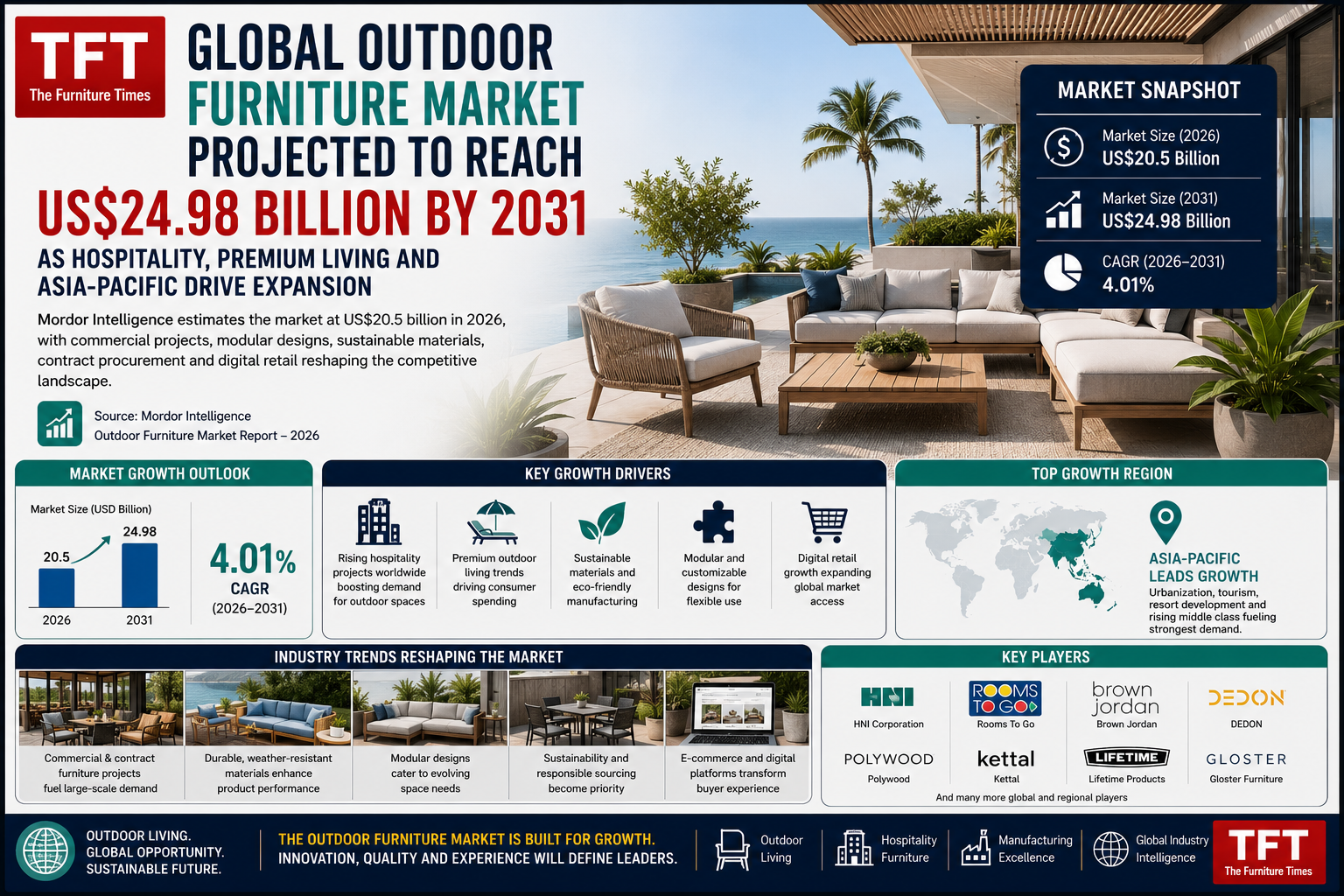
Global Outdoor Furniture Market Projected to Reach US$24.98 Billion by 2031 as Hospitality
Premium Living and Asia-Pacific Drive Expansion
Mordor Intelligence estimates the market at US$20.5 billion in 2026, with commercial projects, modular designs, sustainable materials, contract procurement and digital retail reshaping the competitive landscape
By The Furniture Times (TFT) Editorial Desk | Outdoor Furniture | Outdoor Living | Hospitality Furniture | Market Intelligence | Manufacturing | Global Industry Intelligence
The global outdoor furniture market is moving beyond its traditional identity as a seasonal residential category. It is becoming an increasingly strategic part of hospitality development, commercial property planning, urban placemaking, premium housing, restaurant expansion and lifestyle-led renovation.
According to the latest study published by Mordor Intelligence, the outdoor furniture market is estimated at US$20.5 billion in 2026 and is projected to reach US$24.98 billion by 2031. The research forecasts a compound annual growth rate of 4.04% between 2026 and 2031.
The market was valued at approximately US$19.70 billion in 2025, according to the same report.
While the projected growth rate suggests steady rather than explosive expansion, the numbers reveal a deeper transformation. Outdoor furniture is becoming more technically demanding, service-intensive and closely connected to architecture, tourism, wellness, real estate and digital commerce.
Consumers are no longer buying only a basic table and several garden chairs. Hotels, resorts, restaurants, homeowners, property developers and institutional buyers increasingly expect outdoor products to combine:
- Indoor-level comfort.
- Commercial durability.
- Weather resistance.
- Modular flexibility.
- Sustainable materials.
- Easier maintenance.
- Stronger warranties.
- Replaceable components.
- Digital product information.
- Reliable project delivery.
The result is a market in which the product, specification, supply chain, after-sales system and digital purchasing experience are becoming equally important.
Market-data note: All market-size, share and growth figures attributed to Mordor Intelligence are based on the research company’s proprietary estimation framework. They should be treated as forecasts rather than guaranteed future outcomes. Read the Mordor Intelligence outdoor furniture market report.
Global outdoor furniture market: key figures
| Market indicator | Mordor Intelligence estimate |
|---|---|
| Market value in 2025 | US$19.70 billion |
| Estimated market value in 2026 | US$20.50 billion |
| Forecast market value in 2031 | US$24.98 billion |
| Forecast CAGR, 2026–2031 | 4.04% |
| Largest regional market | Asia-Pacific |
| Fastest-growing regional market | Asia-Pacific |
| Asia-Pacific’s 2025 market share | 45.70% |
| Commercial segment’s 2025 share | 59.20% |
| Chairs’ 2025 product share | 39.70% |
| Wood’s 2025 material share | 39.60% |
| Mid-range segment’s 2025 share | 51.40% |
| B2B and contractor channel’s 2025 share | 58.60% |
The data indicates that outdoor furniture is strongly influenced by commercial and project demand. It is not primarily a residential garden category. Hotels, resorts, restaurants, developers, corporate campuses and public-space projects represent a major share of market activity.
Commercial projects control the largest share
The commercial segment accounted for an estimated 59.20% of outdoor furniture revenue in 2025.
This dominance reflects continuing investment in:
- Hotels and resorts.
- Boutique accommodation.
- Beach clubs.
- Restaurants and cafés.
- Rooftop dining areas.
- Corporate terraces.
- Wellness resorts.
- Glamping destinations.
- Cruise and leisure environments.
- Residential development amenities.
- Public parks and recreational spaces.
Outdoor spaces have become revenue-producing assets. A hotel pool deck, restaurant terrace or landscaped courtyard can influence bookings, dining capacity, property positioning and social-media visibility.
For hospitality operators, outdoor furniture is not simply decoration. It is operating equipment.
Every chair, table, lounger, daybed and parasol affects:
- Guest capacity.
- Space utilization.
- Comfort.
- Brand presentation.
- Cleaning time.
- Maintenance cost.
- Replacement frequency.
- Staff efficiency.
- Safety.
- Customer experience.
This explains why hospitality buyers increasingly examine total cost of ownership instead of selecting products only by purchase price.
A low-priced lounger that fades, corrodes, cracks or becomes unstable after one season can be more expensive than a higher-quality product with replaceable slings, cushions and components.
Outdoor areas are becoming headline amenities
Mordor Intelligence identifies resort and boutique-hotel construction as one of the strongest growth drivers for premium poolside furniture.
Hotels increasingly use outdoor environments as differentiating features. Infinity pools, cabanas, rooftop lounges, landscaped dining spaces and wellness decks frequently appear prominently in marketing campaigns.
These spaces must look attractive in photography while also surviving:
- Constant guest use.
- Strong sunlight.
- Rain.
- Humidity.
- Salt exposure.
- Chlorinated water.
- Sunscreen and body oils.
- Cleaning chemicals.
- Food and beverage spills.
- Repeated rearrangement.
- Seasonal storage.
The demand is therefore shifting toward products combining refined design with contract-level engineering.
Manufacturers capable of offering aesthetics without compromising commercial performance are likely to find stronger opportunities in hospitality procurement.
Residential demand continues to evolve
Although commercial buyers currently represent the larger segment, residential outdoor furniture is forecast to grow at a faster 5.19% CAGR through 2031, according to Mordor Intelligence.
Homeowners are treating balconies, patios, terraces, courtyards and gardens as extensions of indoor living space.
The modern outdoor environment can serve as:
- A dining room.
- A family lounge.
- A remote-working area.
- A reading space.
- A wellness zone.
- A children’s activity area.
- An entertainment environment.
- A private retreat.
This change is particularly visible in premium housing, condominium developments and renovated suburban properties.
The pandemic accelerated interest in outdoor living, but the category’s continued development suggests that the behavioural shift has become structural. Buyers now expect many of the comforts associated with indoor furniture to be available outdoors.
That means deeper seats, better cushions, softer textiles, coordinated collections, storage accessories, side tables, shade products and lighting integration.
Indoor comfort is moving outdoors
The distinction between indoor and outdoor furniture is becoming less visible.
Contemporary outdoor collections increasingly feature:
- Upholstered-looking cushions.
- Woven rope.
- Textured fabrics.
- Deep seating.
- Modular sofas.
- Sculptural frames.
- Neutral colour palettes.
- Decorative accessories.
- Coordinated dining and lounging collections.
However, manufacturers must ensure that the visual softness does not conceal inadequate outdoor performance.
An outdoor cushion may resemble an indoor cushion, but it needs a system capable of handling moisture. Relevant considerations include:
- Water-resistant or water-repellent fabrics.
- Quick-dry foam.
- Ventilated construction.
- Removable covers.
- UV stability.
- Stain resistance.
- Mildew management.
- Replaceability.
- Easy cleaning.
Outdoor furniture that looks luxurious on the showroom floor but retains water or fades quickly can generate expensive complaints.
Chairs remain the largest product category
Chairs accounted for an estimated 39.70% of market revenue in 2025, making them the largest product category in Mordor Intelligence’s segmentation.
This is unsurprising because chairs appear across nearly every outdoor environment:
- Dining patios.
- Balconies.
- Pool decks.
- Restaurants.
- Resorts.
- Parks.
- Cafés.
- Gardens.
- Corporate terraces.
- Public spaces.
Outdoor chairs also play a central role in bundled patio and dining sets.
However, chair competition is intense. Manufacturers face pressure to balance design, stackability, weight, durability, comfort and shipping efficiency.
Commercial buyers may require:
- Stackable construction.
- Low product weight.
- High structural strength.
- Replaceable glides.
- Stable performance on uneven surfaces.
- Corrosion resistance.
- Easy cleaning.
- Efficient storage.
- Consistent colours across repeat orders.
Residential buyers may prioritize comfort and appearance, while restaurants need high turnover, easy movement and rapid cleaning.
A successful outdoor chair cannot be designed for every environment without considering these different usage patterns.
Loungers and daybeds emerge as the fastest-growing products
Mordor Intelligence forecasts that loungers and daybeds will grow at a 5.68% CAGR through 2031, faster than the overall outdoor furniture market.
Their expansion is connected to several lifestyle and commercial trends:
- Resort-style residential living.
- Wellness tourism.
- Poolside development.
- Luxury condominium amenities.
- Rooftop recreation.
- Boutique hotel growth.
- Beach-club culture.
- Demand for relaxation-oriented furniture.
Loungers and daybeds are also moving toward multifunctional designs. Newer products may include:
- Adjustable backrests.
- Integrated side tables.
- Wheels.
- Shade canopies.
- Storage compartments.
- Charging features.
- Reversible cushions.
- Modular combinations.
- Convertible seating and sleeping positions.
These features increase perceived value but also raise engineering complexity.
Every moving or integrated component introduces potential concerns involving:
- Corrosion.
- Pinch points.
- Mechanical wear.
- Water ingress.
- Component replacement.
- Cleaning.
- Stability.
- User instructions.
Manufacturers entering the premium lounger and daybed segment need strong testing and after-sales capabilities.
Wood remains the largest material segment
Wood held an estimated 39.60% share of the outdoor furniture market in 2025.
Its popularity is supported by warmth, natural appearance and compatibility with residential, hospitality and luxury environments. Teak remains strongly associated with outdoor durability and premium positioning.
Nevertheless, wood suppliers face increasing pressure involving:
- Material availability.
- Price volatility.
- Chain-of-custody verification.
- Deforestation regulation.
- Moisture control.
- Cracking and movement.
- Surface maintenance.
- Chemical and coating compliance.
- Buyer demand for responsible sourcing.
Manufacturers are therefore investigating eucalyptus, bamboo, thermally modified wood and other alternatives.
The commercial opportunity is not simply to find cheaper wood. It is to find materials capable of delivering suitable weather performance, reliable supply, responsible sourcing and consistent appearance.
Wood buyers are demanding more evidence
In premium residential and commercial projects, buyers may increasingly request:
- Responsible-sourcing certification.
- Chain-of-custody documentation.
- Moisture information.
- Finishing specifications.
- Maintenance instructions.
- Warranty conditions.
- Repair procedures.
- Replacement-part availability.
- Environmental declarations.
A furniture company unable to document its timber origin may lose access to international retailers, public-sector contracts and sustainability-led hospitality projects.
Plastic and polymer furniture gains momentum
Plastic and polymer products are forecast to grow at approximately 5% CAGR, according to the report.
The segment is benefiting from development in:
- Recycled plastic lumber.
- UV-stabilized polymers.
- Weather-resistant composites.
- Moulded modular systems.
- Maintenance-free public furniture.
- Circular material strategies.
Recycled-plastic outdoor furniture can be particularly attractive for coastal, institutional and public environments where low maintenance is a priority.
Unlike natural wood, well-engineered polymer products may not require regular oiling or refinishing. They can also make use of recycled material streams.
However, recycled content alone does not guarantee a high-quality product.
Manufacturers must still control:
- UV stability.
- Colour consistency.
- Brittleness.
- Creep under load.
- Heat expansion.
- Fastener retention.
- Surface temperature.
- Material traceability.
- Recyclability at end of life.
Poor-quality recycled polymer can create a product that deforms, discolours or becomes brittle. Material innovation must therefore be supported by performance testing.
Hybrid construction becomes a practical solution
Outdoor furniture manufacturers are increasingly combining materials rather than relying on a single material system.
Common hybrid constructions include:
- Aluminium frames with synthetic rope.
- Aluminium structures with teak inserts.
- Steel frames with polymer seating elements.
- Wood frames with performance textiles.
- Recycled-plastic slats with metal structures.
- Stainless-steel frames with outdoor upholstery.
- Powder-coated aluminium with ceramic or compact tabletops.
Hybrid construction allows companies to combine the benefits of different materials.
An aluminium skeleton can reduce weight and corrosion risk. Synthetic rope can create visual softness. Teak inserts can add premium warmth. Replaceable textile panels can support easier refurbishment.
However, mixed-material products require attention to how materials interact.
Manufacturers should examine:
- Galvanic corrosion.
- Different rates of thermal expansion.
- Water trapping.
- Joint design.
- Fastener compatibility.
- Material discoloration.
- Replacement procedures.
- End-of-life separation.
A product can use excellent individual materials and still fail because those materials were poorly combined.
The premium segment is growing faster
The mid-range price tier represented approximately 51.40% of the outdoor furniture market in 2025, giving it the largest share.
Nevertheless, Mordor Intelligence expects the premium segment to advance at a stronger 5.88% CAGR through 2031.
Premium demand is being supported by buyers who increasingly evaluate:
- Product lifespan.
- Maintenance requirements.
- Design exclusivity.
- Material provenance.
- Replacement-part availability.
- Warranty support.
- Comfort.
- Service.
- Resale or residual value.
- Total ownership cost.
Premium outdoor furniture companies are also competing through services such as:
- Space planning.
- 3D visualization.
- Finish customization.
- Fabric selection.
- Project coordination.
- White-glove delivery.
- Installation.
- Maintenance.
- Refurbishment.
- Cushion replacement.
This indicates an important market shift: the premium outdoor furniture business is becoming as much about lifecycle service as product design.
Mid-range manufacturers face a difficult challenge
The mid-market must deliver acceptable durability and contemporary design while remaining price-competitive.
Manufacturers in this segment face pressure from both directions.
Economy products compete aggressively on price. Premium brands compete on design, materials, warranty and service.
Mid-range manufacturers must therefore develop clear value propositions around:
- Reliable construction.
- Replaceable components.
- Better finishes.
- Practical modularity.
- Faster delivery.
- Strong online content.
- Honest warranties.
- Consistent quality.
Companies that remain undifferentiated may find themselves trapped between low-cost imports and premium specialists.
B2B and contractor channels remain dominant
B2B and contractor sales accounted for approximately 58.60% of the market in 2025.
This channel includes purchases by:
- Hospitality groups.
- Property developers.
- Architects.
- Designers.
- Landscape professionals.
- Commercial contractors.
- Restaurant operators.
- Corporate buyers.
- Public-sector procurement departments.
B2B customers require more than an attractive catalogue.
They may need:
- CAD and BIM files.
- Technical specifications.
- Product drawings.
- Material documentation.
- Fire-performance information where applicable.
- Mechanical test reports.
- Environmental evidence.
- Fabric data.
- Warranty terms.
- Installation instructions.
- Replacement-part schedules.
- Delivery planning.
- Mock-up samples.
- Batch consistency.
Suppliers that provide complete specification packages can make their products easier for architects and procurement teams to approve.
This creates a major competitive opportunity. Many outdoor furniture companies still have attractive products but weak documentation.
In project markets, poor information can make a good product difficult to specify.
Online outdoor furniture sales accelerate
Within retail and B2C distribution, online sales are projected to expand at a 6.86% CAGR from 2026 to 2031.
Outdoor furniture has historically been challenging to sell online because customers want to evaluate:
- Scale.
- Comfort.
- Colour.
- Texture.
- Cushion quality.
- Weight.
- Assembly.
- Space fit.
Digital tools are reducing some of these barriers.
Retailers and brands are introducing:
- Augmented-reality placement.
- 3D product visualization.
- Configurable product models.
- Online space planning.
- Detailed dimension diagrams.
- Fabric selectors.
- Video demonstrations.
- Virtual design consultations.
- Live inventory information.
- Financing options.
The winning model may not be purely online or purely physical. Hybrid retail allows customers to touch products in a showroom and complete purchases through a broader digital catalogue.
Better product data will determine online performance
Outdoor furniture brands need structured and accurate information covering:
- Exact dimensions.
- Seat height and depth.
- Product weight.
- Materials.
- Finish.
- Cushion construction.
- Weather-resistance guidance.
- Maintenance.
- Assembly.
- Packaging dimensions.
- Lead times.
- Warranty.
- Replacement parts.
- Product certifications.
- Suitable environments.
Poor product data increases returns, damages customer confidence and makes furniture more difficult for search engines and AI discovery systems to understand.
This is where the Furniture Industry Search Engine can play a strategic role. FISE can help manufacturers, brands, suppliers, hospitality buyers, designers and consumers discover outdoor furniture through structured industry information rather than depending entirely on fragmented general search results.
Asia-Pacific leads the global market
Asia-Pacific held an estimated 45.70% share of the outdoor furniture market in 2025 and is forecast to grow at a 6.27% CAGR through 2031, making it both the largest and fastest-growing region in the Mordor Intelligence analysis.
The region’s position is supported by a combination of:
- Large-scale manufacturing.
- Urbanization.
- Residential development.
- Tourism growth.
- Hotel construction.
- Expanding middle-class demand.
- Outdoor-living adoption.
- Export-oriented furniture clusters.
China remains important for both production and demand. India’s residential construction and hospitality pipeline create long-term opportunities. Japan and South Korea support demand for compact and modular products suited to high-density living.
Australia has a deeply established outdoor and alfresco culture, while Southeast Asian countries benefit from tourism, tropical living and luxury-property development.
Malaysia and Southeast Asia hold strategic potential
Malaysia, Singapore, Thailand, Indonesia, Vietnam and the Philippines occupy an important position between manufacturing, tourism and consumption.
Demand can arise from:
- Resorts.
- Condominiums.
- Hotels.
- Beach destinations.
- Restaurants.
- Commercial landscaping.
- Residential terraces.
- Urban rooftop projects.
- Wellness developments.
Malaysia, in particular, has a combination of furniture-manufacturing capability, hospitality demand, tropical-living culture and access to regional markets.
However, products used in tropical climates require careful attention to:
- High humidity.
- Heavy rainfall.
- Strong UV exposure.
- Mould.
- Corrosion.
- Water drainage.
- Insect exposure.
- Cushion drying.
- Maintenance.
A product designed for a dry seasonal climate may not perform reliably in year-round tropical conditions.
North America remains a powerful replacement market
North America ranks behind Asia-Pacific in the report’s regional analysis, but it remains commercially important.
The United States has a mature patio and garden culture supported by:
- Suburban housing.
- Covered porches.
- Backyards.
- Pools.
- Outdoor kitchens.
- Hospitality development.
- Home-improvement spending.
- Large home-centre networks.
Mordor Intelligence notes that product-replacement cycles can support continuing demand. This creates opportunities for manufacturers offering clear improvements in durability, comfort, maintenance and sustainability.
However, tariffs, sourcing risks and logistics costs are influencing supply-chain decisions. Some companies are examining domestic production, regional assembly or nearshoring to shorten lead times and reduce exposure to trade disruption.
Europe raises the sustainability and compliance bar
European buyers often combine strong design expectations with increasingly strict environmental and product-safety requirements.
Demand varies across the region:
- Germany emphasizes compliance and responsible sourcing.
- Italy and France maintain strong premium-design influence.
- Nordic markets prioritize weather-adaptive products.
- Mediterranean countries support café and outdoor-dining demand.
- Eastern Europe continues to expand as a manufacturing base.
Outdoor furniture suppliers serving Europe need to prepare for stronger expectations around:
- Product traceability.
- Responsible timber.
- Chemical restrictions.
- Safety documentation.
- Repairability.
- Environmental claims.
- Online product information.
- Post-market responsibility.
Mordor Intelligence highlights the EU General Product Safety Regulation and updated European outdoor furniture standards as developments increasing the importance of test-backed designs and proper documentation.
Raw-material volatility threatens margins
The report identifies fluctuations in aluminium, teak and petroleum-based materials as a significant restraint.
Outdoor furniture manufacturers are exposed to changes in:
- Aluminium prices.
- Steel prices.
- Timber costs.
- Polymer prices.
- Textile prices.
- Foam costs.
- Coating chemicals.
- Energy.
- Packaging.
- Ocean freight.
- Currency exchange.
Small and medium-sized companies may find it difficult to absorb sudden increases. Raising selling prices can reduce competitiveness, but retaining old prices can destroy margins.
Manufacturers need stronger purchasing and product-engineering strategies, including:
- Multiple approved suppliers.
- Material substitution plans.
- Long-term supply agreements.
- Better yield management.
- Scrap recovery.
- Design optimization.
- Modular components.
- Standardized hardware.
- Regional sourcing.
- Accurate costing.
Material efficiency is becoming a strategic capability.
Seasonality creates inventory risk
Outdoor furniture remains highly seasonal in many Northern Hemisphere markets. Retailers often need inventory before the spring and summer selling period, but uncertain weather can shorten or delay demand.
Outdoor products are also bulky. Unsold sets consume substantial warehouse and showroom space.
A poor season can therefore create:
- Overstock.
- Discounting.
- Storage costs.
- Damaged packaging.
- Obsolete colours.
- Restricted cash flow.
- Retailer cancellations.
- Factory production disruptions.
Companies are responding with:
- Smaller production runs.
- Drop-shipping.
- Vendor-managed inventory.
- Regional warehouses.
- Modular collections.
- Seasonless product strategies.
- Faster replenishment.
- Data-based forecasting.
- Made-to-order production.
Manufacturers that can respond quickly may gain an advantage over suppliers dependent on long, inflexible production cycles.
Sustainability shifts from marketing to procurement
Sustainability claims are becoming part of purchasing decisions, especially in commercial projects.
Buyers may request evidence of:
- Recycled content.
- Certified timber.
- Lower-impact finishes.
- Repairable construction.
- Replaceable fabrics.
- Recyclable materials.
- Reduced packaging.
- Product longevity.
- Local or regional sourcing.
- Environmental declarations.
The strongest sustainability strategy may be to extend product life.
An outdoor chair that lasts ten years and can be repaired may create less waste than one marketed as sustainable but replaced after two seasons.
Circular outdoor furniture design should consider:
- Replaceable slings.
- Removable cushion covers.
- Interchangeable glides.
- Replaceable feet and castors.
- Standard fasteners.
- Refinishable frames.
- Modular components.
- Material separation.
- Refurbishment.
- Take-back programmes.
Smart outdoor furniture begins to emerge
Mordor Intelligence identifies smart features as a developing area of differentiation.
Examples can include:
- USB charging.
- Solar lighting.
- Integrated power.
- Heating.
- Cooling or ventilation.
- Sensor-supported shading.
- Weather-responsive systems.
- Connected lighting.
- Motorized adjustment.
Smart outdoor furniture presents exciting opportunities, but the outdoor environment is demanding.
Electronics must withstand:
- Moisture.
- Heat.
- UV radiation.
- Dust.
- Corrosion.
- Impact.
- Cleaning.
- Cable movement.
Manufacturers should avoid adding technology only as a marketing feature. Smart functions must be reliable, repairable and supported throughout the product’s expected life.
What manufacturers should prepare for before 2031
The forecast points toward a market that rewards more than production capacity.
Outdoor furniture manufacturers should prepare for the following priorities:
1. Commercial-grade durability
Hospitality and contract customers will increasingly expect products designed around demanding usage cycles.
2. Modular collections
Buyers want adaptable configurations, easier replacement and the ability to expand collections over time.
3. Documented sustainability
Unsupported environmental claims will become less persuasive than verified sourcing and measurable material information.
4. Structured product data
Digital buyers, architects, search engines and AI systems need accurate specifications.
5. Faster supply chains
Lead time, inventory visibility and replenishment will influence supplier selection.
6. Tropical and coastal performance
Growth across Asia-Pacific increases the importance of corrosion, humidity, UV and water-management engineering.
7. Lifecycle services
Replacement cushions, repair, refurbishment and spare parts can create recurring revenue.
8. Omnichannel selling
Physical showrooms, B2B portals, online stores, visualization and digital project services must work together.
9. Compliance readiness
Test reports, traceability, safety information and regulatory documentation will become more important in global trade.
10. Clear brand positioning
Manufacturers must decide whether they compete through price, design, durability, sustainability, delivery, customization or service.
The outdoor market opportunity extends across the furniture ecosystem
The projected US$24.98 billion market represents only the core movable outdoor furniture segment measured in the Mordor Intelligence report. Its definition excludes built-in outdoor fixtures, site-built structures, grills and patio heaters.
The broader outdoor-living economy includes:
- Furniture manufacturers.
- Frame producers.
- Timber suppliers.
- Aluminium extruders.
- Textile manufacturers.
- Foam suppliers.
- Coating specialists.
- Hardware companies.
- Parasol suppliers.
- Landscape designers.
- Architects.
- Property developers.
- Hospitality operators.
- Retailers.
- Logistics providers.
- Installers.
- Repair businesses.
- Refurbishment companies.
- Digital platforms.
- Certification and testing organizations.
Outdoor furniture is therefore not an isolated product category. It is part of the larger furniture, interiors, architecture, tourism and property ecosystem.
Visibility and trust will influence who captures the growth
Market growth does not guarantee growth for every manufacturer.
Thousands of outdoor furniture producers remain difficult to discover online. Their websites may not provide detailed specifications, project references, material information, certifications, delivery regions or after-sales capabilities.
A company can manufacture an excellent product and still remain invisible to hotel developers, designers, distributors and global buyers.
This is where the combined role of TFT, FISE and FurniReviewology becomes important:
- The Furniture Times tells the stories behind outdoor furniture manufacturers, materials, innovations and market developments.
- Furniture Industry Search Engine helps buyers find relevant manufacturers, suppliers, products and service providers.
- FurniReviewology adds the trust layer by helping the market understand real customer and project experiences.
As the outdoor furniture market approaches a projected US$25 billion value, the companies positioned to succeed will be those that can be found, understood, specified, verified and trusted.
A steady-growth market with significant strategic change
The Mordor Intelligence forecast presents outdoor furniture as a steadily expanding global market. Yet the most important story is not the 4.04% headline growth rate.
The deeper story is the restructuring taking place underneath it.
Commercial demand controls the largest share. Asia-Pacific leads geographically. Premium products are growing faster. Loungers and daybeds are gaining momentum. B2B remains dominant, while online retail is expanding quickly. Sustainability, modularity, compliance and smart features are becoming competitive differentiators.
Outdoor furniture is becoming an engineered lifestyle and infrastructure category.
For manufacturers, the next phase will demand more than attractive products. It will require stronger materials, better documentation, faster logistics, digital visibility, responsible sourcing, product traceability and dependable after-sales support.
The outdoor market is growing—but the greatest opportunities will go to companies prepared for the way it is changing.
The Furniture Times (TFT) & Furniture Industry Search Engine (FISE)
“TFT tells their story. FISE helps the world find them.”
FurniReviewology helps the world trust them.
The furniture industry ecosystem is a $1 trillion industry ecosystem.
The outdoor market is expanding. Get visible, get specified, get trusted—and become part of the next generation of global outdoor living.

Related Posts
Outdoor Furniture Is Becoming a Lifestyle Industry: Why Global Demand Is Accelerating Across Residential and Hospitality Markets
The Outdoor Furniture Boom: Growth, Pressure & Strategic Shift in a Changing Global Ecosystem
