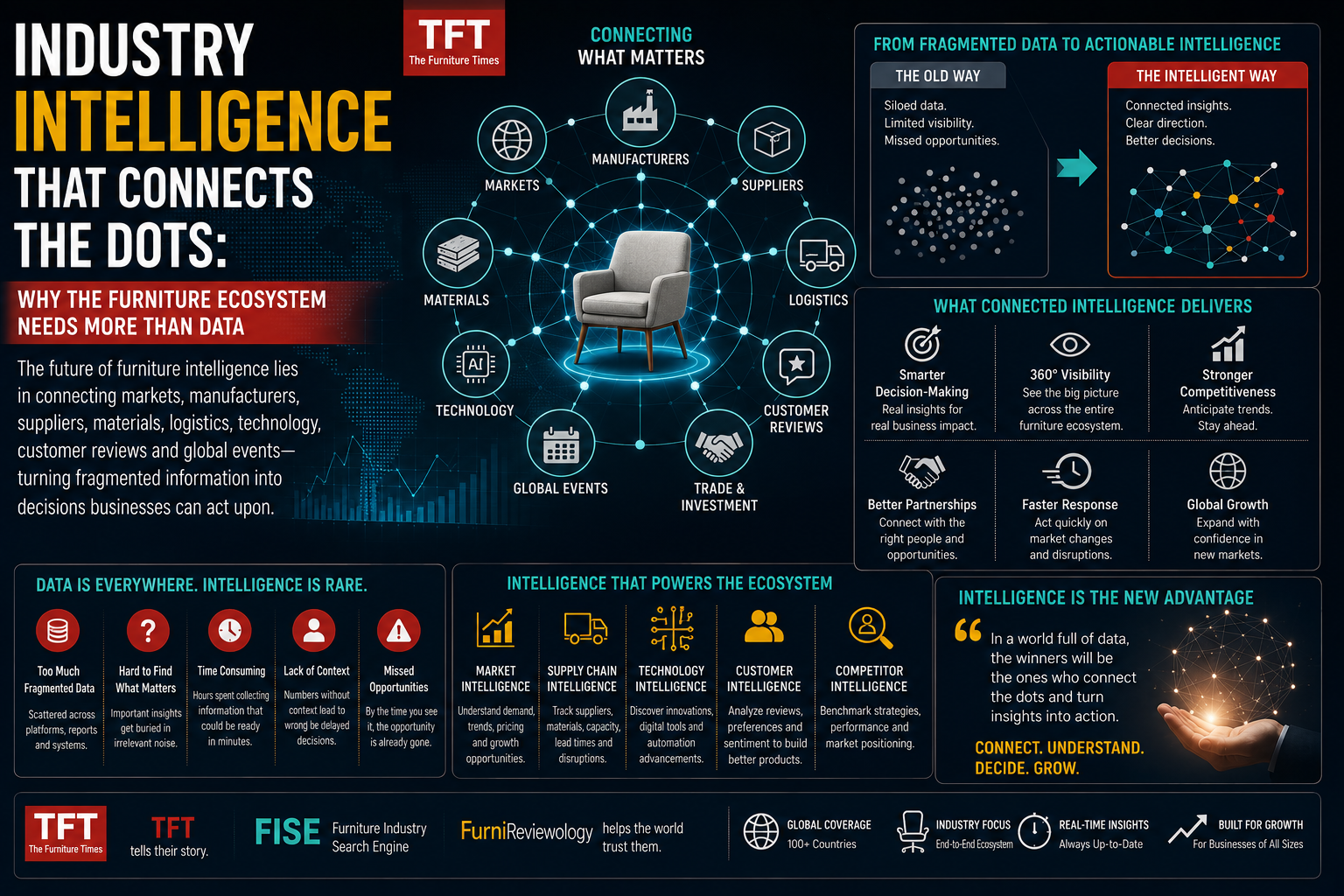
Industry Intelligence That Connects the Dots: Why the Furniture Ecosystem Needs More Than Data
The future of furniture intelligence lies in connecting markets, manufacturers, suppliers, materials, logistics, technology, customer reviews and global events—turning fragmented information into decisions businesses can act upon
By The Furniture Times (TFT) Editorial Desk | Furniture Industry Intelligence | Market Analysis | Data & Discovery | Business Strategy | Global Industry Intelligence
The global furniture industry does not suffer from a shortage of information.
Every day, the ecosystem produces enormous volumes of market reports, customs records, retail figures, product catalogues, exhibition announcements, customer reviews, construction forecasts, shipping updates, material prices and corporate news.
What the industry lacks is connection.
Market information often remains trapped inside separate reports. Supplier information is scattered across catalogues and websites. Customer feedback sits disconnected from manufacturing decisions. Trade statistics may reveal that exports are declining without explaining what is happening inside housing, retail, logistics or consumer confidence.
The furniture industry can see many individual dots, but it does not always see the complete picture they form.
That is why the next stage of industry development must be built around intelligence that connects the dots.
Data reports what happened.
Information explains individual facts.
Intelligence identifies relationships, interprets their meaning and helps businesses decide what to do next.
For manufacturers, retailers, suppliers, designers, investors, logistics companies and policymakers, this difference is becoming strategically important.
The furniture industry is a system, not a single sector
Furniture is commonly treated as one product industry, but it operates as a complex global ecosystem.
It connects forestry, agriculture, chemicals, metals, plastics, textiles, manufacturing, machinery, technology, logistics, construction, real estate, hospitality, retail, finance and consumer behavior.
A sofa is not simply a finished retail product. It represents the combined performance of:
- Timber or metal framing
- Foam and filling materials
- Fabrics or leather
- Springs, webbing and connectors
- Adhesives and finishes
- Product design
- Machinery and manufacturing
- Quality testing
- Packaging
- Warehousing
- Freight
- Final-mile delivery
- Retail merchandising
- Financing
- Warranty and repair
- Customer service
- Reviews and reputation
A disruption in one part of this chain can affect every other participant.
If foam prices increase, manufacturers face higher costs. If manufacturers raise prices, retailers may experience lower conversion. If retailers increase promotional discounting, margins decline. If margins decline, orders to suppliers may be reduced.
The event begins with a material but ends as a commercial and reputational consequence.
Industry intelligence must therefore explain connections—not merely publish isolated developments.
Data tells us what happened; intelligence explains why it matters
Suppose retail furniture sales decline by 3%.
That figure is data.
A deeper analysis might reveal that the decline is connected to:
- Fewer housing transactions
- Higher mortgage costs
- Reduced consumer confidence
- Increased household expenses
- More customers using second-hand marketplaces
- Promotional spending moving into another month
- Furniture purchases shifting to general online marketplaces
- Delayed commercial projects
- Weak delivery performance
- Consumers replacing products less frequently
That is intelligence.
The original figure may describe the symptom. Connected analysis identifies possible causes, affected stakeholders and strategic responses.
Without context, businesses may react incorrectly.
A retailer may cut marketing when its real problem is poor conversion. A manufacturer may reduce production when the problem is channel visibility. A supplier may lower prices when buyers are actually concerned about lead times. A brand may redesign products when customer reviews show that delivery damage is the real source of dissatisfaction.
Intelligence reduces the risk of solving the wrong problem.
The furniture industry has thousands of disconnected data islands
The ecosystem’s information is fragmented across many sources.
Market data
Research companies publish estimates of market size, growth rates, segmentation and regional opportunities. Different organizations may define the market differently, producing forecasts that appear contradictory.
Trade data
Customs and export records show product movements between countries, but they may not explain whether the changes result from demand, tariffs, currency movements or supply-chain restructuring.
Retail data
Retail sales reports show spending by store category, but some furniture sales may be classified under e-commerce, general merchandise or home-improvement retailers.
Housing and construction data
Housing starts, existing-home sales, office development and hotel construction influence furniture demand, but the relationship may appear with a delay.
Product data
Manufacturers hold information about materials, dimensions, performance, certifications and warranties, but product-data formats remain inconsistent.
Supplier data
Information about factories, component companies, material providers and logistics partners is spread across trade directories, exhibition catalogues, websites and personal networks.
Customer data
Reviews, returns, complaints and warranty claims reveal real-world performance, but these signals frequently remain isolated from product-development teams.
Media data
Company announcements and industry news show strategic activity, but they may be promotional and require wider context.
Social data
Search trends, creator content and online conversations may signal changing demand before traditional reports detect it, but social activity can also be noisy or misleading.
The challenge is not only collecting more data. It is determining which information is relevant, credible and connected.
Market growth can hide business weakness
A market report may forecast strong long-term growth, but individual businesses can still struggle.
Growth may be concentrated in:
- Particular countries
- Specific price levels
- Online channels
- Commercial projects
- Modular products
- Sustainable materials
- Smart furniture
- Storage solutions
- Used and refurbished furniture
A manufacturer producing a declining product category cannot assume that general market growth will automatically benefit it.
Similarly, market value can increase because prices are rising while physical unit volumes remain flat or decline. A market may appear larger in monetary terms even though factories and retailers are moving fewer products.
This distinction matters.
Businesses need to examine:
- Value growth
- Volume growth
- Inflation
- Average selling prices
- Product mix
- Channel shifts
- Regional distribution
- Profitability
Headline market size is only the first dot. Industry intelligence must connect it to actual operating conditions.
Housing and furniture demand are connected—but not identical
Housing activity is one of the most important influences on furniture demand.
New construction creates furnishing requirements. Home purchases and relocations frequently lead to replacement or additional furniture purchases. Renovations can stimulate demand for kitchens, wardrobes, storage, upholstery and interior furnishings.
But the relationship is not automatic.
A newly purchased home does not necessarily produce an immediate whole-home furniture order. Buyers may have limited cash after paying deposits, legal fees, moving expenses and renovation costs. They may furnish rooms gradually, reuse existing furniture or purchase second-hand products.
Likewise, a weak home-sales market does not eliminate furniture demand. People who remain in existing homes may spend on renovation, replacement or home improvement.
Connected intelligence must therefore examine:
- New housing construction
- Existing-home transactions
- Rental mobility
- Household formation
- Renovation activity
- Consumer credit
- Mortgage costs
- Disposable income
- Furniture replacement cycles
The question is not simply whether houses are being built. It is when, how and through which channels that activity becomes furniture demand.
Retail weakness does not always mean customers have stopped buying furniture
Furniture-store sales can decline while furniture purchases continue through other channels.
Consumers may buy furniture from:
- Online marketplaces
- General merchandise retailers
- Warehouse clubs
- Department stores
- Home-improvement businesses
- Direct-to-consumer brands
- Social-commerce sellers
- Resale platforms
- Local craftspeople
A decline reported under specialist furniture stores may therefore reflect both weaker demand and a shift in where consumers purchase.
Industry intelligence must distinguish between:
- A decline in total furniture demand.
- A transfer of demand between channels.
- A shift from new to used furniture.
- A move from premium to value products.
- Delayed purchases rather than permanently lost demand.
The strategic response changes depending on the diagnosis.
A true demand decline may require inventory reduction. A channel shift may require stronger e-commerce distribution. A value shift may require new product architecture. Deferred demand may require continued visibility until customers are ready.
Reviews are intelligence—not merely marketing
Customer reviews are among the furniture industry’s most underused sources of intelligence.
Most companies treat reviews as reputation scores. Positive ratings are promoted, while negative feedback is managed defensively.
But reviews contain evidence about how products and services perform in the real world.
They can reveal:
- Repeated structural failures
- Fabric wear
- Cushion deformation
- Mechanism problems
- Finish inconsistency
- Incorrect dimensions
- Misleading product photography
- Packaging weaknesses
- Delivery delays
- Poor assembly instructions
- Missing components
- Warranty difficulties
- Customer-service failures
A complaint about a damaged table may initially appear to be a customer-service issue. If similar complaints appear across several regions, the real cause may be inadequate corner protection in the packaging.
A complaint about loose chairs may indicate assembly problems, weak connectors, moisture-related movement or inconsistent production tolerances.
The review is the visible dot. Intelligence connects it to engineering, materials, packaging, logistics and training.
This is why FurniReviewology has the potential to become an important furniture-industry intelligence layer.
It can help the ecosystem move beyond star ratings and examine patterns across products, brands, delivery experiences and ownership periods.
Warranty claims may be more valuable than trend reports
Furniture companies often pay for external trend reports while ignoring the information contained inside their own warranty departments.
Warranty claims reveal where products fail, when they fail and under what conditions.
A structured warranty database could identify:
- Failure rate by product
- Failure rate by component
- Time from purchase to failure
- Factory or supplier involved
- Geographic or climatic factors
- Installation responsibility
- Repair costs
- Replacement rates
- Repeat complaints
- Customer-satisfaction outcomes
This information can improve design and supplier selection.
For example, repeated recliner-mechanism failures may reveal a component-quality problem. Warping complaints concentrated in humid climates may indicate that material specifications are unsuitable for the destination market. Frequent upholstery damage may require changes in packaging or handling.
The furniture industry needs to stop treating warranty records as administrative expenses. They are product intelligence.
Logistics data can expose hidden commercial problems
Furniture is unusually dependent on logistics performance.
A product may leave the factory in perfect condition but arrive late, damaged or incomplete. The customer rarely distinguishes between manufacturing failure and delivery failure. The entire experience is attributed to the brand or retailer.
Connected intelligence can combine:
- Damage rates
- Packaging types
- Transport routes
- Carrier performance
- Product dimensions
- Warehouse handling
- Delivery-team feedback
- Customer complaints
- Return costs
This can reveal whether particular product designs are difficult to transport, whether certain carriers produce higher damage rates or whether packaging changes would generate a measurable return.
Logistics intelligence is not only about reducing freight cost. It protects reputation, margins and customer trust.
Search behavior is an early indicator of demand
Traditional market reports often describe what has already happened. Search behavior may reveal what customers are beginning to consider.
Growing search interest in terms such as “storage bed,” “pet-friendly sofa,” “outdoor furniture repair” or “small-space dining table” may signal changing consumer needs.
Business buyers may search for:
- Hotel furniture suppliers
- Sustainable materials
- Fire-resistant upholstery
- Fast-delivery office furniture
- Furniture component manufacturers
- Custom joinery companies
- Replacement mechanisms
Search data does not automatically translate into purchases. Some searches represent curiosity, research or inspiration. But when combined with enquiries, sales data, reviews and market developments, it can become a powerful leading indicator.
The challenge is that the furniture industry’s search data is dispersed across general search engines, marketplaces, retailers and social platforms.
A dedicated Furniture Industry Search Engine can create more relevant intelligence by observing what participants within the ecosystem actually need.
FISE can become a demand-intelligence network
The Furniture Industry Search Engine is not only a mechanism for helping people locate companies. Over time, anonymized and responsibly managed search patterns could provide valuable insight into the ecosystem.
FISE could help reveal:
- Which product categories are gaining attention
- Which countries buyers are exploring
- Which supplier capabilities are difficult to find
- Which materials are receiving more interest
- Where regional supply gaps exist
- Which commercial sectors are generating enquiries
- What language buyers use when searching
- Which categories produce searches but few results
This information could help manufacturers decide where to invest.
If many users search for a particular component but few qualified suppliers appear, that gap may represent an opportunity. If buyers frequently search for certified hospitality manufacturers in a particular region, local businesses may improve their listings, certifications or production capabilities.
Search becomes more than discovery. It becomes a map of unmet demand.
Media intelligence explains why individual developments matter
An isolated company announcement may appear small:
- A factory expands.
- A retailer closes.
- A supplier launches a new material.
- A logistics business opens a warehouse.
- A government introduces a certification requirement.
- A company invests in automation.
Each event becomes more useful when connected to a larger pattern.
Several factory expansions may signal confidence in a particular region. Multiple retail closures may expose a change in consumer behavior or cost structure. New certification requirements may create demand for testing laboratories and compliance consultants. Investments in regional warehouses may indicate that delivery speed is becoming more important.
This is where specialist industry media becomes essential.
The Furniture Times should not simply repeat announcements. It should explain:
- Why the development occurred
- Which sectors are affected
- What it means for competitors
- Whether it reflects a wider trend
- What businesses should do next
That is the difference between carrying news and producing intelligence.
Global events reach furniture through indirect pathways
Furniture businesses may assume that geopolitical events matter only when they affect a country in which the company directly operates.
In reality, global events move through the ecosystem indirectly.
A regional conflict can affect:
- Oil prices
- Container shipping
- Marine insurance
- Currency values
- Consumer confidence
- Material costs
- Delivery schedules
- Hospitality investment
- Construction activity
A furniture retailer thousands of kilometers away may experience higher freight costs or lower consumer spending without immediately connecting those effects to the original event.
Similarly, tariffs can alter sourcing patterns. Environmental regulations can change material choices. Interest-rate decisions can influence construction and housing. Currency movements can make exports more competitive or imports more expensive.
Industry intelligence must trace these pathways.
The most useful question is not only, “What happened?” It is, “How will this event travel through the furniture ecosystem?”
Compliance is becoming a competitive-intelligence issue
Furniture regulation is becoming more complex.
Manufacturers must monitor:
- Safety standards
- Structural-performance requirements
- Fire regulations
- Chemical restrictions
- Timber legality
- Environmental claims
- Product labeling
- Packaging rules
- Digital product requirements
- Certification procedures
A regulatory change may appear to be a compliance burden, but it can also reshape competition.
Companies that prepare early may gain market access while unprepared competitors face delays. Testing laboratories, consultants and material suppliers may experience new demand. Product portfolios may need to be rationalized if certifying every variant becomes expensive.
Compliance intelligence should explain:
- Which products are affected
- When requirements begin
- What documentation is needed
- Which markets recognize the certification
- What testing capacity is available
- How costs may affect smaller manufacturers
- What commercial opportunities may emerge
Regulation is not an isolated legal issue. It influences design, production, sourcing, pricing and trade.
Artificial intelligence is changing the speed of intelligence
AI can process large volumes of information more rapidly than traditional analysis.
It can help identify patterns across:
- Market reports
- Sales data
- Search behavior
- Reviews
- Warranty claims
- Logistics records
- News coverage
- Social discussions
- Product specifications
But AI does not eliminate the need for judgment.
Different data sources may use different definitions. Reviews may contain bias. Market forecasts may depend on uncertain assumptions. Search trends may be temporary. Company announcements may emphasize positive developments while omitting risk.
AI can identify relationships, but industry expertise must evaluate whether those relationships are commercially meaningful.
The most valuable model combines:
Technology for scale.
Industry knowledge for context.
Editorial judgment for meaning.
Verified evidence for trust.
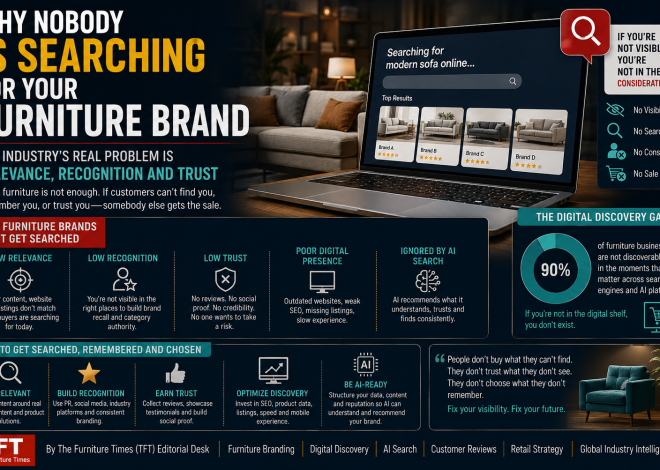
AI cannot connect information it cannot find
The furniture industry’s digital-data weaknesses also limit the quality of AI intelligence.
Many companies have incomplete websites, outdated catalogues and inconsistent business information. Product specifications may exist only in image-based PDFs. Certifications may not be digitally linked to individual products. Reviews may be scattered across unrelated platforms.
As a result, AI systems may overlook capable businesses or misunderstand what they provide.
To become part of the intelligence economy, companies must make themselves machine-readable.
They should organize:
- Company identity
- Product categories
- Materials
- Dimensions
- Certifications
- Manufacturing capabilities
- Service locations
- Delivery areas
- Warranty information
- Reviews
- Project history
- Media references
Better data improves human discovery, search visibility and AI understanding simultaneously.
Industry intelligence should serve SMEs—not only large corporations
Large companies can purchase expensive research, hire analysts and build internal data systems.
Small and medium-sized enterprises rarely have the same resources.
This creates an intelligence gap.
A small furniture manufacturer may not know that demand is growing in a nearby export market. A component supplier may not see an emerging product trend. An artisan may not understand where buyers are looking for specialist craftsmanship. A retailer may not recognize changing search behavior until sales decline.
A more inclusive intelligence system should help SMEs understand:
- Where demand is emerging
- What buyers are searching for
- Which standards are changing
- Which materials are gaining attention
- Where supply gaps exist
- What customer complaints are increasing
- Which markets offer realistic opportunities
Industry intelligence should not become another advantage available only to large companies.
It should help capable smaller businesses make better decisions.
The TFT–FISE–FurniReviewology intelligence model
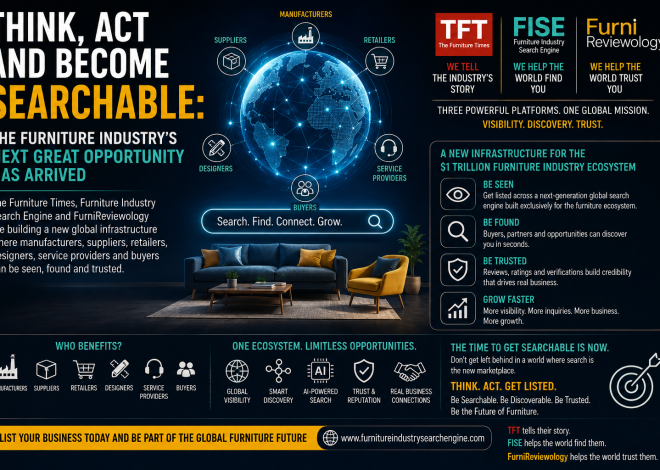
The combination of The Furniture Times, Furniture Industry Search Engine and FurniReviewology creates the foundation for a connected furniture-intelligence ecosystem.
TFT: News, context and interpretation
TFT identifies important events, explains their meaning and connects developments across countries and industry sectors.
It can answer:
- What is happening?
- Why is it happening?
- Who is affected?
- What happens next?
FISE: Businesses, capabilities and demand signals
FISE organizes manufacturers, suppliers, retailers, designers, service providers and industry resources into a searchable ecosystem.
It can answer:
- Who provides the required product or capability?
- Where are they located?
- What markets do they serve?
- Which supply or demand gaps are emerging?
FurniReviewology: Experience, evidence and trust
FurniReviewology organizes customer and trade feedback into furniture-specific reputation and performance intelligence.
It can answer:
- What is the ownership experience?
- Which problems recur?
- How does the company respond?
- What can the ecosystem learn from customer experience?
Together, these three layers connect:
Story + Search + Trust
They also connect:
News + Discovery + Evidence
This is how fragmented data becomes actionable industry intelligence.
A furniture intelligence graph for the future
The long-term opportunity is to create a connected map—or intelligence graph—of the entire furniture ecosystem.
A manufacturer would not appear only as a company name. It could be connected with:
- Its products
- Materials
- Components
- Suppliers
- Certifications
- Countries served
- Retail partners
- Projects
- Reviews
- News coverage
- Warranty performance
- Repair services
A product could be connected with its:
- Manufacturer
- Material composition
- Factory of origin
- Test reports
- Certifications
- Spare parts
- Reviews
- Repair instructions
- Environmental data
- End-of-life options
A market event could be connected with:
- Affected countries
- Relevant product categories
- Suppliers at risk
- Material-price movements
- Logistics routes
- Retail consequences
This network would make the industry easier to understand, search and manage.
It could support sourcing, risk assessment, market entry, quality improvement, sustainability and investment.
Connecting the dots between sustainability and commercial value
Sustainability data is often reported separately from business performance.
Yet environmental and commercial issues are increasingly connected.
For example:
- Better packaging can reduce material use and transit damage.
- Repairable furniture can reduce waste and warranty replacement costs.
- Modular products can extend useful life and simplify logistics.
- Material traceability can support compliance and brand trust.
- Refurbishment can create secondary revenue.
- Durable components can reduce returns and environmental impact.
Connected intelligence prevents sustainability from being treated as an isolated reporting exercise.
It shows where environmental improvement can also create operational and financial value.
Connecting the dots between design and failure
Furniture design is usually evaluated through appearance, function and market appeal.
But design decisions also influence:
- Manufacturing complexity
- Component selection
- Packaging volume
- Assembly difficulty
- Damage risk
- Repairability
- Warranty claims
- Recycling
A visually attractive product may become commercially unsuccessful if it is difficult to manufacture, expensive to ship or frequently damaged.
Review and warranty intelligence should therefore be available to designers during product development.
The goal is not to restrict creativity. It is to ensure that design decisions reflect the complete lifecycle of the product.
Connecting the dots between visibility and revenue
Many furniture businesses view media, search listings, reviews and sales as separate functions.
They are increasingly connected.
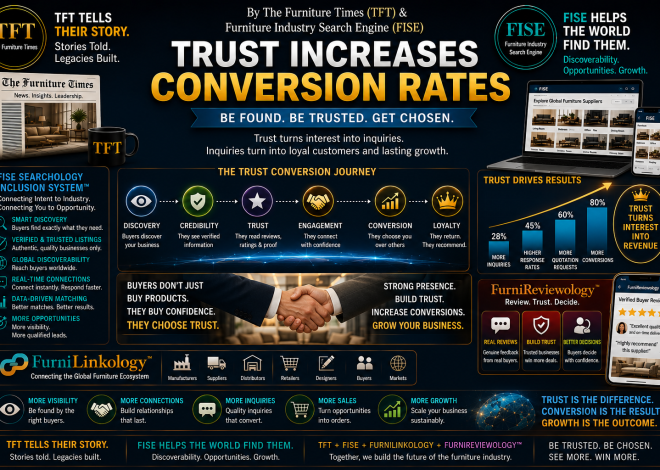
A news article can create awareness. A searchable profile can help the customer find the company later. Product data can help AI understand the offering. Reviews can validate the promise. Reliable delivery can generate further positive reviews.
The complete pathway is:
Visibility → Discovery → Understanding → Trust → Enquiry → Transaction → Experience → Review → Stronger Visibility
Weakness at any stage reduces the value of the entire system.
A business may generate awareness but lose customers because product information is incomplete. It may be discoverable but lack credible reviews. It may make the sale but damage its reputation through poor delivery.
Industry intelligence must examine the complete journey.
What decision-makers should measure
Furniture companies should move beyond a narrow focus on revenue.
Useful intelligence requires a balanced set of indicators.
Market indicators
- Category growth
- Regional demand
- Housing and construction activity
- Search trends
- Competitive expansion
Commercial indicators
- Enquiries
- Conversion rate
- Average order value
- Gross margin
- Repeat purchases
- Promotional dependency
Operational indicators
- Lead times
- Inventory aging
- Production efficiency
- Supplier performance
- Damage rates
- On-time delivery
Product indicators
- Return rate
- Warranty frequency
- Component failure
- Repair cost
- Customer satisfaction
- Product lifespan
Visibility indicators
- Branded searches
- Category-search visibility
- Media mentions
- Business-profile views
- AI citations
- Direct traffic
Trust indicators
- Verified reviews
- Sentiment patterns
- Complaint-resolution rate
- Response time
- Repeat complaints
- Recommendation frequency
No single metric explains the business. The value appears when these indicators are connected.
How businesses can start connecting their own dots
A company does not need an enormous technology platform to begin.
Step 1: Identify critical decisions
Determine what the business needs to understand: product demand, regional opportunities, inventory risk, quality problems or customer acquisition.
Step 2: Locate relevant data
Identify the internal and external information connected to that decision.
Step 3: Standardize the data
Ensure that products, suppliers, regions and complaint categories are recorded consistently.
Step 4: Look for relationships
Compare sales with searches, reviews, returns, promotions, inventory and external market developments.
Step 5: Test conclusions
Do not assume correlation proves cause. Speak with customers, retailers, suppliers and operating teams.
Step 6: Take action
Intelligence has no value if it does not change a decision.
Step 7: Measure the result
Determine whether the action improved performance and feed the result back into the intelligence system.
This creates a continuous learning cycle.
Intelligence must lead to action
The furniture industry does not need another dashboard that nobody uses.
It does not need more reports stored in folders and forgotten.
It needs intelligence that changes decisions.
Connected intelligence should help a company decide:
- Which products to develop
- Which markets to enter
- Which suppliers to qualify
- Which inventory to reduce
- Which complaints to prioritize
- Which technologies to adopt
- Which certifications to pursue
- Which stories to publish
- Which customers to target
- Which risks to prepare for
The value of intelligence is measured not by the amount of data collected, but by the quality of decisions improved.
The opportunity for countries and industry institutions
Governments, trade associations and development organizations can also benefit from connected furniture intelligence.
They could use it to identify:
- Manufacturing clusters
- Workforce shortages
- Export opportunities
- Supplier gaps
- Certification bottlenecks
- Material dependencies
- Logistics weaknesses
- Artisan communities requiring support
- Circular-economy opportunities
- Investment priorities
Instead of promoting the furniture industry only through occasional exhibitions, institutions could build permanent, searchable and evidence-based visibility for their national ecosystems.
This would support trade, employment, investment and regional development.
The future belongs to connected ecosystems
The furniture industry is too large, complex and interconnected to be understood through isolated headlines.
A retail decline may begin with housing. A quality complaint may begin with a component. A delivery failure may begin with packaging. A lost export order may begin with missing certification. A weak brand may begin with incomplete information. An AI recommendation may depend on media coverage, structured data and customer reviews simultaneously.
Every outcome has a chain of causes.
The role of modern industry intelligence is to make those chains visible.
The Furniture Times, Furniture Industry Search Engine and FurniReviewology can help build the necessary infrastructure:
- TFT connects events with context.
- FISE connects buyers with the ecosystem.
- FurniReviewology connects promises with experience.
Together, they can help the industry move from fragmented information to connected intelligence.
The final message
The furniture industry does not need more noise.
It needs clarity.
It does not need more isolated numbers.
It needs relationships.
It does not need information that describes yesterday without preparing businesses for tomorrow.
It needs intelligence that connects the dots.
When market data connects with search behavior, businesses can recognize demand earlier.
When customer reviews connect with manufacturing, products improve.
When logistics data connects with product design, damage declines.
When media visibility connects with search listings and reputation, businesses become easier to discover and trust.
When compliance connects with strategy, regulation becomes a source of competitive readiness.
When manufacturers, suppliers, retailers, designers, customers and policymakers share a common intelligence infrastructure, the entire ecosystem becomes stronger.
That is the opportunity now facing the global furniture industry:
To see the complete picture. To understand what it means. To act before the market forces the decision.
The connected-intelligence declaration
We believe that data without context creates confusion.
We believe that market reports should connect with real business conditions.
We believe that reviews should inform manufacturing and quality.
We believe that search behavior should help identify emerging demand.
We believe that industry news should explain consequences—not merely repeat announcements.
We believe that small and medium-sized businesses deserve access to meaningful industry intelligence.
We believe that the furniture ecosystem becomes more competitive when its participants can find, understand and trust one another.
We believe the industry’s future belongs to those who can connect the dots.
TFT tells their story.
FISE helps the world find them.
FurniReviewology helps the world trust them.
Together, they help the furniture industry understand what is happening, why it matters and what to do next.
The Furniture Times (TFT) & Furniture Industry Search Engine (FISE)
“TFT tells their story. FISE helps the world find them.”
FurniReviewology helps the world trust them.
The furniture industry ecosystem is a $1 trillion industry ecosystem.
Do not merely collect the dots. Connect them, understand them and act on them.