Learn About AI Visibility Audit Service: Security and Reliability Overview
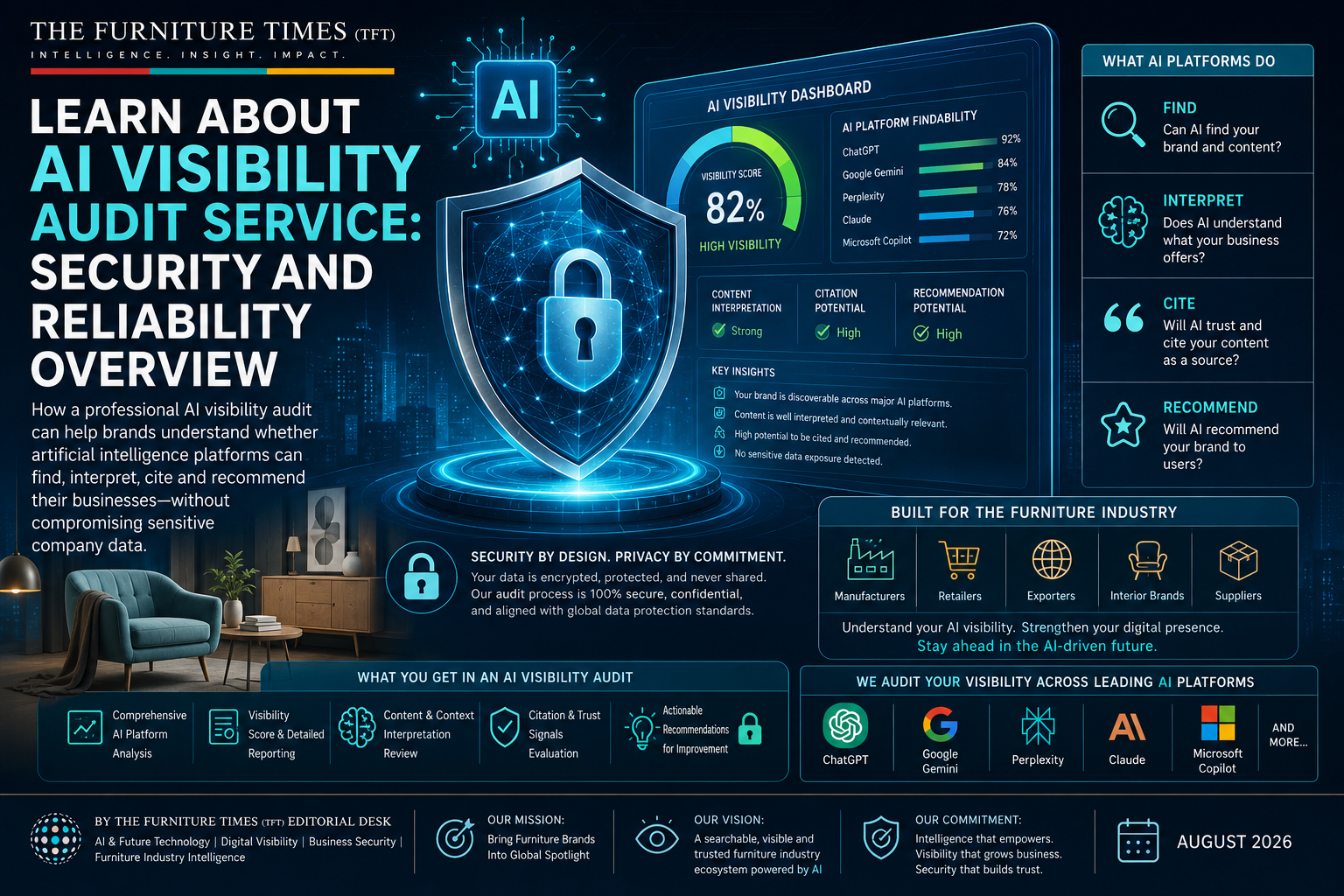
How a professional AI visibility audit can help brands understand whether artificial intelligence platforms can find, interpret, cite and recommend their businesses—without compromising sensitive company data
By The Furniture Times (TFT) Editorial Desk
AI & Future Technology | Digital Visibility | Business Security | Furniture Industry Intelligence
August 2026
Artificial intelligence is becoming a new gateway between businesses and customers.
Consumers, procurement teams, architects, interior designers, hotel developers, retailers and investors are increasingly asking AI systems to identify companies, compare products, recommend suppliers and explain which brands can meet particular requirements.
They are no longer searching only with short keywords such as “furniture manufacturer,” “outdoor furniture supplier” or “cabinet hardware company.” They are asking complete questions:
- Which furniture manufacturers produce sustainable hotel furniture?
- Who supplies weather-resistant outdoor furniture in Malaysia?
- What are the most reliable furniture hardware brands?
- Which sofa manufacturers export to the United States?
- Where can I find certified office-furniture suppliers?
- Which local furniture company has strong customer reviews?
- What furniture is appropriate for a small apartment?
- Which manufacturer can customise a hotel project?
If an AI system cannot find sufficient, consistent and trustworthy information about a business, that company may be excluded from the response—even when it offers exactly what the customer needs.
This is the problem an AI Visibility Audit Service is designed to investigate.
An AI visibility audit examines how accurately a business is represented across websites, search engines, directories, structured data, reviews, editorial coverage and AI-generated answers. It identifies the information gaps that make a brand difficult for machines to find, understand, trust and recommend.
However, because an audit may involve company information, website systems, analytics and external AI platforms, businesses must evaluate more than the promised visibility benefits. They must also ask whether the service is secure, reliable, transparent and responsible.
An audit should never create a cybersecurity problem while attempting to solve a marketing problem.
What Is an AI Visibility Audit?
An AI visibility audit is a structured assessment of how a business appears across AI-assisted discovery environments.
It investigates questions such as:
- Do leading AI systems recognise the company?
- Can they correctly describe what the company does?
- Do they associate the brand with the right industry and location?
- Can they identify its principal products and services?
- Do they confuse it with another business?
- Which online sources do AI systems appear to rely upon?
- Is the available information accurate and current?
- Are important claims supported by credible evidence?
- Can AI systems locate product specifications, reviews and policies?
- Is the business mentioned when users ask relevant commercial questions?
- Are competitors being cited or recommended more frequently?
- What information is missing from the company’s digital presence?
Traditional SEO audits primarily examine visibility in conventional search results. An AI visibility audit expands the analysis to conversational answers, generative search summaries, citations and recommendation environments.
The two disciplines overlap, but they are not identical.
A website may rank for selected Google keywords while remaining poorly understood by generative AI. Conversely, an organisation may be cited in AI answers because authoritative third-party publications discuss it, even when its own website performs modestly in conventional search.
What an AI Visibility Audit Is Not
An AI visibility audit should not be presented as a guaranteed method of controlling AI recommendations.
No responsible audit provider can promise that a business will always be mentioned, ranked first or positively recommended by every AI platform.
AI answers can vary according to:
- The wording of a question
- User location
- Language
- search context
- Platform and model
- Availability of live web search
- Model updates
- Personalisation
- Source accessibility
- Freshness of indexed information
- Safety and quality policies
An audit measures visibility conditions and identifies opportunities. It cannot control an independent platform’s final answer.
An ethical audit service must therefore separate three things:
- What was directly observed
- What can reasonably be inferred
- What cannot be guaranteed
Why AI Visibility Matters to the Furniture Industry
The furniture ecosystem is particularly vulnerable to digital invisibility because it is highly fragmented.
It includes multinational retailers and international manufacturers, but also thousands of smaller companies:
- Independent furniture stores
- Upholstery workshops
- Carpenters and craftspeople
- Component manufacturers
- Hardware suppliers
- Foam and textile companies
- Interior contractors
- Machinery companies
- Logistics providers
- Installers
- Repair specialists
- Designers
- Export agents
- Hospitality suppliers
- Outdoor-furniture manufacturers
Many of these businesses possess considerable technical knowledge but have weak digital documentation. Their websites may contain only basic company descriptions, low-resolution images or downloadable catalogues that provide little searchable information.
Some depend almost entirely on exhibitions, personal introductions, WhatsApp messages or social-media posts. These channels can support relationships, but they may not provide the structured, independently verifiable information AI systems need.
As a result, a smaller manufacturer may have 30 years of experience and excellent production capability yet remain absent from an AI-generated supplier list.
Meanwhile, a newer competitor with clear product pages, credible press coverage, structured business information and verified reviews may be easier for AI systems to understand.
The visibility gap is therefore not always a quality gap. It is often an information gap.
The Four Foundations of AI Visibility
A reliable AI visibility audit should evaluate four connected foundations.
01 — Findability
Findability concerns whether search engines, crawlers, directories and AI-enabled platforms can access the company’s public information.
The audit may examine:
- Search-engine indexing
- Robots.txt configuration
- Sitemap availability
- Internal linking
- Page status codes
- Mobile accessibility
- Website speed
- Canonical URLs
- JavaScript rendering
- Broken pages
- Duplicate content
- Public directory listings
If critical pages are blocked, disconnected or technically inaccessible, AI systems may have limited information from which to construct an answer.
02 — Understandability
A website can be accessible without being understandable.
An audit should determine whether a machine can clearly identify:
- The business’s legal and trading names
- Industry category
- Products and services
- Headquarters and service locations
- Contact information
- Target markets
- Manufacturing capabilities
- Certifications
- Leadership and authorship
- Delivery coverage
- Warranty and return policies
- Product materials and specifications
Structured data can help search systems interpret this information. Google explains that organisation structured data may help it understand administrative details and distinguish one organisation from another. Product structured data can communicate information such as price, availability, review ratings and shipping details. Google’s organisation structured-data guidance, Google’s product structured-data guidance
Structured data must reflect information that is genuinely present and visible on the page. It should not be used to hide unsupported promotional claims.
03 — Credibility
AI systems may be less confident when all information about a company comes from the company itself.
A visibility audit should therefore examine independent evidence, including:
- News coverage
- Trade-publication features
- Association memberships
- Verified directory profiles
- Customer reviews
- Awards
- Certifications
- Case studies
- Research citations
- Exhibition participation
- Distributor references
- Professional profiles
- Reputable backlinks
The objective is not to manufacture artificial authority. It is to make genuine evidence discoverable.
04 — Consistency
A company may have different names, addresses or descriptions across its website, social pages, directories and marketplaces.
Such inconsistencies can create confusion.
The audit should identify contradictions involving:
- Company name
- Brand spelling
- Address
- Telephone number
- Website address
- Founding year
- Product categories
- Ownership
- Service area
- Certifications
- Social-media profiles
AI systems may struggle to determine which source is correct when the same company is described differently across multiple platforms.
What a Comprehensive AI Visibility Audit Should Cover
A professional audit should provide a clearly defined scope before any work begins.
| Audit area | What should be examined | Typical output |
|---|---|---|
| Brand recognition | Whether AI systems identify the company correctly | Recognition score and error list |
| Category association | Whether the brand is connected to the right products and industry | Category-gap analysis |
| Prompt testing | Performance across relevant customer and buyer questions | Prompt-by-platform matrix |
| Citation analysis | Sources referenced or relied upon in AI answers | Citation and source map |
| Website accessibility | Whether important pages are crawlable and indexable | Technical findings report |
| Entity consistency | Business names, addresses, profiles and identifiers | Consistency checklist |
| Structured data | Organisation, Product, Article and other relevant markup | Validation report |
| Content coverage | Whether essential buyer questions are answered | Content-gap map |
| Reputation | Reviews, media coverage and third-party mentions | Trust-signal assessment |
| Competitor comparison | Relative visibility against selected competitors | Benchmarking report |
| Security | Data access, storage, sharing and deletion practices | Security disclosure |
| Reliability | Repeated tests, dates, platforms and confidence limits | Methodology statement |
The Security Question: What Data Does the Audit Need?
One of the most important principles is data minimisation.
An AI visibility audit should collect only the information required to complete the agreed assessment.
Much of the initial audit can be performed using information already available publicly:
- Public website pages
- Search results
- Public AI responses
- Company profiles
- Product listings
- Public reviews
- News coverage
- Publicly visible structured data
- Public social and directory pages
This means a basic external audit should not automatically require access to:
- Customer databases
- Credit-card information
- Employee records
- Private emails
- Website administrator passwords
- Hosting root credentials
- Financial accounts
- Confidential contracts
- Unreleased product designs
- Private supplier pricing
If a provider requests highly sensitive access without explaining why, the client should pause and ask for a narrower, safer method.
The Principle of Least Privilege
When private access is genuinely useful, it should follow the principle of least privilege.
This means giving the service only the minimum permissions required for the minimum necessary period.
For example:
- Read-only analytics access instead of full administrator access
- Search Console viewer access instead of owner-level control
- Temporary user accounts instead of shared master passwords
- Restricted staging access instead of unrestricted production access
- Redacted data exports instead of complete databases
- Specific folders instead of whole cloud-storage accounts
A legitimate auditor should not resist reasonable access limitations.
No client should send a password through an ordinary email, messaging application or unprotected document. Credentials should be shared through a secure access-management method, and temporary access should be revoked after the engagement.
Security and Reliability Control Matrix
A trustworthy audit service should be able to explain its controls in plain language.
| Control | Why it matters | What the client should ask |
|---|---|---|
| Data minimisation | Reduces exposure of unnecessary information | What exact data do you need? |
| Read-only access | Prevents accidental or unauthorised changes | Can this audit be completed without edit rights? |
| Encryption | Protects data during transfer and storage | How is our information encrypted? |
| Access control | Limits who can view client information | Which team members will have access? |
| Multi-factor authentication | Reduces account takeover risk | Is MFA required for audit systems? |
| Retention limits | Prevents indefinite storage | When will our files and credentials be deleted? |
| Audit logging | Creates accountability | Are access and changes logged? |
| Vendor disclosure | Identifies third-party exposure | Which AI, analytics and cloud providers are used? |
| Incident response | Defines what happens after a breach | How and when will we be notified? |
| Human verification | Reduces misleading automated conclusions | Who reviews the final findings? |
| Repeatable testing | Improves reliability | Can the same test be repeated and dated? |
| Evidence preservation | Supports verification | Will screenshots, URLs and timestamps be supplied? |
The Risks of Entering Confidential Information into AI Systems
An audit provider may use generative AI to organise findings, classify content or test prompts. That does not mean confidential company information should be copied indiscriminately into public AI interfaces.
Before using any external AI system, the provider should assess:
- What information is being submitted
- Whether the information contains personal or confidential data
- How the platform processes submitted content
- Whether data may be retained
- Whether content may be used for model improvement
- Whether an enterprise or protected environment is available
- Whether the client has consented to that use
- Whether the output will be reviewed by a person
Sensitive information should be removed, masked or summarised whenever possible.
The OWASP GenAI Security Project identifies sensitive-information disclosure, prompt injection and supply-chain risks among the significant security concerns affecting generative AI applications. Prompt injection can cause a system to behave in unintended ways, while sensitive-information disclosure can expose personal, financial or proprietary information. OWASP GenAI Security Project
Prompt Injection and Malicious Web Content
AI visibility auditing sometimes involves systems that retrieve and analyse external web pages. This creates a particular risk: a web page could contain instructions intended to manipulate an AI system.
These instructions may be visible or hidden within content that the model processes.
A secure audit workflow should treat all retrieved web content as untrusted data—not as operational instructions.
Appropriate controls may include:
- Separating system instructions from retrieved content
- Disabling unnecessary tool permissions
- Restricting automated actions
- Validating outputs before they enter other systems
- Preventing models from accessing unrelated private data
- Using allowlists for sensitive integrations
- Reviewing suspicious or unexpected outputs
- Keeping a human decision-maker in the process
OWASP warns that prompt injection can alter model behaviour and may contribute to unauthorised data access or unintended actions. OWASP prompt-injection guidance
Reliability: Why One AI Answer Is Not an Audit
A single question asked once on one AI platform cannot provide a reliable visibility assessment.
AI responses may vary between sessions. They may also change when a prompt is reworded.
A professional audit should test multiple prompt groups.
Brand prompts
These establish whether the system knows the company.
Examples include:
- What does this company do?
- Where is this brand located?
- What products does this business manufacture?
- Is this company a manufacturer, retailer or distributor?
Category prompts
These assess whether the brand appears when its name is not included.
Examples include:
- Furniture manufacturers in Malaysia
- Sustainable outdoor-furniture suppliers
- Commercial furniture brands for hotels
- Reliable cabinet-hardware companies
- Teak furniture exporters
Comparison prompts
These evaluate whether AI systems can distinguish the company from alternatives.
Examples include:
- Compare selected furniture brands
- Which supplier is suitable for a hotel project?
- What are the differences between these manufacturers?
- Which company offers custom production?
Transactional prompts
These reflect users closer to taking action.
Examples include:
- Where can I buy a particular product?
- Who supplies furniture to my location?
- Which company offers delivery and installation?
- Which manufacturer accepts custom orders?
Trust prompts
These test reputation and evidence.
Examples include:
- Is the company reliable?
- What do customers say about the brand?
- Does it hold relevant certifications?
- Has it completed notable projects?
The prompts should reflect real customer language, not only marketing terminology used internally by the company.
Tests Should Be Repeated
Reliable testing requires repetition.
A sensible audit may record:
- Platform
- Model or interface
- Date and time
- Country or region
- Language
- Exact prompt
- Whether live web retrieval was active
- Brand appearance
- Position within the response
- Sentiment
- Accuracy
- Citations
- Competitor mentions
- Unsupported claims
Repeated testing helps distinguish a stable pattern from a random or temporary response.
The report should not claim scientific certainty unless its sampling method genuinely supports that level of confidence.
Accuracy Must Be Separated from Visibility
A company may be highly visible but incorrectly represented.
For example, an AI system might:
- Associate the brand with the wrong country
- List discontinued products
- Confuse it with a similarly named company
- Report an old address
- Misstate its manufacturing capabilities
- Attribute another company’s reviews
- Describe a distributor as the manufacturer
- Mention certifications the company does not hold
These are not merely visibility issues. They are accuracy and reputation risks.
A proper audit should therefore create separate measurements for:
- Brand recognition
- Factual accuracy
- Category relevance
- Citation quality
- Reputation sentiment
- Recommendation frequency
- Information freshness
A high recognition score should not hide serious factual errors.
Citation Quality Matters More Than Citation Quantity
An AI answer can cite several sources and still be unreliable.
The audit should evaluate whether sources are:
- Relevant
- Independent
- Current
- Authoritative
- Accessible
- Consistent with the claim
- Clearly associated with the right business
A company’s own website is appropriate for basic facts such as product categories and official locations. Independent trade publications, certification bodies, recognised directories and verified customer platforms may provide stronger support for external credibility.
The audit should also identify “citation concentration.” If nearly every AI answer depends on one old article or directory profile, the company’s visibility may be fragile.
Human Review Is Essential
Automation can make audits faster, but final findings require human judgment.
An automated tool may incorrectly classify:
- A negative statement as neutral
- A distributor as a manufacturer
- A product review as a company review
- Two similarly named brands as one entity
- An expired certification as current
- A sponsored article as independent editorial coverage
Human review should verify significant findings, particularly those involving reputation, legal claims, product safety, certifications and competitor comparisons.
A professional report should indicate where conclusions were generated automatically and where they were manually validated.
Following a Risk-Management Framework
A credible audit methodology can be strengthened by recognised risk-management principles.
The U.S. National Institute of Standards and Technology’s AI Risk Management Framework organises AI risk activities around four functions:
- Govern
- Map
- Measure
- Manage
The framework is voluntary and designed to help organisations incorporate trustworthiness into the development and use of AI systems. NIST has also published a Generative AI Profile addressing risks specific to generative systems. NIST AI Risk Management Framework, NIST Generative AI Profile
An AI visibility audit can adapt these principles:
Govern
Define responsibilities, acceptable data use, approval requirements and reporting standards.
Map
Identify the company’s digital ecosystem, audiences, platforms, information sources and potential risks.
Measure
Test visibility, accuracy, citations, consistency and security controls.
Manage
Prioritise corrections, assign owners, monitor changes and establish escalation procedures.
Using a framework does not automatically make a provider secure, but it gives clients a structured basis for evaluating the process.
Standards and Certifications: Avoid Misleading Claims
A provider may refer to standards such as ISO/IEC 27001 for information-security management or ISO/IEC 42001 for artificial-intelligence management.
Businesses should ask whether the company is actually certified, whether it merely aligns its practices with the standard, or whether it is simply mentioning the standard in marketing.
These are different claims.
ISO explains that certification can demonstrate that a product or service meets specified expectations, while certification is conducted through relevant assessment bodies—not by ISO itself. ISO certification overview
A provider should not claim “ISO certified” without identifying:
- The exact standard
- The certified legal entity
- The certification body
- Certificate validity
- Scope of certification
Clients should be cautious of vague security badges or statements that cannot be independently verified.
What the Client Should Receive
A complete AI visibility audit should produce practical deliverables rather than a dashboard filled with unexplained scores.
The final package may include:
Executive summary
A concise explanation of the most important findings, business risks and priorities.
AI visibility scorecard
Separate ratings for recognition, accuracy, authority, consistency and recommendation visibility.
Prompt-testing register
The exact prompts, platforms, dates, responses and evaluation outcomes.
Citation map
A record of the sources appearing across tested AI answers.
Competitor benchmark
A comparison showing where selected competitors receive stronger or weaker visibility.
Technical discovery report
Findings involving crawlability, indexing, structured data, entity signals and information architecture.
Content-gap analysis
Missing pages, unanswered customer questions and weak product information.
Security statement
A description of data collected, access granted, tools used, retention period and deletion procedure.
Prioritised action plan
Recommendations divided into urgent, short-term and longer-term actions.
Evidence file
Screenshots, public URLs, structured-data results and timestamps supporting the conclusions.
Recommended Priority Levels
Not every finding carries the same urgency.
Critical
- AI systems repeatedly confuse the company with another organisation
- Sensitive data have been exposed
- False safety or certification claims appear
- The website contains serious security weaknesses
- Important public business information has been compromised
High priority
- Core products cannot be identified
- Business location information is inconsistent
- AI answers contain major factual errors
- Important pages are blocked from discovery
- Outdated information dominates citations
Medium priority
- Structured data are incomplete
- Product specifications lack consistency
- Important buyer questions are unanswered
- Competitor authority is substantially stronger
- Review coverage is weak
Development opportunity
- Additional editorial coverage
- New industry guides
- More detailed case studies
- Expanded multilingual content
- Stronger image and video information
- New directory and association profiles
Red Flags When Choosing an Audit Provider
Businesses should be cautious when a provider:
- Guarantees first position in AI recommendations
- Claims to control ChatGPT, Gemini or other independent platforms
- Requests unrestricted passwords unnecessarily
- Cannot explain where client data are stored
- Refuses to identify third-party tools
- Provides scores without evidence
- Uses fabricated reviews or citations
- Recommends fake press coverage
- Proposes deceptive structured data
- Cannot explain its deletion policy
- Fails to distinguish estimated results from verified facts
- Promises permanent visibility
- Uses confidential information without documented consent
- Claims certifications that cannot be verified
AI visibility should be earned through accurate information, credible evidence and useful content—not manipulation.
Questions to Ask Before Appointing a Provider
A potential client should ask:
01 — What exactly will you audit?
The scope should identify platforms, languages, markets and competitors.
02 — What information do you require from us?
Every requested access permission should have a clear reason.
03 — Can the first stage be completed using public data?
External analysis should normally precede requests for private access.
04 — Which AI and analytics platforms will you use?
The client should understand where its information may be processed.
05 — Will our information be used to train any model?
The answer should be documented, not assumed.
06 — How long will you retain our data?
The provider should state a specific retention and deletion policy.
07 — How do you protect credentials?
Shared passwords should be avoided.
08 — How are results verified?
A qualified person should review significant findings.
09 — Will you provide the exact prompts and evidence?
The client should be able to reproduce at least part of the assessment.
10 — What can you guarantee?
A responsible provider should guarantee its process and deliverables—not third-party AI rankings.
A Secure AI Visibility Audit Workflow
A well-managed engagement can follow seven stages.
Stage 01 — Written scope and consent
The client and provider agree on the websites, brands, markets, platforms, competitors and permitted data use.
Stage 02 — Public-data discovery
The audit begins with publicly accessible information and requires no privileged access.
Stage 03 — Risk and access assessment
If analytics or technical access would improve the findings, the provider requests limited, read-only permissions.
Stage 04 — Controlled testing
Prompts are tested systematically across selected platforms, languages and locations.
Stage 05 — Human validation
Important statements, citations and errors are checked manually.
Stage 06 — Reporting and remediation
The provider delivers evidence, prioritised recommendations and implementation guidance.
Stage 07 — Access removal and data deletion
Temporary accounts are disabled, permissions are revoked and unnecessary client information is securely deleted.
From Audit to Improvement
The audit is not the final objective. Its value depends on what the organisation does next.
Typical improvements may include:
- Correcting inconsistent company information
- Rebuilding incomplete product pages
- Adding accurate organisation and product structured data
- Publishing clear author and company profiles
- Improving About, Contact and Location pages
- Creating material and manufacturing guides
- Publishing verifiable case studies
- Strengthening review collection and response procedures
- Earning credible editorial coverage
- Making certification information easier to verify
- Improving site speed and mobile accessibility
- Creating multilingual market pages
- Building accessible product feeds
- Updating discontinued or inaccurate content
Google states that structured data helps it understand page content, but implementation does not guarantee a special search appearance. This is a useful model for AI visibility more broadly: improvements can strengthen the information environment, but they cannot guarantee a specific platform outcome. Google’s structured-data guidelines
Monitoring Should Continue After the Audit
AI platforms, search systems, websites, competitors and source databases change continuously.
A visibility result recorded today may look different after:
- A model update
- A website redesign
- A major news article
- A product launch
- New customer reviews
- A domain migration
- A change in structured data
- New competitor coverage
- A correction to an external directory
- A significant reputation event
Businesses should therefore maintain a scheduled monitoring programme.
Quarterly monitoring may be sufficient for smaller organisations. Large retailers, public companies, healthcare businesses, financial services or brands experiencing rapid change may require more frequent review.
Monitoring should focus on material movement, not minor fluctuations in every individual answer.
Why Security and Reliability Build Trust
An AI visibility audit deals with the public identity of a business. If conducted carelessly, it can expose confidential information, produce misleading conclusions or encourage manipulative marketing.
If conducted professionally, it can help an organisation understand:
- What AI systems know
- What they misunderstand
- Which sources influence their answers
- Where competitors are stronger
- Which information is missing
- What should be corrected first
- How to improve visibility responsibly
Security protects the client during the audit. Reliability makes the findings worth acting upon.
Both are essential.
The Furniture Industry’s Opportunity
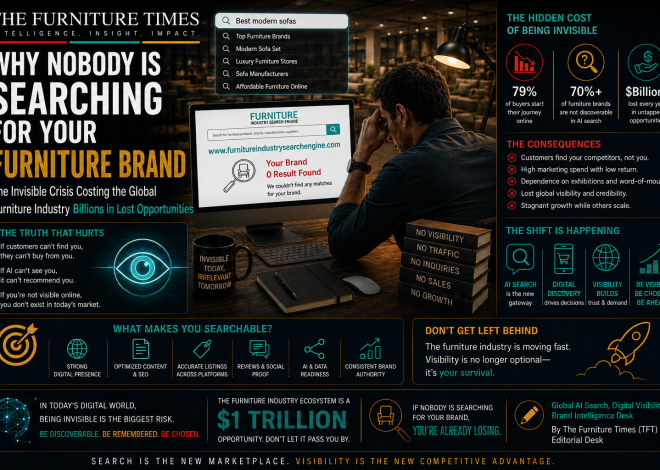
The furniture industry ecosystem is estimated to represent approximately US$1 trillion in interconnected economic activity, yet a large percentage of its manufacturers, suppliers, retailers, craftspeople and service providers remain difficult to discover.
An AI Visibility Audit Service can help reduce this gap, but it must be accessible to smaller businesses—not designed exclusively for multinational brands.
A fair visibility system should give an artisan, regional factory, component supplier or independent retailer a practical way to understand why it is invisible and what it can responsibly improve.
The future of furniture discovery will not be determined only by who has the largest advertising budget. It will also be influenced by who provides the clearest information, strongest evidence and most trustworthy digital identity.
Conclusion: Audit Visibility Without Compromising Security
AI visibility is becoming a serious business concern, but urgency should never replace due diligence.
Before appointing an AI visibility audit provider, organisations should examine its methodology, data requirements, security procedures, evidence standards and reliability claims.
The safest and most credible service will:
- Begin with public information
- Minimise private-data access
- Use read-only permissions where possible
- Document external tools and vendors
- Protect confidential information
- Repeat tests across relevant prompts
- Preserve evidence
- Require human verification
- Explain uncertainty
- Avoid guarantees it cannot control
- Delete unnecessary data after completion
An AI visibility audit should leave a company more discoverable, more accurate and more trusted—without leaving it more exposed.
In the new discovery economy, the question is no longer only, “Can customers find your website?”
The deeper question is:
Can AI find your brand, understand it correctly, verify its claims and recommend it with confidence?
The Furniture Times (TFT) & Furniture Industry Search Engine (FISE)
“TFT tells their story. FISE helps the world find them.”
FurniReviewology helps the world trust them.
The furniture industry ecosystem is a $1 trillion industry ecosystem. Be searchable. Be visible. Be secure. Be trusted.