
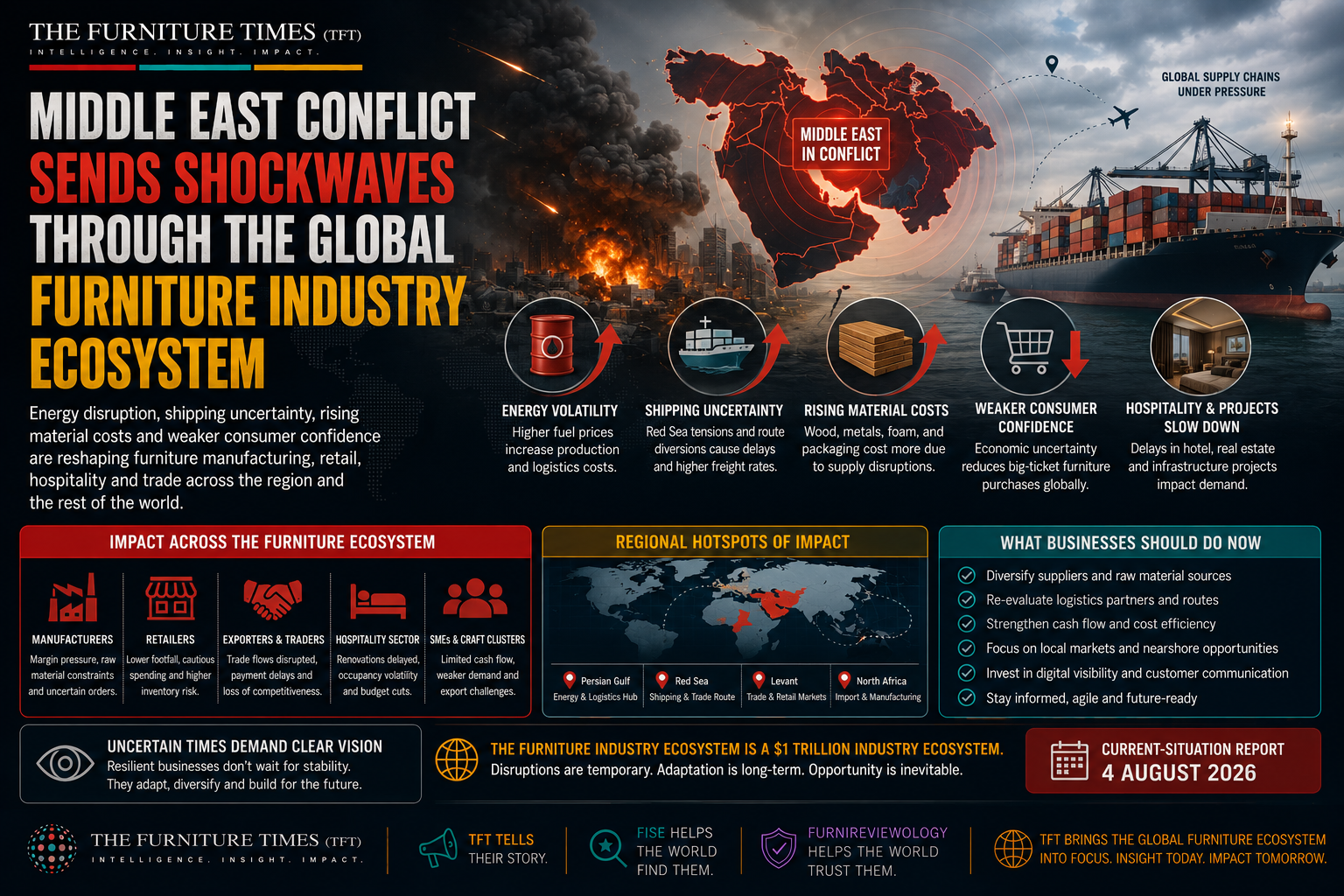
Middle East Conflict Sends Shockwaves Through the Global Furniture Industry Ecosystem
Energy disruption, shipping uncertainty, rising material costs and weaker consumer confidence are reshaping furniture manufacturing, retail, hospitality and trade across the region and the rest of the world
By The Furniture Times (TFT) Editorial Desk | Middle East Conflict | Global Furniture Trade | Supply-Chain Intelligence | Furniture Industry Ecosystem
Current-situation report: 4 August 2026
The continuing Middle East conflict has developed into far more than a regional security crisis. It is now an international economic shock affecting energy supplies, maritime trade, industrial materials, transportation costs, consumer confidence and business investment.
For the global furniture industry ecosystem, the consequences are spreading across nearly every segment—from timber processing, foam, plastics, coatings and furniture hardware to manufacturing, international freight, retail, hospitality projects and household demand.
The industry’s exposure is not always immediately visible. Furniture may not appear as energy-dependent as steelmaking, aviation or chemical production, but almost every piece of furniture contains costs connected to energy and global trade.
Factories require electricity. Timber must be dried and processed. Foam and plastics depend on petrochemical inputs. Hardware requires metal production. Upholstery and finished products must be transported. Retailers require warehousing, delivery fleets and consumer confidence.
When energy, shipping and confidence are disrupted simultaneously, the furniture industry experiences pressure at every stage.
01 — Current Situation: A Conflict With Global Economic Reach
As of 4 August 2026, the conflict involving Iran, the United States and Israel remains a major source of regional and global uncertainty. Maritime access through the Strait of Hormuz continues to be central to diplomatic and economic discussions, while the security of energy facilities and commercial shipping remains a critical international concern.
Reporting on 3 August indicated renewed efforts to discuss shipping arrangements through Oman, but major disagreements and uncertainty remained. Businesses should therefore avoid treating diplomatic contacts as proof of an immediate return to normal commercial conditions.
The Strait of Hormuz matters because it connects Gulf energy producers and commercial ports with global markets. Disruption around this passage affects oil, gas, petrochemicals, shipping insurance, freight availability and delivery schedules.
The conflict has consequently become an economic transmission system: disruption in one part of the Middle East can travel through fuel prices, freight rates and material markets before reaching furniture factories and consumers thousands of kilometres away.
02 — The Scale of the Energy Shock
A May 2026 United Nations analysis described the conflict as having produced the largest energy-supply shock on record. According to that assessment, Middle Eastern oil output fell by at least nine million barrels per day in March compared with estimated February production of 26 million barrels per day.
The UN also warned that disruption to the Strait of Hormuz could hold approximately 16 million barrels per day of crude oil back from the world market. Damage to liquefied-natural-gas infrastructure was expected to constrain some supplies for an extended period. United Nations Department of Economic and Social Affairs
The International Monetary Fund’s April 2026 outlook projected global growth of 3.1% for 2026 under an assumption that the conflict remained limited in duration and scope. The IMF warned that downside risks remained dominant and that emerging and developing economies were particularly vulnerable to higher inflation and weaker growth. IMF World Economic Outlook, April 2026
These figures matter to furniture companies because energy does not remain a separate line in the economy. Higher energy costs travel through materials, manufacturing, freight, packaging, warehouses, showrooms and household budgets.
03 — Why Furniture Is More Energy-Exposed Than It Appears
A furniture company may purchase timber, fabric, foam, glass, hardware and packaging rather than crude oil. Nevertheless, energy is embedded throughout those products.
Energy is required for:
- Sawmilling and timber drying
- Engineered-board production
- Metal casting and finishing
- Glass manufacturing
- Foam and synthetic-fibre production
- Adhesive and coating manufacture
- Plastic-component production
- CNC machinery and factory operations
- Heating, ventilation and dust extraction
- Packaging production
- Container transportation
- Warehousing and last-mile delivery
When fuel and electricity costs rise, suppliers eventually attempt to recover those costs through higher prices.
Furniture manufacturers may therefore face cost increases from several directions simultaneously, even when the price of their principal timber species remains stable.
04 — Petrochemical Disruption Reaches Furniture Factories
The furniture industry uses a wide range of petroleum-related and petrochemical materials.
These include:
- Polyurethane foam
- Polyester upholstery
- Synthetic leather
- Plastic chair shells
- Polypropylene components
- Edge banding
- Laminates
- Adhesives
- Sealants
- Coatings
- Packaging film
- Protective wrapping
- Plastic fittings
- Resin systems
The UN warned that conflict-related disruption was affecting industrial inputs such as naphtha and creating risks for plastics and packaging production.
Separate supply-chain research has highlighted the Middle East’s important position in global petrochemical trade, including ethylene glycol and polyethylene. Interruptions can therefore affect manufacturers in major Asian production centres, not only factories located inside the Gulf.
For upholstered-furniture and mattress manufacturers, foam availability and pricing deserve particular attention. For ready-to-assemble and flat-pack producers, packaging costs may also become increasingly important.
05 — Foam, Fabrics and Upholstery Face Cost Pressure
Upholstered furniture is among the industry segments most exposed to petrochemical inflation.
A sofa contains more than a visible fabric covering. It may include foam in several densities, polyester fibre, webbing, synthetic backing, adhesives, plastic feet and protective packaging.
Price pressure may therefore emerge across multiple bill-of-material categories.
Manufacturers may respond by:
- Renegotiating supply agreements
- Reducing the number of material options
- Increasing minimum order quantities
- Adjusting product specifications
- Using alternative suppliers
- Redesigning products
- Increasing retail prices
- Accepting lower margins temporarily
Businesses must avoid making hidden material substitutions that damage comfort, durability or customer trust. Any redesign should be tested properly and communicated accurately.
Reducing foam density, fabric quality or component performance may deliver short-term savings but create warranty claims and reputational damage later.
06 — Timber and Engineered Boards Are Indirectly Affected
The Middle East is not the world’s main source of all furniture timber, but wood products remain vulnerable to the wider logistics and energy shock.
Timber must be harvested, processed, kiln-dried, treated and transported. Engineered boards require energy, resins and industrial production systems. MDF, particleboard and plywood prices can consequently be affected by changes in electricity, adhesives, freight and factory operating costs.
Import-dependent Middle Eastern furniture companies may face higher landed prices for timber and boards arriving from:
- Southeast Asia
- Europe
- China
- Türkiye
- Africa
- North America
- South Asia
Manufacturers outside the region may also be affected when vessels, containers, insurance capacity or shipping schedules are reorganised.
The result may not always be an immediate shortage. It may appear as longer lead times, less predictable quotations and reduced willingness among suppliers to guarantee prices.
07 — Furniture Hardware and Metal Components
Furniture hardware is another area of exposure.
Hinges, runners, connectors, fasteners, brackets, handles, castors, recliner mechanisms and height-adjustment systems depend on metals, energy-intensive manufacturing, coatings and international transportation.
Higher energy costs can affect metal production and finishing. Freight disruption can delay component deliveries. Currency pressure may make imported hardware more expensive in regional markets.
A missing hinge or drawer slide can stop the completion of an entire cabinet, kitchen or furniture order. The financial importance of a component is therefore much greater than its individual purchase price.
Manufacturers should identify components that have:
- Only one approved supplier
- Long replenishment periods
- No locally available substitute
- Special tooling requirements
- Customer-specific certification
- High failure risk if substituted
- Dependence on disrupted routes
These items deserve priority in supply-chain planning.
08 — Freight Costs Become a Major Furniture Risk
Furniture is physically bulky relative to its value. This makes transportation a major component of the final cost.
A container can carry only a limited number of assembled sofas, beds or dining sets. Flat-pack designs improve shipping efficiency, but they still depend on container availability, predictable routes and manageable freight rates.
Conflict-related shipping risks can produce:
- Higher marine-insurance premiums
- Security surcharges
- Longer routes
- Vessel delays
- Port congestion
- Container imbalances
- Unpredictable sailing schedules
- Longer customer lead times
- Greater inventory requirements
- Higher working-capital needs
A freight increase that appears manageable for small, high-value goods may have a much larger effect on low-margin, bulky furniture.
Exporters should therefore calculate the impact at product level rather than relying only on an average shipping-cost percentage.
09 — The Strait of Hormuz and Gulf Furniture Trade
The Gulf states are important furniture-importing, retail, hospitality, construction and project markets.
Furniture moves into the region for:
- Residential development
- Hotels and resorts
- Offices
- Restaurants
- Educational facilities
- Healthcare environments
- Retail stores
- Government projects
- Luxury villas
- Serviced apartments
- Entertainment destinations
Disruption around the Strait of Hormuz can affect inbound materials and finished products, even if ports remain open. Carriers may revise schedules, insurers may reprice risk and suppliers may hesitate to promise exact delivery dates.
Gulf-based companies may also face challenges exporting locally manufactured furniture or re-exporting products through regional distribution centres.
The problem is therefore not simply whether a port is technically operational. The industry must consider whether shipments remain commercially practical, insurable, affordable and predictable.
10 — Red Sea Disruption Compounds the Problem
Furniture trade was already managing uncertainty around Red Sea routes before the latest escalation.
When shipping routes through the Red Sea and Suez Canal become less reliable, vessels may travel around southern Africa. This can extend transit times and increase fuel consumption, freight charges and carbon emissions.
When Hormuz and Red Sea risks exist simultaneously, companies lose flexibility. Alternative routes become more crowded and expensive.
This matters especially for trade between:
- Asia and Europe
- Asia and the Middle East
- Europe and the Gulf
- Türkiye and Asian markets
- North Africa and global destinations
- Indian Subcontinent manufacturers and Gulf buyers
Businesses relying on just-in-time inventory may be forced to hold more stock, tying up cash at a time when financing is already expensive.
11 — The Middle East Furniture Market Faces Uneven Effects
The impact will not be identical across every Middle Eastern economy.
Countries directly exposed to conflict, infrastructure damage or shipping disruption face the greatest operational risk. Oil-importing economies may suffer from higher energy bills, currency pressure and reduced consumer purchasing power.
Some energy-exporting economies may receive higher prices for available exports, but this potential benefit can be offset by reduced production, transport disruption, infrastructure risk and weaker non-oil activity.
The IMF has stressed that the global shock is asymmetric: energy importers are generally more exposed than exporters, poorer countries more vulnerable than richer ones and economies with limited financial buffers more at risk than those with stronger reserves. IMF analysis of energy, trade and financial effects
Furniture-industry planning must therefore be country-specific. A regional average may hide severe differences between markets.
12 — Consumer Confidence Is Becoming a Central Risk
Furniture is highly sensitive to consumer confidence.
When households fear inflation, employment uncertainty or declining purchasing power, they often postpone large discretionary purchases. A sofa, dining set, bedroom collection or outdoor-furniture package may be delayed even if the customer still intends to buy eventually.
The effects are not limited to the Middle East. On 3 August, reporting on a European Central Bank analysis indicated that the Iran conflict had contributed to a sharp decline in euro-area consumer confidence and discretionary spending, particularly as households feared that conflict-related inflation would reduce their real income. Reuters report on the ECB analysis
This illustrates how a Middle Eastern conflict can affect furniture demand in Europe without a single furniture shipment passing through the Gulf.
Confidence itself becomes a transmission channel.
13 — Inflation Creates a Double Pressure on Furniture Companies
Inflation affects furniture businesses from both directions.
On the cost side, companies face more expensive materials, transport, energy, packaging and financing.
On the demand side, customers have less disposable income after paying more for fuel, utilities, food and transportation.
This creates a margin squeeze:
- Raising prices may weaken demand.
- Absorbing costs reduces profitability.
- Lowering specifications may damage quality.
- Increasing inventory requires more working capital.
- Reducing marketing may weaken future sales.
- Extending customer credit increases financial risk.
There is no universal solution. Businesses need product-level costing, customer segmentation and disciplined cash-flow management.
14 — Hospitality and Commercial Projects Face Uncertainty
The Middle East has been a major market for hotels, resorts, offices, mixed-use developments and large interior projects.
Conflict can affect these projects through:
- Tourism uncertainty
- Airline disruption
- Delayed investment decisions
- Higher construction costs
- Financing constraints
- Labour and logistics challenges
- Imported-material delays
- Insurance complications
- Revised opening schedules
- Government reprioritisation
Furniture, fixtures and equipment are installed relatively late in many construction projects. Delays elsewhere can therefore push furniture deliveries back even after manufacturers have purchased materials or begun production.
Contract furniture suppliers should review:
- Payment schedules
- Storage responsibilities
- Delay clauses
- Currency provisions
- Force-majeure language
- Installation obligations
- Insurance coverage
- Customer-credit exposure
Commercial opportunities may continue, but risk allocation becomes more important.
15 — Retailers May Face Slower Sales and Higher Inventory Costs
Furniture retailers in the region may face declining footfall, cautious consumers and delayed deliveries at the same time.
If retailers increase inventory to protect against shipping disruption, they require more warehouse space and working capital. If demand then slows, products remain unsold for longer.
Retailers should avoid responding with uncontrolled purchasing. Inventory planning should distinguish between:
- Core products with reliable demand
- Seasonal collections
- Trend-sensitive furniture
- Long-lead imported products
- Locally replaceable products
- High-margin items
- Slow-moving stock
- Essential spare parts
Retailers may also need to communicate more clearly about availability, delivery dates and price validity.
Silence or inaccurate promises can damage customer trust.
16 — SMEs Are the Most Financially Exposed
Small and medium-sized furniture businesses often have limited cash reserves, less purchasing power and weaker negotiating positions with shipping companies and suppliers.
An SME may be unable to:
- Reserve large quantities of materials
- Negotiate long-term freight contracts
- Absorb a sudden cost increase
- Maintain several alternative suppliers
- Hold months of inventory
- Obtain affordable working-capital finance
- Carry delayed customer payments
- Recover quickly from a cancelled project
Smaller companies must therefore focus on information and speed.
Weekly cost reviews, supplier communication, updated quotations and careful credit control may be more valuable than complex long-term forecasts.
SMEs should also avoid disappearing from the market. Cutting all marketing and communication can create an additional demand problem at precisely the wrong time.
17 — Türkiye, Egypt, Jordan and Other Regional Producers
Furniture-producing countries around the wider Middle East and Eastern Mediterranean may experience a mixture of risks and opportunities.
Higher energy and freight costs can weaken competitiveness. Regional demand may slow. Currency volatility can make imported components more expensive.
At the same time, buyers may search for suppliers closer to their projects to reduce maritime risk and lead times. This may create opportunities for manufacturers capable of offering regional production, flexible quantities and reliable delivery.
Nearshoring could benefit companies in countries with:
- Established furniture clusters
- Skilled labour
- Access to timber or panels
- Strong upholstery capabilities
- Regional road connections
- Export experience
- Flexible manufacturing
- Recognised quality standards
However, opportunity should not be confused with certainty. Local producers remain exposed to imported foam chemicals, hardware, machinery parts, fabrics and energy.
18 — Asian Furniture Manufacturers Face Significant Exposure
Asia is the world’s largest furniture-manufacturing base, with major activity in China, Vietnam, Malaysia, Indonesia, India and other countries.
Asian manufacturers are affected through several channels:
- Energy prices
- Petrochemical availability
- European demand
- Gulf demand
- Freight costs
- Shipping delays
- Currency movements
- Packaging expenses
- Imported hardware
- Buyer uncertainty
South and East Asian economies are also major customers for Middle Eastern energy. Disruption can therefore raise factory electricity and transportation costs even when a company sells mainly to the United States or Europe.
Malaysia’s furniture sector, for example, may not be physically close to the conflict, but it remains connected through fuel, shipping, resins, foam, packaging and export demand.
19 — European Furniture Demand Faces a Confidence Shock
Europe may experience the conflict through higher energy prices, inflation concerns, weaker household confidence and slower economic growth.
Furniture retailers could face delayed consumer spending while manufacturers deal with higher production and transportation costs.
European businesses sourcing from Asia may also encounter longer routes and less predictable container schedules.
The combination can be particularly difficult:
- Imported furniture costs more to land.
- Locally manufactured furniture costs more to produce.
- Consumers become more cautious.
- Retailers discount to protect sales.
- Margins narrow across the chain.
Premium and contract segments may show different behaviour from mass-market residential furniture, making customer segmentation essential.
20 — North America Is Not Fully Insulated
The United States and Canada may be less directly dependent on Gulf energy than some Asian and European economies, but they remain connected to global commodity and freight markets.
Potential effects include:
- Higher transport costs
- More expensive imported furniture
- Volatile container rates
- Increased packaging costs
- Supply delays from Asia
- Consumer inflation concerns
- Changes in interest rates
- Reduced housing-related spending
Furniture demand is closely connected to housing transactions, renovation, credit conditions and household confidence. If inflation remains elevated, borrowing costs may stay higher for longer, affecting property activity and furniture purchases.
North American manufacturers may gain some demand from customers seeking shorter supply chains, but domestic production still relies on globally traded materials and components.
21 — Africa and Developing Economies Face Greater Vulnerability
Developing economies often have fewer financial resources to absorb energy and freight shocks.
Higher fuel prices affect transportation, electricity generation, household income and industrial production. Currency depreciation can make imported furniture, components and machinery much more expensive.
The UN and IMF have warned that poorer and import-dependent economies face disproportionate pressure from the conflict.
Furniture businesses in these markets may experience:
- Reduced consumer purchasing power
- Higher imported-material costs
- Limited access to foreign currency
- More expensive logistics
- Delayed machinery maintenance
- Reduced construction activity
- Greater demand for repair and second-hand furniture
The repair, refurbishment and resale sectors may grow as consumers extend the life of existing products.
22 — Currency and Financing Risks
Conflict-driven uncertainty can strengthen some safe-haven currencies while weakening the currencies of vulnerable importing economies.
A furniture importer may agree to purchase in US dollars but sell in local currency. If the local currency falls before payment is due, the actual cost can rise substantially.
Higher inflation can also influence interest-rate policy, making working-capital loans and consumer financing more expensive.
Businesses should review:
- Currency exposure
- Payment timing
- Price-validity periods
- Customer deposits
- Supplier-credit terms
- Interest costs
- Inventory financing
- Insurance coverage
- Credit limits
Furniture orders with long production periods are particularly exposed because several months may pass between quotation and final delivery.
23 — Contract and Quotation Practices Must Change
Furniture companies should not continue issuing long-validity quotations based on outdated assumptions.
Quotations may need clear provisions covering:
- Freight adjustments
- Fuel surcharges
- Currency movements
- Material-price changes
- Shipping-route changes
- Delivery windows
- Storage charges
- Government restrictions
- Insurance-related costs
- Force-majeure events
These provisions should be transparent and commercially reasonable. Customers need to understand which costs are fixed and which remain subject to exceptional changes.
Ambiguous terms can create disputes precisely when both supplier and buyer are already under pressure.
24 — Supply-Chain Diversification Becomes Essential
The conflict strengthens the case for diversified sourcing.
A resilient furniture company should avoid excessive dependence on:
- One shipping route
- One foam supplier
- One hardware manufacturer
- One fabric mill
- One packaging producer
- One timber source
- One foreign currency
- One major customer
- One regional market
Diversification does not mean replacing every supplier immediately. It means qualifying alternatives before an emergency occurs.
Businesses should create a critical-component map identifying which missing item could stop production. Alternative products should be tested before they are needed.
25 — Local and Regional Manufacturing May Gain Importance
The conflict may accelerate interest in local and regional supply chains.
Buyers may increasingly value:
- Shorter delivery distances
- Smaller order quantities
- Faster replenishment
- Easier factory inspection
- More reliable communication
- Reduced shipping exposure
- Local after-sales support
- Replacement-part availability
This can create opportunities for regional furniture clusters and component manufacturers.
However, “locally made” does not always mean locally supplied. A regional factory may still depend on imported foam chemicals, hardware, machinery, fabrics and coatings.
True resilience requires understanding the origin of second- and third-tier inputs.
26 — Sustainability Goals Face a Difficult Test
Longer shipping routes consume more fuel and create additional emissions. Emergency sourcing may also encourage companies to prioritise availability over environmental performance.
Businesses should avoid abandoning sustainability entirely. Instead, they can use the crisis to improve:
- Material efficiency
- Flat-pack engineering
- Container utilisation
- Product durability
- Repairability
- Local sourcing
- Packaging reduction
- Inventory accuracy
- Replacement-part systems
- Circular furniture programmes
A durable product that uses fewer materials and remains serviceable for longer can support both cost control and environmental responsibility.
27 — What Furniture Businesses Should Do Immediately
Action 01 — Map critical exposure.
Identify materials, components, routes, markets and customers connected to the Middle East disruption.
Action 02 — Recalculate product costs.
Include updated energy, freight, insurance, currency and financing expenses.
Action 03 — Contact strategic suppliers.
Request current lead times, availability information and alternative-route plans.
Action 04 — Protect essential inventory.
Prioritise components capable of stopping production, not every item equally.
Action 05 — Update quotations.
Use realistic validity periods and transparent adjustment provisions.
Action 06 — Review customer credit.
Delayed projects can create payment risk.
Action 07 — Qualify alternatives.
Test replacement materials and suppliers before an emergency.
Action 08 — Communicate honestly.
Inform customers about delivery changes before deadlines are missed.
Action 09 — Protect visibility.
Continue search, media and customer communication even if budgets must be reduced.
Action 10 — Prepare scenarios.
Plan for improvement, continued disruption and further escalation.
28 — Three Scenarios for the Furniture Industry
Scenario A — Diplomatic De-escalation and Route Normalisation
Under this scenario, maritime access improves, energy flows recover and insurance and freight pressures gradually ease.
Furniture companies may still experience delayed effects because inventories, contracts and shipping schedules take time to normalise.
Scenario B — Prolonged Managed Disruption
Commercial shipping continues under restrictions, higher insurance costs and uncertain schedules. Energy and material prices remain elevated but available.
This scenario requires careful inventory, pricing and cash-flow management.
Scenario C — Wider Regional Escalation
Further disruption affects energy infrastructure, maritime routes, aviation, investment and consumer confidence.
Furniture demand could weaken sharply while material and freight costs rise. Highly leveraged businesses, import-dependent retailers and SMEs would face the greatest risk.
These are planning scenarios, not predictions. The current outlook remains uncertain.
29 — Why Marketing and Visibility Must Continue
In periods of conflict and uncertainty, many furniture businesses cut advertising and stop communicating.
This can create another problem: declining demand is followed by declining visibility.
Customers still search for furniture, components, suppliers and alternatives. Buyers want to know:
- Which companies remain operational?
- Which products are available?
- Who can deliver?
- Which suppliers have regional capacity?
- Which brands provide reliable support?
- What alternatives exist?
Companies should reduce waste but maintain accurate websites, industry coverage, customer updates, search presence and review activity.
A crisis can change demand, but invisibility prevents a business from capturing whatever demand remains.
30 — The Role of TFT, FISE and FurniReviewology
The conflict demonstrates why the furniture industry needs connected information, discovery and trust systems.
The Furniture Times (TFT) helps businesses and decision-makers understand market developments and communicate important company stories.
Furniture Industry Search Engine (FISE) helps buyers discover manufacturers, suppliers, retailers, service providers and industry alternatives.
FurniReviewology supports trust through customer experiences, reviews and reputation.
During disrupted markets, these functions become more valuable:
- TFT explains what is happening.
- FISE helps the industry find alternatives.
- FurniReviewology helps buyers evaluate whom to trust.
31 — Conclusion: A Regional Conflict With Industry-Wide Consequences
The Middle East conflict is reshaping the furniture economy far beyond the countries directly involved.
Its effects are travelling through energy markets, petrochemicals, shipping routes, freight insurance, currencies, inflation, consumer confidence and investment decisions.
Regional furniture businesses face the most immediate pressure, but manufacturers and retailers in Asia, Europe, Africa and North America are also exposed.
The furniture industry cannot control the conflict. It can control how quickly it identifies risks, communicates with customers, diversifies supply, protects cash flow and preserves market visibility.
Companies that understand their true exposure will be better positioned than those that wait for shortages, cancelled projects or margin losses to reveal it.
The immediate priority is resilience: protect people, preserve business continuity, communicate honestly and prepare for several possible outcomes.
Editorial note: This report reflects information available on 4 August 2026. Conflict conditions, maritime access, energy flows and diplomatic negotiations can change quickly.
The Furniture Times (TFT) & Furniture Industry Search Engine (FISE)
“TFT tells their story. FISE helps the world find them.”
FurniReviewology helps the world trust them.
The furniture industry ecosystem is a $1 trillion industry ecosystem.
