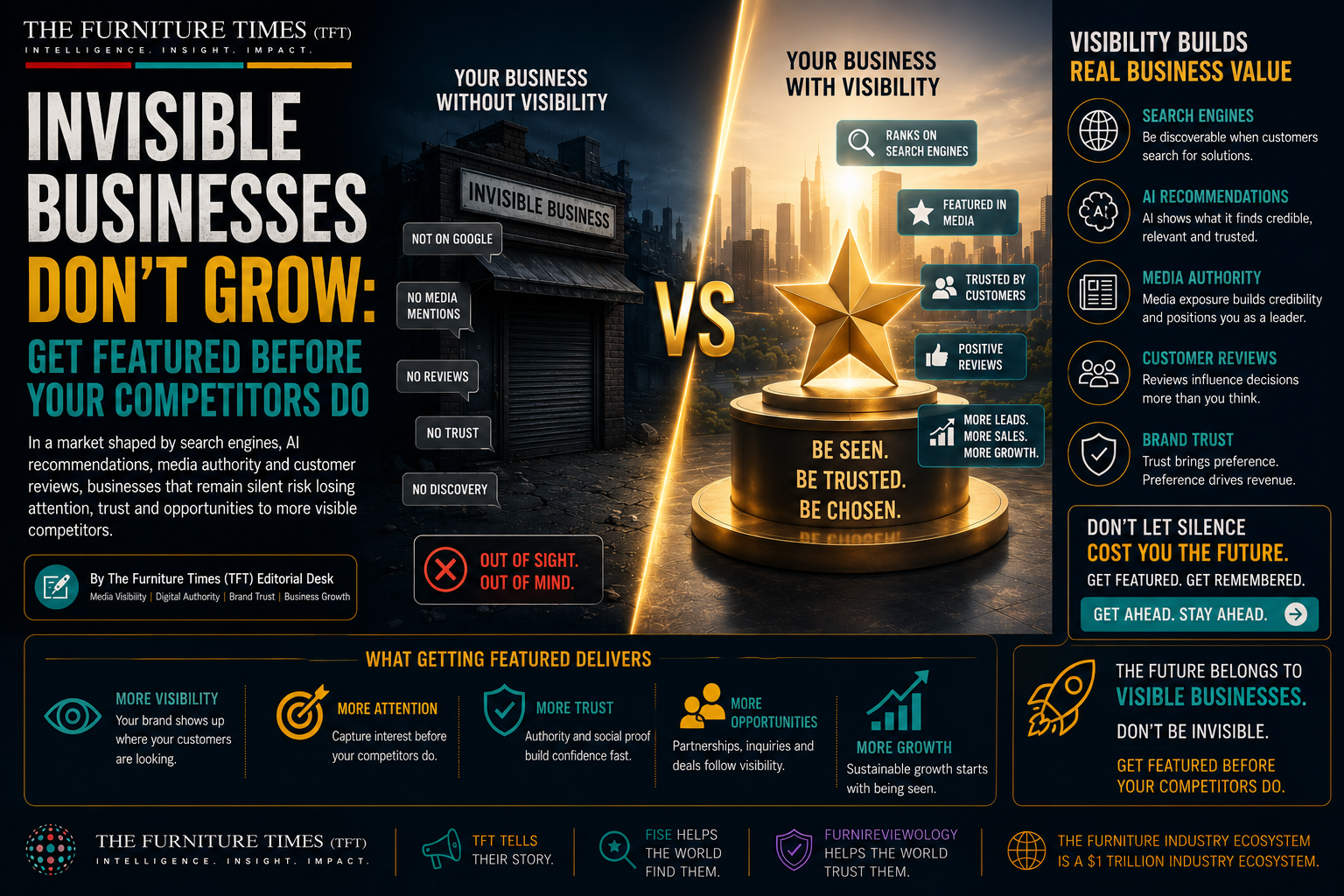
Invisible Businesses Don’t Grow: Get Featured Before Your Competitors Do
In a market shaped by search engines, AI recommendations, media authority and customer reviews, businesses that remain silent risk losing attention, trust and opportunities to more visible competitors
By The Furniture Times (TFT) Editorial Desk | Media Visibility | Digital Authority | Brand Trust | Business Growth
A business can have an excellent product, an experienced team, competitive prices and dependable customer service—and still struggle to grow.
The reason may not be product quality. It may not be a lack of demand. It may not even be competition.
The real problem may be invisibility.
Customers cannot purchase from a company they cannot find. Buyers cannot request quotations from suppliers they have never encountered. Journalists cannot cover businesses that never communicate. Search engines cannot understand companies with limited information, and artificial-intelligence systems cannot confidently recommend brands without enough reliable evidence.
Invisibility is no longer a minor marketing weakness. It is a commercial risk.
A furniture manufacturer may own modern machinery, employ skilled craftspeople and produce products for international markets. Yet if the company has no current news, incomplete product information, weak search visibility and few credible third-party references, buyers may overlook it.
Meanwhile, a competitor with comparable—or even less capable—products may appear repeatedly in news articles, search results, business directories, reviews, social media and AI-generated recommendations.
The market does not always reward the best company.
It frequently rewards the best-known, easiest-to-find and most trusted company.
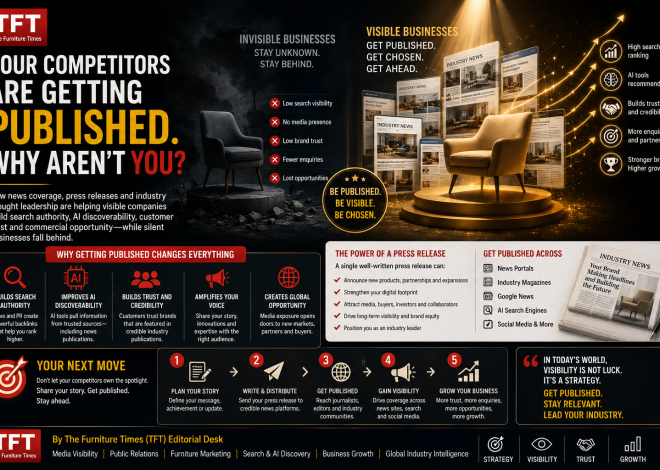
This is why businesses should get featured before their competitors do.
01 — Visibility Comes Before Opportunity
Every business opportunity begins with some form of discovery.
A prospective customer may discover a company through:
- A news article
- A search result
- An advertisement
- An industry directory
- A review
- A trade publication
- A press release
- A social-media post
- An AI-generated recommendation
- A business referral
- An exhibition
Before a customer can evaluate quality, price or service, the customer must first encounter the business.
This creates a simple commercial sequence:
Visibility → Discovery → Consideration → Trust → Enquiry → Conversion
When visibility is missing, the rest of the sequence may never begin.
A business cannot rely entirely on the hope that customers will somehow find it.
02 — Good Products Do Not Promote Themselves
Many manufacturers believe quality should speak for itself.
Quality matters enormously, but products do not speak unless businesses communicate their value.
Customers need information explaining:
- What the product is
- Who created it
- What materials are used
- Which problem it solves
- How it differs
- Where it is available
- What it costs
- Whether it is reliable
- What support is offered
A well-made product sitting inside a warehouse remains commercially silent.
The manufacturer must transform product quality into:
- Photographs
- Specifications
- Demonstrations
- Articles
- Case studies
- Press releases
- Reviews
- Searchable listings
Quality creates value. Visibility allows the market to recognize that value.
03 — Your Competitors Are Defining the Market
When your company remains silent, competitors gain greater influence over how customers understand the category.
They publish articles explaining:
- Which materials are best
- What customers should consider
- Which trends are important
- How products should be compared
- Why their solutions are valuable
The company producing this information can gradually become recognized as the authority.
Journalists contact it. Customers remember it. Search engines index it, while AI systems may cite or recommend it.
Your competitor is not only advertising a product. It is influencing the customer’s definition of quality.
If your business has greater expertise but never communicates it, the market cannot benefit from that knowledge.
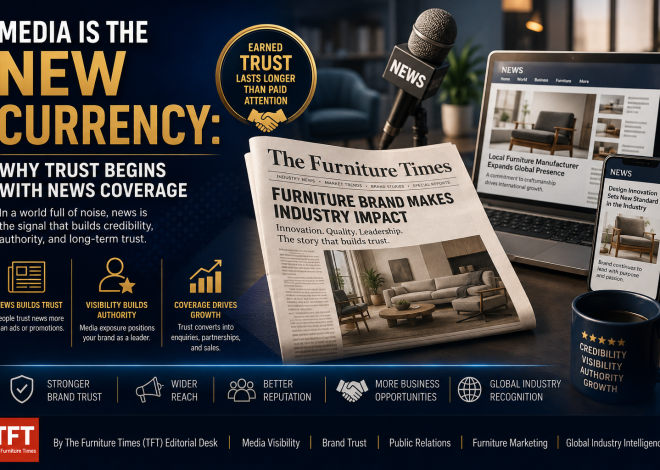
04 — Media Coverage Creates Third-Party Credibility
A company’s website presents its own version of its story. That information is necessary, but customers also look for external confirmation.
News coverage can provide another layer of visibility and credibility.
A business may be featured for:
- Launching a product
- Opening a facility
- Entering a market
- Completing a major project
- Receiving certification
- Introducing sustainable practices
- Forming a partnership
- Publishing research
- Creating employment
- Supporting a community
- Adopting new technology
Media exposure does not automatically mean endorsement. Reputable publications maintain editorial independence. However, legitimate coverage confirms that the company is active enough to become part of the public conversation.
That public record can support customers, distributors, investors, employees and business partners.
05 — Being Featured Makes Your Business Searchable
A published feature creates a digital asset.
It may include:
- Company name
- Product category
- Location
- Leadership
- Industry
- Services
- Website
- Business development
- Market relevance
These associations help search engines understand what the company does.
For example, an article about a Malaysian outdoor-furniture manufacturer expanding its hospitality collection may connect the business with:
- Outdoor furniture
- Malaysian furniture manufacturing
- Hospitality projects
- Weather-resistant materials
- Commercial furnishing
One article will not guarantee high rankings. Search visibility develops through a wider combination of useful content, technical quality, links, business listings, reviews and sustained authority.
Nevertheless, credible media features can contribute to the evidence surrounding a brand.
06 — Media Mentions Can Support AI Discovery
Search behavior is moving from short keywords toward conversational questions.
Customers increasingly ask AI systems:
- Which furniture brands offer sustainable products?
- Who supplies hotel furniture in Southeast Asia?
- What manufacturers specialize in outdoor collections?
- Which furniture businesses are expanding internationally?
- Which retailers have reliable customer service?
AI systems need information from accessible sources to answer these questions.
A company with:
- Current news
- Detailed product pages
- Verified listings
- Independent references
- Authentic reviews
- Clear policies
- Consistent business information
is easier to understand than a company with a nearly empty digital footprint.
Getting featured therefore supports more than immediate publicity. It can contribute to the brand’s wider information environment.
07 — Invisibility Makes Sales More Difficult
An invisible company depends heavily on cold selling.
Its salespeople must introduce the business, establish credibility, explain the offer and overcome uncertainty before discussing the transaction.
A company with media visibility gives sales teams stronger evidence.
They can share:
- News features
- Company interviews
- Product-launch articles
- Market reports
- Award announcements
- Project coverage
- Sustainability stories
These materials can strengthen:
- Sales presentations
- Distributor discussions
- Export outreach
- Tender submissions
- Investor conversations
- Recruitment
Being featured does not close the sale automatically. It improves the environment in which the sale is attempted.
08 — Buyers Use Visibility as a Risk Signal
Furniture purchases can involve significant risk.
A retailer placing a large order wants confidence that the manufacturer can fulfill it. A hotel wants assurance that its furniture supplier will meet specifications and deadlines. A consumer wants to know that the retailer will remain available after delivery.
Buyers investigate:
- Company history
- Recent activity
- Customer reviews
- Media coverage
- Certifications
- Product information
- Contact details
- Public reputation
A business with no recent public presence may create questions:
- Is it still operating?
- Is its information accurate?
- Has it completed similar projects?
- Does it provide after-sales service?
- Can it be trusted with a large order?
Visibility cannot replace due diligence, but it helps reduce uncertainty.
09 — Competitors Gain the Attention You Abandon
Customer attention is limited.
If five furniture companies serve the same market and only two consistently communicate, those two can gain a disproportionate share of awareness.
This is the strategic importance of share of voice.
A company’s share of voice represents its visibility relative to competitors. When competitors reduce advertising and media activity, businesses that maintain a credible presence may gain relative attention.
WARC describes “excess share of voice” as a condition in which a brand’s share of advertising visibility exceeds its market share. Historical marketing evidence has associated this position with stronger long-term growth potential. WARC’s marketing-effectiveness glossary
Greater visibility does not guarantee success, but complete invisibility makes growth considerably more difficult.
10 — SMEs Have the Most to Lose From Silence
Large corporations have accumulated awareness through decades of advertising, distribution and customer exposure.
An SME may not have this protection.
If a smaller furniture company stops communicating, customers can forget it quickly or assume it has left the market.
SMEs should therefore maintain a minimum public presence through:
- Industry listings
- Company news
- Local search
- Product information
- Customer reviews
- Useful content
- Direct communication
- Focused advertising
Visibility does not always require a huge budget. It requires consistency, clarity and strategic discipline.
11 — Press Releases Turn Business Milestones Into Public Assets
Many companies achieve important milestones but never document them.
They may:
- Enter a new export market
- Purchase machinery
- Obtain certification
- Open a showroom
- Complete a hotel project
- Launch a collection
- Introduce recyclable packaging
- Hire new employees
- Develop a smart product
Internally, these are significant achievements. Externally, they may remain unknown.
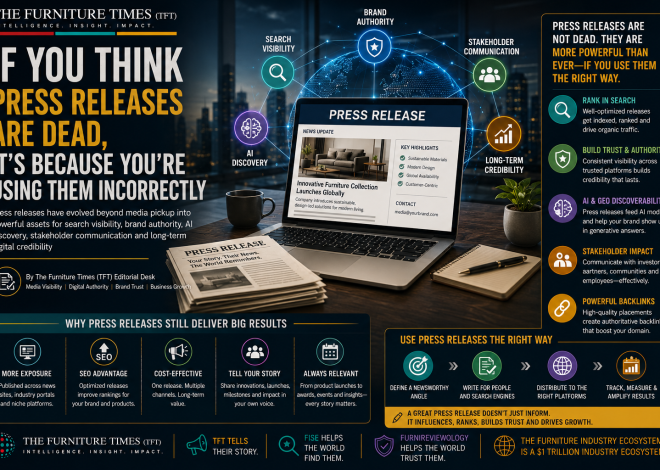
A press release can convert the development into a structured, public announcement.
A strong release should explain:
- What happened
- Why it matters
- Who is involved
- Where it occurred
- When it happened
- What evidence supports it
- Who can provide additional information
The objective is not exaggeration. It is documentation.
12 — Not Every Company Update Is News
Businesses should not distribute press releases merely to create activity.
A newsworthy development should be:
- Timely
- Relevant
- Specific
- Verifiable
- Meaningful to an audience
A normal discount or ordinary social-media update may not justify a formal release.
Companies should avoid:
- Unsupported claims
- Promotional superlatives
- Fabricated awards
- Misleading figures
- Artificial urgency
- Purchased praise
- Fake reviews
Visibility built through misinformation eventually damages trust.
13 — Getting Featured Is Different From Buying an Advertisement
Advertisements and editorial features serve different purposes.
Advertisement
The company pays for controlled promotional space.
Sponsored content
Commercial content is published with appropriate disclosure.
Press release
The company issues an official announcement.
Independent news article
A publication makes its own editorial decision about the subject and presentation.
Businesses should understand these differences and never misrepresent paid or self-issued content as independent endorsement.
A strong visibility strategy may use all four formats transparently.
14 — Media Coverage Can Generate Valuable Backlinks
When a publication references a company and links to its website, that link may generate:
- Referral traffic
- Customer discovery
- Brand recognition
- Search signals
- Sales enquiries
However, backlinks should not become the only objective.
A link from an irrelevant or low-quality website may offer little value. Large-scale link schemes can create search-engine risks.
The most valuable media link is usually earned because the company provided:
- Genuine news
- Useful data
- Expert insight
- A relevant case study
- A meaningful industry development
The story comes first. The link is a potential benefit.
15 — One Feature Can Support Multiple Business Functions
A published article does not need to remain isolated on a news website.
The company may share it through:
- Its website newsroom
- Email newsletters
- Sales presentations
- Distributor communication
- Recruitment materials
- Social media
- Trade-show follow-up
- Investor information
- Customer proposals
The feature becomes a reusable credibility asset.
Businesses should not copy an entire copyrighted article without permission. They can share the original link, summarize the coverage and use approved excerpts where appropriate.
16 — Media Visibility Strengthens Brand Recall
Customers may not purchase immediately after reading about a company.
They may remember the brand later when the need becomes active.
Repeated exposure reinforces memory through:
- News coverage
- Advertising
- Search results
- Reviews
- Content
- Showroom experience
- Recommendations
A single article can introduce the name. Continued visibility helps the customer remember it.
This is why businesses should view media as part of a sustained strategy rather than a one-time event.
17 — Invisibility Increases Dependence on Discounts
When customers do not recognize a brand, the company may find it difficult to justify its price.
Visible brands can communicate:
- Quality
- Materials
- Design
- Experience
- Warranty
- Customer service
- Product longevity
- Manufacturing origin
Invisible businesses are more likely to be compared only on price.
Google’s research on profitable growth notes that reducing marketing investment can weaken differentiation, increase price sensitivity and erode profitability. Google’s Unlocking Profitable Growth report
Visibility does not permit unreasonable pricing, but it helps customers understand why products differ.
18 — News Can Attract Business Partners
Media features are read by more than consumers.
They may reach:
- Distributors
- Retailers
- Architects
- Interior designers
- Developers
- Technology companies
- Logistics providers
- Investors
- Government agencies
- Trade associations
- Potential employees
A public story can therefore create opportunities beyond direct sales.
A manufacturer featured for sustainable innovation might receive interest from a material supplier, architect or international distributor.
The company cannot predict every outcome, but invisibility prevents many outcomes from beginning.
19 — Media Exposure Supports Recruitment
Talented people often research companies before applying for jobs.
They look for evidence of:
- Growth
- Leadership
- Innovation
- Culture
- Stability
- Market relevance
A business with no recent public information may struggle to attract candidates.
News coverage can present the company as active and forward-looking, provided the story reflects reality.
Visibility helps businesses compete for both customers and talent.
20 — Local Businesses Need Media Visibility Too
Some companies believe media coverage is only useful for multinational corporations.
Local furniture retailers can also benefit from stories about:
- New showroom openings
- Community projects
- Local employment
- Sustainable practices
- Design workshops
- Customer education
- Business anniversaries
- New services
- Regional partnerships
Local media can connect the business with nearby customers and strengthen geographic search relevance.
A company does not need a global announcement when its primary market is local. It needs the right story in the right place.
21 — Industry Media Reaches High-Value Audiences
General media offers broad reach, while industry media can provide concentrated relevance.
Furniture-industry publications may reach:
- Manufacturers
- Retailers
- Suppliers
- Buyers
- Designers
- Consultants
- Project managers
- Investors
- Event organizers
A feature in a relevant industry publication may generate fewer total views than mass media but more valuable commercial attention.
Reach should be evaluated together with audience quality.
22 — Furniture Companies Have More Stories Than They Realize
Furniture businesses often assume they have nothing newsworthy to communicate.
In reality, potential stories may exist across:
- Craftsmanship
- Product engineering
- Materials
- Sustainability
- Export growth
- Local manufacturing
- Digital transformation
- Furniture tourism
- Workforce development
- Customer experience
- Logistics
- Circularity
- Smart furniture
- Community impact
The challenge is identifying why the development matters beyond the company.
A new machine is not automatically a story. Its effect—such as reduced waste, improved quality or greater local employment—may make it newsworthy.
23 — Timing Determines Competitive Advantage
A company that waits until every competitor is visible may find it expensive and difficult to gain attention.
Getting featured earlier can help establish the brand before the market becomes crowded.
Strong timing opportunities include:
- Before an exhibition
- During a product launch
- When entering a market
- After achieving certification
- Following a major project
- During industry change
- When publishing research
- Before opening a showroom
The company should not manufacture false urgency, but it should avoid delaying genuine news until it becomes outdated.
24 — Hard Times Can Be Good Times to Communicate
During difficult conditions, some companies disappear from advertising and media.
This reduces competitive noise and can create opportunities for businesses that remain active.
Communication during a downturn should be sensitive and relevant. Suitable messages may focus on:
- Value
- Durability
- Repairability
- Reliability
- Customer support
- Product efficiency
- Business resilience
- Practical innovation
Media visibility should not pretend that challenges do not exist. It should demonstrate how the company is responding.
25 — How to Become Media-Ready
Before approaching publications, a business should prepare:
- Accurate company profile
- Clear website
- Current contact details
- Professional product images
- Leadership information
- Verifiable facts
- Relevant statistics
- Customer or project evidence
- Media contact
- Concise announcement
- Supporting documents
The company should also decide who can speak publicly and what information can be verified.
Professional preparation increases the likelihood that journalists can understand and use the story.
26 — A Practical “Get Featured” Framework
Step 01 — Identify the development
Determine what has changed and why it matters.
Step 02 — Define the audience
Identify whether the story is relevant to customers, industry buyers, investors, local communities or another group.
Step 03 — Gather evidence
Collect facts, dates, figures, photographs and named sources.
Step 04 — Build the story angle
Explain the wider significance, not only the company’s internal excitement.
Step 05 — Choose the right format
Decide whether the development requires a press release, media pitch, interview, article or advertisement.
Step 06 — Select relevant publications
Prioritize audience fit and editorial relevance.
Step 07 — Respond quickly
Be ready to answer questions and provide supporting material.
Step 08 — Amplify responsibly
Share published coverage through appropriate company channels.
Step 09 — Measure outcomes
Track referral traffic, enquiries, media interest, branded searches and business opportunities.
Step 10 — Continue communicating
One feature is a beginning, not a complete visibility strategy.
27 — What Businesses Should Measure
Media visibility should be evaluated beyond raw views.
Useful indicators include:
- Referral traffic
- Branded searches
- Qualified enquiries
- Distributor interest
- Media requests
- Customer engagement
- Backlink quality
- Sales-team usage
- Newsletter growth
- Showroom visits
- AI referrals where identifiable
- Long-term search visibility
Not every feature will produce immediate revenue.
Some coverage supports awareness, trust and future consideration. Measurement should reflect the actual objective.
28 — Common Mistakes That Keep Businesses Invisible
Companies frequently undermine their own visibility by:
- Waiting for “perfect” timing
- Believing quality promotes itself
- Contacting irrelevant publications
- Writing advertisements instead of news
- Providing weak photographs
- Making unsupported claims
- Responding slowly
- Publishing once and disappearing
- Failing to update their website
- Ignoring customer reviews
- Measuring only immediate sales
Visibility is a long-term business capability.
29 — TFT, FISE and FurniReviewology: Story, Discovery and Trust
The modern furniture business needs three connected assets.
Story
The market needs to understand what the company does and why it matters.
The Furniture Times tells their story.
Discovery
Customers and industry buyers need to find the company when searching.
Furniture Industry Search Engine helps the world find them.
Trust
Buyers need evidence from customer experiences and transparent evaluation.
FurniReviewology helps the world trust them.
A business may have a story but remain unsearchable. It may be searchable but lack trust. Sustainable visibility requires all three.
30 — Get Featured Before Your Competitors Define the Market
Every day a company remains invisible, competitors gain an opportunity to become:
- Better known
- More searchable
- More trusted
- More frequently quoted
- More strongly reviewed
- More likely to be recommended
Waiting has a cost.
A business should not rush into publishing weak or misleading stories. It should identify genuine developments, prepare accurate information and communicate consistently.
The objective is not publicity for its own sake.
The objective is to ensure that the market knows the company exists, understands what it offers and has evidence to evaluate it.
Final Analysis: Invisible Businesses Don’t Grow Reliably
Some invisible businesses survive through referrals and long-established relationships. A few may even grow for a period.
But invisibility makes growth fragile.
It leaves the company dependent on:
- A small customer network
- One distributor
- One exhibition
- One sales representative
- One marketplace
- Word of mouth
- Price competition
A visible business has more ways to be discovered.
News exposure, search visibility, industry listings, product information and authentic reviews create multiple paths into the company.
Getting featured does not guarantee success. The business must still deliver quality, service and value. But remaining invisible guarantees that many potential customers will never have the opportunity to evaluate it.
Competitors are already communicating.
They are publishing their milestones, explaining their expertise, improving their search presence and building trust.
The question is no longer whether your business has a story.
The question is whether your competitors will tell their stories first and become the brands customers remember.
Do not wait until the market forgets you.
Get featured while your developments are current, your expertise is relevant and the opportunity to lead the conversation is still available.
Key Takeaways
01 — Customers cannot choose businesses they cannot discover.
02 — Excellent products still require communication.
03 — News coverage can strengthen credibility and search visibility.
04 — Media features create assets that support sales, recruitment and partnerships.
05 — Press releases should document genuine, verifiable developments.
06 — Being featured can help search engines and AI systems understand a business.
07 — SMEs may face greater risks from prolonged invisibility.
08 — Industry media can provide highly relevant commercial reach.
09 — Visibility should be measured through meaningful outcomes.
10 — Businesses should get featured before competitors dominate the conversation.
The Furniture Times (TFT) & Furniture Industry Search Engine (FISE)
“TFT tells their story. FISE helps the world find them.”
FurniReviewology helps the world trust them.
The furniture industry ecosystem is a $1 trillion industry ecosystem.