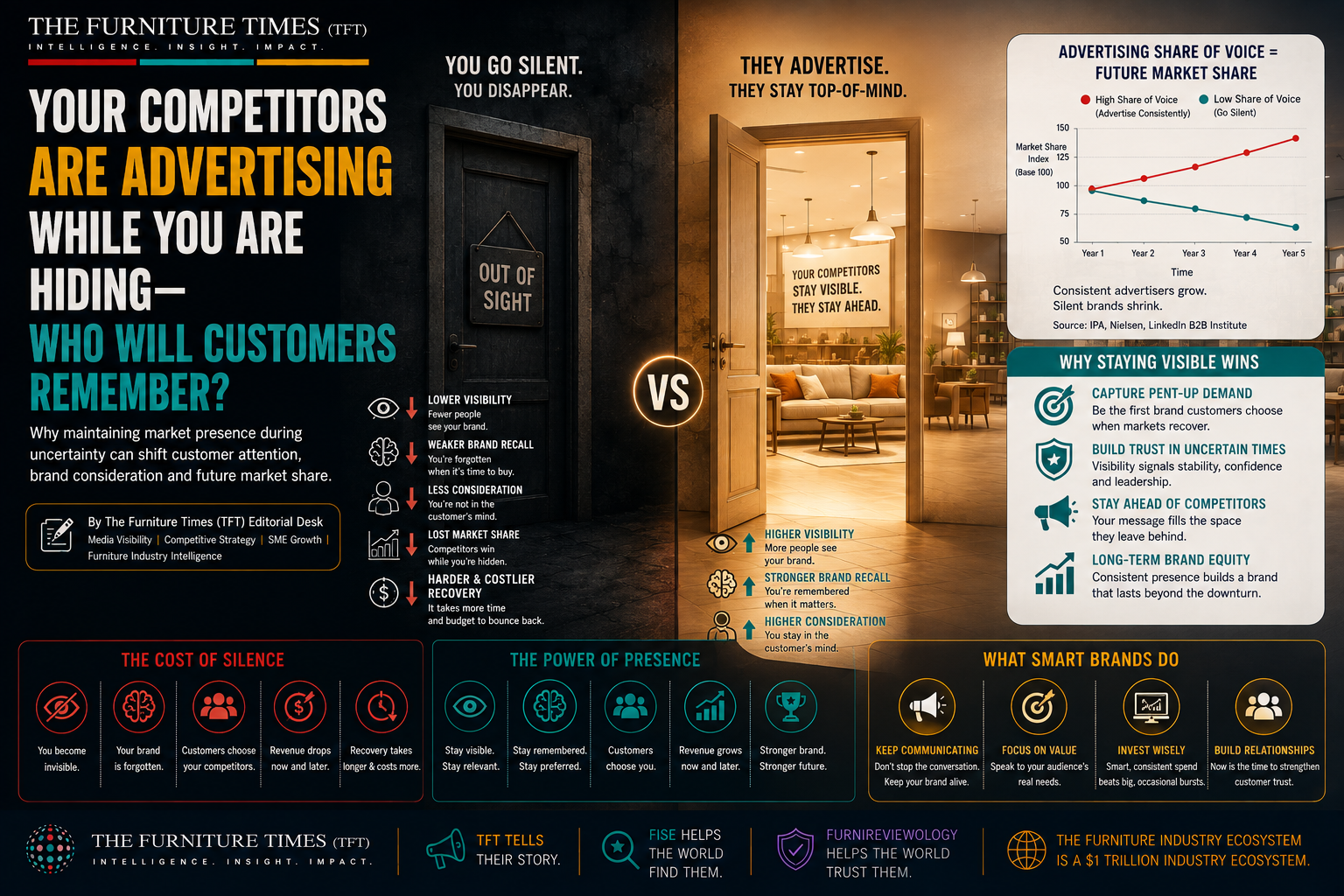
Your Competitors Are Advertising While You Are Hiding—Who Will Customers Remember?
Why maintaining market presence during uncertainty can shift customer attention, brand consideration and future market share
By The Furniture Times (TFT) Editorial Desk | Media Visibility | Competitive Strategy | SME Growth | Furniture Industry Intelligence
When markets become uncertain, many companies retreat.
They reduce advertising, postpone product launches, stop publishing news, cut search campaigns and wait for economic conditions to improve. Management describes this as caution, cost control or temporary protection of cash flow.
At the same time, a smaller group of competitors continues communicating.
These businesses remain visible in search results, publish useful content, update customers, collect reviews, announce genuine developments and advertise selectively around their strongest products and markets.
One company disappears. Another keeps appearing.
When customers are finally ready to purchase, which company are they more likely to remember?
The answer is rarely the company that remained silent.
This is the central competitive danger of reducing marketing without a visibility strategy. A business may save money in the short term while transferring customer attention to competitors. That attention can later become branded searches, website visits, enquiries, showroom appointments, distributor relationships and sales.
The problem is especially serious in the furniture industry, where customers do not purchase products every day. A consumer may research a sofa for weeks. A hotel may begin identifying suppliers months before releasing a tender. An office project can involve a lengthy process of consultation, budgeting and specification.
Brands must be visible before the final purchase decision—not only when they urgently need revenue.
01 — Customers Remember What They Encounter Repeatedly
Customer memory is not a permanent storage system.
People are exposed to thousands of brands, products and messages. They remember a limited number that are repeatedly connected with a need, category or experience.
A furniture brand can reinforce memory through:
- Advertising
- Search visibility
- News coverage
- Customer reviews
- Product demonstrations
- Social content
- Industry listings
- Showroom presence
- Trade exhibitions
- Email communication
- Recommendations
- AI-generated answers
When these signals disappear, the brand’s position in the customer’s mind can weaken.
The customer may still recognize the name when prompted but fail to recall it independently when considering a purchase.
That difference between recognition and recall is commercially significant.
Recognition means, “I have seen this company before.”
Recall means, “This is one of the companies I should consider.”
Companies need both, but recall places the brand inside the active buying decision.
02 — The Market Does Not Wait for Your Return
A company may pause advertising and assume it can return whenever conditions improve.
However, competitors do not pause their ambitions.
While one company waits, another may:
- Capture search positions
- Grow its email database
- Collect recent reviews
- Establish media relationships
- Introduce new collections
- Expand into new cities
- Strengthen distributor partnerships
- Improve product information
- Become visible to AI systems
- Build customer confidence
When the silent company returns, it does not return to the same competitive environment it left.
It may find that other brands have occupied its former position.
The market continued moving during its absence.
03 — Silence Transfers Attention to Competitors
Customer attention is limited.
If several companies normally compete for visibility and most reduce their activity, the remaining advertisers can receive a larger relative share of attention.
This does not necessarily require them to double their spending. They may gain simply by maintaining consistent activity while others disappear.
This is the strategic importance of share of voice.
Share of voice broadly describes the proportion of market visibility held by a brand compared with its competitors. It can include paid advertising, media coverage, search presence and other forms of communication.
WARC defines “excess share of voice” as a situation where a brand’s share of advertising visibility exceeds its share of the market. Historical marketing evidence has associated this condition with stronger long-term growth potential. WARC’s marketing-effectiveness glossary
The principle should not be interpreted as a guaranteed formula. Greater visibility cannot repair bad products, weak service or poor fulfillment. But when competing companies offer reasonably comparable value, the more visible and trusted brand is more likely to be considered.
04 — Competitors Can Gain Market Share Without Winning Every Customer
Market share does not shift only through dramatic product breakthroughs or aggressive pricing.
It can move gradually, one customer decision at a time.
A competitor may gain because:
- Its advertisement appeared during the research stage.
- Its article answered a customer’s question.
- Its showroom was easier to find.
- Its reviews were more recent.
- Its product details were clearer.
- Its company news suggested stability.
- Its sales team responded faster.
- Its brand appeared in an AI-generated recommendation.
None of these advantages alone may seem decisive. Together, they can change the customer’s shortlist.
The competitor does not need to win the entire market. It only needs to capture some of the opportunities that a silent company failed to pursue.
05 — Hard Times Make Customers More Careful
During uncertain periods, customers often become more cautious—not completely inactive.
They may:
- Delay purchases
- Compare more brands
- Search for better value
- Read additional reviews
- Investigate warranties
- Ask more questions
- Negotiate prices
- Prefer reliable suppliers
- Avoid unfamiliar companies
- Demand clearer delivery commitments
This means the buying journey can become longer and more research-intensive.
A company that stops advertising because customers are “not buying” misunderstands the situation. Many customers may still be researching, comparing and preparing.
When demand eventually converts into a purchase, the brands visible during the research period possess an advantage.
06 — Furniture Purchases Have Long Decision Cycles
Furniture is usually a considered purchase.
A household may spend weeks comparing:
- Dimensions
- Materials
- Colors
- Comfort
- Delivery
- Warranty
- Customer reviews
- Price
- Maintenance
- Brand reputation
Commercial purchases can take even longer. Hospitality, office, educational and institutional furniture may involve:
- Budget approval
- Design development
- Product specification
- Tendering
- Sample evaluation
- Supplier verification
- Contract negotiation
- Production
- Installation planning
The company that begins advertising only after a tender is issued may already be behind. Other suppliers may have built awareness and relationships months earlier.
Marketing should support the entire decision cycle, not only the final transaction.
07 — Visibility Makes Sales Conversations Easier
A salesperson contacting a prospect from a visible brand begins with some familiarity.
The buyer may have:
- Seen the company’s advertisement
- Read a press release
- Visited its website
- Encountered customer reviews
- Viewed a product demonstration
- Seen the company at an exhibition
- Found it through an industry platform
This familiarity does not guarantee a sale, but it reduces the burden of introducing an unknown business.
A salesperson representing an invisible company must explain:
- Who the company is
- Whether it is legitimate
- What it produces
- Why it is different
- Who already trusts it
- Whether it can fulfill the order
- Why the buyer should respond
Marketing gives salespeople a warmer starting point.
When advertising is cut, management may save money in one department while making every sales conversation more expensive and difficult.
08 — Search Advertising Captures Existing Demand
Search advertising is particularly important because it can reach customers who are actively expressing a need.
A person searching for “outdoor furniture showroom Kuala Lumpur” or “hotel furniture supplier Malaysia” is not being interrupted randomly. The person is looking for a relevant business.
If one company stops search advertising while competitors remain active, those competitors can appear at the precise moment of demand.
This does not mean every company should bid on every keyword. Search campaigns must be controlled according to:
- Product availability
- Geographic service area
- Profit margin
- Customer intent
- Conversion history
- Competition
- Sales capacity
The objective is not maximum traffic. It is commercially relevant visibility.
09 — Organic Visibility Also Requires Maintenance
Paid advertising can be turned on or off quickly. Organic search visibility usually develops more slowly.
Furniture companies can strengthen organic discovery through:
- Complete product pages
- Category descriptions
- Local showroom pages
- Buying guides
- Company news
- Technical information
- Authentic reviews
- Useful photographs
- Structured product data
- Industry listings
A company that stops advertising and neglects these assets may lose visibility across both paid and organic channels.
Meanwhile, active competitors continue improving the information search engines and customers use to evaluate the market.
10 — AI Is Becoming a New Competitive Battlefield
In 2026, customers increasingly use AI assistants to research purchases and identify brands.
They may ask:
- Which furniture brands offer the best value?
- Who manufactures sustainable office furniture?
- Where can I buy weather-resistant outdoor furniture?
- Which furniture companies offer reliable warranties?
- What brands are suitable for hotel projects?
- Which retailers have positive customer reviews?
AI-generated recommendations depend on accessible information.
A company that maintains:
- Current product data
- Detailed specifications
- News coverage
- Business listings
- Customer reviews
- Clear policies
- Independent references
- Useful educational content
is easier for AI systems to understand than a company with limited or outdated information.
The silent brand may not merely lose advertising visibility. It may disappear from the next generation of product discovery.
11 — Advertising Signals That the Company Is Active
Customers do not have direct access to a company’s internal operations.
They rely on external signals.
Consistent communication can indicate that the business is:
- Operating
- Investing
- Serving customers
- Launching products
- Entering markets
- Supporting distributors
- Responding to change
Silence can create uncertainty, especially if the website, social profiles and product catalog also become outdated.
Customers may wonder whether the company will remain available after the purchase. This is particularly important for furniture, where warranty, service and replacement parts may be required years later.
Advertising is not proof of financial strength, but continued, credible communication can reassure the market that the company remains engaged.
12 — Competitors Can Become the Category Authority
Advertising is not limited to promotional campaigns.
Brands build authority by publishing knowledge.
A furniture company may create content about:
- Material selection
- Product maintenance
- Ergonomic design
- Compact living
- Outdoor durability
- Sustainable sourcing
- Hospitality specifications
- Furniture logistics
- Workplace planning
- Product safety
If one company stops publishing while a competitor consistently answers industry questions, the competitor may become recognized as the category expert.
That authority can influence:
- Search rankings
- Media invitations
- Customer trust
- Distributor interest
- AI citations
- Commercial enquiries
The visible competitor becomes the voice explaining the market.
13 — News Coverage Builds Credibility Beyond Advertising
Advertising tells customers what the company wants to say.
News coverage and industry features can provide additional credibility because the information appears within a broader editorial environment.
Genuine news may include:
- Factory expansion
- Product innovation
- Export milestones
- Certifications
- Sustainability initiatives
- Partnerships
- New showrooms
- Research findings
- Community programs
- Leadership appointments
Press releases can document these developments and provide media with verified information.
When a company stops publishing news, competitors gain more opportunities to define the direction of the industry.
14 — Recent Reviews Influence Modern Buyers
Customer reviews reduce uncertainty.
People use reviews to evaluate:
- Product quality
- Delivery
- Assembly
- Customer service
- Comfort
- Durability
- Warranty handling
- Value
A brand with recent and detailed reviews appears active and relevant. A company whose latest review is several years old may create doubt.
Competitors that actively request honest feedback can build a growing body of trust evidence.
Review strategy should never involve fabricated or purchased ratings. Authenticity is essential.
FurniReviewology can support the wider furniture ecosystem by helping customers identify credible experiences and compare brands more transparently.
15 — Visible Brands Often Retain Pricing Power
Customers are more willing to pay for a product when they understand its value.
Advertising helps explain:
- Material quality
- Construction
- Product life
- Warranty
- Design
- Customization
- Repairability
- Customer support
When a brand becomes invisible, customers may struggle to distinguish its products from cheaper alternatives.
The company can then become increasingly dependent on discounts.
Google’s research into profitable growth states that reducing marketing investment can weaken differentiation, increase price sensitivity and damage long-term profitability. Google’s Unlocking Profitable Growth report
Visible competitors can continue communicating value while silent businesses are forced to defend price.
16 — Competitors Can Recruit Your Distributors
Retailers and distributors prefer brands that support them.
They want manufacturers that create customer interest, provide marketing materials, generate enquiries and maintain a strong reputation.
When a manufacturer stops advertising, dealers may need to work harder to sell its products.
A competing supplier that remains active may offer:
- Better product content
- Local advertising
- Dealer leads
- Showroom support
- Training
- Digital assets
- News coverage
- Customer demand
Over time, distributors can shift attention and showroom space toward the brand helping them generate sales.
Advertising is therefore not only customer-facing. It supports the entire channel network.
17 — Competitors Can Recruit Your Employees
Brand visibility also influences talent.
Skilled designers, salespeople, engineers, marketers and managers often want to join companies that appear active, ambitious and relevant.
If one company disappears from public view while another communicates innovation, growth and purpose, potential employees may prefer the visible organization.
Silence can affect:
- Recruitment
- Employee confidence
- Industry reputation
- Leadership credibility
- Partnership opportunities
A company’s public identity matters to more than customers.
18 — Competitors Can Gain Better Media Opportunities
Journalists and publications need credible sources, data and industry voices.
Businesses that regularly provide:
- Expert commentary
- Market insights
- New developments
- Original research
- Product information
- Responsive spokespeople
are more likely to become part of the media’s source network.
When a company goes silent, editors and journalists look elsewhere.
The competitor becomes easier to contact, quote and feature. Each appearance strengthens that brand’s authority and search presence.
Media relationships are cumulative. They cannot always be reactivated instantly after years of silence.
19 — Competitors Learn Faster
Advertising generates information.
Campaigns can reveal:
- Which products attract interest
- Which locations generate demand
- Which messages perform well
- Which customer concerns appear repeatedly
- Which categories are growing
- Which price levels receive responses
A company that stops advertising also reduces the flow of market feedback.
Active competitors continue testing, learning and improving. By the time the silent company returns, rivals may understand the customer more deeply.
Advertising should therefore be considered not only a communication expense but also a market-learning tool.
20 — Staying Visible Does Not Mean Spending Recklessly
Maintaining market presence does not require preserving every campaign.
Businesses should reduce or stop activity that:
- Targets the wrong audience
- Promotes unavailable products
- Produces poor-quality leads
- Uses outdated creative material
- Cannot be measured
- Damages customer trust
- Has no connection with business priorities
The objective is strategic continuity.
A company can maintain visibility by concentrating on:
- Best-performing products
- Profitable regions
- High-intent searches
- Existing customers
- Strong content
- Local search
- Reviews
- Genuine news
- Distributor communication
- Retargeting
The correct response to uncertainty is not uncontrolled spending. It is disciplined visibility.
21 — A Minimum Market-Presence Strategy
Companies facing budget pressure can protect the following areas.
Maintain accurate business information
Keep addresses, contact details, opening hours and service areas current.
Protect branded search
Customers specifically searching for the company should find accurate and credible information.
Focus on high-intent categories
Prioritize searches and audiences closest to a commercial decision.
Communicate with past customers
Existing relationships can provide repeat purchases, referrals and reviews.
Publish useful content
Answer questions customers ask during difficult buying decisions.
Continue genuine news communication
Document important business developments through press releases and articles.
Maintain review activity
Encourage honest customer feedback and respond professionally.
Update product data
Accurate specifications support customers, search engines and AI systems.
22 — Messaging Must Reflect Economic Reality
A company should not continue using the same message when customer priorities have changed.
During uncertain periods, furniture buyers may focus on:
- Durability
- Affordability
- Total cost of ownership
- Repairability
- Warranty
- Multifunctionality
- Space efficiency
- Delivery reliability
- Low maintenance
- Long-term value
Businesses should communicate confidence without appearing disconnected from customer pressure.
The best advertising during difficult conditions helps customers make safer decisions.
23 — Do Not Confuse Visibility With Noise
Customers do not remember brands merely because those brands publish constantly.
Excessive, repetitive and irrelevant communication can create fatigue.
Effective visibility requires:
- Clear positioning
- Relevant information
- Consistent identity
- Useful content
- Appropriate frequency
- Honest claims
- Professional presentation
The goal is not to say more than every competitor. It is to communicate more meaningfully.
24 — Measure Attention That Can Become Revenue
Visibility campaigns should be connected to business outcomes.
Furniture companies can track:
- Branded searches
- Website visitors
- Product-page engagement
- Calls
- Messages
- Showroom appointments
- Quotation requests
- Sample requests
- Distributor enquiries
- Trade leads
- Sales
- Repeat purchases
- Media coverage
- Review growth
- AI referrals where identifiable
Not every advertising exposure converts immediately. Some activities support awareness, while others capture active demand.
Management should understand both roles.
25 — A 90-Day Competitive Visibility Plan
Days 01–15: Audit
- Review competitor advertising
- Search for priority products
- Test AI recommendations
- Inspect website information
- Analyze customer enquiries
- Identify profitable categories
- Check business listings and reviews
Days 16–30: Prioritize
- Define the minimum visibility budget
- Select high-intent customer groups
- Protect strongest products
- Improve key landing pages
- Update product specifications
- Prepare relevant messages
Days 31–60: Activate
- Launch focused search campaigns
- Publish useful content
- Distribute genuine company news
- Contact existing customers
- Request authentic reviews
- Retarget interested visitors
- Support distributors
Days 61–90: Optimize
- Measure enquiries and sales
- Review lead quality
- Compare channel performance
- Stop wasteful placements
- Increase effective activities carefully
- Prepare the next quarter’s content and news
26 — Who Will Customers Remember?
Customers are most likely to remember brands that remain:
- Visible
- Relevant
- Useful
- Consistent
- Trustworthy
- Easy to find
- Easy to understand
- Responsive
- Supported by evidence
A company cannot control every economic condition. It can control whether the market continues hearing from it.
If competitors keep communicating while your company disappears, they are not simply spending money. They are building familiarity, authority and future consideration.
They are preparing to receive the demand that returns.
Final Analysis: Hiding Is Also a Competitive Decision
Businesses often describe reduced advertising as “doing nothing.”
It is not doing nothing.
It is making a competitive decision to leave more customer attention available to others.
That decision may be necessary when a company faces immediate financial danger. Solvency, payroll, safety, quality and essential operations must come first.
But companies should understand the full consequences before becoming completely silent.
A brand that withdraws may lose:
- Customer memory
- Search visibility
- Distributor confidence
- Media relationships
- Review momentum
- Pricing power
- Sales efficiency
- AI discoverability
- Future market share
Meanwhile, competitors that stay visible can gain these advantages.
The winning company is not necessarily the one with the biggest advertising budget. It is often the company that communicates consistently, targets carefully and remains useful when others become fearful.
Customers cannot remember every brand.
They remember the companies that continue giving them reasons to remember.
Key Takeaways
01 — Customer attention does not remain empty when one brand disappears.
02 — Competitors can gain relative share of voice without dramatically increasing spending.
03 — Furniture brands must remain visible throughout long buying cycles.
04 — Marketing creates familiarity that makes sales conversations easier.
05 — Search and AI visibility depend on current, accessible information.
06 — Active communication can reassure customers and distributors.
07 — News coverage, content and authentic reviews reinforce paid advertising.
08 — Silent brands may become more dependent on discounts.
09 — Hard times require better targeting, not automatic disappearance.
10 — The businesses customers remember today may capture the demand that returns tomorrow.
The Furniture Times (TFT) & Furniture Industry Search Engine (FISE)
“TFT tells their story. FISE helps the world find them.”
FurniReviewology helps the world trust them.
The furniture industry ecosystem is a $1 trillion industry ecosystem.