
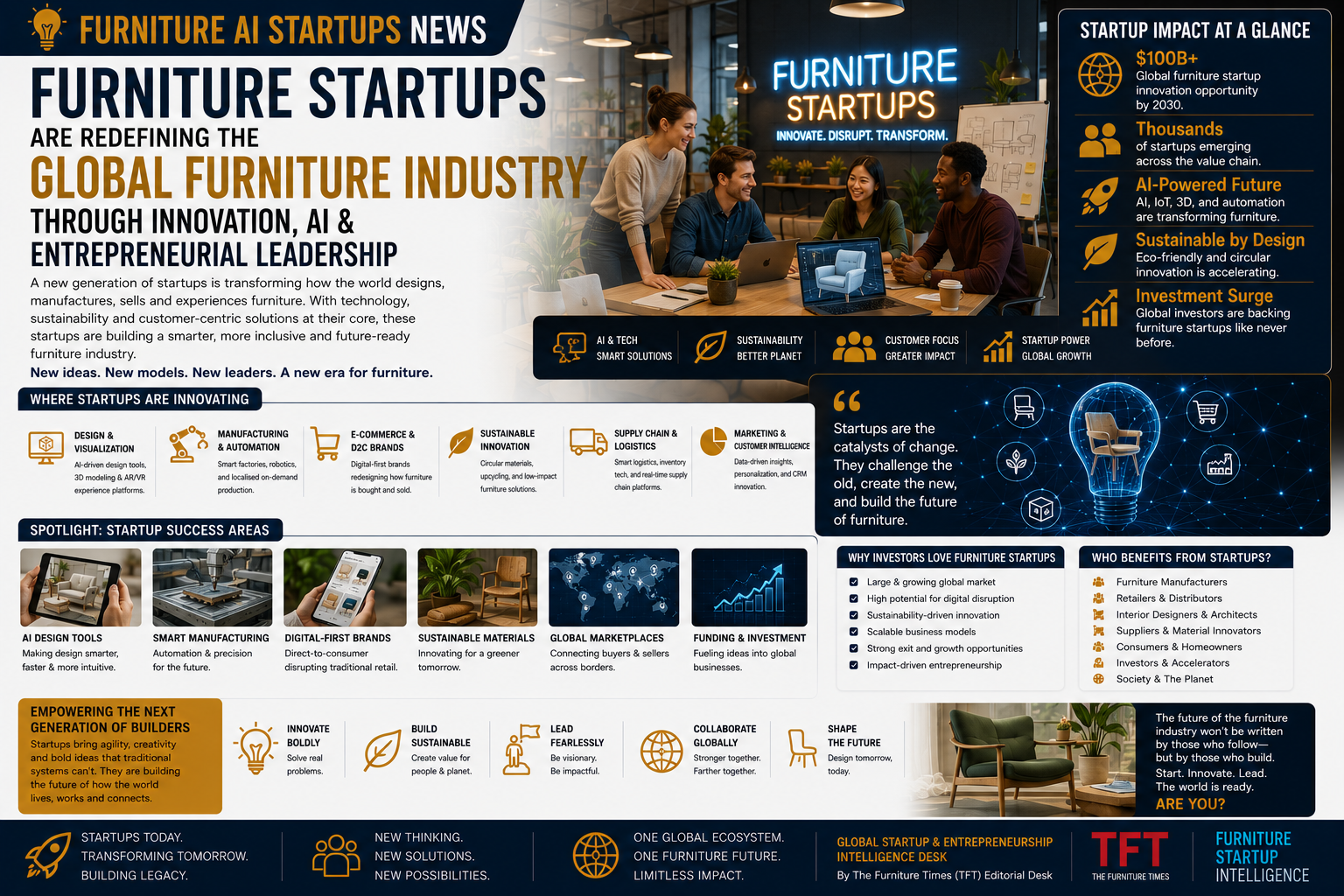
Furniture Startups Are Redefining the Global Furniture Industry Through Innovation, AI & Entrepreneurial Leadership
Global Startup & Entrepreneurship Intelligence Desk
By The Furniture Times (TFT) Editorial Desk
Executive Summary
The global furniture industry is witnessing the rise of a new generation of entrepreneurs.
Unlike traditional furniture businesses that focused primarily on manufacturing and retail, today’s startups are combining Artificial Intelligence (AI), digital technology, sustainability, e-commerce, smart manufacturing and data-driven innovation to create entirely new business models.
Furniture startups are no longer competing only by producing better products.
They are building platforms, ecosystems and intelligent services that solve long-standing industry challenges.
Across the world, startups are transforming:
- Furniture manufacturing
- Interior design
- E-commerce
- Logistics
- Rental furniture
- Circular economy
- Smart furniture
- AI-powered design
- Digital sourcing
- Supply chain technology
Industry trends indicate growing investment in AI, customization, modular design and digital transformation across the furniture sector, creating fertile conditions for startup innovation.
According to The Furniture Times (TFT), the next billion-dollar furniture companies may not emerge from traditional business models.
They will emerge from startups that combine innovation, technology and customer-first thinking.
The Rise of Furniture Entrepreneurship
Furniture startups are changing how the industry thinks.
Instead of asking:
“How do we manufacture more furniture?”
They ask:
- How do we simplify furniture buying?
- How do we personalise every product?
- How do we eliminate waste?
- How do we improve logistics?
- How do we use AI to make better decisions?
- How do we create smarter customer experiences?
Innovation begins by solving problems.
Why Furniture Startups Matter
Startups bring:
- Fresh ideas
- Faster innovation
- New technologies
- Modern business models
- Digital-first thinking
- Global scalability
- Customer-focused solutions
They often move faster than established businesses because they are built around adaptability.
AI Is Becoming the Startup Advantage
Artificial Intelligence enables startups to:
Generate furniture designs.
Recommend products.
Forecast demand.
Automate customer service.
Improve manufacturing.
Personalise shopping experiences.
Optimise inventory.
Analyse customer behaviour.
AI allows smaller businesses to compete with much larger organisations.
Digital-First Business Models
Modern furniture startups increasingly operate through:
Online marketplaces.
Direct-to-consumer platforms.
Digital catalogues.
Virtual showrooms.
Mobile applications.
Subscription services.
Cloud-based collaboration.
Digital operations reduce costs while increasing global reach.
Personalisation Is Driving Innovation
Consumers increasingly expect furniture made for them.
Startups respond through:
Made-to-order production.
Custom dimensions.
Material selection.
Colour personalisation.
Modular configurations.
Online configuration tools.
Companies using digital configuration and 3D visualisation are helping customers personalise furniture before purchase.
Circular Economy Startups Are Growing
Many new businesses focus on:
Furniture rental.
Furniture refurbishment.
Second-hand marketplaces.
Repair services.
Recycling.
Product subscription.
Circular economy models extend product life while reducing waste.
Smart Furniture Is Becoming a Startup Opportunity
Innovation areas include:
Smart office furniture.
Connected home furniture.
Health-monitoring seating.
Wireless charging furniture.
Adaptive workstations.
IoT-enabled products.
Technology is creating entirely new product categories.
Furniture Technology Startups
Emerging companies are developing solutions for:
Manufacturing software.
ERP systems.
CAD/CAM platforms.
Factory automation.
Warehouse management.
AI analytics.
Supply chain optimisation.
Digital technology is becoming an industry in itself.
Logistics Innovation
Furniture startups are improving:
Last-mile delivery.
Warehouse automation.
Route optimisation.
Shipment tracking.
Cross-border logistics.
Installation management.
Efficient logistics improves customer satisfaction while reducing operational costs.
Sustainability Creates New Businesses
Entrepreneurs increasingly develop solutions involving:
Responsible materials.
Recycled products.
Green manufacturing.
Carbon reduction.
Eco-packaging.
Renewable resources.
Sustainability continues creating opportunities for innovation.
Global Opportunities for Furniture Startups
Growing opportunities exist in:
Home furniture.
Office furniture.
Hospitality furniture.
Healthcare furniture.
Educational furniture.
Outdoor furniture.
Luxury interiors.
Smart homes.
Digital commerce.
Business-to-business platforms.
The furniture ecosystem offers numerous underserved markets.
Funding Is Becoming More Accessible
Furniture startups increasingly attract:
Angel investors.
Venture capital.
Private equity.
Government innovation grants.
Accelerator programmes.
Strategic partnerships.
Investors are showing growing interest in businesses that combine manufacturing with technology and scalable digital solutions.
SMEs Can Become Global Startups
Technology allows small businesses to scale internationally.
Through:
Digital marketing.
AI.
SEO.
E-commerce.
Cloud software.
Global logistics.
Virtual meetings.
Even small furniture companies can reach international customers.
The Future Startup Ecosystem
The next decade may produce startups focused on:
AI-powered furniture search.
Furniture tourism.
Furniture finance.
Smart logistics.
Furniture education.
Digital manufacturing.
Circular economy platforms.
Industry-specific marketplaces.
These opportunities extend well beyond traditional furniture production.
The Furniture Times Analysis
The furniture industry is entering an entrepreneurial era.
Tomorrow’s industry leaders may not begin as the largest manufacturers.
They may begin as innovative startups solving industry problems through:
Technology.
Creativity.
Customer understanding.
Digital transformation.
Sustainability.
Entrepreneurship has become one of the industry’s strongest growth drivers.
Final Verdict
The future of the furniture industry belongs to innovators willing to challenge traditional business models.
Furniture startups have the opportunity to transform:
Manufacturing.
Retail.
Design.
Logistics.
Artificial Intelligence.
Sustainability.
Customer experience.
Global trade.
The companies that succeed will not simply manufacture furniture.
They will build intelligent businesses that connect people, technology and ideas.
Because every global furniture brand once started as a single idea.
The next breakthrough company may already be building the future today.
By The Furniture Times (TFT) Editorial Desk
Global Startup & Entrepreneurship Intelligence Desk | July 2026
“TFT tells their story. FISE helps the world find them.”
The furniture industry ecosystem is a $1 Trillion Dollar Industry.
