
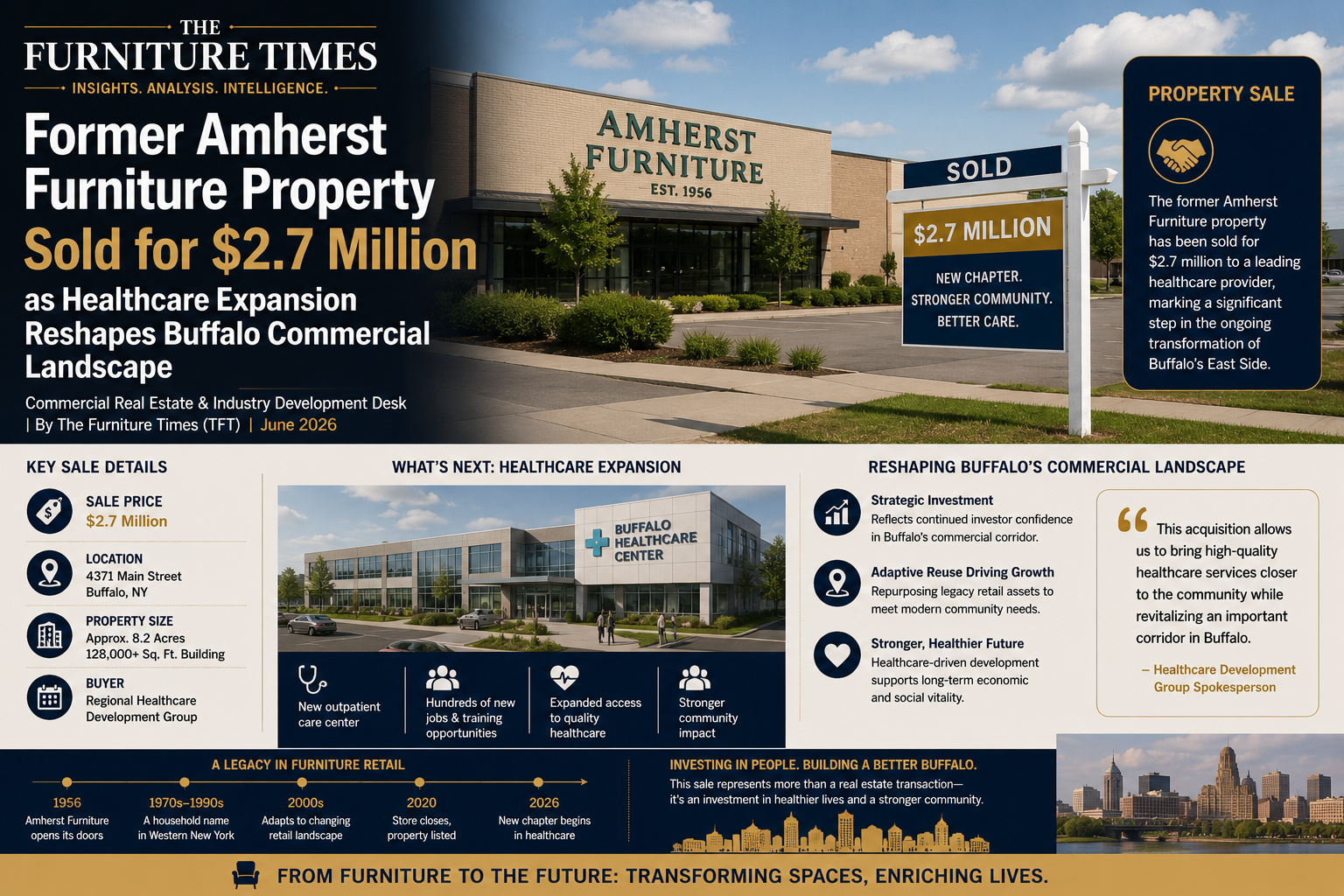
Former Amherst Furniture Property Sold for $2.7 Million as Healthcare Expansion Reshapes Buffalo Commercial Landscape
Commercial Real Estate & Industry Development Desk | By The Furniture Times (TFT) | June 2026
A significant chapter in Western New York’s furniture retail landscape has officially come to an end following the sale of the former Amherst Furniture property for approximately $2.7 million. The acquisition by Excelsior Orthopaedics, one of the region’s leading orthopedic healthcare providers, signals a growing trend in which former retail spaces are being repurposed to support expanding healthcare infrastructure and evolving community needs.
The transaction represents more than a real estate sale. It reflects the ongoing transformation of commercial property markets across North America, where changing consumer behavior, retail consolidation, and healthcare expansion are reshaping the use of prime commercial locations.
For the furniture industry, the sale also marks the conclusion of another longstanding furniture retail site, illustrating how commercial real estate once dedicated to furniture sales is increasingly finding new purposes in today’s economy.
From Furniture Retail to Healthcare Services
The Amherst Furniture location had long been recognized as part of the local retail landscape, serving consumers seeking home furnishings and interior solutions.
Like many independent and regional furniture retailers across the United States, furniture businesses have faced substantial changes over the past decade due to:
- E-commerce growth
- Online furniture marketplaces
- Changing consumer purchasing habits
- Rising operational costs
- Supply chain disruptions
- Increased competition from national brands
These forces have contributed to a growing number of retail property transitions throughout North America.
The acquisition by Excelsior Orthopaedics demonstrates how healthcare providers are increasingly becoming major occupiers of commercial real estate previously used by traditional retailers.
Healthcare Expansion Continues Across the United States
Healthcare organizations nationwide are investing heavily in expanded facilities to meet growing patient demand.
Several factors are driving this expansion:
Aging Population
Growing healthcare needs among aging populations continue increasing demand for specialized medical services.
Outpatient Care Growth
Modern healthcare increasingly focuses on outpatient treatment centers rather than traditional hospital-based care.
Patient Accessibility
Healthcare providers seek locations closer to residential communities and commercial centers to improve patient convenience.
Population Growth
Expanding suburban populations continue creating demand for additional healthcare facilities.
As a result, former retail locations often become attractive opportunities due to:
- Established infrastructure
- Accessible locations
- Existing parking facilities
- Strong transportation connectivity
- High visibility
Commercial Real Estate Is Evolving
The sale highlights broader changes occurring throughout commercial real estate markets.
Historically, furniture retailers occupied some of the largest showroom spaces in commercial corridors. Their requirements for:
- Large floor areas
- Customer parking
- Visibility
- Accessibility
made them ideal tenants for major retail districts.
Today, many healthcare providers require similar characteristics, creating opportunities for adaptive property reuse.
Industry analysts note that healthcare organizations are becoming increasingly active buyers of former retail assets as they seek strategically located facilities capable of serving growing patient populations.
What This Means for the Furniture Industry
The transition of furniture properties into alternative uses reflects the ongoing evolution of furniture retail.
While furniture remains a substantial global industry, retail operations are changing significantly.
Today’s furniture businesses increasingly rely upon:
- Digital showrooms
- Online product discovery
- Omnichannel sales strategies
- Warehouse-based fulfillment
- Virtual design consultations
- Direct-to-consumer models
As these trends continue, some traditional large-format furniture retail spaces may experience redevelopment or repurposing.
However, industry experts emphasize that furniture retail is not disappearing—it is evolving.
Consumers continue purchasing furniture, but their buying journeys increasingly begin online before they visit physical locations.
Economic Impact on the Region
The acquisition is expected to generate positive economic activity through:
- Healthcare investment
- Facility upgrades
- Construction and renovation work
- Job creation
- Expanded medical services
- Increased community accessibility
For local residents, the project may improve access to specialized orthopedic care while simultaneously bringing new life to an existing commercial property.
TFT Industry Analysis
At The Furniture Times, the sale of the former Amherst Furniture property represents a broader story about adaptation.
The commercial spaces of yesterday are becoming the strategic assets of tomorrow.
Across the furniture industry, businesses are rethinking how they use retail space, engage customers, and deliver products.
Meanwhile, healthcare providers continue expanding their physical footprints to meet growing demand for medical services.
The intersection of these two trends is creating a new commercial landscape where former furniture stores increasingly become healthcare centers, logistics hubs, mixed-use developments, or community facilities.
Looking Ahead
The $2.7 million acquisition of the former Amherst Furniture property by Excelsior Orthopaedics is more than a local real estate transaction.
It reflects changing consumer habits, evolving retail strategies, growing healthcare demand, and the adaptive reuse of commercial assets.
For the furniture industry, it serves as another reminder that while products remain essential, the future of furniture retail will increasingly depend on flexibility, digital engagement, and strategic adaptation to changing market realities.
As healthcare and retail continue evolving, similar property transformations are expected to become increasingly common across North America.
By The Furniture Times (TFT)
Commercial Real Estate & Industry Development Desk
Bringing Furniture Brands Into Global Spotlight
