Warehouse Lighting for Industrial Efficiency
By The Furniture Times (TFT) | Indoor & Outdoor Lighting | Commercial & Hospitality Lighting
How Intelligent Warehouse Lighting Is Transforming Industrial Efficiency, Workplace Safety, Logistics Performance, Sustainability, and the Future of Global Supply Chains
Warehouses have become the backbone of the modern global economy. As e-commerce, international trade, manufacturing, retail distribution, and logistics continue to expand, warehouses are no longer simple storage facilities—they have evolved into highly sophisticated operational centres where automation, technology, inventory management, robotics, and data analytics work together to move products efficiently across global supply chains.
Whether serving furniture manufacturers, retail distributors, logistics companies, e-commerce giants, automotive industries, pharmaceutical firms, food processing facilities, or construction suppliers, warehouse performance directly influences customer satisfaction, delivery speed, operational costs, and business competitiveness.
One of the most important yet frequently underestimated factors supporting warehouse productivity is lighting.
Warehouse lighting has evolved far beyond illuminating storage racks and loading bays. Today, intelligent lighting systems improve employee safety, operational accuracy, inventory visibility, equipment performance, automation efficiency, sustainability, and overall warehouse productivity.
Powered by Artificial Intelligence (AI), Internet of Things (IoT), LED technology, smart sensors, industrial automation, warehouse management systems (WMS), digital twins, and sustainable engineering, modern warehouse lighting has become a strategic business investment that supports Industry 4.0 and the future of smart logistics.
For warehouse operators, logistics companies, manufacturers, furniture producers, commercial developers, architects, lighting manufacturers, facility managers, automation providers, and government infrastructure planners, intelligent lighting has become an essential element of operational excellence.
Warehouses Have Become Intelligent Logistics Hubs
Today’s warehouses perform far more than storage functions.
Modern facilities support:
- Inventory management
- Order fulfilment
- Cross-docking
- Manufacturing support
- Packaging
- Distribution
- Robotics
- Automated retrieval systems
- E-commerce logistics
- International trade
Lighting enables these complex operations to function safely, accurately, and efficiently.
Lighting Directly Impacts Operational Performance
Warehouse employees perform highly detailed tasks throughout the working day.
Proper lighting improves:
- Inventory identification
- Barcode scanning
- Product inspection
- Order picking
- Packing accuracy
- Equipment operation
- Forklift navigation
- Reading documentation
- Quality control
- Workplace productivity
Poor lighting can contribute to reduced visibility, slower workflows, increased fatigue, operational errors, and workplace accidents.
Lighting should therefore be viewed as an investment in operational performance rather than simply a utility expense.
Safety Begins with Proper Illumination
Warehouse environments contain moving vehicles, heavy equipment, elevated storage systems, and constant material handling.
Lighting plays a vital role in improving safety by supporting:
- Clear visibility
- Hazard identification
- Safe forklift operation
- Pedestrian movement
- Emergency evacuation
- Loading dock safety
- Staircase visibility
- Equipment maintenance
- Traffic management
- Security monitoring
Well-designed lighting reduces operational risks while creating safer workplaces.
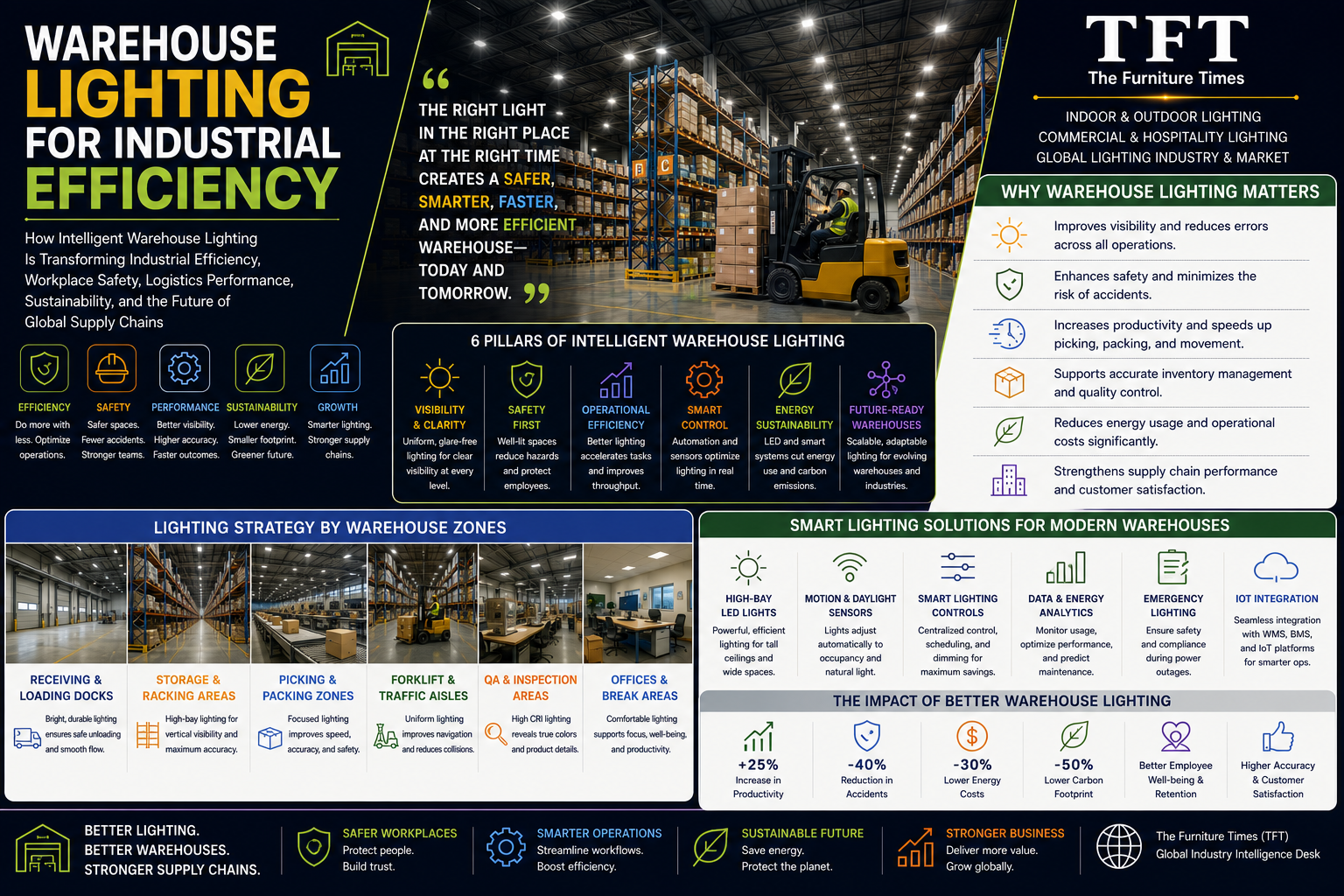
Different Warehouse Zones Require Different Lighting
Each operational area has unique lighting requirements.
Storage Areas
Lighting should provide:
- Uniform illumination
- High visibility
- Rack identification
- Product recognition
- Safe navigation
- Energy efficiency
- Flexible layouts
- Minimal glare
- Long operational life
- Smart control integration
Picking and Packing Zones
These areas require lighting that supports:
- Accuracy
- Speed
- Barcode readability
- Product inspection
- Label verification
- Packaging quality
- Employee comfort
- Continuous operation
- Reduced fatigue
- Workflow efficiency
Loading Docks
Loading areas benefit from lighting that enhances:
- Vehicle positioning
- Container loading
- Shipment verification
- Driver safety
- Equipment operation
- Outdoor visibility
- Security
- Weather adaptability
- Traffic flow
- Operational reliability
Quality Control Areas
Inspection stations require lighting with:
- Excellent colour rendering
- High brightness
- Precision visibility
- Surface inspection
- Defect identification
- Consistent illumination
- Adjustable controls
- Technical accuracy
- Reliable performance
- Comfortable working conditions
Layered Lighting Improves Industrial Operations
Professional warehouse designers implement layered lighting strategies.
Ambient Lighting
Ambient lighting provides consistent illumination throughout warehouse facilities.
Applications include:
- Storage aisles
- Distribution centres
- Corridors
- Packaging areas
- Maintenance workshops
- Administrative offices
- Employee facilities
- Break rooms
- Loading areas
- Equipment storage
Balanced ambient lighting supports efficient movement while reducing shadows.
Task Lighting
Task lighting assists employees during specialised operations.
Applications include:
- Inspection stations
- Maintenance benches
- Inventory counting
- Packing lines
- Technical repairs
- Documentation desks
- Assembly work
- Quality assurance
- Laboratory testing
- Shipping preparation
Proper task lighting improves operational precision.
Accent Lighting
Although less common, accent lighting supports:
- Safety signage
- Emergency exits
- Control rooms
- Reception areas
- Corporate branding
- Visitor pathways
- Training facilities
- Innovation centres
- Demonstration spaces
- Administrative entrances
Accent lighting contributes to orientation while reinforcing corporate identity.
LED Technology Powers Industrial Efficiency
LED lighting has become the global standard for warehouses.
Its advantages include:
- High energy efficiency
- Long operational lifespan
- Reduced maintenance
- Excellent brightness
- Low heat generation
- Instant start-up
- Smart automation compatibility
- Durable performance
- Lower operating costs
- Sustainable operation
LED systems reduce downtime while improving warehouse performance.
Smart Warehouses Depend on Intelligent Lighting
Artificial Intelligence and IoT technologies continue transforming industrial operations.
Smart lighting systems enable warehouses to:
- Detect occupancy.
- Automatically adjust brightness.
- Integrate with warehouse management systems.
- Monitor energy consumption.
- Coordinate with automated equipment.
- Support predictive maintenance.
- Improve inventory visibility.
- Enhance security.
- Reduce operational costs.
- Improve employee comfort.
Lighting has become an essential part of intelligent warehouse ecosystems.
Automation Requires Precision Lighting
Modern warehouses increasingly use:
- Autonomous mobile robots (AMRs)
- Automated guided vehicles (AGVs)
- Robotic picking systems
- Conveyor systems
- Automated storage and retrieval systems (AS/RS)
- AI-powered inventory management
- Smart sensors
- Digital scanning technologies
- Machine vision systems
- Real-time warehouse analytics
Reliable lighting improves the performance of automated technologies and vision-based systems.
Furniture and Industrial Lighting
Industrial furniture increasingly incorporates integrated lighting.
Applications include:
- Workbenches
- Packing stations
- Tool storage
- Maintenance cabinets
- Inspection tables
- Operator workstations
- Control centres
- Administrative desks
- Training facilities
- Warehouse offices
Integrated lighting improves functionality while enhancing workplace organisation.
Furniture manufacturers continue developing industrial solutions that combine ergonomics with intelligent lighting.
Sustainability Drives Warehouse Investment
Warehouse operators increasingly prioritise environmentally responsible lighting systems.
Key initiatives include:
- Energy-efficient LEDs
- Occupancy sensors
- Daylight harvesting
- Renewable energy integration
- Smart energy monitoring
- Sustainable manufacturing
- Recyclable materials
- Green warehouse certifications
- Carbon reduction strategies
- Responsible sourcing
Sustainable lighting reduces both operational expenses and environmental impact.
Artificial Intelligence Will Shape the Warehouse of Tomorrow
Future warehouse lighting systems may automatically:
- Adapt to operational schedules.
- Coordinate with robotic systems.
- Personalise work zones.
- Optimise inventory visibility.
- Predict maintenance requirements.
- Improve energy management.
- Enhance worker safety.
- Integrate with autonomous vehicles.
- Support digital twins.
- Connect with complete Industry 4.0 ecosystems.
Artificial Intelligence will transform lighting into an intelligent logistics management platform.
Opportunities Across the Industrial Sector
The continued expansion of manufacturing and logistics creates opportunities for:
- Warehouse operators
- Logistics providers
- Furniture manufacturers
- Lighting companies
- Architects
- Industrial developers
- Smart automation providers
- Technology companies
- Sustainability consultants
- Commercial infrastructure investors
Businesses capable of combining automation, intelligent lighting, operational efficiency, and sustainable industrial design will lead the future logistics market.
Challenges Facing Warehouse Lighting
Despite rapid innovation, warehouse operators continue addressing:
- Rising energy costs
- Installation complexity
- Smart system interoperability
- Cybersecurity
- Product standardisation
- Maintenance planning
- Skilled workforce shortages
- Technology integration
- Sustainability compliance
- Budget management
Addressing these challenges will strengthen long-term industrial competitiveness.
Lighting the Future of Global Logistics
Warehouse lighting has become one of the most valuable investments in modern industrial infrastructure.
It improves operational efficiency, strengthens workplace safety, supports automation, enhances inventory management, reduces operational costs, contributes to sustainability, and enables smarter supply chains.
From AI-powered automation and intelligent LED systems to integrated industrial furniture, adaptive warehouse environments, robotic operations, and Industry 4.0 technologies, lighting continues transforming warehouses into intelligent logistics centres.
For warehouse operators, manufacturers, furniture companies, architects, lighting providers, automation specialists, commercial developers, and policymakers, the opportunity lies in creating facilities where every lighting decision improves productivity, safety, and operational excellence.
The warehouses of tomorrow will not simply store products.
They will become intelligent logistics ecosystems where technology, automation, sustainability, furniture, and lighting work together to deliver faster, safer, and more efficient global supply chains.
As industrial development continues accelerating worldwide, one reality has become increasingly clear: efficient warehouses are built not only with automation and inventory systems—but with intelligent lighting that powers every operation from receiving to final delivery.