
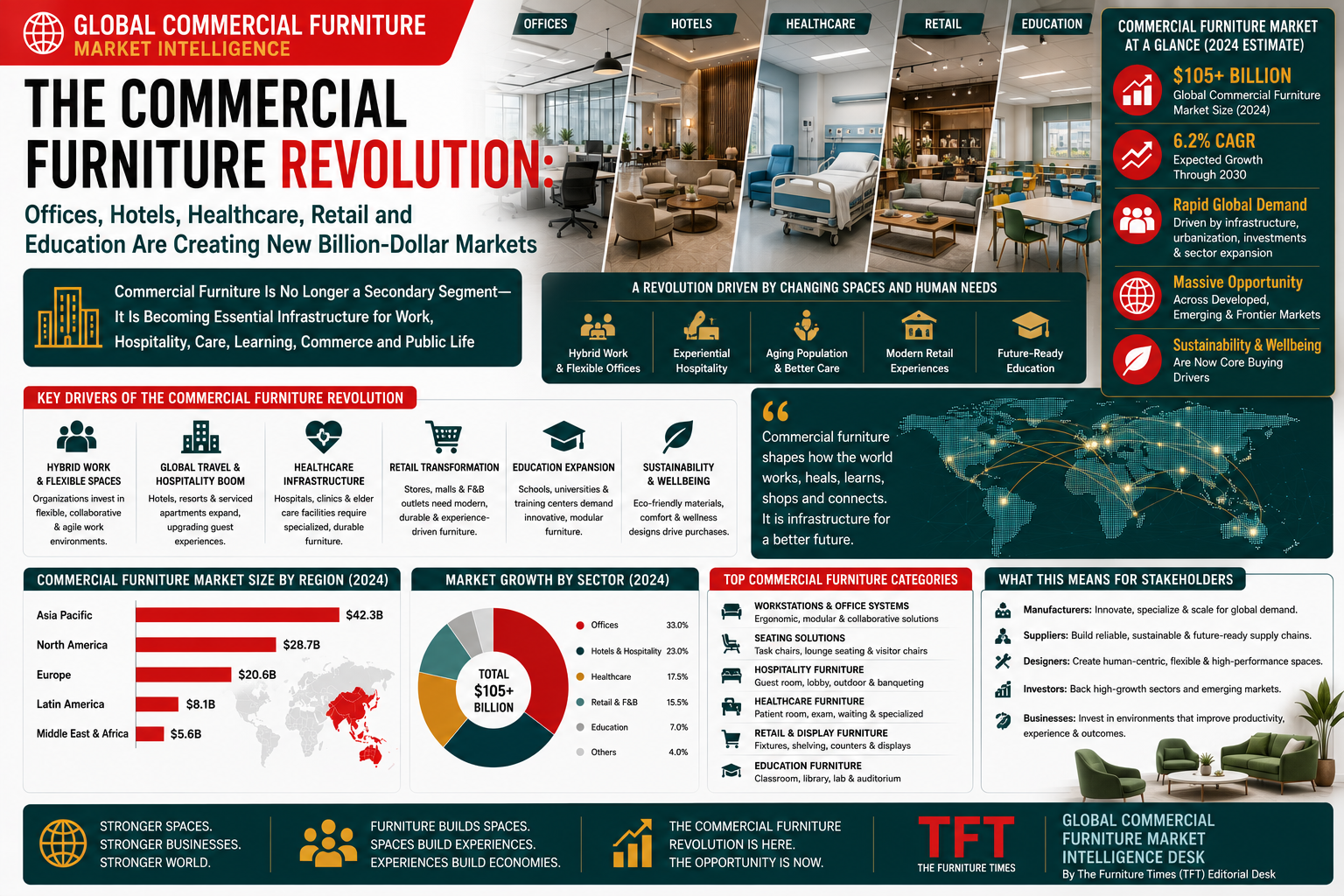
The Commercial Furniture Revolution: Offices, Hotels, Healthcare, Retail and Education Are Creating New Billion-Dollar Markets
Commercial Furniture Is No Longer a Secondary Segment—It Is Becoming Essential Infrastructure for Work, Hospitality, Care, Learning, Commerce and Public Life
Global Commercial Furniture Market Intelligence Desk
By The Furniture Times (TFT) Editorial Desk
Commercial furniture is undergoing a global transformation.
Offices are being redesigned for hybrid work and employee wellbeing. Hotels are investing in more distinctive guest experiences. Hospitals require furniture that supports safety, accessibility and infection-control procedures. Schools and universities are moving toward flexible, technology-enabled learning environments. Retailers are replacing conventional product displays with immersive, adaptable and experience-led spaces.
These changes are creating a new commercial furniture economy.
Unlike residential furniture, commercial furniture is not purchased primarily for one household. It is specified, purchased and installed for organisations that may serve hundreds, thousands or millions of users during a product’s lifetime.
The category includes furniture for:
- Offices and corporate campuses
- Hotels, resorts and serviced residences
- Hospitals, clinics and care facilities
- Schools, universities and training centres
- Retail stores and shopping centres
- Restaurants, cafés and food courts
- Airports and transport terminals
- Government buildings
- Libraries and cultural institutions
- Co-working and flexible-work centres
- Senior-living communities
- Public spaces and mixed-use developments
The global commercial furniture market is difficult to measure precisely because research organisations define it differently. Some include only office and institutional products. Others include hospitality, retail fixtures, restaurant furniture, outdoor products and built-in furniture.
One 2026 estimate values the wider commercial furniture market at approximately US$70.4 billion in 2025, with projected growth to about US$91.05 billion by 2034. The office-furniture segment alone has been estimated at between roughly US$63 billion and US$67.8 billion in 2025–2026, depending on methodology.
Hotel furniture, fixtures and equipment represent another major economic category. One assessment values the global hotel FF&E market at approximately US$67.6 billion in 2026, with projected growth to US$107.9 billion by 2033.
Education furniture is projected by one study to increase from approximately US$12.4 billion in 2026 to US$16.8 billion by 2030, while the narrower school-furniture market is estimated at US$5.04 billion in 2026 and projected to reach US$8.44 billion by 2034.
The hospital-furniture market was valued at approximately US$9.72 billion in 2023 and is projected to reach US$15.39 billion by 2030.
These sectors should not simply be added together because their definitions can overlap. Nevertheless, they demonstrate that commercial furniture is already a collection of substantial global markets.
Its true economic impact is even larger when interior construction, lighting, flooring, technology, logistics, installation, maintenance, refurbishment and facility management are included.
What Makes Commercial Furniture Different?
Commercial furniture is not merely residential furniture sold in larger quantities.
It is designed for different operating conditions.
A dining chair in a private home may be used a few times each day. The same type of chair in a busy restaurant may be used by dozens of customers, moved repeatedly, cleaned frequently and exposed to spills, impacts and uneven handling.
An office chair may be occupied for several hours every working day.
A hospital bed, waiting chair or examination couch may need to support different body sizes while tolerating intensive cleaning.
A school desk may be used by multiple groups of students for years.
This changes the purchasing equation.
Commercial buyers usually evaluate:
- Structural strength
- Durability under intensive use
- Safety and regulatory compliance
- Fire performance
- Ergonomics
- Accessibility
- Cleanability
- Moisture and chemical resistance
- Replaceable components
- Warranty coverage
- Product continuity
- Delivery and installation capacity
- Total lifecycle cost
Appearance still matters, but commercial success depends on performance after installation.
Commercial Furniture Is an Infrastructure Investment
Furniture determines whether a commercial building can fulfil its purpose.
An office without desks, seating and meeting furniture cannot support effective work.
A hotel room without a bed, wardrobe, desk and seating cannot be sold to a guest.
A hospital without appropriate beds, treatment furniture, storage and waiting seating cannot provide care properly.
A classroom without suitable desks and chairs cannot support an effective learning environment.
A retail store without displays, counters and customer seating cannot present products or facilitate transactions.
Furniture should therefore be treated as operational infrastructure.
Commercial organisations do not simply purchase objects. They purchase the ability to accommodate people, deliver services, create experiences and generate revenue.
The Office Furniture Revolution
The office sector has experienced one of the largest workplace transformations in modern history.
Remote and hybrid work changed how employees use corporate buildings. Many organisations no longer need one permanently assigned desk for every employee. Instead, they are creating flexible environments that support different activities.
Modern workplaces may include:
- Shared workstations
- Focus booths
- Collaboration areas
- Informal lounges
- Video-conference rooms
- Project tables
- Training spaces
- Quiet zones
- Wellness rooms
- Social and dining areas
- Outdoor workspaces
This is changing the office furniture market from a desk-and-chair industry into a complete workplace-experience economy.
One estimate projects the global office-furniture market to grow from approximately US$65.63 billion in 2026 to US$115.16 billion by 2034. Other research projects slower expansion, illustrating the uncertainty created by different definitions and assumptions about office occupancy and hybrid work.
Hybrid Work Does Not Eliminate Office Furniture
Hybrid work reduces demand for certain conventional workstation layouts, but it creates demand for different products.
Companies are investing in:
- Modular workstations
- Height-adjustable desks
- Ergonomic seating
- Mobile tables
- Acoustic booths
- Collaborative furniture
- Lockers for shared workplaces
- Video-meeting furniture
- Flexible room dividers
- Reconfigurable storage
JLL identifies comfortable ergonomic seating, sit-stand desks and flexible collaborative spaces as practical priorities for hybrid workplace improvement. It also notes that adaptable fit-outs and furniture can help organisations reconfigure spaces and improve utilisation.
The future office will have fewer rows of identical desks and more settings designed around particular activities.
Employee Wellbeing Is Becoming a Procurement Driver
Office furniture is increasingly evaluated through its effect on:
- Comfort
- Posture
- Movement
- Concentration
- Collaboration
- Privacy
- Mental wellbeing
- Employee attraction and retention
Workplace design has become part of corporate strategy because organisations want offices to support staff satisfaction, performance and organisational culture.
This creates demand for furniture that is adjustable, inclusive and suitable for a wider range of body types and working styles.
Office Furniture Must Become More Flexible
Businesses face uncertainty about headcount, office attendance and future property requirements.
Furniture that is permanently fixed to one layout can become obsolete quickly.
Modular products allow organisations to:
- Reconfigure teams
- Increase or reduce capacity
- Move between properties
- Convert meeting rooms
- Support temporary projects
- Repair individual components
- Avoid replacing complete systems
Flexibility is becoming a financial benefit, not merely a design trend.
The Hospitality Furniture Economy
Hotels and resorts use furniture to create both operational function and emotional experience.
Guests may not know which company manufactured the furniture, but they notice whether:
- The bed is comfortable
- The chair is supportive
- The room provides adequate storage
- The desk is usable
- The lobby feels welcoming
- The restaurant furniture is comfortable
- The pool area looks attractive
- The furniture appears clean and well maintained
Furniture helps determine how guests evaluate a property, share it online and decide whether to return.
The global hotel furniture, fixtures and equipment market is projected by one assessment to grow from approximately US$67.6 billion in 2026 to US$107.9 billion by 2033, at an estimated compound annual growth rate of 6.9%. North America accounted for 38.8% of revenue in 2025 under that methodology.
Hotel Guest-Room Furniture
A typical hotel room may require:
- Bed and headboard
- Bedside tables
- Wardrobe
- Luggage bench
- Desk or working surface
- Chair or lounge seating
- Television unit
- Minibar cabinet
- Mirrors
- Decorative tables
- Outdoor or balcony furniture
Hotels need these products to remain visually consistent across many rooms while tolerating frequent use, cleaning and guest turnover.
Public-Area Furniture
Hotel public areas require:
- Lobby seating
- Reception counters
- Restaurant furniture
- Bar furniture
- Banquet furniture
- Conference tables and chairs
- Poolside loungers
- Spa furniture
- Outdoor dining
- Event furniture
These spaces must reflect the hotel brand while supporting operations and revenue generation.
Hospitality Is Becoming More Experience-Led
Hotels increasingly compete through atmosphere, wellness, local identity and social-media visibility.
This creates demand for:
- Custom furniture
- Local craftsmanship
- Statement seating
- Flexible lobby arrangements
- Multifunctional public spaces
- Outdoor lifestyle furniture
- Wellness and spa furniture
- Furniture suitable for working travellers
Hospitality trends in 2026 include stronger interest in local design, wellness experiences and distinctive, culturally connected hotel environments.
Replacement Cycles Create Recurring Demand
Hotel furniture is replaced because of:
- Wear and damage
- Brand-standard updates
- Renovation requirements
- Ownership changes
- Repositioning of the property
- New technology
- Changing guest expectations
Suppliers that provide replacement parts and maintain product continuity can build long-term relationships beyond the original project.
Healthcare Furniture Is Becoming a Specialist Industry
Healthcare furniture must perform under some of the most demanding conditions in the commercial market.
Products are used in:
- Hospitals
- Clinics
- Dental practices
- Rehabilitation centres
- Laboratories
- Mental-health facilities
- Maternity units
- Care homes
- Senior-living communities
- Home-care environments
The global hospital-furniture market is projected to reach approximately US$15.39 billion by 2030, compared with US$9.72 billion in 2023. North America generated 36.6% of global hospital-furniture revenue in 2023, while Asia-Pacific is projected to be the fastest-growing regional market through 2030.
Healthcare Furniture Categories
- Hospital beds
- Examination couches
- Treatment chairs
- Bedside cabinets
- Overbed tables
- Waiting-room seating
- Clinical storage
- Staff workstations
- Pharmacy cabinets
- Laboratory furniture
- Rehabilitation furniture
- Recliners
- Bariatric furniture
- Maternity furniture
- Senior-care furniture
Infection Prevention Influences Design
Healthcare furniture must allow effective environmental cleaning.
Frequently touched surfaces such as bed rails and handles can become contaminated, making cleanability and infection-control procedures important design considerations.
Furniture should minimise:
- Difficult-to-clean gaps
- Absorbent exposed surfaces
- Damaged coatings
- Unsealed joints
- Unnecessary seams
- Areas where liquids can collect
Materials must also tolerate the intended cleaning agents without cracking, peeling or discolouring prematurely.
Accessibility and Patient Dignity
Healthcare furniture must accommodate:
- Older patients
- People with disabilities
- Patients with limited mobility
- Different body sizes
- Caregivers and visitors
- Long waiting periods
Demand for bariatric chairs, adjustable beds, supportive recliners and accessible furniture is increasing as populations age and healthcare systems serve more diverse users. The wider durable medical-equipment market is projected to grow from US$260.8 billion in 2026 to US$379.8 billion by 2033, supported partly by ageing populations and long-term care needs.
Healthcare Furniture Is Extending Into the Home
Growth in home healthcare is blurring the boundary between residential and clinical furniture.
The global home-healthcare market is projected by one estimate to increase from US$504.8 billion in 2026 to more than US$1 trillion by 2033.
This will create demand for furniture that provides clinical support without making homes look institutional.
Potential growth categories include:
- Adjustable home-care beds
- Supportive recliners
- Accessible tables
- Mobility-support furniture
- Caregiver seating
- Easy-clean bedroom products
- Discreet medical storage
Education Furniture Is Moving Beyond Rows of Desks
The traditional classroom was organised around one teaching direction: students sat in rows while the teacher stood at the front.
Modern education increasingly includes:
- Group learning
- Project-based work
- Digital teaching
- Independent study
- Collaborative discussion
- Laboratory learning
- Creative activities
- Flexible class sizes
- Inclusive education
Furniture must support these different activities.
One market assessment projects global education furniture to grow from approximately US$12.4 billion in 2026 to US$16.8 billion by 2030. North America accounted for 41% of revenue in 2023 under that methodology.
Education Furniture Categories
- Student desks
- Classroom chairs
- Teacher workstations
- Library furniture
- Laboratory furniture
- Computer-room furniture
- Auditorium seating
- Cafeteria furniture
- Dormitory furniture
- Preschool furniture
- Storage systems
- Collaborative tables
- Outdoor learning furniture
Ergonomics Must Match Students
Children and young adults vary greatly in size.
Furniture that does not correspond with student body dimensions can reduce comfort and contribute to poor posture. Research involving university computer laboratories found substantial mismatch between existing furniture and student anthropometric measurements, while adjustable seating reduced some of that mismatch.
Education suppliers should therefore avoid treating one desk and chair size as suitable for every age group.
Flexible Classrooms Create New Demand
Lightweight tables, mobile chairs and reconfigurable layouts allow teachers to move between:
- Lectures
- Group projects
- Individual study
- Examinations
- Presentations
- Creative work
However, mobility must not reduce durability. School furniture may be moved several times each day and must tolerate intensive use.
Education Infrastructure Remains Unequal
UNESCO estimates that approximately 273 million children and young people were out of school globally as of 2024. At the same time, 327 million more children are in school than in 2000, demonstrating both progress and the scale of remaining demand.
Expanding access to education requires classrooms, laboratories, libraries and appropriate furniture. Yet affordability remains critical, particularly in developing regions.
The strongest education-furniture solutions will combine:
- Safety
- Durability
- Repairability
- Local manufacturing
- Efficient transport
- Age-appropriate dimensions
- Affordable pricing
Retail Furniture Is Becoming Experience Infrastructure
Retail furniture includes more than shelves and checkout counters.
It shapes how shoppers move, discover products, interact with staff and experience a brand.
The category includes:
- Display tables
- Shelving
- Product stands
- Cash counters
- Fitting-room furniture
- Customer seating
- Consultation tables
- Wall systems
- Storage cabinets
- Kiosks
- Café and hospitality zones
- Pop-up retail systems
Physical Retail Is Becoming More Experiential
E-commerce has reduced the need for stores to carry every product physically.
Stores increasingly function as:
- Brand experiences
- Product-testing environments
- Consultation centres
- Collection points
- Social spaces
- Content-production settings
- Hospitality destinations
This requires adaptable furniture and fixtures rather than permanent product-dense layouts.
Modular Retail Systems Are Gaining Value
Retailers need to change:
- Collections
- Promotions
- Seasonal displays
- Store layouts
- Product categories
- Technology
Modular systems reduce the cost and waste involved in rebuilding complete interiors.
Furniture Brands Are Blending Retail and Hospitality
Premium retailers increasingly incorporate cafés, restaurants and lounge settings into their stores.
This reflects a wider movement toward destinations that combine commerce, design and lifestyle. RH’s 2026 London flagship, for example, combines furniture retail with restaurants, bars and a tea salon.
Retail furniture suppliers must therefore understand hospitality, customer experience and visual merchandising—not merely shelving.
Restaurant and Café Furniture Is a High-Intensity Market
Restaurant furniture sits between hospitality and retail.
Products must support atmosphere while tolerating:
- Frequent use
- Spills
- Cleaning
- Movement
- Stacking
- Table turnover
- Indoor and outdoor exposure
Important categories include:
- Dining chairs
- Bar stools
- Tables
- Booth seating
- Banquettes
- Waiting benches
- Outdoor café furniture
- Host counters
- Storage and service units
Restaurant operators evaluate furniture according to revenue per square metre.
A chair that is too wide may reduce seating capacity. A table base that obstructs customers may reduce comfort. Furniture that is difficult to move may slow cleaning and reconfiguration.
Design decisions therefore have direct operational and financial consequences.
The Commercial Outdoor Furniture Market
Hotels, restaurants, educational campuses, offices, healthcare facilities and public developments are investing in usable outdoor spaces.
The global commercial outdoor-furniture market was valued at approximately US$22.7 billion in 2025 and is projected by one assessment to grow from US$23.9 billion in 2026 to US$37.7 billion by 2033.
Demand includes:
- Hotel loungers
- Restaurant terrace furniture
- Campus seating
- Outdoor work tables
- Public benches
- Healthcare gardens
- Rooftop lounges
- Poolside furniture
- Shade systems
Commercial outdoor products must be designed according to climate, wind, UV exposure, moisture, salt, cleaning and security requirements.
How Commercial Furniture Is Purchased
Commercial furniture procurement usually involves multiple decision-makers.
These may include:
- Property owners
- Developers
- Architects
- Interior designers
- Procurement managers
- Contractors
- Facility managers
- Operations teams
- Finance departments
- Brand representatives
- Health and safety specialists
- Information-technology teams
Each participant evaluates the product differently.
The designer may prioritise appearance.
The facility manager may prioritise maintenance.
The finance team may prioritise cost.
The operator may prioritise functionality.
The procurement manager may prioritise delivery and documentation.
The owner may prioritise return on investment.
Successful suppliers must address all of these concerns.
Understanding the Commercial Furniture Project Cycle
Stage One: Brief Development
The client defines:
- Project purpose
- User numbers
- Brand position
- Budget
- Completion date
- Performance requirements
Stage Two: Design and Specification
Architects and designers determine:
- Furniture types
- Dimensions
- Materials
- Colours
- Quantities
- Technical requirements
Stage Three: Tender and Supplier Selection
Suppliers submit:
- Prices
- Technical information
- Samples
- Certifications
- Lead times
- Warranty terms
- Company experience
Stage Four: Prototyping and Approval
Custom furniture may require:
- Drawings
- Samples
- Mock-up rooms
- Finish approvals
- Structural testing
- Design revisions
Stage Five: Manufacturing
Production must be coordinated with the wider construction programme.
Stage Six: Logistics and Installation
Products must arrive in the correct sequence, at the correct location and without damage.
Stage Seven: Handover
The client receives:
- Product records
- Warranties
- Care instructions
- Spare parts
- Maintenance guidance
Stage Eight: After-Sales Support
The supplier may later provide:
- Repairs
- Replacement components
- Additional units
- Reupholstery
- Refurbishment
- Reconfiguration
Commercial furniture companies must manage the entire process, not simply manufacture products.
Furniture Specification Is Becoming More Technical
Professional buyers increasingly request information about:
- Structural testing
- Material composition
- Fire performance
- Abrasion resistance
- Emissions
- Timber certification
- Recycled content
- Cleaning compatibility
- Weight capacity
- Accessibility
- Warranty
- Spare parts
- Disassembly
This creates a competitive advantage for manufacturers that maintain accurate product data.
A supplier with a beautiful product but incomplete documentation may be excluded from a professional project.
Materials Shaping Commercial Furniture
Engineered Wood
Used widely in:
- Office storage
- Hotel casegoods
- School furniture
- Retail fixtures
- Cabinets
- Reception counters
Commercial performance depends on board quality, edge protection, hardware, moisture resistance and connection strength.
Solid Wood
Used in premium hospitality, executive offices, restaurants and public furniture.
It supports craftsmanship and repair but requires responsible sourcing and proper moisture control.
Steel
Steel remains essential for:
- Workstations
- Storage
- School furniture
- Hospital furniture
- Restaurant frames
- Shelving
- Mechanisms
Its advantages include strength, precision and recyclability.
Aluminium
Aluminium is gaining importance in outdoor, hospitality, café and modular furniture because it is lightweight and corrosion resistant.
Upholstery
Commercial fabrics must meet higher expectations for:
- Abrasion
- Cleanability
- Fire performance
- Colourfastness
- Stain resistance
- Replaceability
Plastic and Polymers
Moulded seating is common in schools, healthcare, cafés and public spaces because it can be lightweight, stackable and easy to clean.
Glass and Stone
These materials remain important in premium hotels, offices, restaurants and retail settings, but require careful logistics and installation.
Technology Is Entering Commercial Furniture
Commercial furniture is becoming connected to building-management and workplace systems.
Technology-enabled furniture may include:
- Desk-occupancy sensors
- Charging points
- Wireless charging
- Integrated screens
- Booking indicators
- Height-adjustment controls
- Asset-tracking tags
- Connected lockers
- Smart beds
- Environmental sensors
The global smart-bed market alone is projected to grow from approximately US$3.1 billion in 2026 to US$5.4 billion by 2033, with demand spanning healthcare, hospitality and residential applications.
Technology should solve a genuine operational problem. Features that are difficult to maintain or quickly become outdated can shorten furniture life rather than extend it.
Commercial Furniture Search Behaviour
Professional buyers search differently from household customers.
They often use application, location, capacity, certification and project terminology.
Typical searches include:
- Commercial furniture manufacturer
- Office furniture supplier
- Hotel furniture manufacturer
- Healthcare furniture supplier
- School desk manufacturer
- Restaurant furniture contractor
- Retail fixture manufacturer
- Commercial outdoor furniture supplier
- Custom furniture for hotels
- Furniture supplier with installation
- Contract furniture manufacturer near me
- Commercial furniture tender
- Sustainable office furniture
- Hospital furniture with certification
- Bulk classroom furniture supplier
Buyers may also search by problem:
- Furniture for hybrid offices
- Easy-clean hospital waiting chairs
- Stackable restaurant chairs
- Furniture for small hotel rooms
- Flexible classroom tables
- Retail displays that can be reconfigured
Suppliers must optimise websites around industries, applications, materials, performance and geography—not only around product names.
Digital Visibility Is Becoming a Tender Qualification Tool
Before contacting a supplier, commercial buyers frequently review:
- Website
- Product catalogue
- Previous projects
- Certifications
- Client references
- Production capacity
- Export experience
- Technical documentation
- Company location
- Contact information
A manufacturer may possess excellent facilities but lose projects because its digital presence does not demonstrate capability.
Commercial furniture businesses should create dedicated pages for:
- Offices
- Hotels
- Healthcare
- Education
- Retail
- Restaurants
- Public spaces
- Outdoor projects
Each page should explain relevant products, materials, performance standards and completed work.
Total Lifecycle Cost Is Replacing Lowest Purchase Price
The lowest quotation does not always create the lowest cost.
Commercial buyers must consider:
- Expected product life
- Maintenance
- Cleaning
- Downtime
- Repair
- Replacement parts
- Delivery failures
- Installation
- Disposal
- Business interruption
A low-cost hotel chair that fails after one year may be more expensive than a better product that lasts for several renovation cycles.
A school desk that can be repaired locally may create greater value than one that must be discarded when one component breaks.
Lifecycle thinking changes furniture from a short-term expense into a managed asset.
Furniture-as-a-Service Will Expand
Commercial buyers may increasingly lease or subscribe to furniture rather than purchase it permanently.
Potential users include:
- Flexible offices
- Startups
- Temporary project teams
- Hotels undergoing phased renovations
- Event operators
- Pop-up retailers
- Student accommodation
- Rental-property operators
The service provider can retain product ownership and manage:
- Installation
- Maintenance
- Reconfiguration
- Refurbishment
- Replacement
- End-of-life recovery
This model encourages manufacturers to build products that last because durability protects the provider’s own asset value.
Sustainability Is Becoming a Procurement Requirement
Commercial organisations are increasingly expected to report environmental performance.
Furniture procurement may therefore consider:
- Certified timber
- Recycled materials
- Low-emission finishes
- Product durability
- Repairability
- Local sourcing
- Packaging
- Carbon impact
- Take-back programmes
- End-of-life recovery
The European Union’s sustainable-product policy direction promotes products that are more durable, repairable and resource-efficient, with Digital Product Passports intended to provide structured sustainability information.
Commercial furniture manufacturers should begin organising material and product-lifecycle data before large customers make it mandatory.
Regional Commercial Furniture Outlook
Asia-Pacific
Asia-Pacific is positioned to remain a major production and consumption centre.
Growth is supported by:
- Corporate expansion
- Hotel construction
- Healthcare investment
- Education infrastructure
- Retail development
- Urbanisation
- Manufacturing capacity
China, India, Japan, South Korea, Vietnam, Indonesia, Malaysia, Thailand and Australia offer different opportunities across office, hospitality and institutional sectors.
Asia-Pacific accounted for approximately 36%–39% of the office-furniture market in some 2025–2026 estimates.
North America
North America has mature but substantial office, hospitality, healthcare and education markets.
The North American contract-furniture market was estimated at US$38.56 billion in 2023 and is projected to reach approximately US$51.58 billion by 2030.
Replacement, renovation, workplace adaptation and healthcare spending create recurring demand.
Europe
Europe remains influential in:
- Office design
- Hospitality furniture
- Sustainability
- Ergonomics
- Public procurement
- Design-led manufacturing
Demand will increasingly favour repairable, traceable and circular products.
Middle East
The Middle East is creating strong project demand through:
- Tourism development
- New hotels
- Premium offices
- Healthcare facilities
- Educational campuses
- Shopping destinations
- Mixed-use developments
Saudi Arabia, the United Arab Emirates, Qatar, Bahrain and Oman represent significant opportunities for suppliers capable of meeting project schedules and premium specifications.
Africa
Africa requires major investment in:
- Schools
- Hospitals
- Offices
- Hotels
- Public facilities
- Retail infrastructure
Local manufacturing can reduce import dependence and create employment, particularly in school, healthcare and institutional furniture.
Latin America
Commercial growth is supported by urban development, tourism, healthcare, education and modern retail.
Brazil and Mexico are major markets, while regional suppliers can benefit from shorter lead times and locally adapted products.
Major Risks Facing Commercial Furniture Companies
Construction Delays
Furniture is usually installed near the end of a project. Delays elsewhere can disrupt manufacturing, storage and cash flow.
Late Payments
Project suppliers may wait months for payment while carrying material and labour costs.
Specification Changes
Late design changes can create waste and production delays.
Commodity Volatility
Wood, steel, aluminium, foam, fabric and energy prices affect margins.
Product Failure
A defect repeated across hundreds of units can create major financial and reputational damage.
Incomplete Documentation
Missing certifications or test results can disqualify suppliers.
Logistics Damage
Commercial projects often have fixed opening dates. Damaged or missing furniture can delay operations.
Design Copying
Custom designs may be copied by competing suppliers.
Capacity Overstatement
Manufacturers may win large contracts they cannot deliver reliably.
After-Sales Failure
A supplier that disappears after installation creates serious operational risk for the buyer.
Strategic Priorities for Commercial Furniture Businesses
Manufacturers and suppliers should:
- Select commercial sectors in which they can build genuine expertise.
- Develop separate specifications for residential and contract use.
- Invest in structural and material testing.
- Maintain accurate technical documentation.
- Build project-management capacity.
- Improve production scheduling.
- Create sample and mock-up procedures.
- Strengthen packaging and delivery systems.
- Develop professional installation teams.
- Maintain replacement components.
- Offer repair and refurbishment services.
- Calculate lifecycle value.
- Organise product data for architects and designers.
- Build dedicated industry webpages.
- Document completed projects professionally.
- Train sales teams in tendering and specifications.
- Develop sustainable material records.
- Avoid accepting projects beyond production capacity.
- Strengthen cash-flow planning.
- Treat after-sales service as a long-term revenue opportunity.
The Future of Commercial Furniture to 2035
Commercial furniture demand will grow not simply because more buildings will be constructed.
Growth will come from the need to make existing buildings work better.
Offices will be redesigned for flexibility and collaboration.
Hotels will create more personalised and memorable environments.
Healthcare facilities will require accessible, cleanable and adaptable furniture.
Schools will move toward flexible learning.
Retail spaces will become experience-led.
Restaurants will seek greater operational efficiency.
Public spaces will need furniture that is inclusive, durable and climate appropriate.
The strongest commercial furniture businesses will combine:
- Design
- Engineering
- Material knowledge
- Documentation
- Manufacturing
- Logistics
- Installation
- Technology
- Maintenance
- Digital visibility
They will no longer describe themselves only as manufacturers.
They will become project partners, performance providers and lifecycle managers.
Commercial Furniture Is the Infrastructure of Human Activity
Commercial furniture determines how people work, rest, recover, learn, shop, eat and interact.
A well-designed office chair can support productive work.
A comfortable hotel bed can shape a guest’s entire stay.
An accessible hospital chair can protect patient dignity.
A correctly sized school desk can improve the learning environment.
A flexible retail display can help a business respond to changing demand.
The commercial furniture revolution is therefore about more than market size.
It is about recognising furniture as a strategic part of organisational performance.
The manufacturers that understand the operational purpose behind each product will outperform those that focus only on appearance.
The suppliers that provide documentation, reliability and long-term support will be more valuable than those offering only the lowest quotation.
The businesses that become searchable, verifiable and trusted will gain access to opportunities beyond their local markets.
Commercial furniture is no longer simply placed inside a building. It helps the building perform, the organisation operate and the user experience succeed.
