
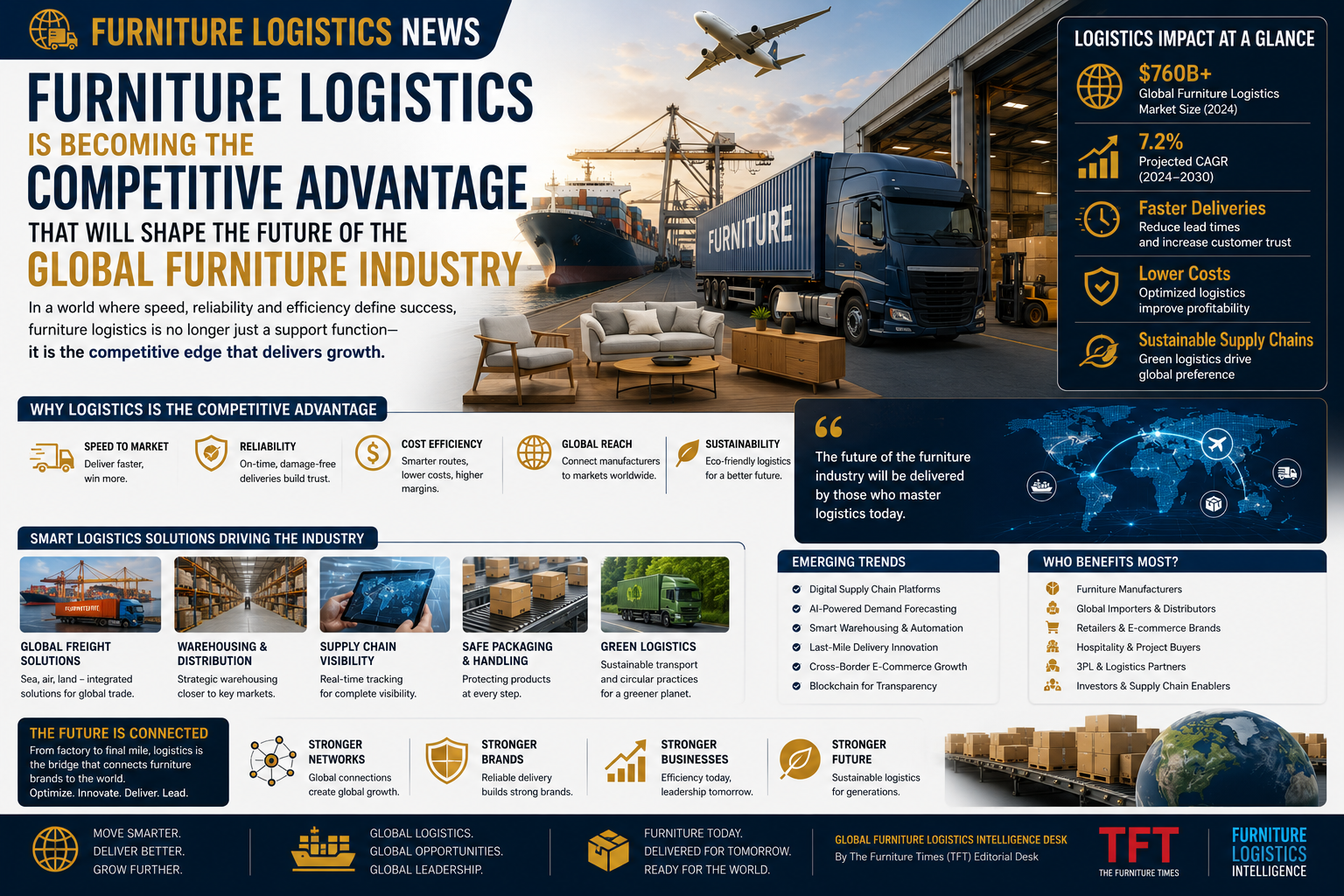
Furniture Logistics Is Becoming the Competitive Advantage That Will Shape the Future of the Global Furniture Industry
Global Furniture Logistics Intelligence Desk
By The Furniture Times (TFT) Editorial Desk
Executive Summary
The furniture industry has long focused on manufacturing, product design and retail.
However, one critical pillar has often received far less attention despite its enormous economic importance.
A beautifully designed sofa has little value if it cannot reach the customer safely, on time and at a competitive cost.
A premium hotel project cannot open without reliable furniture delivery.
An export order cannot generate revenue until products successfully cross international borders.
Every chair, dining table, mattress, wardrobe and office workstation depends on an efficient logistics ecosystem.
Today, logistics has become one of the most strategic competitive advantages in the global furniture industry.
The sector is rapidly evolving through:
- Artificial Intelligence (AI)
- Warehouse automation
- Smart transportation
- Digital supply chains
- Cross-border logistics
- White-glove delivery
- Reverse logistics
- Real-time shipment visibility
According to The Furniture Times (TFT), logistics is no longer a support function.
It is becoming one of the industry’s most valuable growth engines.
The Hidden Engine Behind Every Furniture Sale
Every furniture product follows a complex journey.
Raw materials move from forests and suppliers.
↓
Components travel to factories.
↓
Finished products enter warehouses.
↓
Containers move to ports.
↓
Ships transport products internationally.
↓
Distribution centres receive inventory.
↓
Retailers process orders.
↓
Delivery teams install products.
Only after completing this journey does a customer experience the product.
Without logistics, manufacturing cannot become commerce.
Why Furniture Logistics Is Different
Furniture logistics is more complex than transporting many consumer goods.
Furniture products are:
Large.
Heavy.
Fragile.
High-value.
Often customised.
Space-consuming.
These characteristics require specialised handling, packaging and transportation.
Global Furniture Trade Depends on Logistics
Every year, millions of furniture products move across international supply chains.
Logistics connects:
Manufacturers.
Exporters.
Importers.
Retailers.
Hotels.
Developers.
Interior designers.
Consumers.
The stronger the logistics network, the stronger the furniture economy.
AI Is Transforming Logistics
Artificial Intelligence is improving logistics through:
Demand forecasting.
Route optimisation.
Inventory planning.
Warehouse management.
Shipment prediction.
Delivery scheduling.
Fuel optimisation.
Risk analysis.
AI enables logistics providers to make faster and more informed operational decisions.
Smart Warehouses Improve Efficiency
Modern furniture warehouses increasingly use:
Automation.
Barcode systems.
RFID tracking.
Robotics.
Digital inventory management.
Warehouse Management Systems (WMS).
These technologies reduce errors while improving order accuracy.
Last-Mile Delivery Has Become Critical
For customers, the delivery experience often defines the entire purchasing journey.
Professional furniture delivery includes:
Scheduling.
Safe transportation.
Home delivery.
Assembly.
Installation.
Packaging removal.
Customer support.
This “white-glove” service has become an important competitive advantage for retailers and manufacturers.
White-Glove Installation Is Growing
Unlike many consumer products, furniture often requires professional installation.
Services increasingly include:
Assembly.
Room placement.
Installation.
Testing.
Packaging disposal.
Customer education.
Professional installation improves customer satisfaction while reducing product damage.
Reverse Logistics Creates New Opportunities
The furniture industry increasingly supports:
Product returns.
Warranty collection.
Repair.
Refurbishment.
Recycling.
Trade-in programmes.
Reverse logistics strengthens sustainability while supporting the circular economy.
Cross-Border Logistics Supports Export Growth
International furniture exports require expertise in:
Customs clearance.
Documentation.
Container optimisation.
Freight forwarding.
Port operations.
International compliance.
Reliable cross-border logistics enables manufacturers to compete globally.
Ports Play a Strategic Role
Major furniture-exporting countries depend on efficient ports.
Ports support:
Container movement.
Export processing.
Import clearance.
Distribution.
International connectivity.
Investment in port infrastructure strengthens export competitiveness.
Malaysia’s Strategic Opportunity
Malaysia possesses significant advantages for becoming a regional furniture logistics hub.
These include:
Strategic geographic location.
Modern ports.
Well-developed highways.
Regional connectivity.
Strong manufacturing base.
ASEAN market access.
By strengthening logistics infrastructure between Malaysia and Singapore as an initial phase, the industry can improve delivery speed, reduce transportation costs and enhance regional competitiveness.
A more integrated logistics network could support manufacturers, retailers, exporters and SMEs while creating new employment opportunities throughout the supply chain.
Furniture Logistics Parks
Many countries are now developing specialised industrial logistics hubs.
Future furniture logistics parks may include:
Warehouses.
Distribution centres.
Container yards.
Packaging facilities.
Showrooms.
Export centres.
Training facilities.
Customs services.
Technology hubs.
These integrated ecosystems reduce costs while improving operational efficiency.
Digital Tracking Builds Customer Confidence
Customers increasingly expect:
Real-time shipment tracking.
Delivery notifications.
Installation scheduling.
Digital documentation.
Service updates.
Visibility strengthens trust throughout the purchasing journey.
Sustainability Begins with Better Logistics
Efficient logistics reduces:
Fuel consumption.
Carbon emissions.
Empty transport.
Packaging waste.
Warehouse inefficiency.
Optimised logistics supports both environmental and financial sustainability.
E-Commerce Depends on Logistics
Furniture e-commerce continues expanding.
Success depends on:
Fast fulfilment.
Accurate inventory.
Reliable delivery.
Simple returns.
Professional installation.
Outstanding logistics has become essential for online furniture retail.
Logistics Supports Furniture Tourism
Emerging Furniture Tourism initiatives also depend on logistics.
Visitors require:
Transportation.
Factory transfers.
Exhibition logistics.
Sample shipping.
Business travel coordination.
Technology and logistics together strengthen international business experiences.
SMEs Need Better Logistics Support
Small and medium-sized manufacturers often face:
Higher shipping costs.
Limited warehousing.
Export challenges.
Distribution limitations.
Shared logistics platforms can improve competitiveness while reducing operating costs.
Education Is Essential
The furniture industry increasingly requires professionals specialising in:
Supply chain management.
Warehouse operations.
International trade.
Freight forwarding.
Inventory planning.
Digital logistics.
AI-powered operations.
Developing these skills strengthens the industry’s future workforce.
The Future of Furniture Logistics
Over the next decade, logistics may include:
Autonomous delivery vehicles.
AI-powered route planning.
Smart warehouses.
Digital freight marketplaces.
Predictive supply chains.
Drone inventory systems.
Blockchain documentation.
Carbon-neutral transportation.
Fully integrated logistics ecosystems.
Technology will continue transforming how furniture moves around the world.
The Furniture Times Analysis
The furniture industry has traditionally celebrated manufacturers.
Tomorrow’s industry will also celebrate logistics excellence.
Businesses that invest in:
Digital supply chains.
AI.
Professional delivery.
Warehouse innovation.
Cross-border logistics.
Customer experience.
Will build stronger competitive advantages.
Logistics is becoming a strategic differentiator rather than simply an operational expense.
Final Verdict
The future of the global furniture industry will not depend solely on manufacturing exceptional products.
It will depend on delivering those products intelligently.
Furniture logistics is becoming the invisible infrastructure behind customer satisfaction, export growth and global competitiveness.
Governments.
Manufacturers.
Retailers.
Logistics providers.
Technology companies.
Investors.
Educational institutions.
All have important roles in building stronger furniture logistics ecosystems.
Because every successful furniture business ultimately depends on one simple promise:
The right product.
At the right place.
At the right time.
In perfect condition.
The companies that master this promise will shape the future of the global furniture industry.
By The Furniture Times (TFT) Editorial Desk
Global Furniture Logistics Intelligence Desk | July 2026
“TFT tells their story. FISE helps the world find them.”
The furniture industry ecosystem is a $1 Trillion Dollar Industry.
