
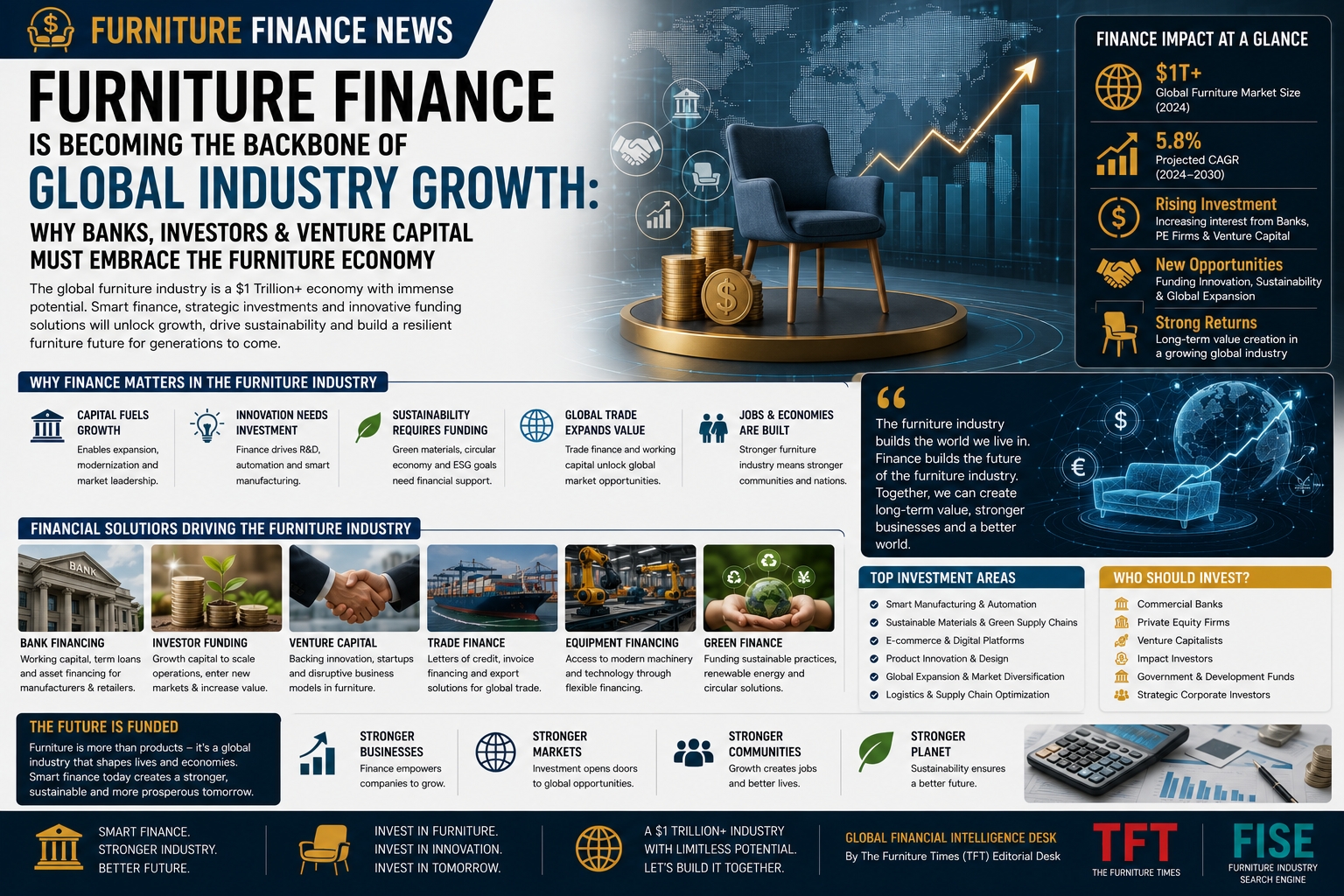
Furniture Finance Is Becoming the Backbone of Global Industry Growth: Why Banks, Investors & Venture Capital Must Embrace the Furniture Economy
Global Financial Intelligence Desk
By The Furniture Times (TFT) Editorial Desk
Executive Summary
The global furniture industry is one of the world’s largest manufacturing and consumer sectors.
Yet despite generating hundreds of billions of dollars in annual economic activity and supporting millions of jobs worldwide, furniture businesses—particularly small and medium-sized enterprises (SMEs)—often face persistent challenges in accessing finance.
Across the industry, entrepreneurs frequently struggle to secure:
- Working capital
- Factory expansion loans
- Export financing
- Machinery investment
- Digital transformation funding
- Research and development capital
- Venture capital
- Private equity investment
At the same time, investors are increasingly looking for resilient industries with long-term growth potential, driven by urbanisation, housing demand, hospitality, e-commerce and smart manufacturing.
According to The Furniture Times (TFT), finance is no longer simply about borrowing money.
It is becoming the strategic engine that enables innovation, global expansion, sustainability and long-term competitiveness across the furniture industry ecosystem.
The Furniture Economy Needs Financial Innovation
The furniture industry has traditionally relied on:
Personal savings.
Family investment.
Commercial bank loans.
Trade credit.
Supplier financing.
While these remain important, today’s businesses require more sophisticated financial solutions to compete globally.
Future growth will increasingly depend on:
Digital finance.
Supply chain finance.
Export credit.
Equipment leasing.
Green financing.
AI-driven financial planning.
Investment partnerships.
Why Furniture Matters to Financial Institutions
The furniture industry supports an enormous economic ecosystem.
It includes:
Manufacturers.
Retailers.
Interior designers.
Architects.
Logistics providers.
Hospitality businesses.
Construction companies.
Raw material suppliers.
Technology providers.
Maintenance services.
Because the industry connects so many sectors, investment in furniture creates a multiplier effect throughout national economies.
SMEs Need Better Access to Capital
Small and medium-sized furniture businesses often have:
Strong craftsmanship.
Quality products.
Experienced teams.
Loyal customers.
But they may lack access to affordable financing.
Without sufficient capital, businesses struggle to:
Purchase machinery.
Expand factories.
Hire skilled workers.
Invest in marketing.
Develop exports.
Adopt new technologies.
Closing this financing gap can unlock significant economic potential.
Export Finance Drives International Growth
Furniture exporters require financial support for:
International orders.
Working capital.
Shipping.
Inventory.
Trade insurance.
Letters of credit.
Export financing helps manufacturers compete in international markets while reducing commercial risks.
Many export credit agencies around the world provide financial support to help businesses expand internationally and manage payment risks. (iccwbo.org)
Equipment Financing Accelerates Modern Manufacturing
Modern furniture production depends on advanced machinery.
Investment areas include:
CNC machines.
Robotics.
Automation.
Spray finishing systems.
Digital production software.
Warehouse automation.
Equipment financing allows businesses to modernise operations without large upfront capital expenditure.
Venture Capital Is Discovering Manufacturing
Historically, venture capital focused primarily on software and technology startups.
Today, investors are increasingly interested in:
Manufacturing technology.
Smart factories.
Furniture technology.
Circular economy.
AI platforms.
Sustainable materials.
Digital marketplaces.
Companies that combine manufacturing with innovation are attracting growing investor attention.
Private Equity Supports Industry Expansion
Private equity firms increasingly seek opportunities within mature industries capable of operational improvement.
Furniture businesses may benefit through:
Factory expansion.
International acquisitions.
Operational restructuring.
Technology upgrades.
Market expansion.
Professional management.
Long-term investment can accelerate business transformation.
Green Finance Is Becoming Essential
Financial institutions increasingly support projects involving:
Renewable energy.
Energy-efficient manufacturing.
Responsible forestry.
Circular economy.
Carbon reduction.
Sustainable buildings.
Businesses investing in environmentally responsible operations may gain improved access to sustainability-linked financing, depending on lender criteria. (worldbank.org)
Insurance Protects Business Continuity
Furniture businesses face risks including:
Fire.
Flooding.
Supply chain disruption.
Product liability.
Cybersecurity.
International trade.
Appropriate insurance strengthens resilience while improving lender confidence.
Risk management is becoming an essential component of financial planning.
Digital Payments Are Transforming Retail
Furniture retailers increasingly offer:
Digital wallets.
Online payments.
Buy Now, Pay Later (BNPL).
Installment financing.
Business payment platforms.
Flexible payment solutions improve customer convenience while supporting sales growth.
AI Is Reshaping Financial Management
Artificial Intelligence helps businesses:
Forecast cash flow.
Predict demand.
Manage inventory.
Reduce financial risk.
Analyse profitability.
Detect fraud.
Improve budgeting.
AI strengthens financial decision-making across the organisation.
Supply Chain Finance Supports Manufacturers
Furniture supply chains involve multiple businesses.
Supply chain finance enables:
Earlier supplier payments.
Improved cash flow.
Reduced financing costs.
Stronger buyer-supplier relationships.
Working capital optimisation.
Healthy supply chains strengthen the entire furniture ecosystem.
Real Estate & Industrial Investment
Furniture manufacturing requires:
Industrial land.
Warehouses.
Production facilities.
Showrooms.
Distribution centres.
Property investment remains closely connected to long-term manufacturing growth.
Industrial development continues supporting furniture clusters worldwide.
IPO Opportunities
As furniture companies grow, some may explore public capital markets.
An Initial Public Offering (IPO) can provide funding for:
International expansion.
Research and development.
Technology.
Manufacturing.
Acquisitions.
Brand development.
Going public requires strong governance, financial transparency and sustainable growth.
Why Banks Should Understand the Furniture Industry Better
Banks often classify furniture businesses simply as manufacturers or retailers.
However, the furniture ecosystem includes:
Design.
Technology.
Hospitality.
Construction.
Healthcare.
Education.
Logistics.
Tourism.
Digital commerce.
Understanding this broader ecosystem allows financial institutions to develop more specialised financing products.
Opportunities for Governments
Governments can accelerate industry growth through:
Export credit programmes.
Innovation grants.
SME financing.
Industrial development funds.
Green investment incentives.
Skills development.
Technology adoption support.
Public-private partnerships can strengthen national competitiveness.
Opportunities for Investors
The furniture industry offers opportunities across:
Manufacturing.
Retail.
Technology.
Logistics.
Artificial Intelligence.
Smart furniture.
Circular economy.
Digital marketplaces.
Industry platforms.
Businesses that combine traditional craftsmanship with innovation may offer attractive long-term growth potential.
The Furniture Times Analysis
The global furniture industry cannot achieve its full potential without stronger financial infrastructure.
Manufacturing excellence alone is insufficient.
Businesses also require:
Capital.
Investment.
Financial literacy.
Risk management.
Technology funding.
Strategic partnerships.
Finance should be viewed not as a support function but as a growth strategy.
Final Verdict
The future of the furniture industry depends not only on better products.
It also depends on better financing.
Banks.
Investors.
Governments.
Venture capital firms.
Private equity.
Insurance providers.
Financial technology companies.
All have an opportunity to help build a stronger, smarter and more resilient global furniture ecosystem.
The next generation of industry leaders will be those who combine:
Innovation.
Manufacturing.
Technology.
Sustainability.
Customer trust.
Financial strength.
Because every great furniture business begins with an idea.
But every global furniture business grows through access to the right capital at the right time.
By The Furniture Times (TFT) Editorial Desk
Global Financial Intelligence Desk | July 2026
“TFT tells their story. FISE helps the world find them.”
The furniture industry ecosystem is a $1 Trillion Dollar Industry.
