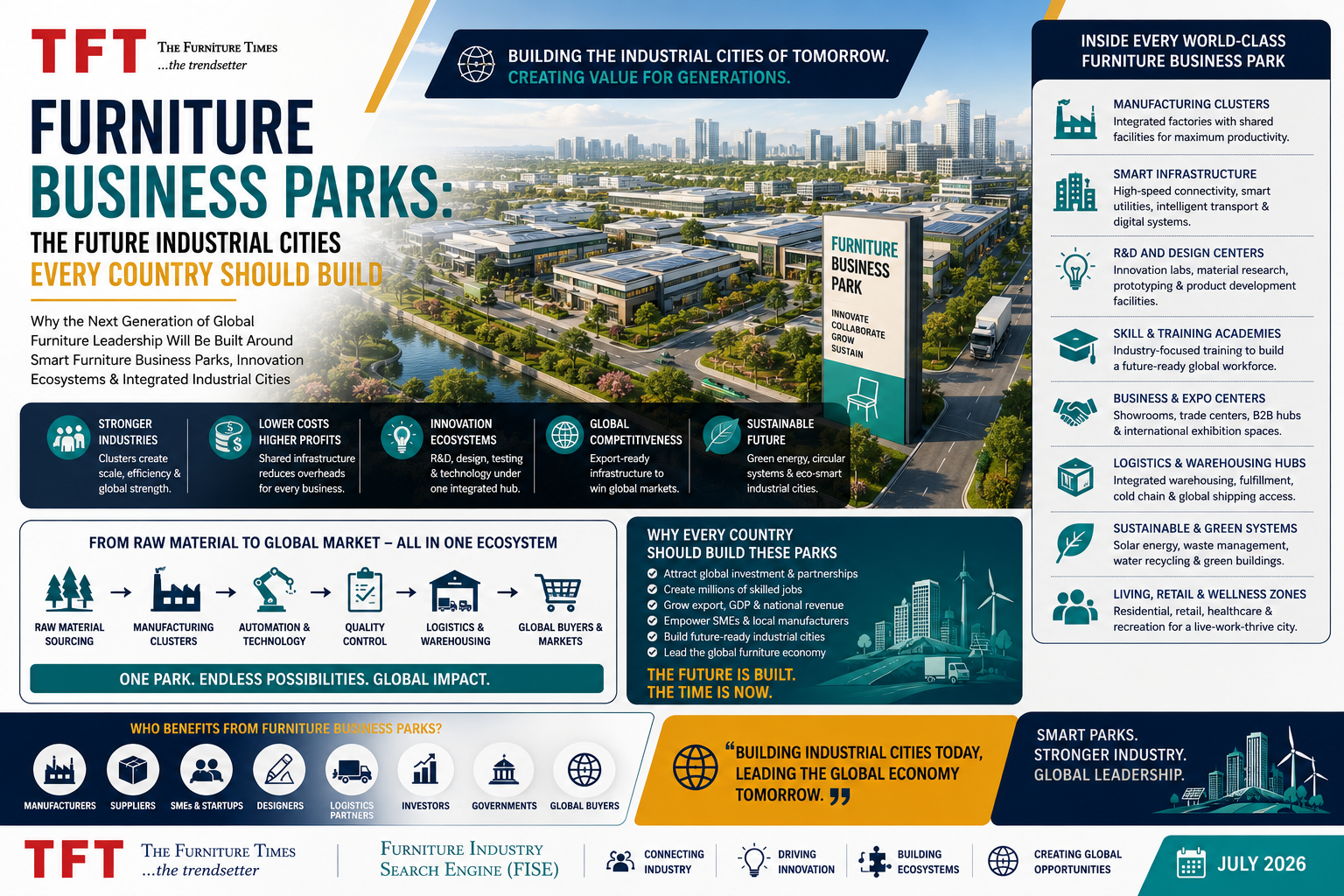
Furniture Business Parks: The Future Industrial Cities Every Country Should Build
Why the Next Generation of Global Furniture Leadership Will Be Built Around Smart Furniture Business Parks, Innovation Ecosystems & Integrated Industrial Cities
Smart Infrastructure & Industrial Development Desk
By The Furniture Times (TFT) & Furniture Industry Search Engine (FISE)
July 2026
The global furniture industry is entering a new era.
An era where manufacturing alone is no longer enough.
Factories alone are no longer enough.
Industrial parks alone are no longer enough.
Countries that aspire to become global furniture leaders must begin thinking beyond individual factories and isolated industrial estates.
They must build complete ecosystems.
The future belongs to Furniture Business Parks.
Dedicated industrial cities designed specifically for the furniture industry ecosystem.
Places where manufacturing, innovation, logistics, education, research, design, technology and international trade operate together under one integrated vision.
According to The Furniture Times (TFT), Furniture Business Parks could become one of the greatest economic development opportunities for furniture-producing countries over the next two decades.
Instead of scattered factories…
Create connected ecosystems.
Instead of isolated manufacturers…
Build collaborative industrial communities.
Instead of exporting products alone…
Export innovation, knowledge, services and global competitiveness.
Furniture Business Parks represent the future of industrial development.
Manufacturing Is No Longer Enough
For decades, industrial development focused primarily on factories.
Governments allocated industrial land.
Companies built production facilities.
Roads were developed.
Utilities were installed.
Production increased.
Exports grew.
That model created significant success.
However, today’s furniture industry requires much more.
Manufacturers need:
Designers.
Technology providers.
Research institutions.
Training centres.
Warehousing.
Logistics.
Digital infrastructure.
Export services.
Innovation partners.
Industrial development must evolve into ecosystem development.
What Is a Furniture Business Park?
A Furniture Business Park is a dedicated industrial ecosystem designed specifically for the furniture industry.
It combines every essential service within one integrated environment.
Instead of separating manufacturing from research, logistics and education…
Everything works together.
One location.
One ecosystem.
One vision.
The Components of a Modern Furniture Business Park
A world-class Furniture Business Park could include:
Furniture manufacturers.
OEM production centres.
Smart factories.
Furniture design studios.
Research & Development laboratories.
Testing centres.
Furniture innovation hubs.
Training academies.
Furniture universities.
Digital manufacturing centres.
Machinery suppliers.
Hardware manufacturers.
Timber processing.
Foam production.
Textile suppliers.
Packaging companies.
Furniture logistics parks.
Warehousing.
Export documentation.
Trade finance.
Insurance services.
Business incubators.
AI technology companies.
Marketing agencies.
Photography studios.
Furniture exhibition halls.
Business hotels.
Conference centres.
Restaurants.
Healthcare facilities.
Residential accommodation.
Every component supports another.
Manufacturing Clusters Create Competitive Advantage
Global success rarely comes from one factory.
It comes from manufacturing clusters.
Clusters create:
Knowledge sharing.
Supplier collaboration.
Lower logistics costs.
Shared infrastructure.
Greater innovation.
Skilled workforce availability.
Higher productivity.
Countries like Italy, China, Vietnam, Poland and Malaysia demonstrate how manufacturing concentration strengthens international competitiveness.
Furniture Business Parks take this concept even further.
Smart Factories Will Lead the Future
The factories inside future Furniture Business Parks will become intelligent.
They will integrate:
Artificial Intelligence.
Automation.
Robotics.
Internet of Things (IoT).
Digital Twins.
Predictive maintenance.
Real-time quality control.
Energy optimisation.
Smart factories produce:
Higher quality.
Lower waste.
Faster production.
Greater flexibility.
Better customer satisfaction.
Technology becomes a competitive advantage.
Research & Development Becomes the Innovation Engine
Furniture industries cannot rely only on manufacturing.
Innovation determines long-term competitiveness.
Every Furniture Business Park should include dedicated R&D centres focusing on:
New materials.
Sustainable timber.
Recycled products.
Smart furniture.
Furniture robotics.
AI manufacturing.
Ergonomics.
Circular economy.
Product engineering.
Innovation transforms manufacturers into global leaders.
Design Hubs Shape Global Trends
Furniture is not simply manufacturing.
It is creativity.
Dedicated design hubs encourage collaboration between:
Industrial designers.
Interior designers.
Architects.
Furniture engineers.
Universities.
Technology companies.
Manufacturers.
Young entrepreneurs.
Great design increases export value.
Countries known for design become recognised worldwide.
Shared Logistics Reduces Cost
Every manufacturer requires logistics.
Instead of building separate infrastructure…
Furniture Business Parks can provide:
Central warehousing.
Shared container yards.
Distribution centres.
Cross-border logistics.
Furniture installation teams.
Digital tracking.
Export consolidation.
Shared logistics improves efficiency for everyone.
Especially SMEs.
Training Centres Create Future Talent
Technology changes rapidly.
Workforce development becomes essential.
Furniture Business Parks should establish training centres teaching:
Furniture manufacturing.
CNC programming.
AI.
Automation.
Quality management.
Digital design.
Export management.
Furniture logistics.
Customer experience.
Leadership.
Continuous learning strengthens industry competitiveness.
Export Zones Accelerate International Growth
Export-ready manufacturers require specialised services.
Furniture Business Parks can include:
Export documentation.
Trade finance.
Customs facilitation.
International marketing.
Buyer lounges.
Product inspection.
Certification.
International trade advisory.
Export zones simplify international business.
SMEs Become Global Faster
One of the greatest advantages of Furniture Business Parks is accessibility.
SMEs gain access to infrastructure previously affordable only to multinational corporations.
Shared facilities include:
Testing laboratories.
Warehousing.
Marketing.
Training.
Digital technology.
Export services.
Logistics.
SMEs become globally competitive.
Furniture Tourism Naturally Develops
Furniture Business Parks become destinations.
International buyers visit.
Architects visit.
Interior designers visit.
Students visit.
Researchers visit.
Government delegations visit.
Investors visit.
Furniture Business Tourism grows naturally.
Industrial development and tourism become connected.
Universities Become Innovation Partners
Furniture Business Parks should work closely with universities.
Students receive:
Industrial placements.
Research opportunities.
Factory visits.
Innovation projects.
Entrepreneurship programmes.
Industry mentoring.
Education becomes practical.
Industry gains future talent.
Sustainability Becomes Infrastructure
Future Furniture Business Parks should integrate:
Solar energy.
Rainwater harvesting.
Waste recycling.
Green buildings.
Electric logistics fleets.
Sustainable timber management.
Carbon monitoring.
Circular manufacturing.
Sustainability becomes part of industrial planning.
Artificial Intelligence Connects Everything
AI will manage:
Production planning.
Inventory.
Logistics.
Predictive maintenance.
Quality inspection.
Visitor management.
Buyer matching.
Energy optimisation.
Business analytics.
AI transforms Business Parks into Smart Industrial Cities.
Furniture Industry Search Engine (FISE): Connecting the Ecosystem
A Furniture Business Park must also be digitally discoverable.
Global buyers should easily locate:
Manufacturers.
Designers.
Machinery suppliers.
Training centres.
Hotels.
Warehouses.
Service providers.
Furniture Industry Search Engine (FISE) can provide the searchable digital ecosystem connecting every business within the park.
Digital discoverability increases international competitiveness.
Why The Furniture Times Created This Vision
According to Togbega Dortor Dr. Bilal Ahmad Bhat, Founder of The Furniture Times (TFT) and Furniture Industry Search Engine (FISE):
“The next generation of industrial development is no longer about building factories. It is about building ecosystems where every business strengthens another. Furniture Business Parks represent that future.”
He continues:
“Every country that wants to become a global furniture leader should begin planning dedicated Furniture Business Parks. Manufacturing, logistics, education, technology, research and tourism must exist together—not separately.”
He adds:
“This is not only an infrastructure project. It is an economic development strategy capable of creating employment, attracting investment, supporting SMEs and building globally recognised furniture cities.”
The Role of TFT & FISE
The Furniture Times continues introducing future-focused concepts designed to strengthen the global furniture ecosystem.
Furniture Industry Search Engine (FISE) provides the digital infrastructure connecting manufacturers, service providers, investors, researchers, buyers and governments into one searchable ecosystem.
Together they support the next generation of Furniture Business Parks.
TFT & FISE Analysis
Industrial development is evolving.
The future belongs to integrated ecosystems rather than isolated industrial estates.
Furniture Business Parks combine:
Manufacturing.
Innovation.
Research.
Education.
Logistics.
Technology.
Tourism.
Trade.
Investment.
Digital discoverability.
This integrated model creates stronger industries, more resilient economies and greater international competitiveness.
Final Verdict
The world’s next furniture leaders will not simply build larger factories.
They will build smarter ecosystems.
Furniture Business Parks represent a new model of industrial development where manufacturing is only one part of a much larger economic engine.
Governments gain investment.
Manufacturers gain competitiveness.
SMEs gain opportunity.
Students gain careers.
Researchers gain innovation.
Communities gain employment.
Countries gain international recognition.
The future of the global furniture industry will not be built factory by factory.
It will be built ecosystem by ecosystem.
And those ecosystems will become the Furniture Business Parks of tomorrow.
By The Furniture Times (TFT) & Furniture Industry Search Engine (FISE)
Smart Infrastructure & Industrial Development Desk | July 2026
“TFT tells their story. FISE helps the world find them.”
The furniture industry ecosystem is a $1 Trillion Dollar Industry.

Related Posts
Global Drivers Analysis: How the Furniture Logistics Market Is Rapidly Evolving
The Furniture Economy 2050: How Manufacturing, Tourism, AI, Logistics, Education, Finance & Sustainability Will Become One Connected Ecosystem