The Furniture Logistics Economy: Why Every Successful Furniture Industry Needs a Dedicated Logistics Ecosystem
Why Logistics Is No Longer a Cost Centre—It Is the Competitive Advantage That Will Define the Future of the Global Furniture Industry
Global Logistics Intelligence Desk
By The Furniture Times (TFT) & Furniture Industry Search Engine (FISE)
July 2026
For decades, the furniture industry has invested heavily in manufacturing.
Companies built larger factories.
Purchased advanced machinery.
Expanded production capacity.
Improved product quality.
Developed better designs.
Participated in international exhibitions.
Invested in digital marketing.
Yet one critical area has remained significantly underdeveloped.
Logistics.
The furniture industry has traditionally viewed logistics as something that happens after manufacturing.
Produce the furniture.
Store it.
Ship it.
Deliver it.
That mindset is rapidly becoming obsolete.
Today’s furniture economy is no longer won by the company that manufactures the best product.
It is increasingly won by the company that delivers the best customer experience.
And that experience begins with logistics.
According to The Furniture Times (TFT), the next decade will belong to countries and companies that build dedicated Furniture Logistics Ecosystems rather than treating logistics as a support service.
Furniture logistics is becoming an independent industry.
It deserves its own infrastructure.
Its own policies.
Its own investments.
Its own innovation.
Its own workforce.
Its own digital platforms.
And its own national strategy.
The Global Furniture Industry Has a Logistics Problem
The furniture industry is unlike most manufacturing sectors.
Furniture products are:
Large.
Heavy.
Fragile.
High-value.
Custom-built.
Often assembled after delivery.
Require installation.
Require careful handling.
Unlike electronics or apparel, furniture logistics is highly specialised.
One mistake can result in:
Damaged products.
Customer dissatisfaction.
Returns.
Warranty claims.
Lost reputation.
Financial losses.
Poor logistics destroys great products.
The Furniture Logistics Economy
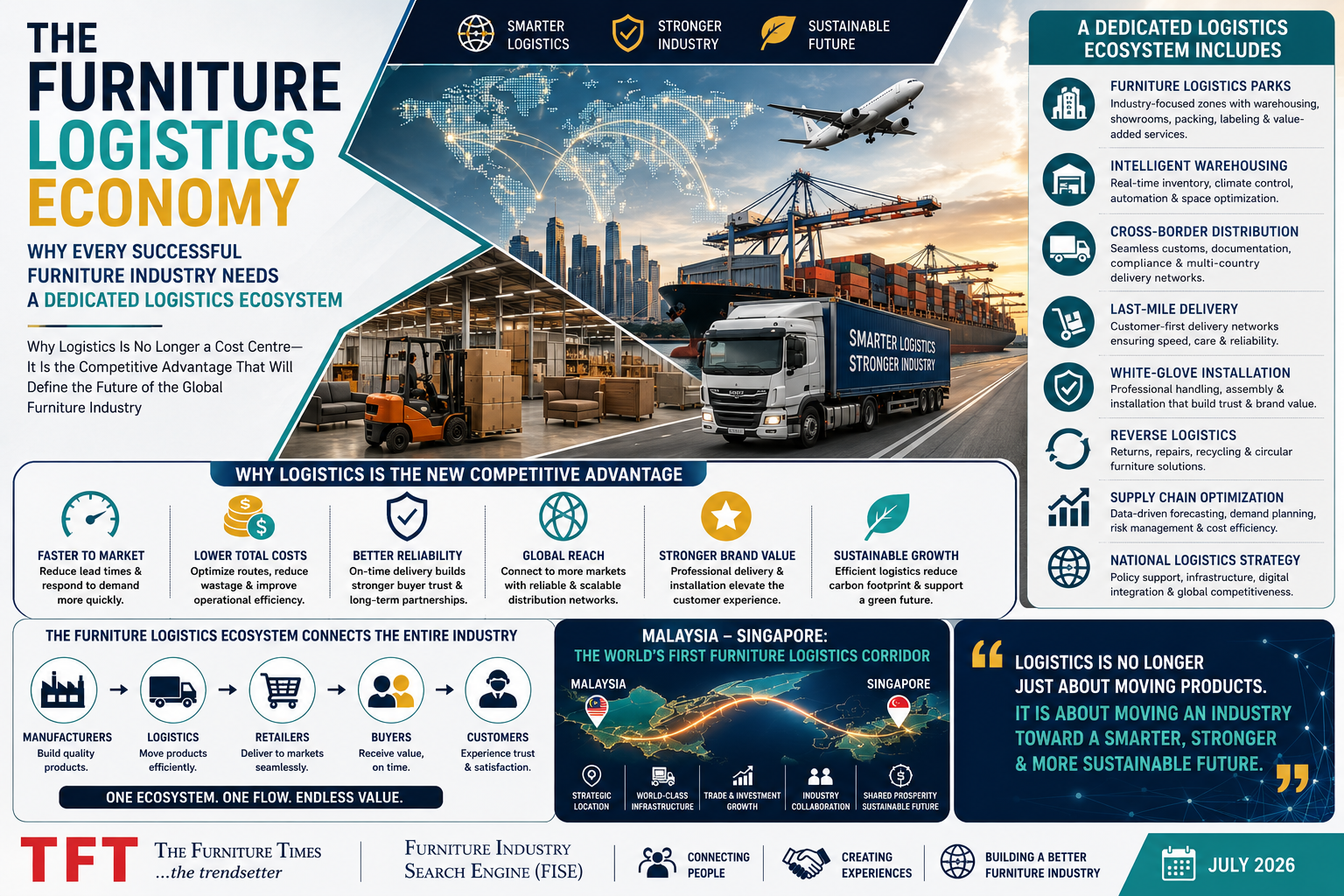
The Furniture Logistics Economy includes every service involved in moving furniture from factory to customer.
It is much larger than transportation.
It includes:
Furniture logistics parks.
Warehousing.
Cross-border distribution.
Container consolidation.
Inventory management.
Digital tracking.
White-glove delivery.
Professional installation.
Assembly services.
Returns management.
Furniture refurbishment.
Repair.
Reverse logistics.
After-sales logistics.
Packaging.
Supply chain technology.
Fleet management.
Customs clearance.
Freight forwarding.
Insurance.
Digital logistics platforms.
Every one of these services creates business opportunities.
Furniture Logistics Parks
Most countries have industrial parks.
Some have technology parks.
Some have logistics hubs.
Very few have dedicated Furniture Logistics Parks.
Imagine one integrated facility containing:
Warehouses.
Container yards.
Assembly centres.
Quality inspection.
Packaging facilities.
Installation teams.
Repair centres.
Training academies.
Digital logistics command centres.
Export documentation services.
Furniture logistics parks could dramatically improve operational efficiency.
Warehousing Is Becoming Strategic
Warehouses are no longer simply storage buildings.
Modern furniture warehouses become:
Inventory intelligence centres.
Distribution hubs.
Customer fulfilment centres.
Regional stock points.
Cross-border consolidation centres.
AI-managed inventory systems.
Smart warehousing reduces delivery time.
Improves inventory accuracy.
Reduces costs.
Supports faster customer service.
Cross-Border Distribution Creates Regional Growth
Cross-border logistics will define the next generation of furniture trade.
Malaysia–Singapore.
Thailand–Malaysia.
Vietnam–Cambodia.
Indonesia–Singapore.
China–ASEAN.
Europe.
North America.
Efficient cross-border distribution enables manufacturers to serve nearby international markets with speed and reliability.
The future belongs to regional logistics corridors.
Last-Mile Delivery Is the Customer Experience
Customers rarely judge logistics by container shipping.
They judge it by final delivery.
Was the furniture delivered on time?
Was it assembled correctly?
Was the installation professional?
Was the home protected during installation?
Was the packaging removed?
Last-mile delivery becomes the brand experience.
Excellent products deserve excellent delivery.
White-Glove Installation Creates Premium Value
Furniture installation is no longer simply unloading products.
Premium customers increasingly expect:
Professional delivery.
Assembly.
Installation.
Placement.
Cleaning.
Packaging removal.
Usage guidance.
Customer education.
White-glove services increase customer satisfaction while creating additional revenue streams.
Reverse Logistics Is Becoming Essential
Not every order ends successfully.
Products require:
Returns.
Repairs.
Replacement.
Warranty handling.
Refurbishment.
Recycling.
Responsible disposal.
A strong reverse logistics system protects customer trust while supporting the circular economy.
Supply Chain Optimisation
The furniture industry must optimise:
Supplier relationships.
Production planning.
Warehouse operations.
Transport scheduling.
Inventory movement.
Container utilisation.
Route planning.
Customer communication.
Every optimisation improves profitability.
Every delay increases cost.
Artificial Intelligence Will Transform Furniture Logistics
AI will optimise:
Warehouse management.
Delivery scheduling.
Traffic routing.
Inventory forecasting.
Fleet management.
Demand prediction.
Container optimisation.
Installation planning.
Customer notifications.
Artificial Intelligence turns logistics into a predictive rather than reactive business.
Malaysia Can Lead ASEAN
Malaysia already possesses many advantages.
Strategic ports.
Strong furniture manufacturers.
Experienced exporters.
Excellent road infrastructure.
Growing digital economy.
Regional connectivity.
Now Malaysia has the opportunity to become ASEAN’s Furniture Logistics Hub.
Starting with the Malaysia–Singapore Furniture Logistics Corridor.
Expanding throughout ASEAN.
Eventually connecting global furniture markets.
SMEs Need Shared Logistics
Large corporations can build private logistics systems.
SMEs cannot.
Shared furniture logistics ecosystems allow SMEs to access:
Professional warehousing.
Shared transport.
Cross-border distribution.
Installation services.
Export support.
Digital logistics.
Shared infrastructure creates equal opportunities.
Furniture Business Tourism Depends on Logistics
Furniture Tourism cannot succeed without logistics.
Visitors buying furniture need confidence.
Can products be shipped?
Can they be installed?
Can after-sales service be provided?
Can warranty claims be managed?
Furniture Tourism and Furniture Logistics are inseparable.
Together they create customer confidence.
National Logistics Strategy
Every furniture-producing nation should consider a dedicated Furniture Logistics Strategy.
Recommendations include:
Establish Furniture Logistics Parks.
Develop national furniture distribution corridors.
Support SME logistics.
Digitise logistics systems.
Develop AI logistics platforms.
Improve customs efficiency.
Encourage public-private partnerships.
Train specialised logistics professionals.
Promote cross-border cooperation.
Integrate logistics into national export strategies.
Countries investing today will become tomorrow’s furniture logistics leaders.
The Role of TFT & FISE
The Furniture Times believes logistics should become a core pillar of the global furniture ecosystem.
Furniture Industry Search Engine (FISE) can connect:
Manufacturers.
Warehouses.
Freight companies.
Installation specialists.
Logistics providers.
Packaging companies.
Export consultants.
Furniture movers.
Customers.
One searchable ecosystem.
One connected industry.
CEO Perspective
According to Togbega Dortor Dr. Bilal Ahmad Bhat, Founder of The Furniture Times (TFT) and Furniture Industry Search Engine (FISE):
“During my more than thirty years in the furniture industry, I realised that manufacturing alone does not build global leadership. Logistics completes the journey. A beautiful product delayed, damaged or poorly installed loses its value. The companies and countries that solve logistics will lead the next generation of the furniture industry.”
He continues:
“Furniture logistics should become a recognised industry by itself. It creates employment, strengthens exports, supports SMEs, improves customer satisfaction and builds national competitiveness. We should stop treating logistics as an expense and start treating it as an investment.”
He concludes:
“The future Furniture Economy will stand on four pillars: Manufacturing. Logistics. Digital Discoverability. Furniture Business Tourism. Together they will build the world’s most connected furniture ecosystem.”
TFT & FISE Analysis
The future furniture industry will not compete factory against factory.
It will compete ecosystem against ecosystem.
The strongest ecosystems will combine:
Manufacturing.
Warehousing.
Logistics.
Technology.
Installation.
Tourism.
Digital search.
Education.
Customer experience.
The Furniture Logistics Economy is becoming one of the most strategic pillars of global competitiveness.
Final Verdict
The future of the furniture industry will not be determined solely by who manufactures the best products.
It will be determined by who moves them most intelligently.
Who delivers them most efficiently.
Who installs them most professionally.
Who supports customers most effectively.
The Furniture Logistics Economy represents one of the greatest untapped opportunities in the global furniture industry.
Countries that recognise this today will become tomorrow’s logistics leaders.
Manufacturers that invest today will become tomorrow’s global brands.
SMEs that join today will become tomorrow’s exporters.
The next chapter of the furniture industry will not begin inside a factory.
It will begin with a smarter logistics ecosystem connecting manufacturers, retailers, logistics providers, technology companies, governments and customers into one integrated Furniture Economy.
By The Furniture Times (TFT) & Furniture Industry Search Engine (FISE)
Global Logistics Intelligence Desk | July 2026
“TFT tells their story. FISE helps the world find them.”
The furniture industry ecosystem is a $1 Trillion Dollar Industry.

Related Posts
Global Drivers Analysis: How the Furniture Logistics Market Is Rapidly Evolving
The Furniture Economy 2050: How Manufacturing, Tourism, AI, Logistics, Education, Finance & Sustainability Will Become One Connected Ecosystem