
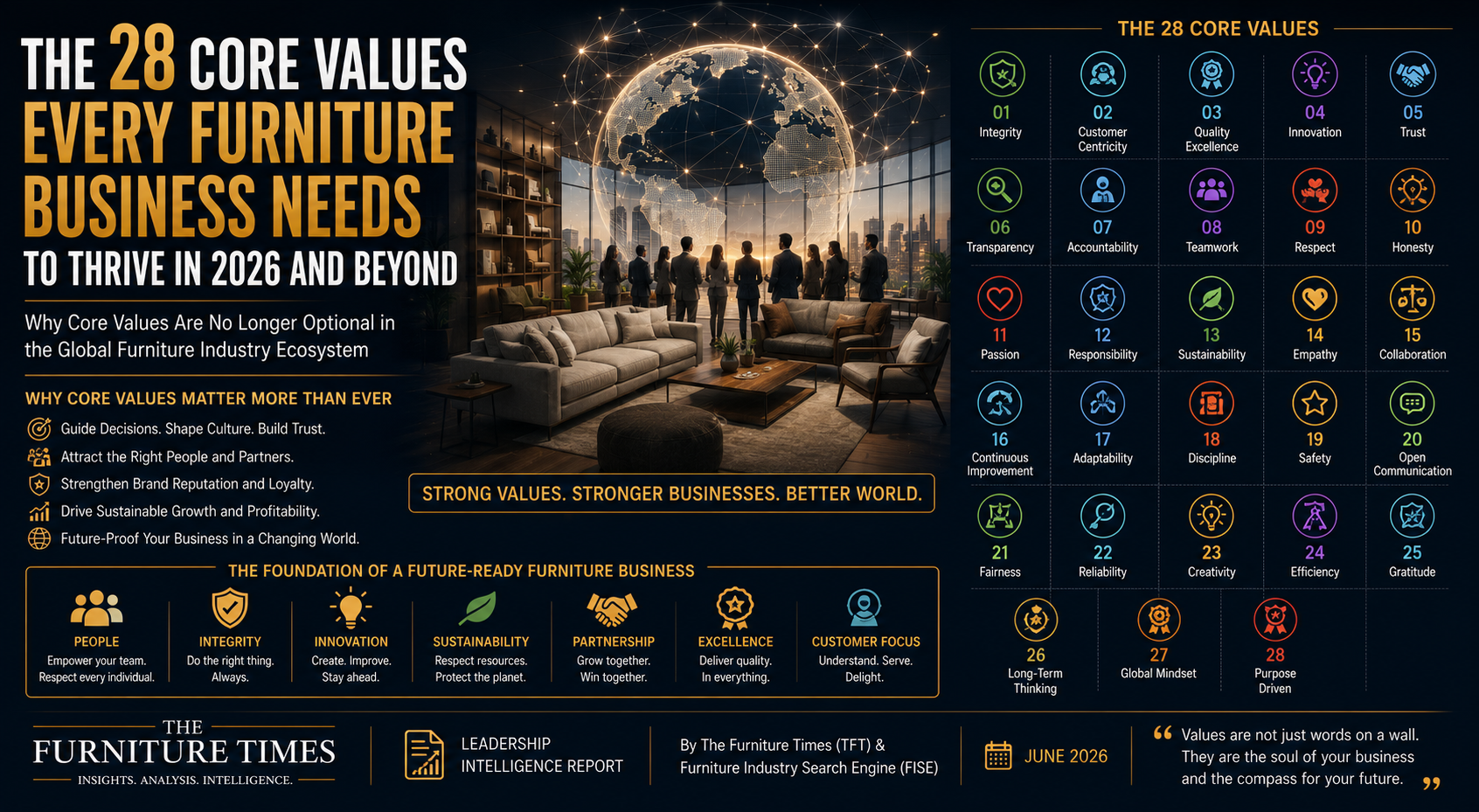
The 28 Core Values Every Furniture Business Needs to Thrive in 2026 and Beyond
Why Core Values Are No Longer Optional in the Global Furniture Industry Ecosystem
Leadership Intelligence Report | By The Furniture Times (TFT) & Furniture Industry Search Engine (FISE) | June 2026
The global furniture industry is a trillion-dollar ecosystem that touches every aspect of human life.
From forests and raw materials to factories, designers, retailers, logistics providers, hospitality projects, interior designers, architects, e-commerce platforms, and consumers, the furniture industry is one of the most interconnected industries in the world.
Yet despite advances in technology, automation, AI, digital marketing, and global trade, one truth remains unchanged:
Businesses do not grow sustainably because of products alone. They grow because of values.
In an era where trust is becoming more important than price, where buyers demand transparency, where employees seek purpose, and where consumers increasingly choose brands that reflect their beliefs, core values have become a strategic business asset.
The 28 Core Values framework promoted through leadership and business ecosystems provides a foundation for building organizations that are resilient, ethical, innovative, and sustainable.
For the furniture industry, these values are more relevant than ever.
Why Core Values Matter in the Furniture Industry
The furniture industry faces numerous challenges:
- Global competition
- Supply chain disruptions
- Rising raw material costs
- Labor shortages
- Sustainability pressures
- Digital transformation
- AI disruption
- Trust deficits
- Market fragmentation
Technology can solve some of these challenges.
Core values solve the human challenges.
Values determine:
- How leaders make decisions
- How teams collaborate
- How customers are treated
- How suppliers are selected
- How crises are managed
- How growth is achieved
Without values, businesses may grow temporarily.
With values, businesses create legacies.
The Foundation: The 28COE Core Values
The 28COE Core Values provide a framework for personal leadership, organizational excellence, and sustainable business growth.
In the furniture industry, every one of these values plays a direct role in long-term success.
1. Vision
Every successful furniture brand begins with vision.
Vision helps businesses see beyond daily operations and focus on long-term impact.
Without vision, companies become reactive.
With vision, companies become industry leaders.
2. Integrity
Trust remains the currency of the furniture industry.
Whether dealing with suppliers, customers, dealers, or project partners, integrity creates confidence.
A furniture business can survive market fluctuations.
It cannot survive the loss of trust.
3. Accountability
Successful organizations take ownership of results.
They do not blame markets.
They do not blame competitors.
They take responsibility and improve continuously.
4. Excellence
Average products create average businesses.
Excellence creates global brands.
From manufacturing quality to customer service, excellence differentiates leaders from followers.
5. Innovation
The future furniture economy belongs to innovators.
Innovation is not limited to products.
It includes:
- Business models
- Technology
- Sustainability
- Customer experience
- Supply chain efficiency
6. Leadership
Strong leadership creates strong organizations.
The furniture industry needs leaders who inspire transformation rather than simply manage operations.
7. Respect
Respect strengthens relationships.
Respect for customers.
Respect for employees.
Respect for suppliers.
Respect for communities.
Without respect, partnerships eventually fail.
8. Commitment
Long-term success requires consistency.
Commitment transforms ideas into execution.
Execution transforms businesses into institutions.
9. Collaboration
No furniture company succeeds alone.
The industry depends on:
- Manufacturers
- Suppliers
- Retailers
- Designers
- Logistics providers
Collaboration creates stronger ecosystems.
10. Customer Focus
Every decision should ultimately improve customer value.
Companies that focus on customer success build stronger brands.
11. Community Ownership
Businesses thrive when they contribute to the communities they serve.
The furniture industry creates jobs, skills, opportunities, and economic development.
Community ownership strengthens long-term sustainability.
12. Sustainability
Sustainability is no longer a trend.
It is a business requirement.
Consumers increasingly expect responsible sourcing and environmentally conscious manufacturing.
13. Transparency
Modern buyers want visibility into:
- Materials
- Manufacturing processes
- Supply chains
- Business practices
Transparency builds trust.
14. Adaptability
Markets change.
Technology changes.
Consumer behavior changes.
Adaptable businesses survive disruption.
15. Learning
The best companies never stop learning.
Continuous improvement remains essential in a rapidly changing industry.
16. Discipline
Growth without discipline creates chaos.
Discipline ensures consistency, quality, and operational excellence.
17. Courage
The courage to innovate.
The courage to transform.
The courage to enter new markets.
Every successful furniture business has demonstrated courage at critical moments.
18. Empathy
Understanding customers and employees creates stronger organizations.
Empathy improves leadership and customer experiences.
19. Reliability
Buyers value reliability as much as product quality.
Reliable suppliers earn repeat business.
20. Resilience
The furniture industry has faced:
- Pandemics
- Economic downturns
- Freight crises
- Inflation
Resilience allows businesses to continue growing despite challenges.
21. Diversity
Diverse teams generate broader perspectives and stronger innovation.
The global furniture industry benefits from cultural diversity and international collaboration.
22. Inclusion
People perform best when they feel valued and included.
Inclusive organizations attract stronger talent.
23. Service
The most respected brands focus on serving customers rather than merely selling products.
Service creates loyalty.
24. Humility
Successful leaders remain teachable.
Humility enables continuous improvement.
25. Gratitude
Gratitude strengthens relationships with:
- Customers
- Employees
- Suppliers
- Partners
Strong relationships drive long-term success.
26. Trust
Trust is the foundation of every business transaction.
Without trust, no industry can thrive.
Research consistently shows that customer trust and stakeholder confidence are among the most influential business values.
27. Purpose
Purpose gives meaning to business activities.
Furniture companies do more than manufacture products.
They create spaces where people live, work, learn, relax, and connect.
28. Legacy
The ultimate goal is not simply profit.
The ultimate goal is building something that endures.
A legacy creates impact beyond generations.
Why Core Values Matter More in 2026
The furniture industry is undergoing profound transformation.
Major trends include:
- Sustainability
- Smart furniture
- AI integration
- Digital sourcing
- Supply chain modernization
- Consumer transparency
- ESG expectations
Industry leaders increasingly recognize that long-term growth requires more than operational efficiency. It requires purpose-driven leadership and value-based decision making.
The Cost of Operating Without Values
Organizations without strong values often experience:
- High employee turnover
- Weak customer loyalty
- Reputation damage
- Internal conflicts
- Inconsistent decision making
- Short-term thinking
The absence of values creates instability.
The presence of values creates resilience.
Core Values and the Future of FISE & TFT
As the global furniture industry becomes increasingly connected through search, AI, data, reviews, visibility, and digital ecosystems, values become even more important.
Technology can connect businesses.
Values determine whether those connections create trust.
The future furniture ecosystem will not be built only on products.
It will be built on:
Trust. Integrity. Sustainability. Leadership. Service. Purpose.
These are the foundations of sustainable growth.
TFT & FISE Analysis
The next generation of successful furniture businesses will not be defined solely by:
- Revenue
- Production capacity
- Factory size
- Market share
They will be defined by their values.
Values influence culture.
Culture influences performance.
Performance influences reputation.
Reputation influences growth.
The companies that embrace strong core values today will become the trusted brands of tomorrow.
Final Verdict
The furniture industry is entering a new era where buyers, employees, partners, and communities increasingly expect businesses to stand for something meaningful.
The 28 Core Values provide more than a leadership framework.
They provide a blueprint for building resilient, trusted, innovative, and sustainable furniture businesses.
Because in the end:
Products create transactions.
Values create relationships.
And relationships are what build industries that last.
By The Furniture Times (TFT) & Furniture Industry Search Engine (FISE)
Leadership Intelligence Desk | June 2026
“TFT tells their story. FISE helps the world find them.”
