
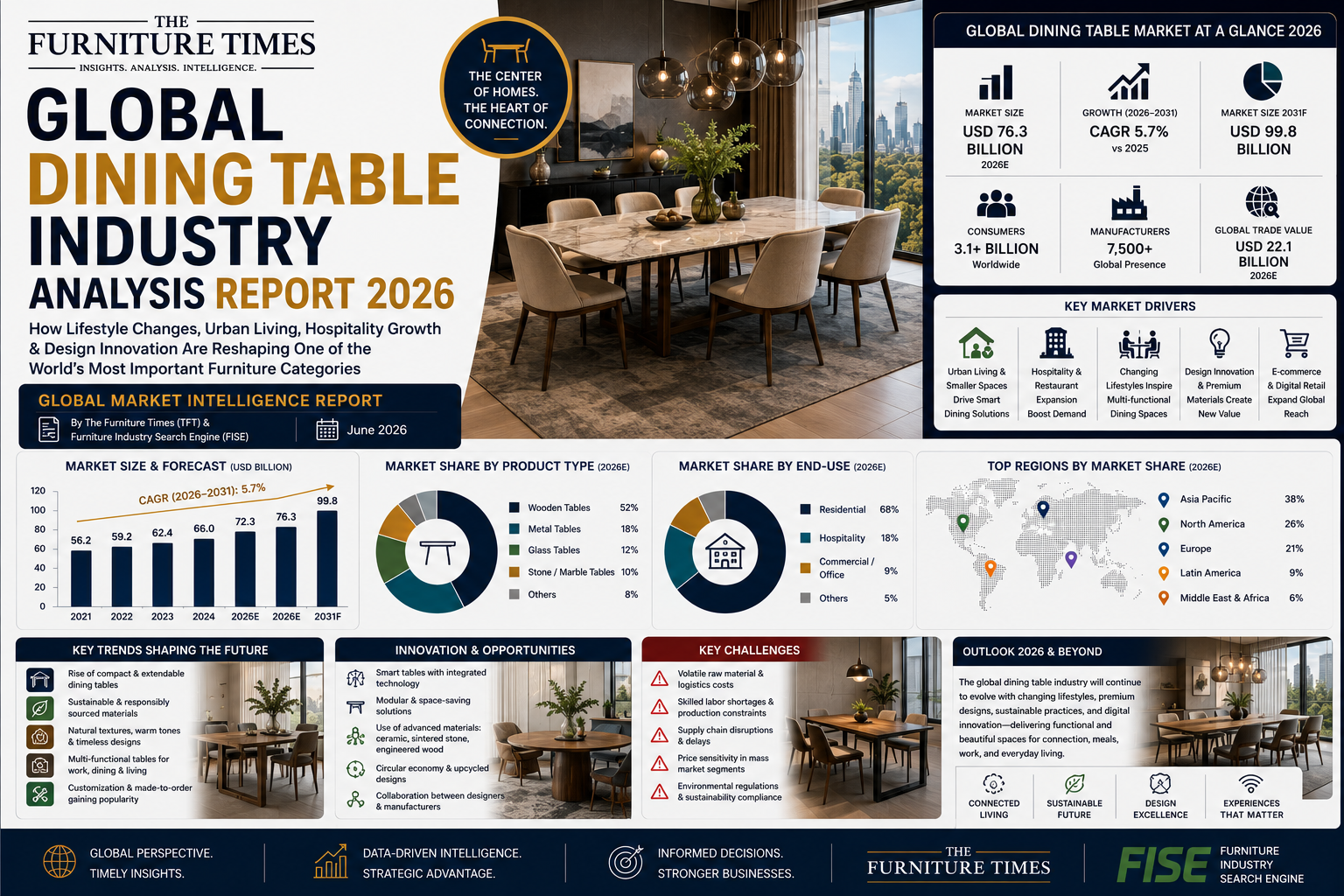
Global Dining Table Industry Analysis Report 2026
How Lifestyle Changes, Urban Living, Hospitality Growth & Design Innovation Are Reshaping One of the World’s Most Important Furniture Categories
Global Market Intelligence Report | By The Furniture Times (TFT) & Furniture Industry Search Engine (FISE) | June 2026
The dining table remains one of the most iconic furniture products ever created.
For centuries, dining tables have been at the center of family gatherings, celebrations, hospitality experiences, business meetings, social interaction, and cultural traditions.
Today, however, the role of the dining table is changing.
In modern homes, dining tables are no longer used only for dining.
They now serve as:
Workstations
Study areas
Meeting spaces
Social hubs
Creative workspaces
Entertainment centers
Multi-purpose family zones
This transformation is creating new opportunities across the global dining furniture market.
As urbanization, apartment living, hospitality development, premium interior design, and flexible lifestyles continue expanding, the dining table industry is evolving from a traditional furniture category into a lifestyle-driven segment of the global furniture economy.
Executive Summary
Global Dining Table Industry Health Check 2026
Consumer Demand: 8.0 / 10
Residential Market Demand: 8.2 / 10
Hospitality Demand: 8.5 / 10
Design Innovation: 8.3 / 10
Material Innovation: 7.8 / 10
Digital Retail Transformation: 8.1 / 10
Manufacturing Health: 7.9 / 10
Overall Industry Health Score: 8.1 / 10
The dining table market remains one of the most resilient categories in the furniture industry.
Why Dining Tables Still Matter
Despite changing lifestyles and increased dining outside the home, dining tables remain deeply connected to human behavior.
Across cultures, the dining table represents:
Family
Community
Hospitality
Tradition
Celebration
Connection
Even in highly digital societies, people continue gathering around tables.
This emotional connection makes dining tables one of the least replaceable furniture products.
Unlike decorative furniture, dining tables serve both functional and symbolic purposes.
Market Size & Industry Outlook
The global dining table market is estimated to represent a substantial segment of the broader household furniture industry, with demand continuing to expand through residential development, home renovation, hospitality investment, and commercial projects.
Growth is being supported by:
Urban housing expansion
Rising disposable income
Premium furniture demand
Hospitality projects
Interior design investment
Luxury residential development
Hybrid work lifestyles
The industry is expected to experience steady growth through 2035.
Regional Analysis
Asia-Pacific: The Growth Powerhouse
Asia-Pacific remains the largest growth region for dining furniture.
Major markets include:
China
India
Indonesia
Malaysia
Vietnam
Thailand
Philippines
Japan
South Korea
China
China remains both the world’s largest furniture manufacturing base and one of its largest consumer markets.
Dining table demand is increasingly focused on:
Premium materials
Smart furniture
Compact apartment solutions
Contemporary designs
India
India is witnessing strong demand due to:
Urban housing growth
Rising middle-class incomes
Apartment living
Modular furniture adoption
Dining spaces are becoming increasingly important within modern Indian homes.
Southeast Asia
Rapid urbanization continues supporting demand across:
Malaysia
Indonesia
Vietnam
Thailand
Consumers increasingly seek dining furniture that combines design, durability, and space efficiency.
Europe: Design & Craftsmanship Leadership
Europe remains one of the most sophisticated dining furniture markets globally.
Key markets include:
Germany
Italy
France
United Kingdom
Spain
Poland
European consumers prioritize:
Design
Aesthetic value remains critical.
Sustainability
Demand for certified wood continues growing.
Longevity
Consumers increasingly prefer furniture that lasts.
Craftsmanship
Premium woodworking remains highly respected.
Europe continues influencing global dining furniture trends.
North America: Large Homes, Large Tables
North America remains one of the world’s largest dining furniture markets.
Consumers increasingly favor:
Large dining tables
Extendable tables
Family-sized seating
Multi-functional furniture
Demand is supported by:
Home renovation
Suburban housing
Premium dining furniture
Open-plan living spaces
Dining tables increasingly function as shared family workspaces.
Middle East: Luxury & Hospitality
The Middle East continues experiencing strong growth.
Major demand centers:
UAE
Saudi Arabia
Qatar
Kuwait
Bahrain
Growth drivers include:
Luxury villas
Hospitality projects
Premium apartments
High-end interior design
Consumers often prefer:
Large dining tables
Luxury materials
Marble surfaces
Customized solutions
Africa: Emerging Opportunity
Africa’s dining furniture market continues expanding.
Key markets:
South Africa
Nigeria
Kenya
Ghana
Egypt
Morocco
Growth is supported by:
Urbanization
Housing development
Hospitality expansion
Retail modernization
Affordable yet durable dining furniture remains highly attractive.
Oceania: Quality & Sustainability
Australia and New Zealand continue emphasizing:
Premium quality
Sustainable timber
Family-sized dining tables
Indoor-outdoor lifestyles
Consumers increasingly seek dining furniture that balances durability with aesthetics.
Materials Driving the Market
Material selection plays a major role in purchasing decisions.
Solid Wood
The most respected material globally.
Popular species include:
Oak
Walnut
Teak
Ash
Maple
Advantages:
Durability
Natural beauty
Longevity
Engineered Wood
Includes:
MDF
Plywood
Particleboard
Advantages:
Affordability
Consistency
Modern finishes
Marble
Growing rapidly in luxury markets.
Popular for:
Premium homes
Luxury hospitality
Statement interiors
Ceramic & Sintered Stone
One of the fastest-growing categories.
Advantages:
Scratch resistance
Heat resistance
Modern appearance
Glass
Still popular in contemporary interiors.
Advantages:
Visual lightness
Modern aesthetics
Metal
Increasingly used for:
Industrial styles
Contemporary furniture
Hospitality applications
Most Popular Dining Table Styles in 2026
Rectangular Dining Tables
Remain the global standard.
Best suited for:
Families
Large dining spaces
Hospitality environments
Round Dining Tables
Growing rapidly.
Advantages:
Better social interaction
Space efficiency
Modern appeal
Especially popular in apartments and urban homes.
Extendable Dining Tables
One of the fastest-growing segments.
Consumers increasingly seek flexibility.
Benefits include:
Space saving
Adaptability
Entertaining capability
Live Edge Tables
Popular in luxury and natural-design markets.
Consumers appreciate:
Authenticity
Craftsmanship
Unique appearance
Minimalist Scandinavian Designs
Strong global demand continues.
Characteristics:
Clean lines
Light wood tones
Functional simplicity
Dining Table Trends Shaping 2026–2030
Multi-Functional Living
Dining tables increasingly serve multiple purposes.
Compact Urban Furniture
Apartment living is driving demand for:
Smaller tables
Extendable solutions
Foldable designs
Premium Natural Materials
Consumers increasingly value authenticity.
Sustainability
Certified timber and environmentally responsible production continue gaining importance.
Luxury Dining Experiences
Consumers increasingly invest in statement dining furniture.
Indoor-Outdoor Living
Demand for versatile dining solutions continues growing.
Hospitality Sector Impact
Hotels, restaurants, cafés, resorts, and serviced apartments continue creating significant demand.
Key categories include:
Restaurant dining tables
Banquet tables
Resort dining furniture
Outdoor hospitality dining
Luxury hotel dining spaces
Hospitality growth across:
UAE
Saudi Arabia
Qatar
Malaysia
Thailand
Indonesia
Vietnam
continues supporting the industry.
Manufacturing Trends
Dining table manufacturers increasingly invest in:
Automation
Improving productivity.
CNC Technology
Increasing precision.
Sustainable Production
Meeting environmental expectations.
Custom Manufacturing
Supporting personalization.
Faster Lead Times
Responding to changing consumer expectations.
Digital Transformation
Consumers increasingly discover dining furniture through:
Search engines
AI recommendations
Social media
Interior design platforms
E-commerce sites
The buying journey increasingly begins online.
Manufacturers and retailers must therefore focus on:
Digital visibility
Product visualization
Reviews
Content marketing
Major Industry Challenges
Rising Timber Costs
Wood prices remain volatile.
Labor Shortages
Skilled woodworking remains difficult to replace.
Freight Costs
Global logistics continue impacting margins.
Consumer Price Sensitivity
Competition remains intense.
Material Sustainability
Environmental expectations continue increasing.
TFT & FISE Analysis
The dining table industry is evolving from a furniture category into a lifestyle category.
The strongest brands are not simply selling tables.
They are selling:
Experiences
Gatherings
Family moments
Design identity
Hospitality culture
The emotional connection attached to dining spaces remains one of the industry’s greatest strengths.
As homes become more multifunctional, dining tables become even more important.
Final Verdict
The global dining table market remains one of the strongest segments within the furniture ecosystem.
Demand continues growing across:
Residential markets
Hospitality projects
Commercial interiors
Luxury developments
Consumers increasingly seek:
Design + Durability + Sustainability + Flexibility + Visibility
The future winners will combine:
Craftsmanship + Innovation + Material Excellence + Digital Discoverability
Because dining tables are no longer just places to eat.
They are where families connect, ideas are shared, celebrations happen, and memories are created.
The dining table remains one of the most powerful symbols of human interaction within the built environment.
By The Furniture Times (TFT) & Furniture Industry Search Engine (FISE)
Global Market Intelligence Desk | June 2026
“TFT tells their story. FISE helps the world find them.”
