
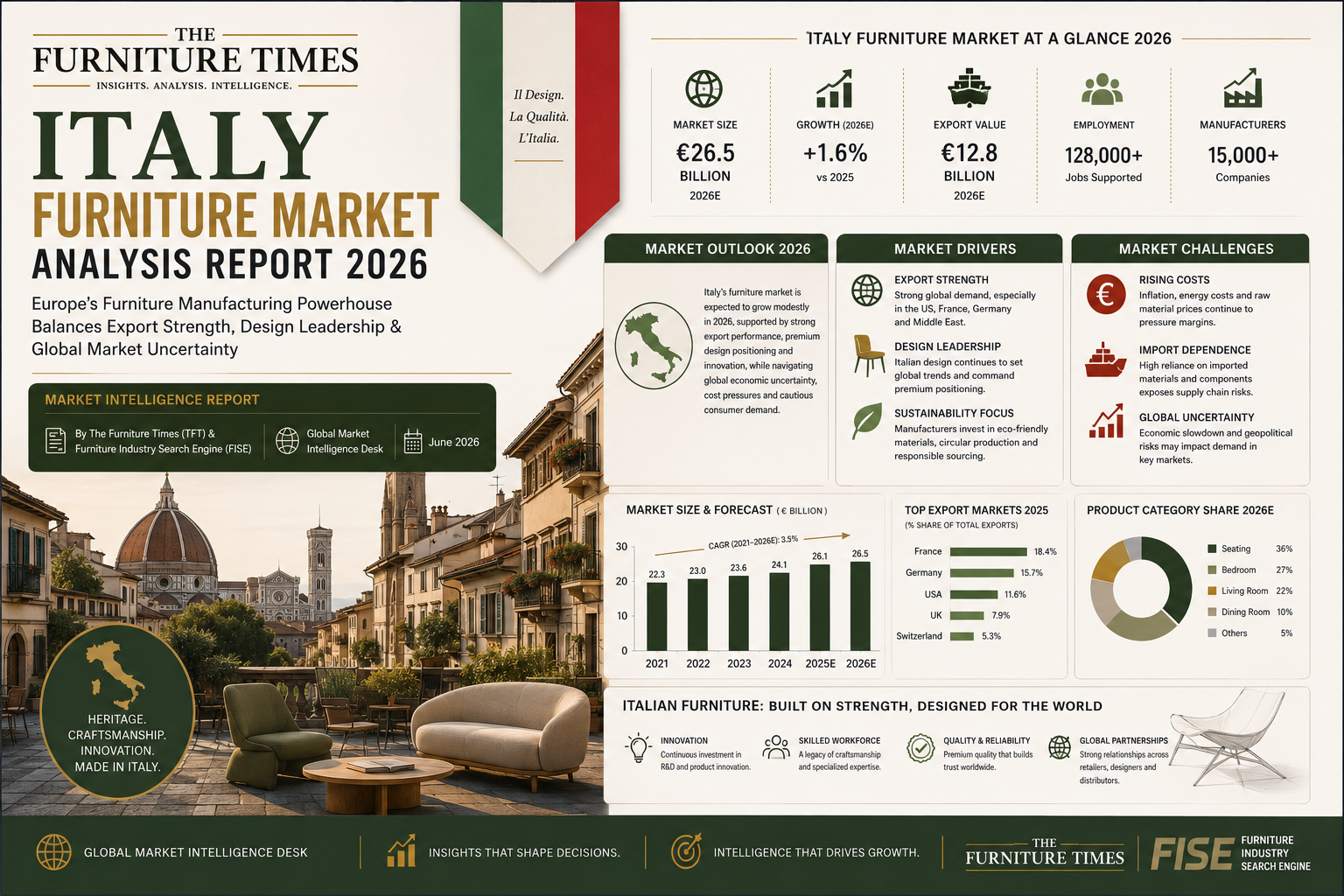
Italy Furniture Market Analysis Report 2026
Europe’s Furniture Manufacturing Powerhouse Balances Export Strength, Design Leadership & Global Market Uncertainty
Market Intelligence Report | By The Furniture Times (TFT) & Furniture Industry Search Engine (FISE) | Global Market Intelligence Desk | June 2026
Italy remains one of the most influential furniture nations in the world.
While Germany may be Europe’s largest furniture consumption market, Italy continues to hold a unique position as one of the world’s most respected furniture manufacturing, design, and export centers. From luxury residential furniture and premium kitchens to contract furniture, hospitality solutions, lighting, and interior design systems, Italian furniture brands continue to shape global trends and define excellence across the industry.
However, 2026 presents a mixed landscape.
Global economic uncertainty, slower construction activity across parts of Europe, rising production costs, geopolitical disruptions, and cautious consumer spending are creating new challenges. Yet Italy’s reputation for design, craftsmanship, innovation, and export competitiveness continues to provide resilience and long-term opportunity.
Italy Furniture Industry Health Check 2026
Consumer Demand Health
7.2 / 10
Manufacturing Health
8.8 / 10
Export Performance Health
8.5 / 10
Retail Market Health
6.8 / 10
Design & Luxury Segment Health
9.5 / 10
Sustainability Readiness
8.0 / 10
Overall Industry Health Score
8.1 / 10
Italy remains one of the strongest furniture ecosystems globally, supported by manufacturing excellence and international demand.
Italy: A Global Furniture Superpower
Italy is far more than a furniture market.
It is a furniture ecosystem.
The country is internationally recognized for:
- Luxury furniture
- Designer furniture
- Kitchen systems
- Upholstered furniture
- Contract furniture
- Hospitality interiors
- Office furniture
- Lighting solutions
- Interior architecture
Italian furniture brands continue to influence design trends across Europe, North America, the Middle East, Asia, and Africa.
For many global buyers, “Made in Italy” remains one of the most powerful quality signals within the furniture industry.
Manufacturing Remains Italy’s Greatest Strength
Unlike many European countries that rely heavily on imports, Italy maintains a strong domestic manufacturing base.
Furniture production remains concentrated in highly specialized industrial districts known for:
- Craftsmanship
- Design expertise
- Production flexibility
- Export capability
- Innovation
These manufacturing clusters create strong competitive advantages.
Italian companies continue investing in:
- Smart manufacturing
- Automation
- Sustainable production
- Digital product development
- International distribution
The result is a furniture sector that continues competing successfully in premium and mid-premium categories worldwide.
Exports Continue to Drive Growth
Italy remains one of the world’s leading furniture exporters.
Key export destinations include:
- Germany
- France
- United States
- United Kingdom
- Switzerland
- United Arab Emirates
- Saudi Arabia
- China
Italian manufacturers continue benefiting from strong demand in:
Luxury Residential Projects
High-net-worth consumers continue investing in premium furnishings.
Hospitality Projects
Hotels, resorts, restaurants, and mixed-use developments remain major buyers.
Commercial Interiors
Corporate offices and premium workspaces continue supporting demand.
International Design Projects
Architects and designers worldwide continue specifying Italian furniture brands.
Export diversification remains one of Italy’s strongest strategic advantages.
Domestic Demand Shows Stability
Consumer demand within Italy remains relatively stable.
Although inflation and broader European economic concerns have influenced spending behavior, Italian consumers continue demonstrating strong interest in:
- Home improvement
- Interior design
- Premium furnishings
- Space optimization
- Outdoor living products
Consumers are becoming more selective, but not necessarily spending less.
Instead, purchasing decisions increasingly prioritize:
- Design value
- Product longevity
- Sustainability
- Brand reputation
- Material quality
Milan Remains the Capital of Furniture Influence
Few cities influence global furniture trends as much as Milan.
Events such as:
- Salone del Mobile
- Fuorisalone
- Design Week
continue attracting global attention and reinforcing Italy’s position as the world’s design capital.
The influence extends beyond furniture sales.
It shapes:
- Product innovation
- Material trends
- Consumer preferences
- Hospitality design
- Architectural projects
Italy’s design leadership remains one of its most valuable assets.
Sustainability Is Becoming a Competitive Advantage
Sustainability is increasingly influencing purchasing decisions globally.
Italian manufacturers are responding through:
- FSC-certified materials
- Circular production systems
- Eco-friendly finishes
- Energy-efficient manufacturing
- Sustainable packaging
Many international buyers now require sustainability documentation as part of procurement processes.
For Italian brands, sustainability is becoming both a responsibility and a market opportunity.
Digital Transformation Accelerates
Traditionally, furniture sales depended heavily on showrooms, trade fairs, and dealer networks.
Today, digital discovery is reshaping the customer journey.
Buyers increasingly begin their search through:
- Search engines
- AI assistants
- Social platforms
- Review systems
- Design platforms
- Digital catalogs
This shift is creating new opportunities and challenges.
Manufacturers must now compete not only on design and quality but also on discoverability.
Italy’s Growing Opportunities
Several sectors are showing strong growth potential.
Luxury Furniture
Italy remains the global benchmark.
Hospitality Furniture
Tourism and hotel investment continue supporting demand.
Outdoor Living
Premium outdoor furniture continues expanding.
Contract Furniture
Corporate and commercial projects remain active.
Sustainable Furniture
Eco-conscious consumers are creating new opportunities.
Smart Furniture
Technology integration is becoming increasingly relevant.
Risks Facing the Market
Despite its strengths, Italy faces several challenges.
Rising Production Costs
Energy and labor costs continue affecting margins.
Geopolitical Uncertainty
Global trade disruptions impact supply chains.
European Economic Slowdown
Consumer confidence remains uneven across Europe.
Import Competition
Lower-cost manufacturing nations continue increasing competition.
Housing Market Weakness
Some European markets remain below pre-pandemic construction levels.
These risks require continued innovation and operational efficiency.
The Visibility Economy Arrives in Italy
One of the most important trends affecting Italian furniture companies is the rise of what TFT and FISE call the Visibility Economy.
The traditional formula was:
Design + Quality = Success
The new formula is:
Design + Quality + Visibility + Trust + Searchability = Growth
Increasingly, buyers discover suppliers through:
- AI systems
- Industry platforms
- Digital directories
- Online reviews
The manufacturers who are easiest to find often become the manufacturers considered first.
TFT & FISE Analysis
Italy remains one of the strongest furniture ecosystems in the world.
The industry benefits from:
- Global brand recognition
- Export strength
- Design leadership
- Manufacturing excellence
- Premium positioning
However, the future will require more than heritage.
Success will increasingly depend upon:
- Digital discoverability
- Sustainability leadership
- Supply chain resilience
- Customer trust
- AI readiness
Italian furniture companies that embrace these trends will likely strengthen their global leadership over the next decade.
Final Verdict
Italy’s furniture industry enters the second half of 2026 from a position of relative strength.
The market faces challenges, but its foundations remain exceptionally strong.
Few countries combine:
- Design influence
- Manufacturing capability
- Export power
- Brand prestige
- Innovation culture
as effectively as Italy.
The future winners within the Italian furniture industry will not simply be the largest manufacturers.
They will be the companies that successfully combine Italian craftsmanship with digital intelligence, sustainability, visibility, and global connectivity.
By The Furniture Times (TFT) & Furniture Industry Search Engine (FISE)
Global Market Intelligence Desk | June 2026
“TFT tells their story. FISE helps the world find them.”
