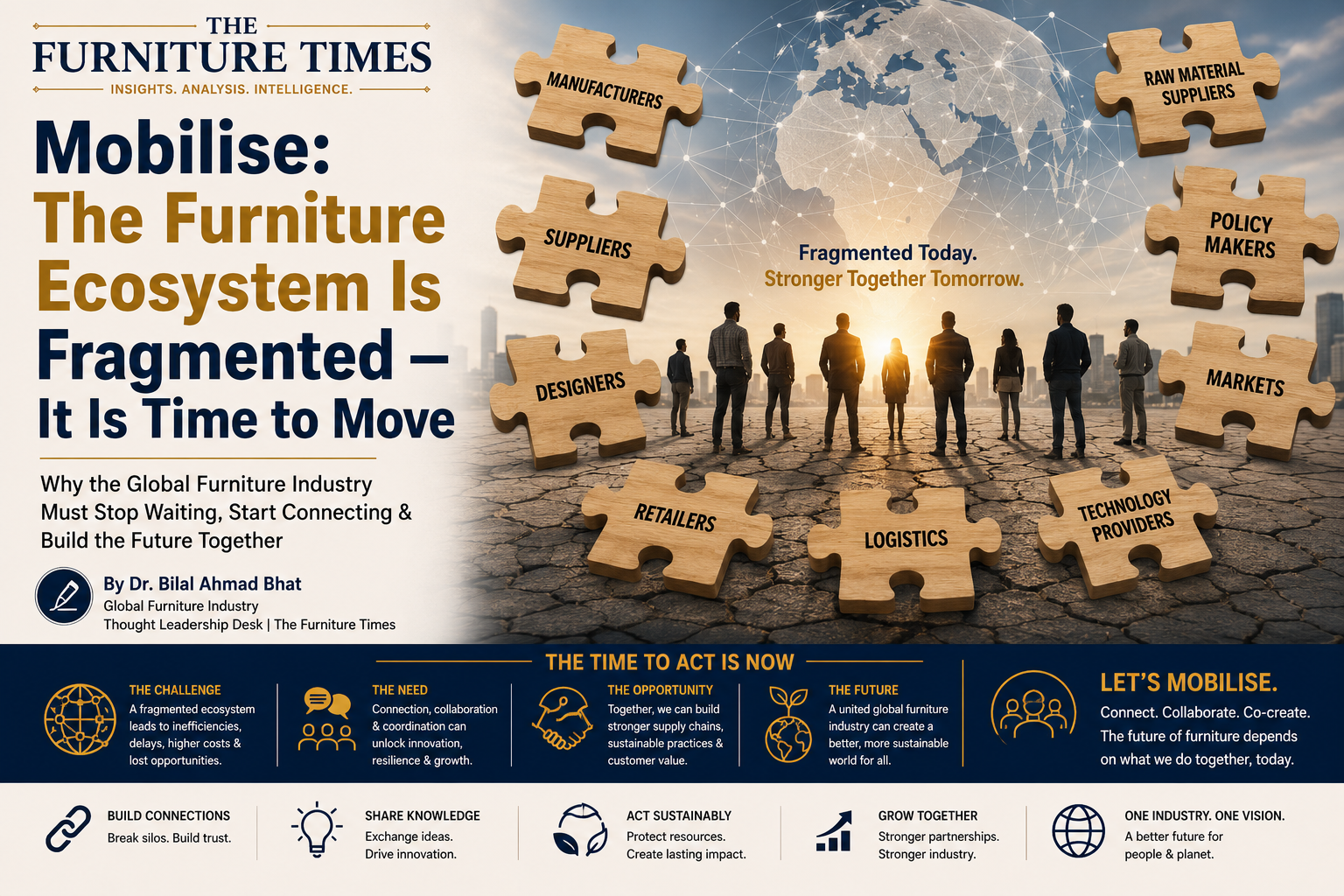
Mobilise: The Furniture Ecosystem Is Fragmented — It Is Time to Move
Why the Global Furniture Industry Must Stop Waiting, Start Connecting & Build the Future Together
Global Furniture Industry Thought Leadership Desk | The Furniture Times
The global furniture industry is one of the largest, oldest, and most essential industries in human civilization.
It builds homes.
It shapes hotels.
It supports offices.
It furnishes schools.
It serves hospitals.
It creates comfort, identity, lifestyle, dignity, and human experience.
Yet despite its size, history, and importance, the furniture ecosystem remains deeply fragmented.
Manufacturers are separated from retailers.
Retailers are separated from designers.
Designers are separated from architects.
Suppliers are separated from buyers.
Artisans are separated from global markets.
SMEs are separated from visibility.
Factories are separated from digital discovery.
And across the world, millions of furniture businesses are working hard, producing value, but still remaining unseen.
This is the moment to say clearly:
Mobilise.
The furniture industry cannot afford to remain scattered.
It is time to move.
It is time to connect.
It is time to organize.
It is time to build the future furniture ecosystem together.
The Furniture Industry Is Huge, But Still Disconnected
The global furniture industry is widely recognized as a trillion-dollar ecosystem when all connected sectors are considered: manufacturing, retail, interiors, hospitality, logistics, raw materials, machinery, design, exports, and digital commerce.
Yet the industry still behaves like a fragmented network of isolated islands.
One company manufactures.
Another imports.
Another retails.
Another installs.
Another designs.
Another ships.
Another writes about the industry.
Another searches for buyers.
But the real problem is that they often do not operate as one connected ecosystem.
This fragmentation weakens the entire industry.
It creates duplication.
It creates missed opportunities.
It creates poor visibility.
It creates trust gaps.
It creates communication problems.
It creates unnecessary dependency on middlemen.
It creates slow growth for small businesses.
The industry is not lacking talent.
It is lacking mobilization.
Why Mobilisation Is Now Urgent
The furniture industry is facing one of the most uncertain periods in recent memory.
Businesses are dealing with:
rising raw material costs
tariff pressure
wars and geopolitical instability
shipping uncertainty
labour shortages
insurance challenges
consumer slowdown
high competition
digital disruption
AI transformation
In such an environment, businesses cannot survive by standing alone.
The industry needs collective movement.
The industry needs shared visibility.
The industry needs connected infrastructure.
The industry needs platforms that help businesses become searchable, credible, visible, and connected.
This is why mobilization is not a slogan.
It is a survival strategy.
“Just Move” — The Philosophy of Action
Dr. Bilal Ahmad Bhat believes that many businesses fail not because they lack ability, but because they stop moving.
They wait for perfect timing.
They wait for perfect funding.
They wait for perfect markets.
They wait for perfect conditions.
But in business, perfect conditions rarely come.
The furniture industry must understand one powerful truth:
Movement creates momentum.
If the market is uncertain, move.
If competition is increasing, move.
If visibility is weak, move.
If sales are slowing, move.
If technology is changing, move.
If AI is transforming discovery, move.
Standing still is no longer safe.
The Cost of Fragmentation
Fragmentation is expensive.
It costs the industry in many ways.
1. Lost Visibility
Many furniture manufacturers produce excellent products, but buyers cannot find them.
2. Weak Trust
When businesses are not visible, customers hesitate to trust them.
3. Poor Communication
Disconnected systems create delays, confusion, and missed deals.
4. Limited Global Reach
Many SMEs remain trapped in local markets because they are not digitally discoverable.
5. Missed Collaboration
Designers, manufacturers, retailers, and media platforms often work separately instead of growing together.
The result is clear:
A fragmented industry grows slower than a connected industry.
The Future Belongs to Connected Ecosystems
The furniture industry is no longer only about production.
It is becoming about ecosystems.
The future winners will be those who connect:
manufacturing
design
retail
media
logistics
digital visibility
search engines
AI discovery
buyer networks
supplier databases
The future furniture business must not only produce.
It must be found.
It must be trusted.
It must be connected.
It must be part of a larger industry movement.
Visibility Is the New Infrastructure
In the past, factories were infrastructure.
Warehouses were infrastructure.
Showrooms were infrastructure.
Ports were infrastructure.
Today, visibility itself has become infrastructure.
If a furniture business is not visible online, it becomes invisible to the modern buyer.
If it is not searchable, it loses opportunities.
If it is not discoverable, it cannot grow globally.
If it is not credible, buyers hesitate.
This is why the furniture industry must mobilize around digital visibility.
Not tomorrow.
Now.
Why The Furniture Times Matters
The Furniture Times exists to give the industry a voice.
It is not only a media platform.
It is an industry visibility platform.
It tells the stories of:
manufacturers
exporters
retailers
designers
artisans
suppliers
innovators
entrepreneurs
furniture ecosystems
The Furniture Times helps the world understand the furniture industry not as scattered businesses, but as a powerful global ecosystem.
Its purpose is simple:
Bringing Furniture Brands Into Global Spotlight
Why FISE Matters
Furniture Industry Search Engine exists because the industry needs findability.
The future buyer does not only walk into a showroom.
The future buyer searches.
They search for:
manufacturers
suppliers
exporters
furniture categories
hospitality furniture
outdoor furniture
office furniture
custom furniture
local furniture businesses
If businesses are not searchable, they are not visible.
FISE is built around one core belief:
If you are not searchable, you are almost invisible.
The furniture ecosystem must be indexed.
It must be organized.
It must be discoverable.
It must be connected.
Mobilise the SMEs
Small and medium-sized furniture businesses are the backbone of the industry.
They include:
carpenters
workshops
upholsterers
local manufacturers
exporters
retailers
interior contractors
component suppliers
artisans
But SMEs often lack:
marketing teams
SEO knowledge
digital infrastructure
export connections
strong branding
media visibility
Mobilisation must begin with SMEs.
Because when SMEs become visible, the whole industry becomes stronger.
Mobilise the Manufacturers
Manufacturers must stop depending only on old business models.
They must invest in:
digital catalogues
professional websites
searchable profiles
product storytelling
export-ready communication
industry listings
AI-readable content
Manufacturers cannot depend only on exhibitions and agents.
They must become visible every day.
Mobilise the Retailers
Furniture retailers must understand that modern customers research before they visit.
Retailers must strengthen:
Google presence
customer reviews
product pages
social media trust
showroom storytelling
online inquiry systems
The customer journey has changed.
Retail must change with it.
Mobilise the Designers
Interior designers, architects, decorators, and project consultants are powerful connectors inside the ecosystem.
They influence:
product choices
material selection
brand trust
project procurement
customer decisions
Designers must be part of the industry movement.
Their ideas can connect manufacturers with markets and customers with better solutions.
Mobilise the Media
Industry media must do more than publish random news.
It must educate.
It must connect.
It must document.
It must analyze.
It must give visibility to hidden businesses.
The Furniture Times believes industry media must become a movement platform.
Not only reporting the industry.
But helping the industry move forward.
Mobilise the Youth
The future of furniture depends on young people.
But many young people do not see the furniture industry as exciting.
This must change.
The industry must show youth that furniture is connected to:
design
technology
AI
architecture
sustainability
exports
digital commerce
smart living
entrepreneurship
The furniture industry is not old-fashioned.
It is one of the most important future industries.
Mobilise Around AI
Artificial Intelligence is changing how buyers discover businesses.
AI will increasingly influence:
supplier discovery
product comparison
furniture recommendations
content visibility
customer service
market research
If the furniture industry does not prepare for AI discoverability, millions of businesses may become invisible to the next generation of buyers.
AI visibility is no longer optional.
It is becoming part of survival.
Mobilise Around Trust
The future furniture ecosystem must build trust.
Trust comes from:
verified listings
real business profiles
customer reviews
transparent information
visible industry presence
consistent communication
Trust cannot be built in darkness.
Trust requires visibility.
Mobilise Around Collaboration
The industry must stop thinking only in isolated competition.
Collaboration can create:
shared visibility
stronger networks
better sourcing
export opportunities
industry education
innovation
stronger credibility
A connected ecosystem creates value for everyone.
Manufacturers need retailers.
Retailers need suppliers.
Designers need products.
Customers need trust.
Media needs stories.
Search engines need data.
The whole ecosystem must move together.
What Mobilisation Looks Like
Mobilisation does not need to begin with large budgets.
It begins with action.
Every furniture business can start by:
creating a clear business profile
listing on industry platforms
publishing product information
sharing company stories
improving website visibility
joining digital directories
building partnerships
using media exposure
engaging with industry ecosystems
becoming searchable
Small steps create movement.
Movement creates momentum.
Momentum creates transformation.
The Clear Message to the Industry
The message is simple:
Stop waiting.
Start moving.
Stop hiding.
Start showing.
Stop operating alone.
Start connecting.
Stop being invisible.
Start becoming searchable.
The future furniture industry will not reward businesses that remain passive.
It will reward those who mobilize.
Dr. Bilal Ahmad Bhat’s Industry Insight
According to Dr. Bilal Ahmad Bhat:
“The furniture ecosystem is fragmented. It is time to mobilize. Just move. The businesses that keep waiting will watch the future pass by. The businesses that move will help build the future.”
This is not only business advice.
It is an industry call.
The furniture industry must wake up.
It must organize.
It must build infrastructure.
It must become visible.
It must connect the disconnected.
Final Thought
The furniture industry does not need more silence.
It needs movement.
It does not need more fragmentation.
It needs connection.
It does not need more invisible businesses.
It needs visibility.
The future will not wait for those who are slow to act.
The future will belong to those who mobilize early, move with purpose, and connect themselves to the larger ecosystem.
The furniture industry is fragmented.
But it does not have to remain that way.
The moment has arrived.
Mobilise.
Just move.
The future furniture ecosystem is being built now.
Closing Insight
“A fragmented industry survives slowly. A mobilized industry grows powerfully. The furniture ecosystem must now move together — because visibility, connection, and action will define the next generation of winners.”